
Wrong pedal, full throttle, zero warning. Tesla’s defense against unintended acceleration runs deeper than most drivers realize—dual inductive sensors, dedicated pedal monitors, and brake-override logic working silently in the background. It sounds bulletproof. Yet crashes still happen. Understanding why that layered system occasionally falls short isn’t just technical trivia—it could change how you think about the car sitting in your driveway.
How Tesla Recognizes a Wrong-Pedal Input Before It Causes a Crash
Tesla doesn’t just wait for a crash to happen and then sort out who pressed what — its Autopilot sensor suite actively monitors driver inputs in real time to catch likely pedal misapplications before they become collisions.
The system uses sensor fusion, combining camera, radar, and ultrasonic data, to build a continuous depiction of what’s directly in your vehicle’s path. Neural networks process this raw visual and sensor data to identify obstacles and hazards continuously, enabling the system to react to what it currently sees rather than relying on pre-memorized maps.
Here’s where driver intent becomes critical. If you’re flooring the accelerator while an obstacle sits two feet ahead, the system flags a mismatch between your input and the surrounding environment. That contradiction is the tell.
Tesla’s Pedal Misapplication Mitigation (PMM) software processes these conflicting signals and cuts motor torque before the vehicle fully commits to the input.
According to Tesla’s Ashok Elluswamy, this recognition process prevents roughly 40 wrong-pedal crashes daily — meaning the system isn’t theoretical. It’s quietly working while you’re still behind the wheel. Elluswamy detailed this capability during his CVPR 2022 Workshop talk, which was later released publicly on YouTube.
Brake Override: Why Braking Always Stops Unintended Acceleration
Catching a wrong-pedal input early is only half the equation — the other half is making sure your brakes can actually win the fight if you’re pressing both pedals at once. That’s where brake override enters, and it’s straightforward fail-safe logic: brake input outranks throttle input, full stop.
Your car’s sensors detect simultaneous pedal pressure, report it to the vehicle computer, and that computer enforces a clear throttle hierarchy — brakes win, motor power drops. Tesla’s system can reduce torque almost immediately (activation typically kicks in around 0.5 seconds of sustained brake pressure above roughly 5 mph). Software updates delivered over-the-air to vehicles can refine or adjust these control-layer priority rules without requiring a service visit, which means brake override behavior can be improved across the entire fleet simultaneously.
Here’s the physics that makes this sensible: once motor output drops, your brakes only need to overcome existing momentum rather than fight rising power. It’s not a mechanical upgrade — it’s a software-enforced priority rule built into the control layer, ensuring your stopping ability is never subordinate to an unintended throttle command. Toyota developed a comparable solution called the Brake Override System, which cuts fuel delivery to the engine the moment brake input is detected alongside throttle activity.
A surprising number of pedal-related incidents come down to something simple—your foot not getting the grip it should in the moment it matters most. A high-friction brake pedal cover keeps your footing stable and consistent, reducing the chance of slip during sudden stops or tight parking situations.
Three Redundant Sensors That Block False Acceleration Commands
Brake override handles the worst-case scenario, but the more interesting question is how the system catches a false acceleration command before it ever reaches the motor. Tesla’s accelerator pedal assembly uses two independent inductive sensors, and sensor redundancy here isn’t cosmetic — it’s structural. Both sensors must agree before the system honors any torque request.
Here’s what that looks like in practice:
- Two sensors, one pedal: Both sensors measure your pedal position simultaneously, maintaining a fixed 2:1 voltage ratio between them.
- A dedicated Pedal Monitor watching both: This separate module independently calculates expected torque and cross-checks signal integrity against both sensor readings continuously.
- Disagreement means zero torque: If the ratio breaks, the monitor kills the motor command entirely — not reduced, not limited, zero.
Single-point electrical faults simply can’t produce a valid acceleration command. The math won’t allow it. NHTSA’s ongoing review of 127 claimed incidents has yet to identify a case where data contradicted Tesla’s logs showing the accelerator was intentionally depressed. This same principle of layered verification extends to Tesla’s sensor fusion architecture, where cameras and other inputs must collectively agree before the system acts on any environmental command.
How Obstacle Aware Acceleration Prevents Low-Speed Unintended Crashes
Even the most resilient sensor redundancy and brake override logic can’t fully account for one very human problem: you’re in a parking lot, you’re distracted, and you hit the wrong pedal. That’s exactly where Obstacle Aware Acceleration steps in.
This feature activates only when you’re stopped or moving below 16 km/h with an object detected directly in your path. Think of it as low speed collision mitigation built into the software itself. Instead of letting full torque reach the wheels, the system reduces motor output and can apply the brakes automatically.
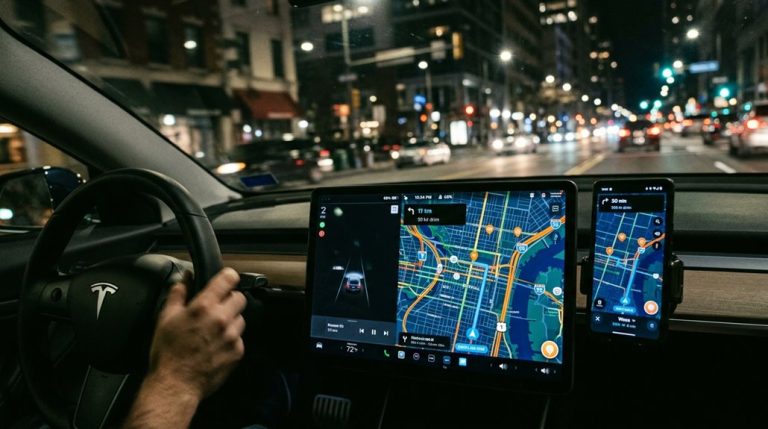
Your touchscreen flashes a warning, a chime sounds, and suddenly you’ve got a critical extra second to realize the mistake.
That’s the real value of obstacle aware tuning — it doesn’t prevent every crash, but it meaningfully reduces severity during the tight, slow maneuvers where wrong-pedal events are most common. Parking lots, driveways, garages — exactly where humans make mistakes. Tesla’s onboard Battery Management System uses real-time BMS negotiation to continuously regulate motor output, ensuring power delivery remains controlled even when acceleration inputs are unexpectedly aggressive. Similar systems, like Honda’s pedal misapplication mitigation, are designed to avoid activating during intentional firm accelerator use so the driver’s deliberate inputs remain unaffected.
Do Tesla’s Safety Layers Actually Prevent Unintended Acceleration?
All of that low-speed collision mitigation works great in a parking lot, but it still leaves the bigger question unanswered: when someone reports their Tesla “suddenly accelerated on its own,” do Tesla’s safety layers actually hold up under scrutiny?
The evidence is surprisingly consistent:
- Two independent pedal sensors must agree before torque is ever requested — sensor fusion catches disagreements before they reach the motor.
- Software limits intervene when Autopilot’s sensor suite flags your input as likely unintentional, cutting torque as a separate layer entirely.
- Data logs from 29 accident vehicles — 19 involving unintended-acceleration claims — returned 100% pedal misapplication findings.
No single layer guarantees perfection. Brake override, sensor fusion, and software limits work together rather than independently.
Tesla’s drivetrain architecture also contributes to this reliability, as the system contains roughly 20 moving parts compared to approximately 2,000 in a comparable internal combustion engine, leaving far fewer mechanical components capable of producing a runaway-torque fault.
But when regulators and engineers reviewed actual vehicle data, the cars performed exactly as designed. Your foot told the car to go. It went.
When Hardware Fails: What the Cybertruck Recall Revealed
The Cybertruck recall of 2024 proved something worth grasping: Tesla’s software safeguards are only as reliable as the hardware feeding them inputs.
Between November 13, 2023, and April 4, 2024, Tesla built 3,878 Cybertrucks with a compromised accelerator pedal assembly. The culprit? Soap used as a lubricant during manufacturing reduced the retention force holding the pedal pad in place — a direct assembly procedures failure that no software layer could anticipate.
Once that pedal material dislodged, it wedged into interior trim above the pedal, physically holding the accelerator down. Your vehicle would keep accelerating after you lifted your foot. Fortunately, pressing the brake cuts motor torque entirely, even with both pedals pressed simultaneously — so the override works.
Tesla issued repairs at no charge and revised the pedal component for vehicles produced on or after April 17, 2024. No crashes or injuries occurred. The Cybertruck’s 48-volt electrical architecture powers the steer-by-wire actuators and steering control systems that depend on equally reliable hardware integrity to translate driver inputs accurately under all conditions.
When pedal-related incidents are questioned, memory isn’t enough—clear footage is what settles uncertainty. A dual-channel dashcam with cabin monitoring records both the road and driver inputs, giving you a reliable record of exactly what happened in those critical moments.
Driver Steps That Reinforce Tesla’s Unintended Acceleration Defenses
Tesla’s electronic safeguards are genuinely impressive, but they only work as well as the driver operating behind them—so your habits matter more than most people realize.
If acceleration ever feels wrong, confirm your foot is firmly on the brake (not hovering near the accelerator), apply sustained, steady pressure rather than pumping it, and hold that pressure until the car stops completely, because brake override cuts motor torque the moment you commit to the pedal.
If you’re running Autopilot or Traffic-Aware Cruise Control, cancel it immediately using the brake pedal or the stalk, since removing that layer of active torque command eliminates one more variable while you regain full manual control.
Keeping your battery charge below 80% is also worth noting, as a well-managed state of charge supports more predictable regenerative braking response, giving you an additional deceleration tool the moment you lift off the accelerator.
Confirm Correct Pedal Use
Even the most sophisticated unintended-acceleration defenses Tesla builds into its hardware—dual redundant accelerator-position sensors, brake-override logic, Autopilot-assisted torque cutoff—can’t fully compensate for a foot landing on the wrong pedal in the first place. Pedal visualisation and foot ergonomics close that gap before electronics ever engage.
Before every low-speed move, run this three-step confirmation:
- Look down and visually confirm your right foot hovers directly above the brake pedal, not near the accelerator.
- Hold that position deliberately through the entire parking or driveway maneuver—one stable foot placement beats frantic pedal-switching under pressure.
- Press only after confirming—NHTSA traced over 200 Tesla sudden-acceleration complaints to drivers pressing the accelerator, not a rogue torque command.
Your foot discipline is the first safety system. Tesla’s over-the-air software updates can address many vehicle issues remotely, but no update can retrain a driver’s muscle memory in the moment a pedal error occurs.
Apply Brakes Firmly
Brake hard and hold it—that’s the single most effective action you can take when your Tesla starts moving faster than you commanded.
Hydraulic brakes generate enough force to overpower the drivetrain even under full acceleration demand, so firm pressure wins that physical tug-of-war every time. Don’t pump the pedal; continuous force is what creates rapid deceleration.
Pedal discipline means one foot, one pedal, full commitment—no hesitation, no partial inputs. Tesla’s brake override system is designed to cut propulsion when sufficient braking force is detected, meaning your mechanical stopping power works alongside the electronics (not against them).
Hold the brake down until the vehicle is completely stopped. That’s not a suggestion—it’s physics reinforcing engineering. Tesla’s over-the-air software updates continuously refine vehicle safety systems, meaning the brake override logic you rely on in an emergency can be improved without a service visit.
Cancel Cruise Control Promptly
Brakes stop the car, but if Traffic-Aware Cruise Control is still active when you release that pedal, the system will resume chasing its set speed—right back into the problem you just escaped. Cancel it deliberately.
Three moves that lock this sequence in:
- Right stalk, quick tap upward — one short flick disengages TACC instantly; the dashboard confirms it immediately with a visual change
- Touchscreen toggle — use the menus to find the Autopilot menu and switch TACC off if the stalk method feels uncertain (slower, but valid)
- Watch for the chime and indicator shift — Tesla signals disengagement audibly and visually, so you’ll know the system stopped commanding speed
Don’t hold that stalk up too long—some configurations read a prolonged input as a Neutral shift, not a cancel.
The touchscreen toggle method routes through context-aware display layers that shift their information hierarchy based on your vehicle’s operational state, so what you see in the Autopilot menu may look different depending on whether you’re parked, cruising, or actively decelerating.
Frequently Asked Questions
Can Tesla’s Unintended Acceleration Protections Be Disabled Through Software Updates?
Like a seatbelt you can’t unbuckle mid-crash, Tesla’s unintended acceleration protections aren’t yours to switch off — no software rollback removes them, and user overrides don’t exist for these built-in safety systems.
Does Tesla’s Warranty Cover Repairs Related to Unintended Acceleration Incidents?
Tesla’s warranty coverage depends on whether a defect exists. If data shows you pressed the wrong pedal, you’ll face repair exclusions—Tesla won’t cover incidents classified as driver error, not vehicle malfunction.
How Does Tesla’s PMM System Behave Differently Across Various Vehicle Models?
Tesla doesn’t publish a PMM spec sheet, yet your vehicle’s behavior shifts dramatically across models through different motor tuning and software mapping — older platforms respond differently than newer hardware generations managing torque arbitration.
Are Tesla’s Acceleration Safety Features Affected by Extreme Cold or Heat?
Yes, extreme cold affects your battery performance, limiting regen braking and power delivery until it warms up. Heat triggers thermal management adjustments. Both conditions influence sensor calibration, slightly altering how Tesla’s acceleration safety features respond.
Has Tesla Faced Legal Liability From Unintended Acceleration Crashes in Court?
Tesla’s faced lawsuits, yet you’ll find no landmark liability settlements or legal precedents holding it responsible—courts have largely sided with Tesla’s data showing driver error, not vehicle defects, caused unintended acceleration incidents.