
Adding 1,000-plus pounds of lithium cells to a vehicle’s floor should make crashes *worse*. Physics says so. Yet the NHTSA data tells a completely different story—one that challenges everything you assumed about heavy batteries and collision outcomes. The sub-scores buried inside these ratings reveal a counterintuitive truth about how EVs actually behave at 40 mph against an immovable object. Before you buy, you need to understand what those numbers are really measuring.
Why EV Battery Packs Perform Better in Crash Tests
When you think about why EV battery packs hold up so well in crash tests, the answer starts with where they sit in the vehicle. Structural placement matters enormously — packs mount low in the chassis, where surrounding steel absorbs impact before forces ever reach the cells. That low position also lowers the center of gravity, improving rollover resistance as a bonus. In some advanced designs, the battery pack itself functions as a load-bearing floor element, reducing overall part count while simultaneously contributing to the vehicle’s torsional rigidity.
Reinforced enclosures spread collision forces away from individual modules, while electrical isolation systems shut everything down the moment sensors detect abnormal readings. UL 2580 testing validates all of it — structural integrity, short-circuit prevention, and energy containment under real crash loading.
Then there’s thermal management, arguably the more difficult problem. Crash damage can push temperatures past 800°C in severe cases, so smart venting, cooling pathways, and insulation layers work together to stop one damaged cell from triggering a full pack failure. Engineering that controls heat controls the outcome. Some systems go further, using a self-powered suppression module that harvests electricity from failing cells to drive coolant or inert-gas actuators when external power is unavailable.
How Do NHTSA and IIHS Actually Score Electric Vehicles?
Grasping why a battery pack survives a crash is one thing — knowing how regulators actually grade that survival is another. Two organizations dominate EV safety evaluation, and they use completely different crash metrics.
| Category | NHTSA | IIHS |
|---|---|---|
| Scoring System | 1–5 stars | Good / Acceptable / Marginal / Poor |
| Core Tests | Frontal, side, rollover | Small overlap, moderate overlap, side, roof strength |
| Overall Score | Single combined rating | No single score |
| Organization Type | Federal program | Independent nonprofit |
NHTSA delivers one clean number — easy to compare across models. IIHS breaks performance into individual test grades, revealing rating differences that a star score can quietly hide.
You’ll want both. A Tesla Model Y earning five NHTSA stars tells you one story; its IIHS headlight or small-overlap result tells another. Together, they build the complete portrayal. Tesla’s structural engineering is shaped in part by the demands of housing a large battery pack, as the NACS connector standard unifies charging hardware under a single plug design that influences how underbody components are engineered and protected.
Notably, neither agency conducts rear impact testing, leaving a significant gap in crash worthiness assessment given that rear-end collisions represent a common real-world accident scenario.
Crash test ratings prove your EV is built to protect you—but they can’t capture what happens in a real-world hit-and-run, parking scrape, or sudden freeway incident. Stay one step ahead of uncertainty with this 4K dual dash cam front and rear system that quietly records every drive so you’re never left guessing when it matters most.
The Highest-Rated Electric Vehicles Right Now
Ratings narrow the field fast — but picking the highest-rated EV still depends on what you’re actually optimizing for.
If you’re hauling a family, the Kia EV9 stands out as a top-tier family hauler. It’s a three-row SUV balancing range (up to 349 WLTP miles), space, and price better than most rivals can manage. Experts consistently rank it as the best overall EV for mainstream buyers in 2025.
If range is your priority, the Tesla Model 3 earns its long range performer reputation hard — 309 EPA-estimated miles in the Performance version, plus a 0–60 time of 2.9 seconds. That’s not just fast; that’s legitimately quick by any standard.
Other strong contenders include the Hyundai Ioniq 5 (354 WLTP miles) and the BMW i5 (368 EPA miles). Your best pick ultimately hinges on whether you’re optimizing for space, distance, performance, or value. The Ioniq 5 also supports ultra-rapid charging at up to 350kW, allowing a 10–80% charge in approximately 18 minutes at peak speeds.
The Tesla Model Y, the world’s best-selling car in 2023, is also worth considering for families who want a proven safety record alongside a heat pump cabin heating system that delivers up to 300% greater efficiency than traditional resistance heating.
Even the highest crash test ratings won’t help when you’re stranded on the roadside with a dead battery, a flat tire, or low visibility at night. Be ready for the moments ratings can’t predict with this car emergency kit jump starter reflective triangle first aid roadside kit so you’re not left vulnerable when something unexpected stops your drive.
Which EVs Earn IIHS Top Safety Pick+ in 2025?
Meanwhile, the Tesla Model 3 landed Top Safety Pick, not the plus tier, which is a meaningful distinction you shouldn’t overlook. The Tesla Model S Plaid, by contrast, prioritizes performance over safety ratings, featuring a tri-motor powertrain producing 1,020 horsepower and a 0–60 mph time of just 2.1 seconds. The Hyundai Ioniq 6 earned IIHS Top Safety Pick+ alongside a 5-star NHTSA overall rating, making it one of the strongest performers across both major rating systems.
Tesla Model Y Safety Ratings Explained
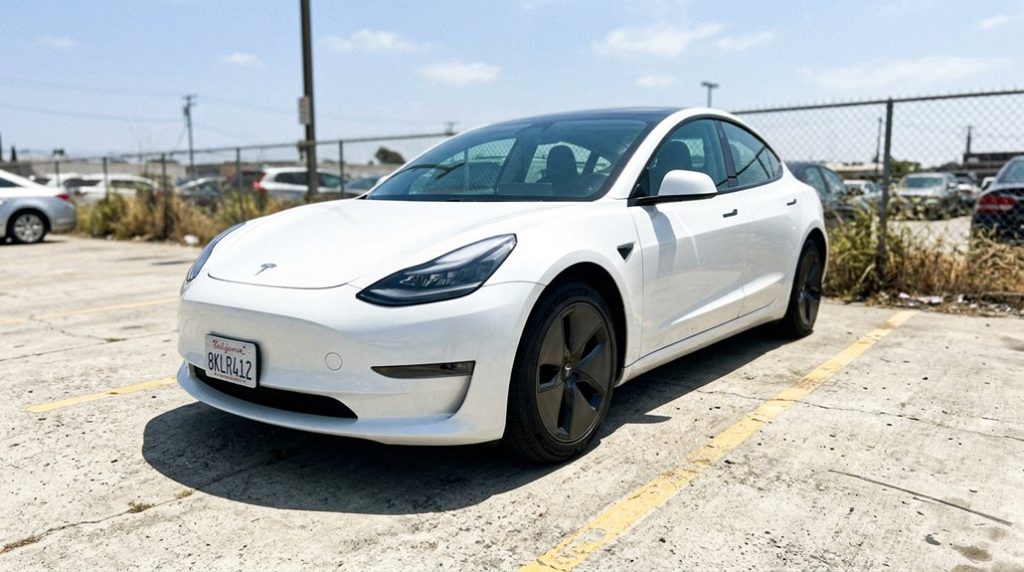
The Tesla Model Y doesn’t just pass crash tests — it dominates them across every major rating agency. NHTSA awarded it a 5-star overall rating, including a 7.9% rollover risk — the lowest ever recorded for an SUV. That’s structural integrity doing its job.
| Agency | Top Score | Model Y Result |
|---|---|---|
| NHTSA | 5 Stars | 5 Stars |
| Euro NCAP | 5 Stars | 91% Adult Protection |
| ANCAP | 5 Stars | 97% Adult Protection |
IIHS rated it Good across all crashworthiness categories for 2022–2025, including both small-overlap front tests. Side-barrier testing earned maximum points. You’re also getting standard AEB, lane support, and driver monitoring built in.
Euro NCAP even called it a “benign impact partner” — meaning it’s safer for whoever you hit, too. Battery isolation during a crash keeps thermal runaway risks controlled, protecting occupants beyond the initial impact. The Model Y’s eight-camera system provides 360-degree coverage with overlapping fields of view, giving the vehicle a consistent geometric picture of its surroundings to support collision avoidance before impact ever occurs.
Which Driver-Assistance Features Raise EV Safety Scores
Safety scores don’t improve by accident — they reflect specific technologies doing measurable work. Automatic emergency braking is one of the clearest examples: IIHS research shows it cuts rear-end crashes in half when paired with forward collision warning. That’s not a marketing claim; that’s measured impact.
Blind spot detection contributes differently. It warns you when vehicles occupy adjacent lanes, reducing lane-change crashes by 14% according to IIHS data. HLDI research also found lower insurance injury claims in vehicles equipped with it — which tells you something real about its effectiveness.
Lane departure prevention, flexible cruise control, and rear cross-traffic alert each add another layer. No single feature carries the whole score. Safety ratings climb when these systems work together, bundled into packages that address multiple crash types simultaneously. The math is straightforward: more coverage means fewer gaps for errors to slip through. Systems like Tesla’s Autosteer can even shift the vehicle’s position within a lane when a large truck is detected nearby, illustrating how sensor fusion technology translates real-time hazard detection into physical safety margins.
What EV Safety Scores Actually Tell You Before You Buy
When you pull up an EV’s safety score, you’re looking at structured data from two distinct systems—NHTSA’s one-to-five-star ratings (built around crash protection and rollover resistance) and IIHS’s Good-to-Poor scale (which separates crashworthiness from crash avoidance).
Each system tests specific scenarios, so a five-star overall NHTSA rating doesn’t guarantee every sub-category performed equally well, and an IIHS “Good” in frontal impact tells you nothing about rear-seat protection or headlight performance.
Reading both systems together, by model year and trim, gives you a far more complete image than any single headline number ever could. Beyond crash ratings, it’s worth noting that EVs like Tesla carry 800–1,200 lb battery packs that significantly affect structural load dynamics, which is a factor no headline safety score directly communicates to buyers.
Decoding Safety Score Categories
Before you spend six figures on a sleek EV, grasping what its safety score actually measures will save you from a costly assumption: that all high-rated vehicles are equally safe. IIHS evaluates occupant intrusion and crash avoidance technology, while NHTSA tests frontal, side, and rollover performance using a 1–5 star scale. Neither system measures sensor redundancy, battery range, or charging reliability.
| Category | IIHS Measures | NHTSA Measures |
|---|---|---|
| Crash Protection | Occupant intrusion resistance | Frontal & side impact |
| Tech Evaluation | Crash avoidance systems | Not included |
| Rollover Risk | Limited coverage | Directly tested |
You’ll want both strong IIHS recognition and a 5-star NHTSA rating before signing anything. One system alone doesn’t complete the image. Tesla’s proprietary insurance program takes a different approach to evaluating driver behavior, adjusting monthly premiums based on a sensor-based Safety Score that tracks real-world driving habits rather than relying on crash test results alone.
Ratings Beyond the Stars
Now that you know what IIHS and NHTSA actually measure, the next logical question is what those scores mean in practice before you hand over a deposit. Stars tell you how a vehicle performed in controlled scenarios—they don’t guarantee safety across every real-world condition. Road debris, weather, and driver distraction fall completely outside the testing scope.
Sub-scores matter more than the headline number. A model can earn five stars overall while posting a weaker frontal crash result, and that gap affects your actual odds. Active features like pedestrian detection and sensor reliability contribute to crash avoidance scores but won’t appear on a standard star badge. Compare results within your vehicle class, since heavier vehicles statistically protect occupants better when colliding with smaller ones. For example, the Tesla Model X, with its 100-kWh battery pack and substantial curb weight, represents the kind of larger platform that can influence collision dynamics compared to lighter vehicles in its segment.
Frequently Asked Questions
Do EV Safety Ratings Differ Between the US and European Markets?
Yes, EV safety ratings differ between the U.S. and European markets due to regulatory divergence. You’ll find NHTSA and Euro NCAP use different test protocols, scoring methods, and standards—similar to how charging etiquette varies by region.
Can a Used Electric Vehicle Still Carry Its Original Safety Rating?
Like a trophy from a past win, a used EV can carry its original safety rating, but you’ll want post-repair inspections, software updates, and battery degradation checks to confirm used ownership safety.
Are Smaller EVS Rated Less Safe Than Larger Electric SUVS?
No, compact EVs aren’t automatically rated less safe. You’ll find that crashworthiness metrics and occupant protection standards drive urban safety ratings, so you should compare vehicles within the same size class for accurate results.
Do EV Safety Ratings Account for Fire Risk After a Collision?
It’s a reasonable theory, but EV safety ratings don’t account for post-crash thermal events. Fire risk is a separate evaluation layer—one that involves battery forensics, damage severity, and reignition potential beyond what crash scores measure.
How Often Do NHTSA and IIHS Update Their Electric Vehicle Ratings?
Neither agency follows a fixed annual updates schedule. NHTSA ties testing to model-year cycles, while IIHS uses rolling updates, posting results as vehicles are evaluated. You’ll want to recheck ratings before purchasing.