
Most car cabin filters are barely keeping up with highway dust. Tesla’s HEPA system is playing an entirely different game — one that captures particles as small as 0.3 microns at 99.97% efficiency. That’s not a minor upgrade; it’s a fundamental rethinking of what clean cabin air actually means. The technology behind it is far more sophisticated than most drivers realize.
What Makes Tesla’s HEPA Filter Different From Standard Cabin Filters?
When most automakers talk about cabin filtration, they mean a single rectangular filter tucked behind your glovebox — that’s it. Tesla’s approach is fundamentally different in two ways: intake placement and dual filtration working as a coordinated system.
Standard cabin filters sit inside the HVAC module, catching dust, pollen, and road debris from air already moving through the interior loop. They’re reactive — cleaning air after it enters the system. Tesla’s HEPA filter, by contrast, sits upstream in the fresh-air intake path, before outside air ever reaches your HVAC system. That’s a whole-intake barrier, not a polishing filter.
Here’s where dual filtration gets interesting. A carbon filter pairs with the HEPA unit at intake, tackling odors and finer contaminants simultaneously. Your standard cabin filter still operates inside the HVAC loop, handling recirculated air. The result is a two-stage process: aggressive pre-filtering at intake, then ongoing interior air maintenance — something no glovebox filter alone can accomplish. Unlike engine-related maintenance that Tesla has largely eliminated, cabin filter replacement remains one of the few recurring service tasks owners still need to schedule. For vehicles equipped with this system, Tesla recommends replacing the HEPA filter every 3 years to sustain that hospital-grade performance.
How Tesla’s HEPA Filter Actually Catches Pollen, Bacteria, and Smoke
Tesla’s HEPA filter doesn’t just passively catch particles — it forces incoming air through a dense fiber matrix where mechanical interception, inertial impaction, and diffusion work together to trap particles as small as 0.3 microns at 99.97% efficiency, which means pollen (typically 10–100 microns), mold spores, bacteria, and fine smoke particulates like PM2.5 don’t stand much of a chance.
You’re effectively running outside air through a physical gauntlet before it ever touches your cabin, with the filter media retaining captured material rather than releasing it back into circulation. A paired activated carbon layer handles what HEPA can’t — gaseous odors, volatile organic compounds, and combustion byproducts that slip through particulate barriers entirely — giving you both mechanical and chemical filtration in a single system. Tesla’s broader vehicle design philosophy reflects this same attention to the cabin experience, with minimalist interiors centered on a single touchscreen serving as the primary interface for controlling climate and filtration settings. The real-world stakes behind this design are significant, as over 4 million people die each year from exposure to poor air quality globally.
How HEPA Filtration Works
- Interception — Mid-sized particles follow airflow but contact fibers directly and stick
- Impaction — Heavier particles (like pollen) can’t steer tight fiber curves and collide into the media
- Diffusion — Tiny particles move erratically, increasing fiber contact probability until capture occurs
- Combined effect — These mechanisms work simultaneously, targeting particles across the full size range. Tesla’s HEPA filter is located in the frunk, positioned before the HVAC system so outside air is cleaned before it ever enters the cabin.
The result? A system that removes 99.97% of particles at 0.3 micrometers — including smoke, bacteria, and pollen — rather than simply blocking whatever can’t squeeze through.
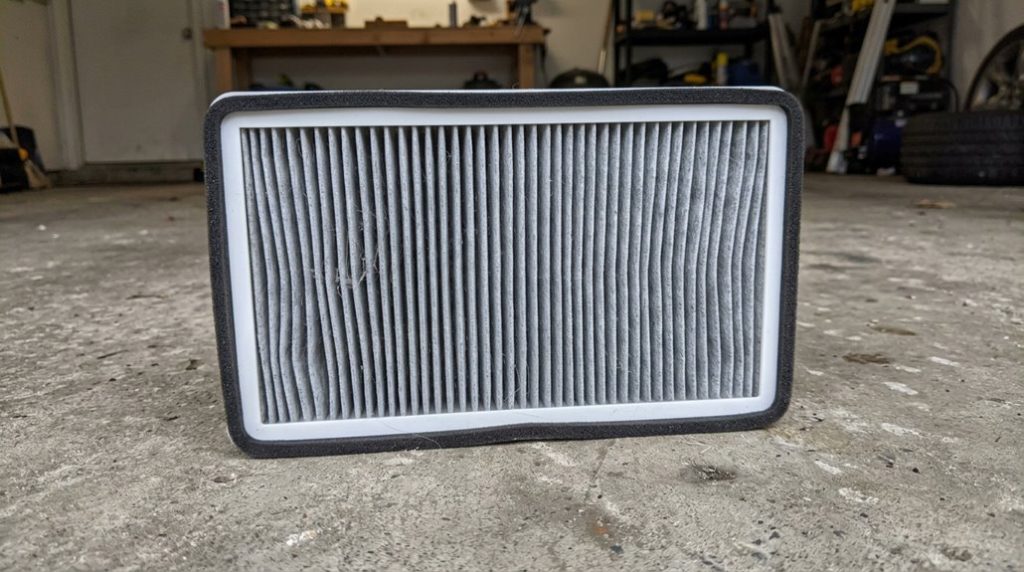
As pollen, dust, and city pollution build up inside your Tesla cabin, the difference is impossible to ignore. Keep your Model 3 or Model Y breathing clean again with this HEPA activated carbon 2-pack so every drive feels fresh, filtered, and noticeably more comfortable.
Targeting Microscopic Airborne Threats
Pollen, bacteria, and smoke aren’t just unpleasant — they’re small enough to stay airborne indefinitely and slip past conventional cabin filters without much resistance. Grasping particle behavior explains why. PM2.5 particles (2.5 microns or smaller) float suspended in air currents, bypassing your body’s natural immune response and reaching deep lung tissue. Replacing your cabin air filter on schedule ensures the system continues intercepting these particles at full efficiency, as accelerated wear under real driving conditions can degrade filtration performance faster than expected.
Tesla’s HEPA system targets particles down to 0.3 microns, capturing 99.97% of airborne contaminants including pollen, bacteria, mold spores, and fine smoke particulates. That’s not marketing language — it’s the same filtration standard used in hospital operating rooms.
Wildfire smoke, which carries dense concentrations of PM2.5, gets filtered before it ever enters your HVAC system. You’re effectively breathing pre-screened air while everyone outside is just hoping for the best. HEPA-equipped Teslas use a dual-filtration setup, pairing the HEPA filter with additional cabin filters to deliver layered protection that standard single-filter vehicles simply can’t match.
As dust settles on your screen, vents, and console, it slowly becomes harder to keep your Tesla cabin looking new. This Tesla interior cleaning kit gives you the right tools to stay ahead of grime before it becomes something you notice every single drive.
Carbon Filters Neutralize Odors
Keeping the cabin filter maintained fits naturally into the broader Tesla ownership routine, where over-the-air updates and scheduled preconditioning already work in the background to optimize your vehicle’s performance before you even open the door.
You’re not recycling stale cabin air here — you’re cleaning everything before it reaches you.
Where the Massive Filter Assembly Actually Lives in Your Tesla
You might assume Tesla tucked a hospital-grade HEPA assembly somewhere inside the cabin, but it actually lives in the front trunk (frunk), hidden beneath the underhood storage unit and several layers of trim, aprons, and carpet.
Accessing it requires removing the front underhood apron, disconnecting both the inlet and outlet ducts, and maneuvering the assembly past the brake fluid reservoir — not exactly a five-minute roadside swap.
The module itself houses both HEPA and carbon filter elements behind a 10-screw cover, making the entire unit a self-contained filtration block that Tesla designed to be removed as one piece rather than serviced in place. This accessibility matters especially for Tesla owners who also rely on the vehicle’s over-the-air software updates to manage cabin air quality features, since Tesla has continued expanding system functionality through remote updates like OTA 2025.2.
Front Trunk Location
Most Tesla owners assume the HEPA filter tucks somewhere behind the dashboard or under a seat, but Tesla actually houses the entire assembly in the front trunk — the frunk — beneath the rear underhood apron. This frunk ergonomics decision keeps filtration close to the vehicle’s front air intake, which makes logical engineering sense. Service accessibility requires opening the hood first, then working through several layered components before reaching the cassette. The VIN lower windshield corner location and the frunk maintenance panel are both found in the same general area, reinforcing why Tesla centralizes so many serviceable components toward the front of the vehicle.
Here’s what you remove to get there:
- Rear underhood apron (pull clips with a non-marring tool)
- Underhood storage bin (secured by 10 mm bolts, a push pin, and electrical connectors)
- Washer fluid reservoir neck (routes tightly around the assembly)
- Two retention bolts securing the HEPA module itself
Hidden Behind Panels
Tucked behind the rear underhood apron in the front trunk compartment, the HEPA filter assembly is one of the more deliberately hidden components in any production vehicle — you won’t spot it simply by popping the hood. Panel removal begins by opening the LH front door and lowering the LH front window for clearance. Once the apron unclips, the cassette sits beneath the underhood storage unit, adjacent to the brake fluid reservoir.
| Reference Point | Role in Location | Service Access Detail |
|---|---|---|
| Rear underhood apron | Primary concealment panel | Unclip and lift out first |
| Underhood storage unit | Sits above filter assembly | Remove reservoir-neck bolt |
| Brake fluid reservoir | Rear-edge clearance constraint | Tilt assembly carefully past it |
Two bolts secure the entire assembly, which houses the filters behind a 10-screw T20 cover. Unlike the over-the-air software updates that Tesla uses to modify cabin features and vehicle settings without any physical disassembly, servicing the HEPA filter is one of the few maintenance tasks that requires hands-on access to hardware tucked behind multiple panels.
How to Activate Bioweapon Defense Mode When Air Quality Drops
When air quality drops suddenly — wildfire smoke rolling in, exhaust fumes thickening, urban particulate spiking — activating Bioweapon Defense Mode takes only a few taps.
You’ve got two paths: direct touchscreen control or remote activation through the Tesla app before you even open the door.
- Touchscreen: Tap the temperature display, locate the biohazard icon near recirculation controls, and tap it to engage.
- Tesla app: Open Climate, swipe up on the panel, and select Bioweapon Defense Mode remotely.
- System response: The cabin fan ramps up immediately, routing outside air through HEPA and activated carbon filtration layers.
- Positive pressure: The cabin seals tighter, creating internal pressure that physically resists unfiltered air infiltration.
Think of app-based activation as your emergency protocol — useful when conditions deteriorate before you reach the vehicle.
Note that hardware limitations on older vehicles can restrict which software features and climate-related functions are available to you.
Afterward, returning climate controls to Auto restores normal operation cleanly.
How Bioweapon Defense Mode Pressurizes Your Cabin Against Pollution
Bioweapon Defense Mode doesn’t just filter the air coming in — it actively changes the physics of your cabin environment. When you enable the feature, the fan runs at maximum speed, pushing filtered air into the cabin faster than it can escape. That imbalance creates cabin overpressure — a slight but deliberate pressure differential where your interior sits above ambient outside pressure.
Here’s why that matters. Normally, small gaps around door seals and windows can pull contaminated outside air inward. Cabin overpressure reverses that behavior entirely. Instead of drawing pollutants in, those gaps now push filtered cabin air outward, functioning as leakage mitigation against smoke, exhaust, and airborne particulates.
Think of it as how hospital clean rooms work — controlled pressure keeps contamination out. Tesla’s version isn’t dramatic; occupants won’t feel it. But the physics are real, and during a wildfire smoke event, that subtle pressure advantage genuinely matters. This same principle of engineering redundancy and systems working together appears in the Cybertruck’s steer-by-wire triple redundancy, where two primary motors and a third inductive sensor use a two-of-three voting system to maintain safe operation even if one component fails.
How Often Should You Replace Your Tesla’s HEPA Filter?
Keeping that pressurized cabin doing its job depends on one thing you can actually control — maintaining a filter that hasn’t quietly turned into a wall of trapped particulate matter.
A clogged filter doesn’t announce itself — it just quietly starts working against the system it was built to protect.
Tesla’s official guidance sets the filter lifespan at three years for most markets. China gets a tighter one-year interval (higher ambient pollution loads, shorter patience).
Here’s what actually shapes your replacement schedule:
- Standard interval: Replace every 3 years — Tesla’s documented baseline, not a suggestion
- Seasonal timing: High-pollen springs and wildfire summers accelerate loading faster than winter commuting
- Replacement costs: OEM kits run roughly $70–$120; aftermarket options exist but vary in certified filtration efficiency
- Regional exceptions: China-market vehicles follow annual replacement per Tesla’s own service manual
Harsh environments — smoke, dust, dense urban pollution — justify earlier swaps.
Mileage is a rough proxy only; Tesla officially tracks time, not odometer readings.
Tesla’s broader vehicle ecosystem pairs cabin air protection with onboard battery management systems that actively monitor and respond to environmental and thermal conditions in real time.
Signs Your Tesla’s HEPA or Carbon Filter Has Reached the End of Its Life
Filters don’t fail dramatically — they degrade quietly, and your Tesla’s HVAC system will tell you before the service interval does if you know what to look for. Watch for these replacement indicators carefully.
Weak vent output is your first clue. A clogged HEPA filter increases airflow resistance, so you’ll notice the fan working harder just to move the same volume of air. That’s physics announcing a problem.
Persistent odors are next — when the carbon layer saturates, exterior smells like smoke or exhaust stop being absorbed and start following you inside. Your filter lifespan effectively ends the moment odor breakthrough becomes routine.
You can also pull the filter and look. Dark, densely packed pleats tell the whole story without a diagnostic tool.
Finally, if your Tesla issues a service alert or your cabin takes noticeably longer to cool, don’t wait. The filter’s already behind on the job.
Frequently Asked Questions
Does Tesla’s HEPA Filter Work While the Car Is Parked and Off?
No, your Tesla’s HEPA filter doesn’t provide parked filtration when the car’s off. Without HVAC airflow, cabin recirculation stops, so you’ll need climate control actively running for the filter to work.
Can the HEPA Filter Be Cleaned Instead of Fully Replaced?
No, you can’t clean your Tesla’s HEPA filter — it’s a replace-only part. Tesla’s official cleaning methods don’t apply to filter media, and filter lifespan ends at the 3-year replacement interval.
Which Older Tesla Models Completely Lack a HEPA Filter System?
Like ghosts of a simpler era, older models of the Model S, Model X, Model 3, and Model Y are the no filter variants you’d have owned without Tesla’s HEPA system installed.
Does Bioweapon Defense Mode Significantly Drain Your Tesla’s Battery?
Bioweapon Defense Mode won’t cause dramatic battery impact or major range loss, but it’ll increase energy use since it runs your fan at maximum speed while maintaining positive cabin pressure continuously.
Are Aftermarket HEPA Replacements Compatible With Tesla’s Filtration Housing?
Some aftermarket fitment options do work, but you’ll need to verify filter materials match Tesla’s exact gasket profile and multi-filter stack-up — mismatched dimensions can compromise your cabin’s seal integrity.