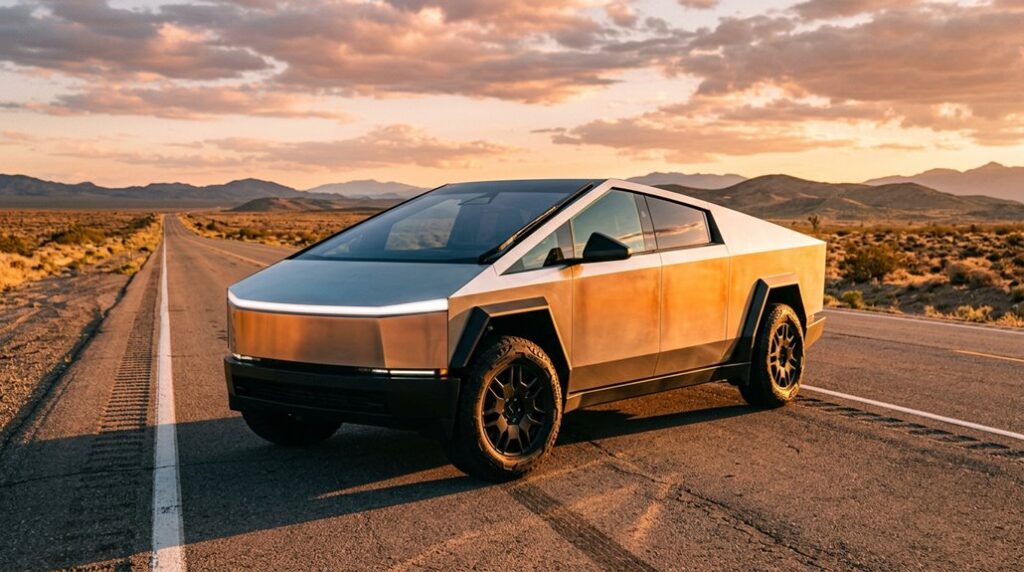

The Tesla Cybertruck isn’t built like a truck—it’s built like a spacecraft that hauls cargo. Aerospace-grade 30X cold-rolled stainless steel, a steer-by-wire system, and a 48V electrical architecture aren’t features borrowed from conventional pickup engineering. They’re deliberate departures from it. But every bold engineering decision comes with measurable tradeoffs, and those tradeoffs will either make this truck indispensable to your life or completely wrong for it.
What Is the Tesla Cybertruck Built From?
Underneath, the structural battery pack does double duty. It’s not simply storing energy; it’s carrying load as a floor element, reducing part count while lowering your center of gravity simultaneously.
The internal frame supplements everything with aluminum, high-strength steel, and ultra-high-strength steel where crash loads demand it. Tesla’s material selection here isn’t aesthetic — it’s physics working across multiple disciplines at once. The outer exoskeleton is formed from cold rolled 30X stainless steel, an alloy combining iron, chromium, nickel, and molybdenum for exceptional strength and corrosion resistance.
Why 30X Cold-Rolled Stainless Steel Changes Everything
When Tesla called this material “nearly impenetrable,” they weren’t writing marketing copy — they were describing physics.
Cold rolling compresses the steel’s grain structure at room temperature, pushing yield strength to roughly 1,100 MPa — versus 270–400 MPa for conventional door panels.
At 3 mm thick (standard doors run 0.7–1 mm), you’re doubling impact resistance before the alloy’s properties even enter the equation.
But cold rolling creates formability tradeoffs. Higher strength means reduced ductility, which is why every Cybertruck panel is flat or minimally curved.
Musk literally said the material could break stamping presses — that’s not hyperbole.
The surface finish resists corrosion without paint, but repair challenges are real.
Specialized tools are required since standard body-shop equipment can’t reshape steel this hard. The automotive industry already stamps materials exceeding 1,200 MPa tensile strength, meaning the more accurate limitation is that 3 mm ultra-strong stainless would demand presses far beyond typical capacity rather than physically destroying them.
This structural rigidity stands in stark contrast to the lightweight aluminum and composite materials found in competitors like the Mustang Mach-E, where conventional stamping and body-shop repair remain straightforward.
How the Cybertruck Exoskeleton Replaces a Traditional Frame
When you swap a conventional ladder frame for the Cybertruck’s exoskeleton, you’re eliminating the separate load-bearing spine that traditional trucks have relied on for decades — instead, the 30X cold-rolled stainless steel outer shell routes suspension, towing, and crash forces through major structural nodes tied to the cabin, battery pack, and corner castings simultaneously.
Think of it as the difference between a building that needs interior columns to stand and one where the outer walls *are* the columns — the Cybertruck’s outer structure handles shape retention, force distribution, and corrosion resistance (stainless steel resists oxidation without paint or coatings) as a single unified system rather than three separate engineering problems.
This hybrid structural approach — stainless shell working alongside internal castings and hidden substructures — produces torsional rigidity that a traditional stamped-steel body bolted onto a frame simply can’t match at equivalent weight. The flat panel geometry of the exoskeleton is a direct result of cold-rolled 30X stainless steel’s resistance to conventional stamping, which would destroy standard automotive press tooling and forced Tesla to develop laser cutting as the primary body manufacturing method instead.
Structural Steel Exoskeleton Design
Most trucks hide their strength inside a traditional body-on-frame setup — a separate steel ladder frame carries all the structural loads while the body panels just sit on top, contributing almost nothing mechanically. The Cybertruck eliminates that redundancy entirely.
Tesla borrowed aerospace monocoque principles, where the outer skin *is* the structure. The exoskeleton’s 30X cold-rolled stainless steel panels carry torsional loads directly, just like a Starship fuselage.
Three things make this work:
- Adhesive bonding distributes stress evenly across panel joints instead of concentrating it at weld points
- Laser-cut flat panels replace stamped bodywork, reducing production complexity
- Internal stamped steel subassembly handles primary torsion while the stainless exterior acts as a durable shield
Dead weight disappears. Structural efficiency replaces it. The result is an exterior shell Tesla describes as nearly impenetrable, designed to resist dents, long-term corrosion, and physical damage that would compromise conventional truck panels.
Replacing Traditional Frame Components
Traditional truck frames are a mechanical compromise — you’re basically bolting a body onto a separate steel ladder, doubling the material doing structural work.
The Cybertruck eliminates that redundancy entirely through frame replacement via panel integration. Its 30X cold-rolled stainless steel exoskeleton acts simultaneously as exterior skin and primary load-bearing structure (a stress-skin configuration borrowed from aerospace engineering).
You’re not just removing the ladder frame — you’re replacing it with something geometrically stiffer. Torsional rigidity improves because stress distributes across the unified shell rather than concentrating in isolated frame rails.
Large gigacast components replace what traditionally required dozens of welded subframe pieces. Fewer parts, fewer failure points, and no paint shop required. That’s structural efficiency without apology. The exoskeleton’s smooth, continuous surface also contributes directly to aerodynamic resilience, something a conventional bolt-on body panel arrangement structurally cannot achieve.
Durability and Corrosion Resistance
Structural efficiency only matters if the structure actually lasts — and that’s where the HFS exoskeleton separates itself from conventional truck chassis in a measurable way.
The 30X cold-rolled stainless steel‘s electrochemical behavior resists oxidation at a molecular level, performing comparably to 316L marine-grade steel used in medical implants and offshore equipment.
Your maintenance rituals shift dramatically here:
- Surface rust isn’t structural — it’s typically foreign metallic debris corroding *on* the panel, not *within* it
- Polishing remains necessary since fingerprints are genuinely visible on bare stainless
- No paint means zero fading, zero peeling, and zero recoating costs across decades
The tradeoff is straightforward: you gain a structure engineered for 30-40 years of operation without corrosion-driven deterioration. Owner Toni has publicly stated the Cybertruck is built to outlast the gas industry and isn’t designed to be replaced.
Why the Cybertruck Looks Like Nothing Else on the Road
When Tesla revealed the Cybertruck in November 2019, it didn’t just introduce a new pickup — it declared war on every design convention the truck segment had spent decades refining. You’re looking at a vehicle built around hard geometric edges, a sharply contoured wedge profile, and ultra-hard stainless steel panels that wear their raw, brushed finish openly.
There’s no paint, no chrome trim, no sculpted surfacing — just exposed material symbolism that says durability louder than any badge could. Its futuristic aesthetic pulled urban reactions ranging from genuine awe to genuine confusion, which was clearly the point.
The design borrows from stealth aircraft, brutalist designer, and pop culture’s cyberpunk imagination, producing something that resembles a concept vehicle that somehow survived production. Elon Musk has credited the Lotus Esprit from the 1977 James Bond film The Spy Who Loved Me as a primary design inspiration, a car itself descended from Giorgetto Giugiaro’s razor-edged Maserati Boomerang concept.
How Steer-By-Wire Works on the Cybertruck
The Cybertruck ditches the mechanical steering column entirely, replacing that physical rod-and-rack connection with an ethernet-transmitted electronic signal loop that runs between your steering wheel’s angle sensor and the rack’s road wheel actuator (a motor drawing between 150 and 1,000 watts depending on load demand).
Because there’s no longer a direct mechanical ratio locking your inputs to wheel movement, Tesla’s control unit adaptively adjusts steering sensitivity and damping in real time using data from speed sensors, accelerometers, and yaw rate sensors simultaneously — meaning the truck tightens its response at highway speeds and softens it when you’re crawling a trail.
The practical result is a full lock-to-lock steering range achievable in fewer rotations than a conventional pickup, which is genuinely useful when you’re threading a 6,900-pound truck through a tight canyon switchback. That maneuverability advantage extends further because the Cybertruck incorporates rear-wheel steering, currently software-controlled to a 3-degree maximum that already shrinks its turning circle to 43.5 feet — tighter than the Ford F-150 Lightning’s 47.8 feet — with planned updates targeting roughly 10 degrees for even sharper turns.
Steer-By-Wire Technology Explained
Unlike every other steering system you’ve likely driven, the Cybertruck’s steer-by-wire setup eliminates the mechanical connection between the steering wheel and the front wheels entirely — no steering column, no U-joints, no physical link whatsoever.
Instead, angle sensors read your input, send electronic signals to a control unit, and electric motors (rated between 150–1,000W) physically move the steering rack.
Here’s what keeps it honest when things go sideways:
- Two primary motors control the front wheels independently
- A third inductive sensor creates triple redundancy via a two-out-of-three voting system
- Electronic failsafes trigger gradual torque reduction, not sudden loss of control
You still feel the road through haptic feedback generated by a dedicated actuator inside the steering wheel module — physics, just rerouted electronically. This concept isn’t entirely new territory, as airplane fly-by-wire systems have operated on the same electronic-over-mechanical principle for decades.
Steering Sensitivity And Damping
Steering a Cybertruck feels nothing like steering a conventional truck — and that’s entirely by design.
The steer-by-wire system adjusts its steering damping continuously, reading speed, yaw rate, and wheel angle data simultaneously. At parking lot speeds, the yoke sweeps just 340 degrees to complete full lock-to-lock movement — less than one full rotation. That’s genuinely impressive for a vehicle this size.
Feedback tuning happens through a dedicated haptic actuator (rated between 150 and 1,000 watts) that translates road surface conditions directly into steering wheel resistance. You’re not feeling mechanical linkage anymore; you’re feeling computed torque.
The control unit integrates accelerometer, angle sensor, and yaw rate inputs to reconstruct road feel electronically — then delivers it precisely where your hands grip the yoke. Unlike conventional systems, the Cybertruck runs on a 48-volt architecture rather than the standard 12-volt electrical system found in most vehicles.
Full Turns, Less Rotation
When you turn the yoke on a Cybertruck, nothing mechanical moves between your hands and the front wheels — and that’s not a quirk, that’s the entire point. Sensors read your input, an ECU interprets it, and electric motors execute the actual wheel angle. No shaft, no column, no mechanical compromise.
Here’s what reduced rotation actually delivers:
- Full steering lock is achievable without wrist-over-wrist hand shuffling
- Enhanced responsiveness at low speeds, where the system maps small yoke inputs to larger wheel angles
- Speed-sensitive ratio adjustments, tightening response in parking lots, softening it at highway speeds
Rear-wheel steering compounds the advantage — both axles respond together, shrinking the turning radius despite the Cybertruck’s considerable footprint. Early testers have noted this gives the Cybertruck best handling compared to other trucks in its class.
What 340° Lock-To-Lock Steering Actually Feels Like
From the first moment you grip the Cybertruck’s yoke and pull out of a parking lot, 340° lock-to-lock redefines what steering a full-size truck feels like. That’s less than one complete wrist rotation versus the 900°–1,080° sweep conventional trucks demand. The result? Parking finesse that feels almost surgical — tiny inputs produce immediate directional change, so tight spaces stop feeling intimidating.
The tradeoff is that familiar muscle memory gets unsettled. The controller feel is unmistakable: responses are electronically defined through steer-by-wire software rather than mechanically fixed, making inputs feel more like a simulator than a hydraulic rack. Speed-sensitive logic calms steering at highway speeds while keeping it sharp in urban environments. Familiarity breeds confidence here — give it time. If something feels off during your session, try again after disabling any privacy-related extensions that may interfere with your experience.
Four-Wheel Steering and the Cybertruck’s Turning Circle
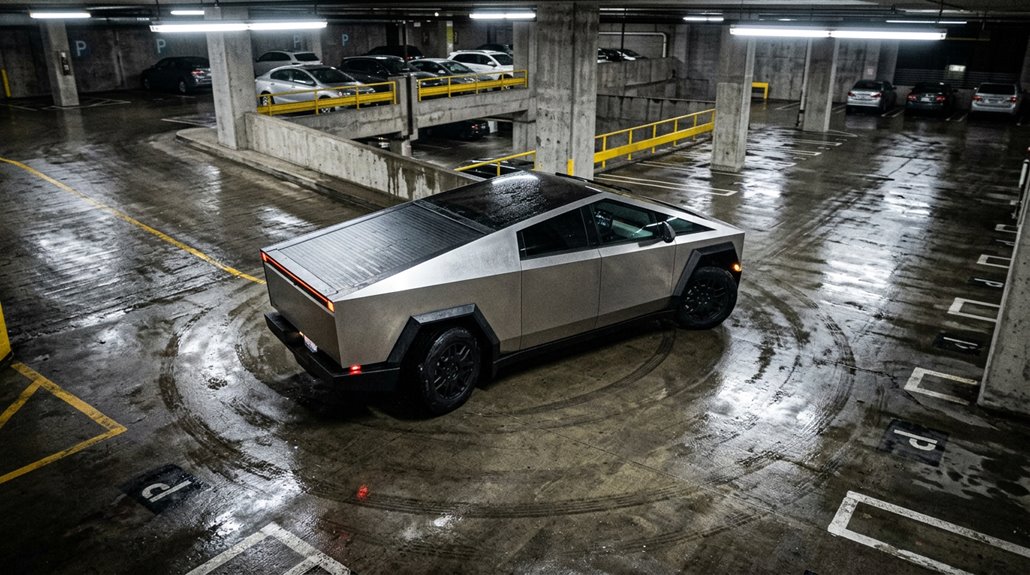
The Cybertruck’s four-wheel steering works by turning the rear wheels in response to your steering input, all processed electronically through sensors in the steering column (no mechanical linkage exists between the wheel and the tires — it’s fully steer-by-wire).
At low speeds, the rear wheels turn opposite to the fronts, tightening the turning circle markedly and making a truck with a long wheelbase feel more manageable in parking lots, drive-through lanes, and sharp urban corners.
The practical result is less hand-over-hand scrambling during U-turns and a vehicle that handles tighter spaces than its physical footprint suggests it should. You can visually confirm rear wheels turning just by watching the truck steer, though driving it is what makes the feature genuinely impressive.
How Four-Wheel Steering Works
Steering a vehicle the size of the Cybertruck into a tight parking garage would normally require about the same planning as a three-point turn on a narrow country road—but four-wheel steering changes that math entirely. Here’s how it actually works:
- Front wheels handle primary directional input, same as any conventional truck.
- Rear wheels pivot independently, reducing the turning radius through precise rear steer calibration.
- Yaw compensation algorithms adjust both axles simultaneously, keeping the vehicle stable during the maneuver.
The control unit reads speed, yaw rate, and accelerometer data continuously.
At low speeds, rear wheels turn opposite the fronts—tightening your arc. At higher speeds, they align with the fronts, improving lane-change stability. Software manages what mechanical linkage physically couldn’t.
Elon Musk announced the addition of rear-wheel steering for the Cybertruck, positioning it to demonstrate four-wheel steering capability ahead of competitors like the GMC Hummer EV.
Rear Wheel Movement Benefits
Knowing *how* the rear wheels steer is one thing—knowing what that actually buys you on the road is another.
At low speeds, the rear wheels turn *opposite* the fronts, shrinking your turning circle to sedan-class dimensions (impressive for a truck this wide). MotorTrend clocks the steering ratio shifting from roughly 5:1 at parking-lot speeds to 12:1 on the highway—meaning the wheel does less work so you do less work. That’s real steering ergonomics improvement, not marketing language.
Cargo maneuvering becomes genuinely practical: lining up trailer approaches, threading narrow campsites, or docking at loading zones requires fewer correction inputs.
At highway speeds, rear wheels steer *with* the fronts, stabilizing lane changes without that unsettling body-roll lurch heavy trucks typically deliver.
The same principle applies to tight switchbacks and narrow mountain roads, where all-wheel steering reduces the wide-arc struggle that makes large trucks genuinely hazardous in confined terrain.
What the Rear Wheels’ 10° Movement Does for Tight Maneuvers
When Tesla engineered the Cybertruck’s four-wheel steering system, it didn’t just bolt on a rear axle that wiggles a few degrees for show — it built a system where the rear wheels articulate up to 10° in the opposite direction of the fronts at low speeds, effectively tricking physics into shrinking the truck’s functional wheelbase mid-turn.
Tesla didn’t build a rear axle that wiggles for show — it built one that shrinks the truck’s wheelbase mid-turn.
That 10° range delivers three measurable advantages:
- A 43.5-foot curb-to-curb turning circle — tighter than a Model S
- Reduced rear-end sweep near curbs, walls, and job-site obstacles
- Same-direction rear steering that enables crab walk repositioning
You’re not white-knuckling multi-point corrections anymore. The system handles parking precision automatically, letting the geometry work while you focus on placement rather than steering arithmetic. This same steer-by-wire system replaces the physical steering column entirely, using software-driven actuators to translate your input into wheel movement without any mechanical connection.
How Speed-Sensitive Steering Handles Rough Terrain
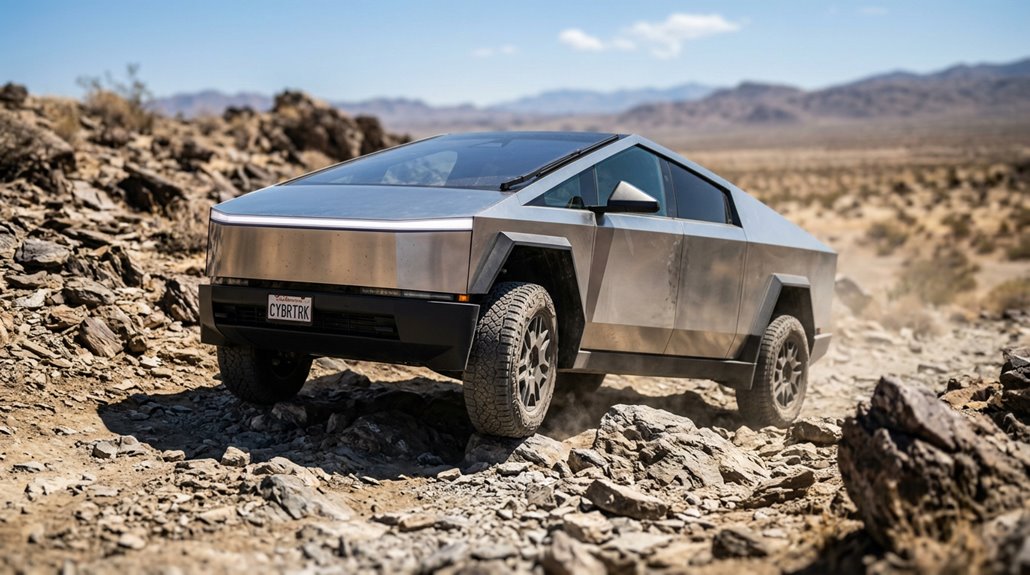
The Cybertruck’s steer-by-wire system doesn’t apply the same steering ratio across 5 mph and 65 mph — it actively scales response based on your current speed, which matters more on rough terrain than most people realize. Crawling through rocky trails, you get amplified steering sensitivity, letting you place wheels precisely around ruts without overcorrecting.
Push into Baja mode at higher speeds, and the system deliberately reduces that sensitivity, preventing washboard surfaces from bouncing your inputs into unintended direction changes.
Actuator redundancy keeps this functioning even if one component degrades mid-trail — steering latency stays imperceptibly low because there’s no mechanical column introducing lag. The software handles adjustment instantly, matching terrain demands without you manually reconfiguring anything.
What the 48V Low-Voltage Architecture Changes for Drivers
Steer-by-wire reworks how the Cybertruck interprets your inputs, but there’s another clean-sheet engineering decision running underneath all of it — the 48V low-voltage system, which quietly changes nearly every electrical system in the truck.
The 48V implications are significant. Here’s what shifts:
- Wiring efficiency — 48V delivers identical power at one-quarter the current of 12V, enabling thinner copper wiring throughout.
- Accessory performance — Seat motors, pumps, and wipers are redesigned for 48V, reducing resistive heat and voltage drop.
- Service procedures — A compact 4Ah lithium-ion battery replaces your traditional lead-acid unit, with a DC-to-DC converter handling any remaining 12V loads.
You’re not just driving different software — you’re driving a fundamentally different electrical design. To visually distinguish voltage domains during service and assembly, 48V connectors are color-coded with baby blue housings or tape throughout the vehicle.
How the Etherloop Network Cuts Cybertruck Wiring by Two-Thirds
If you’ve ever popped open a car’s dashboard and stared into that nightmare tangle of wires, you already grasp why Tesla went looking for a better solution. The Cybertruck’s Etherloop system replaces the old CAN-bus approach — where every controller needed its own dedicated signal wire — with point-to-point Ethernet connections capable of bandwidths exceeding 100 Gbps through Tesla’s TTPoE protocol, slashing total wire count from 490 wires (Model 3’s figure) down to just 155.
That 68% reduction doesn’t sacrifice functionality either; endpoint count actually *increased* from 273 to 368, meaning the truck communicates with more subsystems using roughly two-thirds less physical wiring — a genuinely impressive engineering trade-off that also cuts wiring weight by about 50%. The TTPoE protocol itself is open-source and released under a GPLv2 license, meaning other automakers and engineers are free to study, modify, and build upon the same specification Tesla uses in production.
Traditional CAN Bus Limitations
Classic CAN bus wasn’t built for a vehicle like the Cybertruck—it was built for a world where cars had dozens of sensors, not hundreds.
Traditional CAN bandwidth tops out at 1 Mbps, which sounds adequate until you’re routing ADAS data, telemetry, and OTA firmware updates simultaneously.
Three limitations make CAN fundamentally inadequate for Cybertruck’s architecture:
- Bandwidth ceiling — Even CAN FD’s 5 Mbps can’t match in-vehicle Ethernet’s throughput demands.
- Distance constraints — Signal integrity degrades beyond roughly 40 meters at full speed.
- Security weaknesses — Classic CAN carries zero built-in encryption or authentication, leaving every node vulnerable to frame injection.
You’re effectively asking a garden hose to supply a fire station.
The Cybertruck’s Etherloop framework exists precisely because CAN couldn’t. Modern vehicles now exchange gigabytes of data daily through 360° cameras, radar, LiDAR, and V2X systems—volumes that would completely overwhelm any CAN-based network.
Etherloop Network Architecture Explained
Tesla’s Etherloop doesn’t just replace CAN bus—it replaces the entire philosophy behind how a vehicle talks to itself. Instead of broadcasting messages across a shared bus and hoping the right controller listens, Etherloop runs a looped, point-to-point Ethernet network where every node gets its own dedicated conversation. That loop design delivers something CAN never could: Etherloop redundancy. If one path fails, data routes the other direction around the loop automatically.
You’re also looking at deterministic latency at millisecond scale, with microsecond-level synchronization between controllers—critical when steer-by-wire has zero mechanical fallback. The payoff is measurable: 155 wires versus 490 in the Model 3 (a 68% reduction), and roughly 200 times the data throughput of traditional automotive networks. Less wire, faster communication, and a system that fails gracefully rather than catastrophically.
The technology itself traces back further than most people realize—EtherLoop was originally developed in the 1990s by Elastic Networks to help telephone companies deliver high-speed data over standard twisted-pair copper lines, long before anyone imagined it wiring a pickup truck.
Benefits of Reduced Wiring
Cutting two-thirds of a vehicle’s wiring doesn’t happen by accident—it requires rethinking voltage, network topology, and cable sizing all at once. The Cybertruck’s 48V framework reduces current by 4x versus 12V systems, meaning thinner conductors handle the same power load. Here’s what that delivers in practice:
- Wiring weight reduction of roughly 70–77% in specific harness areas, directly improving efficiency
- Network simplification dropping cross-car connections from 490 (Model 3) to 155
- Fewer connectors, cutting failure points and lowering raw copper costs per vehicle
Less copper means less mass, fewer installation hours, and a harness that mechanized assembly equipment can actually handle without wrestling floppy bundles into tight body cavities—a genuinely underappreciated manufacturing win. Ethernet replaces the bandwidth-limited CAN bus architecture, allowing many devices shared across a single network line rather than requiring individual point-to-point wire runs for every data-hungry system.
Cybertruck Trim Levels: Which Configuration Should You Choose?
Picking the right Cybertruck trim isn’t complicated once you strip the marketing away and look at what the numbers actually mean for your use case. The Long Range‘s single-motor RWD setup delivers roughly 354 miles, making it the leader in range tradeoffs against price. You’re sacrificing towing capacity (7,500 lbs versus 11,000 lbs on higher trims) and acceleration to get there.
The AWD dual-motor hits 0–60 in 4.1 seconds, tows 11,000 lbs, and adds meaningful interior customization through synthetic leather, ventilated seats, and a rear touchscreen. That’s your practical sweet spot.
The Cyberbeast‘s tri-motor 2.6-second sprint is genuinely impressive, but if hauling materials matters more than hauling ego, the AWD configuration handles real truck work without unnecessary compromise. Both trims share a lockable vault bed with 100 cubic feet of storage, which remains one of the most practical cargo solutions in the truck segment regardless of which configuration you choose.
Cyberbeast Tri-Motor: 845 HP and 1,029.6 Lb-Ft of Torque
When the AWD dual-motor‘s 11,000-lb towing capacity and 4.1-second 0–60 already handle most real-world truck work, you have to ask what the Cyberbeast’s tri-motor setup actually adds beyond bragging rights. It adds physics you can actually measure:
- 845 hp (630 kW) from one permanent-magnet front motor plus two rear induction motors
- 2.6-second 0–60 in Beast mode, with a sub-11-second quarter-mile
- 1,029.6 lb-ft of torque, distributed through rear torque vectoring that eliminates wheel hop under hard acceleration
That torque vectoring also feeds directly into motor cooling demands—three motors generating serious heat require aggressive thermal management.
The payoff is 130-mph capability and supercar-tier straight-line performance inside a truck rated for 2,500 lbs of payload. Before launch, the suspension automatically lowers into a cheetah stance, transferring weight rearward and priming all three motors for maximum traction off the line.
Dual-Motor All-Wheel Drive: 600 HP and Real-World Performance
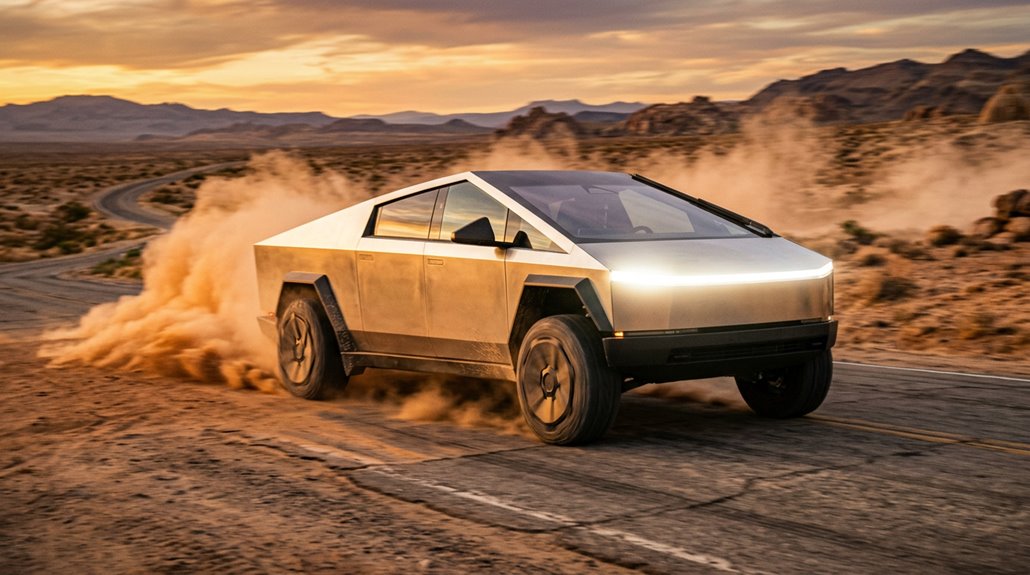
The dual-motor AWD Cybertruck splits its combined ~600 hp between a 303 hp front motor and a 299 hp rear motor, giving you a mechanically balanced AWD system rather than the rear-biased torque dump you’d expect from a truck this size.
Tesla claims a 4.1-second 0–60 mph run, but MotorTrend’s real-world testing on a 2024 Foundation Series (weighing in at 6,660 pounds) clocked 3.8 seconds flat with a quarter-mile of 12.4 seconds at 110.3 mph — numbers that suggest Tesla’s official figure is deliberately conservative.
You’re getting a 325-mile EPA range alongside that straight-line credibility, which positions this trim as the pragmatic choice between the entry-level RWD and the Cyberbeast’s all-out excess. The dual-motor AWD can add 136 miles in 15 minutes on a Tesla Supercharger, meaning you’re not sacrificing charging speed to get that range figure.
Power and Torque Breakdown
Straddling the line between the discontinued base RWD and the 834-hp Cyberbeast, Tesla’s Dual-Motor AWD Cybertruck lands at a rated 600 hp (roughly 442 kW, depending on which spec sheet you trust — Car and Driver clocks it at 593 hp, EVSpecifications at 592.7 hp).
Motor torque figures vary similarly across sources:
- Motor Trend reports 525 lb-ft at the shaft
- JD Power lists 521 lb-ft
- Wikipedia cites 743.5 lb-ft at the wheels — a meaningfully different measurement convention
That wheel-torque figure reflects drivetrain distribution across both axles, with a 219 kW induction motor up front and a 223 kW permanent-magnet unit out back.
You’re getting asymmetric motors working in tandem, which isn’t glamorous — but it’s engineered precision providing real traction balance. Unlike the peak-RPM horsepower figures associated with combustion engines like the Dodge Challenger Hellcat, the Cybertruck’s electric torque is instantly available from a standstill, without any rev-building required.
Real-World Driving Performance
On paper, 4.1 seconds to 60 mph sounds politely quick for a truck pushing 6,600 pounds — but MotorTrend’s instrumented testing of the 2024 Dual Motor Foundation Series punched that number down to 3.8 seconds, with a quarter-mile of 12.4 seconds at 110.3 mph. Car and Driver recorded 3.9 seconds independently, confirming this isn’t a one-off fluke.
Launch consistency is strong here — the AWD system plants power cleanly off the line, even with that considerable mass working against momentum. What keeps you honest at highway speeds is the midrange punch: a 110.3 mph trap speed tells you the motors aren’t fading past the launch. Sport mode sharpens throttle response and drops ride height simultaneously, tightening everything up without requiring you to think twice about it. The Rivian R1T Dual Motor Performance still edges ahead with a 3.3-second 0–60 and a 12.0-second quarter mile, putting the benchmark in clear view for where the Cybertruck’s performance ceiling currently sits.
Base Single-Motor Cybertruck: Is 315 HP Enough?
When Tesla slots a 315 hp rear-wheel-drive motor into a vehicle that weighs north of 6,000 lbs, the obvious question isn’t whether it’s fast — it’s whether it’s *enough*. For everyday usability, the answer is mostly yes. Here’s where that power actually lands:
- Urban and highway driving — adequate torque handles commutes and moderate merging without drama.
- Winter traction — rear-wheel drive loses ground here; ice and snow expose the single-motor’s real limitation.
- Heavy towing — 315 hp gets exposed quickly under load, especially on grades.
That 350-mile EPA range tells you Tesla’s priority: efficiency over brute force. If you’re hauling cargo occasionally and commuting daily, the base trim earns its place. If you’re mastering mountain passes weekly, upgrade. For context, the top-spec Cybertruck with three motors produces 845 horsepower — meaning the base model delivers a fraction of what the platform is capable of.
How Fast Is the Cybertruck From 0 to 60 Mph?
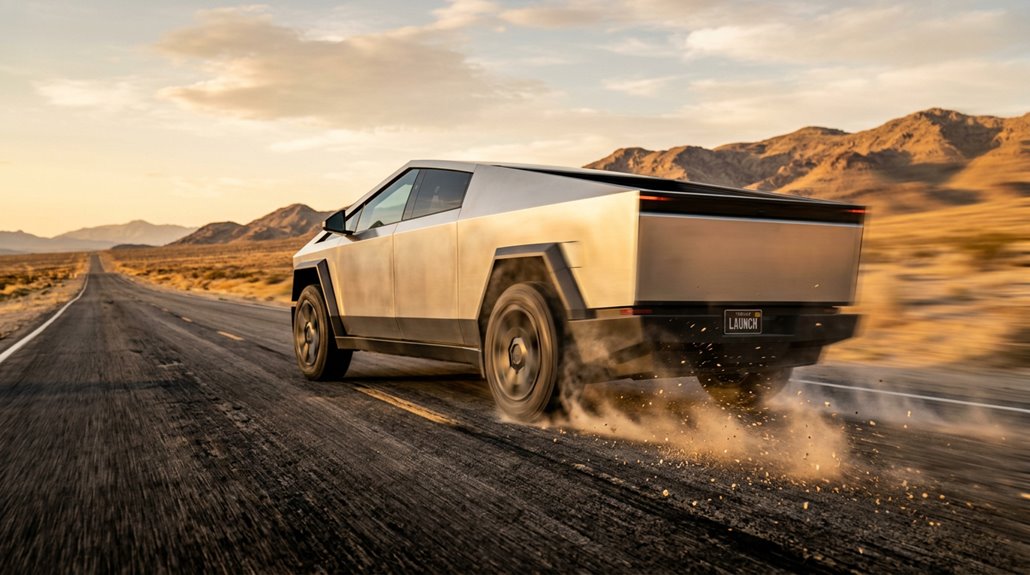
The Cybertruck almost always surprises people who expect a 6,800-lb stainless steel slab to feel slow off the line — it doesn’t. Trim comparisons matter enormously here. Tesla claims 4.1 seconds for the Dual Motor, but MotorTrend’s real world launches produced 3.8 seconds, with a quarter mile of 12.4 seconds at 110.3 mph. That’s meaningfully quicker than advertised.
The Beast operates in a different atmosphere entirely — Car and Driver recorded 2.6 seconds to 60 mph and an 11.0-second quarter mile at 119 mph (excluding the standard 1-foot rollout). That places it among the quickest production pickups ever tested. Your experience varies by trim, conditions, and how hard you actually press the pedal. In a rolling start scenario, Car and Driver also clocked a 5–60 mph time of 2.8 seconds, confirming the Beast’s thrust is just as ferocious once already in motion.
What Is Cybertruck Beast Mode and How Do You Activate It?
Beast Mode is Cybertruck’s highest-performance on-road drive mode, sitting above Comfort, Sport, and Custom in the driving dynamics menu and exclusive to the Cyberbeast trim (Tesla’s own phrasing) that hits 0–60 mph in 2.6 seconds.
To activate it, you open the drive mode selector on the center display, tap Beast, and follow the on-screen prompts — which, for launch mode specifically, means holding both the brake and accelerator until the vehicle signals you to release. One important caveat: skipping those prompts or running mismatched software doesn’t give you launch behavior; it gives you a warning, which is the Cybertruck’s polite way of telling you to read the instructions.
To engage Beast Mode, navigate to Dynamics in the vehicle settings, then hold the brake and accelerator simultaneously to initiate the launch sequence countdown before releasing for full acceleration.
Beast Mode Explained
Unleashing the Cybertruck’s full performance potential requires steering to a specific drive mode that Tesla engineered exclusively for the three-motor Cyberbeast trim — aptly named Beast Mode. When activated, the system reconfigures launch behavior entirely, dropping front suspension height and shifting the infotainment display to a striking black-and-white tunnel visualization. Early details about Beast Mode first surfaced when a developer extracted an animation from Tesla app version 4.27.3, depicting the truck entering a triangular speed tunnel before increasing speed.
Here’s what Beast Mode actually delivers:
- 0–60 mph in 2.5 seconds (MotorTrend-verified, not just Tesla’s claim)
- Quarter-mile in 11.0 seconds at 113.7 mph — sports car territory inside 6,884 pounds
- Optimized thermal management ensuring sustained power output without premature performance rollback
You’re not just selecting an aggressive setting. You’re commanding a purpose-built launch sequence that Tesla reserved specifically for its flagship configuration.
Activating Beast Mode
Activating Beast Mode isn’t a toggle — it’s a deliberate sequence that Tesla buried inside the Performance settings menu, presumably to prevent accidental quarter-mile runs on the school run. Head to Dynamics, select Beast Mode, and the UI animation shifts to a stylized speed-tunnel display — triangular, futuristic, unmistakably intentional.
Then comes the actual launch sequence: left foot firmly on the brake, right foot flooring the accelerator. The truck builds torque against your foot’s resistance, traction systems primed, and then you release. That’s when Tesla’s advertised 2.6-second 0-60 capability becomes MotorTrend’s verified 2.5-second reality. Top speed caps at 130 mph. This isn’t a commute setting — it’s a straight-line performance tool that demands deliberate input before the Cyberbeast delivers anything worth discussing.
Front Motor Locking Differential: How It Works Under Load
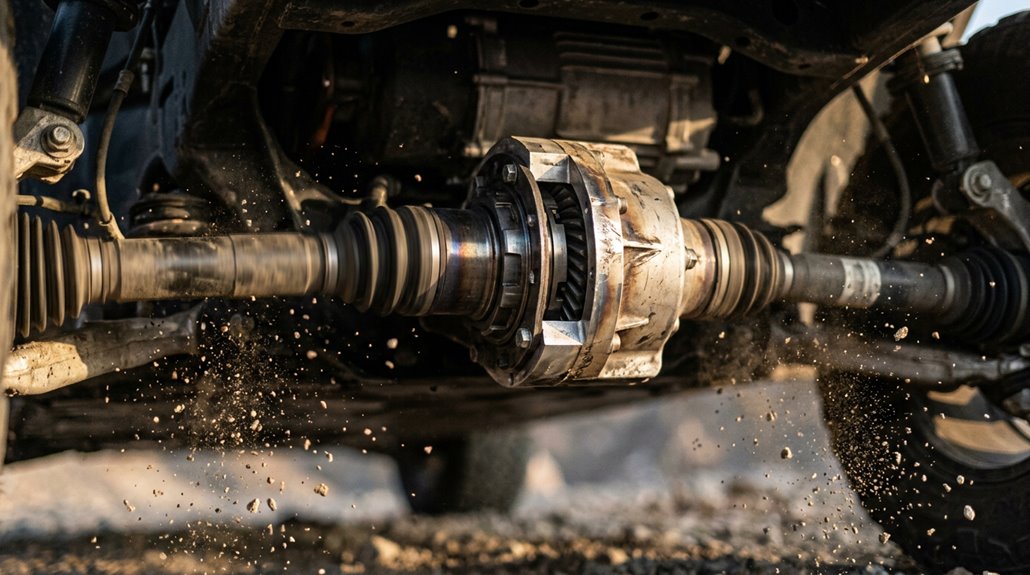
Engineered specifically for low-speed technical terrain, the Cybertruck’s front locking differential forces both front wheels to spin at identical speeds regardless of individual tire grip—eliminating the open differential’s tendency to dump torque into whichever wheel is already spinning uselessly.
That axle behavior shift matters enormously when one front tire unloads over uneven rock or loose sand.
Activate it through the Off-Road app. After first engagement, expect:
- A calibration requirement—drive at least 100 feet with active steering input
- Audible driveline pops during engage/disengage (normal, per Tesla)
- Torque management redirecting usable force toward the wheel maintaining surface contact
Under heavier front-axle loads, the locker still maintains equal wheel speed, preserving forward momentum when weight transfer would otherwise compromise traction.
Cyberbeast vs. Dual-Motor Towing: Which Trim Handles More?
When you’re staring down an 11,000 lb tow rating on both the Dual-Motor AWD and the Cyberbeast, the obvious question is what exactly you’re paying the Cyberbeast premium for—and towing capacity isn’t the answer.
Both trims pull identical maximum loads.
Where they actually diverge is payload margin. The Dual-Motor AWD reaches 2,500 lb on Premium All-Terrain configurations, while the heavier Cyberbeast caps at 2,270 lb on comparable setups. That gap matters because tongue weight eats directly into your payload budget.
Range degradation hits both trims hard (expect 110–190 real miles under load), but the Cyberbeast’s extra power doesn’t slow that drain.
For serious hauling, the Dual-Motor AWD is simply the smarter, more balanced choice.
Cybertruck Towing Capacity: 11,000 Pounds vs. 7,500 Pounds
Most of the confusion around Cybertruck’s towing capacity traces back to a three-year gap between Tesla’s original pitch and what actually rolled off the production line. Tesla initially promised 14,000 pounds. Production delivered 11,000 pounds. Here’s what that gap means practically:
- Hitch classes matter — 11,000 pounds demands a Class IV or V receiver, not a standard Class III.
- Braking impact is real — heavier trailers stress regenerative braking calibration, requiring longer stopping distances.
- 7,500 pounds likely reflects a lower-trim or early-spec reference, not the documented production ceiling.
Store signage confirmed 11,000 pounds before broad deliveries began, matching Car and Driver’s reporting. That figure still clears the F-150 Lightning’s 10,000-pound ceiling, which isn’t nothing.
Cybertruck Payload Capacity: What 2,500 Pounds Looks Like
The Cybertruck’s advertised 2,500 lb payload puts it near the top of the half-ton class, but that number shrinks fast once you factor in passengers, tools, and tongue weight from any trailer you’re pulling. Two 200 lb adults already cut your remaining capacity to roughly 2,100 lb, which sounds generous until you price it against a single yard of gravel (estimated at 2,700 lb) or a bed stacked with drywall.
Unlike towing capacity, which measures what you can pull behind the truck, payload governs everything the truck physically carries — bed cargo, frunk load (441 lb max per MotorTrend), under-bed storage (220 lb max), and every person sitting inside it.
Understanding Payload Capacity Basics
Here’s how payload distribution actually works:
- Occupants — Every person inside the cab counts toward your payload budget
- Cargo — Anything loaded into the bed or cabin reduces remaining capacity
- Tongue weight — Your trailer’s downward hitch pressure eats directly into payload
Weight management becomes critical because payload limits aren’t arbitrary marketing numbers. Engineers calculate them against axle loads, suspension tolerances, brakes, and tire ratings. Exceed those engineering limits and you’re degrading performance across every system simultaneously.
The Cybertruck’s 2,500-pound rating reflects exactly those calculated limits — nothing more, nothing less.
Real-World Payload Examples
Numbers on a spec sheet don’t haul gravel, but your truck does — so let’s put 2,500 pounds in terms that actually mean something. Think dense construction materials, full tool pallets, or stacked equipment — loads that fill a bed with mass, not just volume.
Documented bed experiments push that boundary further. One owner loaded 2,700 pounds into the bed plus 400 pounds in the frunk, exceeding 3,000 pounds combined. Real world squatting occurred immediately at loading, then Cybertruck’s air suspension self-leveled, restoring a stable stance automatically.
Here’s what makes that test genuinely impressive: the subsequent 120-mile haul showed minimal range degradation. Regenerative braking even assisted deceleration with the extra frunk weight contributing forward momentum — physics working for you, not against you.
Payload Vs. Towing Differences
Payload and towing sound interchangeable until you’re standing at a job site trying to figure out why your 11,000-pound tow rating doesn’t mean you can stack 11,000 pounds of concrete blocks in the bed. They measure completely different engineering limits:
- Payload (2,500 lbs max) governs what rides *inside* the truck — passengers, bed cargo, accessories, all of it
- Towing (11,000 lbs max) governs what trails *behind* the hitch
- Braking impact and payload distribution affect both ratings independently through separate chassis thresholds
Exceeding payload stresses suspension, tires, and braking performance — regardless of your tow rating.
Think of them as two distinct budgets. Spend one carelessly, and the other becomes irrelevant when your stopping distance quietly doubles on a downhill grade.
How Much Does Towing Reduce Cybertruck Range?
Towing cuts into the Cybertruck’s range harder than most owners expect, and the physics behind that aren’t complicated — drag scales with the square of speed, so every mph above 60 costs you disproportionately more energy.
Light loads (2,500–4,000 lbs) with aerodynamic trailers typically produce 40–50% range loss, leaving you around 160–200 miles.
Heavy hauling — think 6,000–11,000 lbs — regularly drops that to 110–160 miles.
Cold weather punishes battery thermal management further; one freezing max-tow test at 11,000 lbs returned just 103 miles.
The optional Range Extender recovers roughly 120–130 miles of rated range, though it consumes bed space.
Plan charging stops aggressively — towing converts the Cybertruck from a long-hauler into a regional workhorse.
Cybertruck EPA Range: What 325 Miles Means in Practice
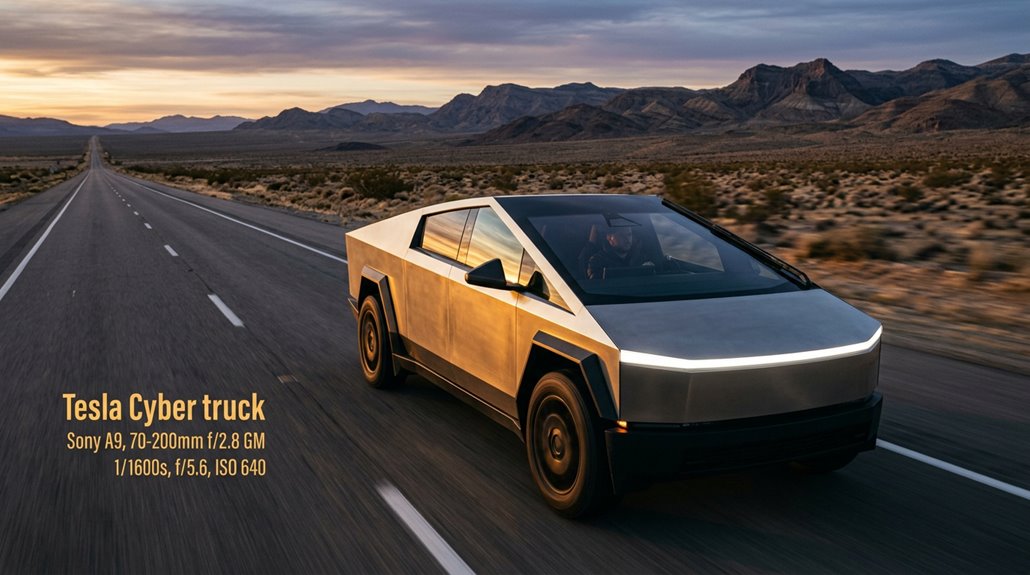
The Cybertruck’s 325-mile EPA rating looks great on paper, but real-world highway driving at 70–75 mph typically delivers closer to 250–270 miles, and once you factor in towing (which can slash range by 40–50%), you’ll want a charging strategy that doesn’t rely on squeezing every last mile out of the pack.
Edmunds’ standardized EV loop actually recorded 334 miles for dual-motor trucks in controlled conditions, yet InsideEVs’ highway test landed at just 254 miles — about 20.6% below Tesla’s own 320-mile claim — which tells you how sharply speed, load, and temperature compress that headline number.
A practical rule of thumb is to plan charging stops around 220–240 miles of usable range, leaving a buffer that accounts for Supercharger availability, ambient conditions, and whatever you’re hauling.
Real-World Range Expectations
When Tesla quotes 325 miles of range for the dual-motor Cybertruck, that number comes straight out of EPA-cycle testing—a controlled, mixed-speed protocol that doesn’t replicate sustained highway cruising.
Push it to 70–75 mph on a real interstate, and the real world hits back fast.
Here’s what you should actually plan around:
- 250–270 miles of highway range in favorable, mild-weather conditions
- 220–240 miles as your practical buffer between Supercharger stops—not the sticker number
- 80% of the EPA figure as a reliable trip planning shortcut (325 miles × 0.80 ≈ 260 miles)
Aerodynamic drag at cruising speed punishes the Cybertruck’s tall, blunt profile harder than most EVs.
Plan accordingly.
Towing Reduces Range
Hook up a trailer to the Cybertruck and that 325-mile EPA figure stops being a planning number—it becomes a ceiling you’ll never touch. Aerodynamic impacts from boxy trailers hit hard at highway speeds, and regenerative braking can’t recover enough energy to compensate. Battery degradation compounds the loss over time. Plan your charging logistics around 120–180 miles between stops, not 325.
| Trailer Weight | Estimated Towing Range | Conditions |
|---|---|---|
| 3,170 lbs | ~160 miles | Mixed highway |
| 4,000 lbs | ~160 miles | Rural/highway |
| 6,000 lbs | 90–165 miles | Speed-dependent |
| 10,000–11,000 lbs | ~162 miles (50% cut) | Near-max load |
| 75% battery used | 68–120 miles | Various |
Cold weather shrinks those numbers further.
Charging Time Considerations
EPA-rated range tells you a ceiling, not a route plan—325 miles is the number Tesla’s Cybertruck AWD earns under controlled test conditions, and real-world driving peels that figure back fast. Charging psychology matters here: most drivers overthink full charges when partial stops actually move them faster.
Smart battery etiquette means targeting these windows:
- 10%–80% DC fast charge: roughly 35–40 minutes on Supercharger hardware
- Peak 300+ kW power: appears briefly on V4 equipment, not sustained
- 100% full charge: expect 60+ minutes, heavily tapered above 80%
That taper above 80% is physics, not a glitch—lithium chemistry slows ion acceptance as cells fill. Charge to your next stop, not your driveway, and you’ll consistently move faster.
Long-Range Single-Motor Models and the 340-Mile Ceiling
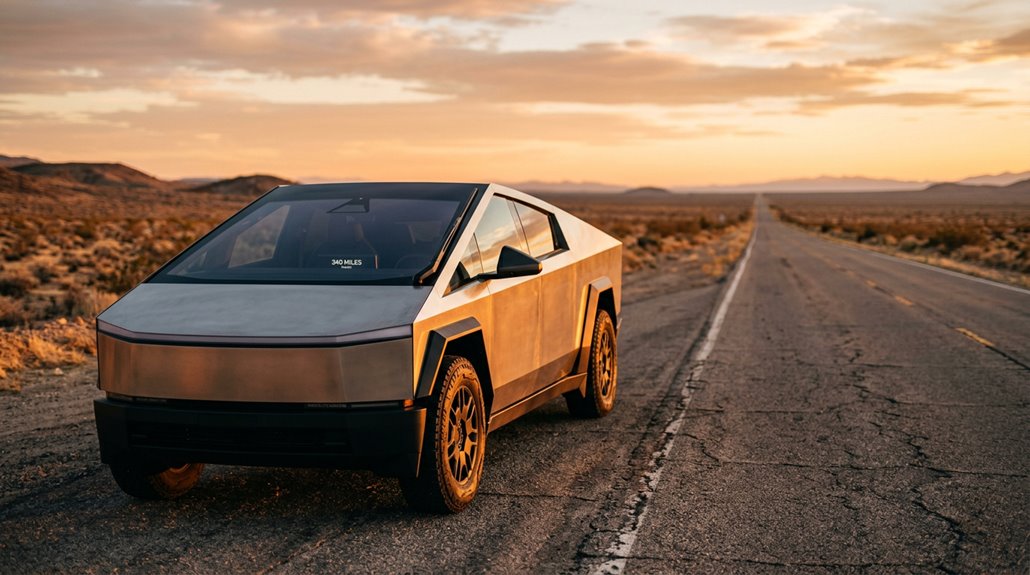
The Long-Range single-motor Cybertruck sits at the bottom of the current trim ladder, priced at $71,985 — roughly $10,000 less than the dual-motor AWD version — and it trades straight-line aggression and towing muscle for a simpler drivetrain and a longer stated range.
Single motor economics make sense here: one rear motor, less complexity, lower cost. Tesla claims 350 miles without the tonneau cover, climbing to 362 miles with it — aerodynamic optimization doing the quiet work a $750 soft cover can manage.
The practical ceiling lands around 340 miles once real-world variables like speed, temperature, and tire choice enter the equation. Opt for 20-inch all-terrain wheels and MotorTrend’s testing puts you at 331 miles. Towing drops to 7,500 pounds, and 0–60 arrives in 6.2 seconds.
How the 800-Volt Powertrain Enables Rapid Charging
Voltage matters more than most buyers realize, and the Cybertruck’s 800-volt architecture is the clearest proof of that.
Higher voltage means lower current for identical power output, which directly benefits battery chemistry stability and thermal management by cutting resistive heat in the wiring.
Here’s what that enables practically:
- Peak charging reaches 325 kW at V4 Supercharger posts, with future cabinets targeting 500 kW.
- Thinner, lighter cables become possible because reduced current demands less copper.
- Split-pack compatibility lets the truck divide into two 400V halves for older infrastructure.
The catch? V3 Superchargers cap around 250 kW, so the 800V advantage only fully materializes when the supporting hardware actually matches the truck’s capability.
Cybertruck Charging Time at 240V: Full Breakdown
Supercharger speeds are impressive, but most Cybertruck miles actually get replenished overnight in your garage. Your circuit size determines everything here. A 48A/240V Wall Connector delivers roughly 11.5 kW, covering 10%–80% in about 6.5–8.5 hours — solid overnight efficiency for most commuters.
Drop to a 30A circuit and that same window stretches to approximately 8.8 hours, adding maybe 12–15 miles per hour. A full 0%–100% charge on a strong 11.5 kW setup takes roughly 12.6 hours (battery taper above 80% slows things considerably).
A 30A circuit handles overnight replenishment fine unless you’re starting genuinely empty. Level 1 at 120V? Technically functional, practically miserable — expect 80-plus hours for a full charge. Upgrade your home circuit accordingly.
Tesla Supercharger Access and Fast-Charging on Road Trips
On road trips, your Cybertruck plugs directly into Tesla’s Supercharger network without adaptors — the NACS charge port matches Supercharger hardware natively across North America, which eliminates the fumbling and compatibility guesswork that plagues other EV owners.
Fast-charging economics favor V4 Superchargers specifically, where you’ll pull up to 325 kW and recover roughly 100 miles in 10 minutes.
Smart supercharger etiquette and charging economics mean knowing three key behaviors:
- Use Trip Planner — bypassing it triggers automatic 80% caps at congested sites
- Arrive below 20% state-of-charge for maximum charge acceptance rates
- Move your truck once charging completes (idle fees accumulate fast)
Battery temperature conditioning happens automatically before sessions begin, so the charging economics work in your favor without manual intervention.
Cybertruck Powershare: Powering Devices, Tools, and Homes
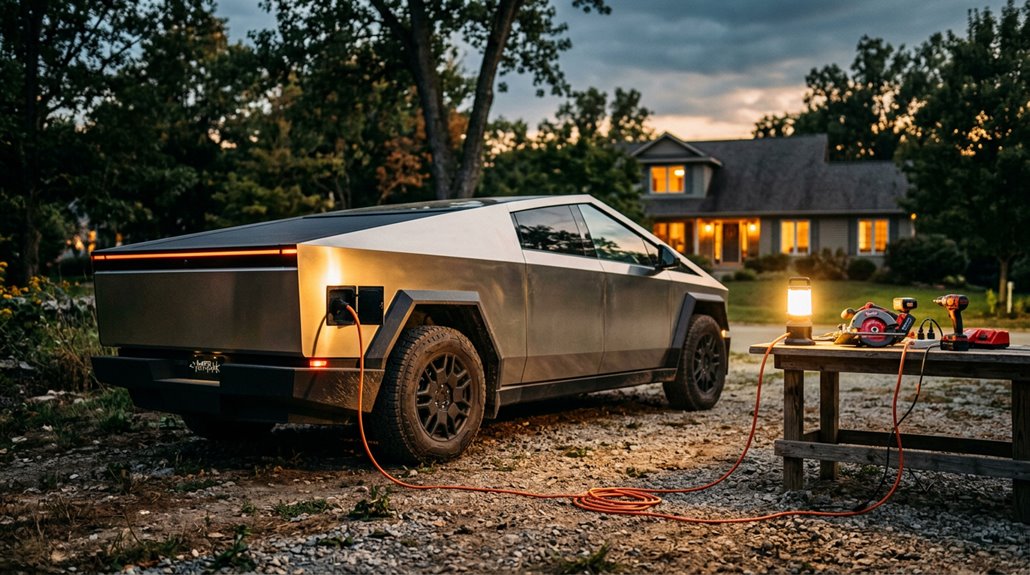
Flip the Cybertruck into Powershare mode and you’ve fundamentally parked a 11.52 kW generator in your driveway — except it runs silently, requires zero fuel mixing, and won’t carbon-monoxide your garage into a hazmat situation.
That continuous output handles serious home resilience scenarios: grid failure triggers automatic backup power within roughly one minute, and a fully charged truck sustains approximately three days of supply at 30 kWh daily consumption.
The 240V AC system carries 110A LRA motor-start capability, meaning it handles compressor-heavy appliances without flinching.
Portable power on job sites works equally well — plug directly into the truck’s outlets.
Pair Powershare with solar panels and you’re actively recharging during outages, extending runtime indefinitely.
The required hardware bundle includes a Universal Wall Connector and Powershare Gateway (professional installation mandatory).
How Much Power the Cybertruck Can Export to External Equipment
The Cybertruck splits its external power output into two distinct tiers depending on how you’re pulling that power. Think of it like choosing between portable powerstations and whole-home solar integration levels of output.
Here’s how the tiers break down:
- Outlet-based (V2L): Five onboard outlets (two cabin, three bed) deliver up to 9.6 kW combined — enough for serious tools and appliances.
- Home-backup (V2H): Through Tesla’s Powershare Gateway and Universal Wall Connector, output jumps to 11.52 kW continuous.
- Battery reserve: The ~123 kWh pack sustains both tiers for extended runtimes, though grid-support programs may reserve capacity.
V2G export isn’t currently available in standard consumer configurations (regulatory limitations, not hardware ones). You’re working within V2L and V2H exclusively for now.
Adaptive Air Suspension on Premium and Cyberbeast Models
If you’re driving an AWD or Cyberbeast Cybertruck, you’ve got access to adjustable air suspension — a system that manually adjusts ride height through the vehicle’s controls to handle everything from steep driveways to deep snow without grinding the undercarriage.
You can raise the suspension for rough terrain or lower it for better handling and improved range (lower center of gravity means less aerodynamic drag and more predictable cornering), with any manual height changes automatically reverting once you exceed 25 mph (40 km/h).
Long Range models don’t get this hardware at all, so if variable ground clearance is non-negotiable for your use case, trim selection matters more than most buyers realize.
Ground Clearance Adjustment
Raising or lowering the Cybertruck’s ride height isn’t a gimmick—it’s a calibrated engineering tool built into the Premium AWD and Cyberbeast variants via adjustable air suspension (notably absent on the Long Range model).
Suspension calibration happens across four distinct positions, each serving specific terrain adaptation purposes:
- High adds 2.4 in. above Medium—solid for general off-road at any speed
- Very High adds 3.9 in.—but caps you at 25 mph before automatically resetting downward
- Extract adds 5.9 in.—limited to 10 mph, designed specifically for underbody obstacle recovery
Lower settings trade clearance for aerodynamics and handling precision.
You’re fundamentally choosing between ground-clearing capability and efficiency, depending on what the terrain requires.
Premium Model Benefits
Responsive air suspension comes standard on the AWD and Cyberbeast variants—skip those trims, and you’re on a fixed-rate setup with no height adjustability whatsoever. The Long Range trim doesn’t get adjustable suspension, full stop. For the trims that do, you’re gaining genuine load-leveling capability that actively compensates for uneven payload distribution between the cab and bed—no rear squat when you’re hauling 2,500 pounds of material.
Speed-linked logic automatically returns ride height to your preferred setting once you exceed 25 mph (40 km/h), reducing drag without requiring constant manual input. Premium comfort here isn’t marketing language—it’s dynamic damping that recalibrates in real time based on road conditions and load weight, making the Cyberbeast and AWD genuinely more capable across towing, hauling, and uneven terrain scenarios.
Coil-Spring Suspension on Base Models: Specs and Trade-Offs
The base Cybertruck’s suspension is the road less traveled by most reviewers—coil springs paired with responsive dampers, no air bladders, no height-adjustment menus, no self-leveling behavior under a loaded bed. That’s the trade-off you accept for a lower entry price and genuine maintenance simplicity.
Coil springs, no air bladders, no fuss—just fewer failure points and a lower price tag worth considering.
Here’s what that actually means for you:
- Coil comfort relies entirely on damper calibration, not ride-height adjustments
- No selectable High or Very High terrain modes—off-road versatility shrinks considerably
- Load compensation under a heavy payload is less sophisticated than air-suspension trims
The hardware is simpler, the failure points fewer. If your Cybertruck mostly works paved roads rather than boulder fields, the coil-spring setup quietly earns its place without apology.
Ground Clearance Up to 16 Inches and What It Unlocks Off-Road
When you push the Cybertruck into Extract mode, the responsive air suspension hoists the truck to a factory-declared 16.02 inches of ground clearance—enough to clear obstacles that would high-center a Ford F-150 Raptor (which maxes out at 11.5 inches) or leave a standard Silverado 1500 weeping at 8.9 inches. That 4-plus-inch advantage isn’t cosmetic; it directly enables trail routing through rock fields, deep snow, and rutted terrain where belly-scraping becomes expensive.
The system spans from a low of 8.54 inches up through Medium (10.12″), High (12.48″), Very High (14.05″), and finally Extract. Using lower modes on pavement also reduces aerodynamic drag, which protects suspension longevity by minimizing unnecessary travel cycles. Pair that with 35° approach and 28° departure angles, and you’ve got genuinely capable geometry.
How the Suspension Auto-Lowers for Easy Entry and Exit
Climbing into a vehicle that sits over a foot off the ground gets old fast—Tesla solved that with Auto-Lower, a suspension convenience feature tucked inside Controls > Motion on the touchscreen.
Shift into Park, and the Cybertruck drops to Entry ride height automatically. Drive away, and it returns to your preferred setting.
Here’s how it works for daily entry ergonomics:
- Park triggers descent — the suspension lowers immediately, reducing step-in height
- Drive cancels it — preferred ride height restores without manual input
- Saved locations raise automatically — suspension diagnostics recognize frequent destinations and adjust proactively
For garage compatibility, verify no tools or debris sit underneath before enabling this feature.
User safety isn’t optional—automatic lowering moves the body meaningfully, not cosmetically.
What the Cybertruck’s 35° Approach and 28° Departure Angles Mean Off-Road
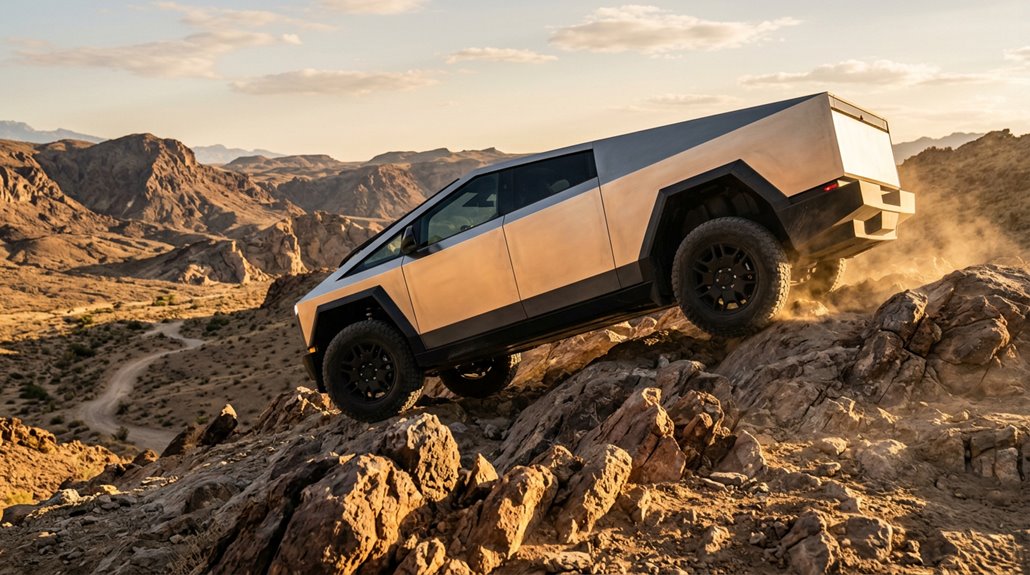
When you’re sizing up a steep trail entry, the approach angle tells you exactly how aggressive a slope your front bumper can meet before it contacts the obstacle — and at 35°, the Cybertruck’s short front overhang lets the wheels begin climbing before the nose ever gets involved.
The departure angle works the same logic in reverse, measuring how steep a drop-off your rear end can clear on exit, and the Cybertruck’s 28° figure means the back bumper handles sharp ledges and downhill exits better than most full-size trucks (though rear cargo load can tighten that margin fast).
Together, these two numbers don’t guarantee trail success on their own — traction, tire selection, and driver judgment still carry the day — but they do confirm the Cybertruck’s geometry is engineered for technical terrain rather than just photographed next to it.
Understanding Approach Angles
Approach angle isn’t a marketing number—it’s the maximum slope angle a vehicle can climb before its front bumper, splitter, or underbody contacts the terrain.
Three factors directly shape your approach characteristics:
- Front overhang length
- Ride height (suspension position)
- Tire diameter
The Cybertruck’s 35° rating reflects smart geometry—its short front overhang reduces the leverage working against you on steep climbs.
Air suspension actively contributes to obstacle mitigation by maintaining usable front-end clearance before contact becomes inevitable.
For reference, 35° matches the Jeep Wrangler Rubicon’s capability (not bad company).
However, ride height setting matters considerably—drop the suspension low and that 35° advantage shrinks fast.
Soft terrain compounds this further, since wheel sink effectively reduces your real-world angle before you’ve touched a single ledge.
Departure Angle Benefits
Getting off an obstacle cleanly is just as technically demanding as getting onto it—and that’s where the Cybertruck’s 28° departure angle starts earning its keep. That figure describes the steepest slope your rear end can exit without the bumper, hitch hardware, or underbody dragging. Your exit strategy on rocky shelves, abrupt ledges, or washout transitions depends heavily on this geometry.
Compare that against the F-150’s 23°—a 5° gap that genuinely matters when the trail falls away sharply behind you. Trail clearance also shrinks under load, since cargo and hitch accessories eat into practical rear geometry fast. The Cybertruck’s rear-angle performance sits closer to dedicated off-road vehicles than conventional full-size pickups, which means fewer compromised line choices and less underbody contact on technical terrain.
How the Cybertruck Performs Off-Road vs. Traditional Body-On-Frame Trucks
The Cybertruck‘s approach to off-road performance is built on fundamentally different engineering principles than a body-on-frame truck like the F-150, Silverado, or Ram — and that difference cuts both ways. You’re trading a proven steel-ladder chassis for a stainless exoskeleton, instant torque, and sophisticated trail electronics that most traditional trucks can’t match.
Here’s where the engineering diverges in practice:
- Traction: Overland and Trail Assist modes manage torque delivery precisely across loose terrain
- Suspension: Air springs deliver up to 17 inches of ground clearance with ~14 inches of wheel travel
- Vulnerability: Low-hanging body panels absorb impacts that exposed steel frames on conventional trucks typically shrug off
Battery cooling performance under sustained trail stress remains an open question.
Drift Mode and Terrain-Specific Handling on the Cybertruck

If you want the Cybertruck to step its rear end out on loose surfaces, Baja mode is your starting point — it’s the factory-supported terrain setting built for high-speed dirt, gravel, and dry lake bed driving where controlled rotation is actually achievable.
Inside Baja mode, the Handling Balance slider lets you push behavior toward oversteer, while the Stability Assist setting (drop it to Min) strips away most traction and stability intervention so the truck can rotate without the software constantly correcting your inputs. Pair that with the Terrain slider’s Smooth setting (medium ride height, damping tuned to minimize pitch and roll) and you’ve got a surprisingly tunable platform for a vehicle that weighs over 6,000 pounds.
Drift Mode Explained
Unlike many performance vehicles that ship with a dedicated drift mode baked into the drive selector, the Cybertruck doesn’t have a factory-labeled “Drift Mode” anywhere in Tesla’s official owner documentation — what you’re actually working with is Baja mode, accessible through the Off-Road app, paired with deliberate reductions in stability intervention and rear-steer behavior.
Your drift setup fundamentally involves three deliberate adjustments:
- Activate Baja mode to minimize handling intervention
- Disable rear steer (set to Off in the Off-Road app)
- Reduce stability control to allow controlled oversteer
That’s your foundation. Traction management becomes your actual skill requirement here — smooth terrain, steering input before throttle, and avoiding full-throttle launches from a stop (which triggers Tesla’s protective logic almost immediately).
Terrain-Specific Tuning Options
Baja mode does the heavy lifting regarding terrain-specific tuning on the Cybertruck — but calling it a single-button solution undersells how much granular control you actually have underneath it. Baja tuning reshapes traction maps for loose surfaces, reducing stability intervention so the truck can slip intentionally without fighting you. You’re also adjusting rear steer behavior directly through the Off-Road app.
| Setting | Function |
|---|---|
| Rear Steer Auto | Tightens turning radius at low speed |
| Rear Steer Off | Stabilizes handling during drift-oriented runs |
| Extract Ride Height | Maximizes clearance, caps speed at 10 mph |
Set rear steer to Off when you’re pushing aggressive lines — Auto gets unpredictable when the rear steps out mid-corner.
Handling Balance Adjustments
Rear steer off, power biased rearward, stability dialed to minimum — that’s your starting point if you want the Cybertruck to step out intentionally.
Tesla doesn’t offer a factory drift mode, but Baja mode gets you closest. Here’s the community-tested configuration:
- Set handling to 100 rear bias
- Reduce stability to minimum
- Disable rear steer entirely
Rear steer complicates yaw response when you’re chasing sustained oversteer — it actively fights the slide. Stability reduction lets the rear end break traction more freely, but that freedom cuts both ways.
More yaw potential means less electronic safety net. Keep this strictly off-road (loose surfaces only), because Tesla explicitly warns that improper differential use on asphalt voids warranty coverage — and that bill won’t be pretty.
The Motorized Vault Cover: Security, Weather, and Function
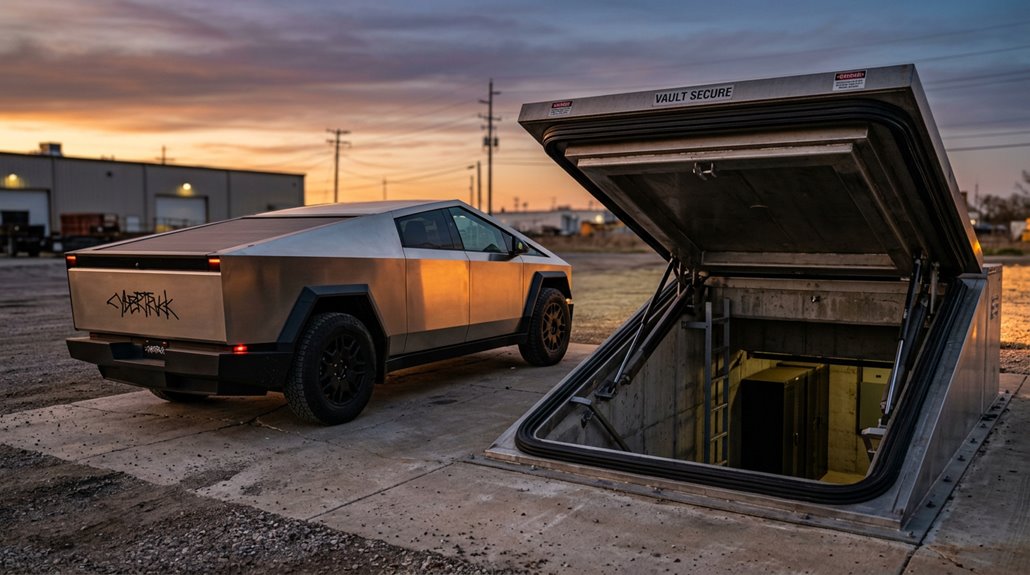
Convenience and security rarely share the same mechanism, but the Cybertruck’s motorized vault cover pulls both off in a single electrically driven panel. The cover seals your 6-foot bed against rain, dust, and road spray while supporting 300 lbs on its stainless steel surface. For anti theft purposes, it conceals cargo entirely—deterrence through obscurity. Vault maintenance means inspecting sealing surfaces regularly; compromised gaskets destroy seal longevity fast. Mechanism redundancy matters too, since motorized systems add failure points that manual covers don’t.
| Feature | Specification | Practical Impact |
|---|---|---|
| Weight Capacity | 300 lbs | Usable work surface |
| Closure Type | Motorized electric | Hands-free operation |
| Weather Rating | Sealed enclosure | Rain and dust protection |
| Security Level | Concealment-based | Deterrence, not absolute |
| Maintenance Need | Seals and mechanism | Long-term performance |
Always verify lock status after closing.
What Happens to the Rear Window When the Tonneau Closes?
When you close the Cybertruck’s powered tonneau, don’t expect it to black out the rear window like a solid hard cover would — the mechanism slides along roof-mounted tracks, leaving the rear glass area unobstructed at the final closed position. The cover’s job is vault sealing, not rear-window concealment, which means you’re still getting that narrow, slot-like mirror sightline whether the tonneau’s up or down.
That said, the closed cover does meaningful work on range, with Car and Driver measuring roughly a 10 percent consumption improvement at 75 mph and a 15.4 percent reduction at 65 mph compared to open-bed testing — so the aerodynamic tradeoff is real even if the security image isn’t quite airtight at the cab-rear junction.
Tonneau Cover Blocks Window
Here’s what actually happens when the tonneau closes:
- The cover stops near the window’s lower edge, creating side gaps
- Sightlines through the vault shift noticeably, altering your rearward viewpoint
- The display automatically activates the rear camera feed to compensate
The glass stays put — your view through it just becomes less practical without the camera doing its job.
Security And Weather Protection
The tonneau cover‘s job is to protect what’s in the bed — not to act as a secondary barrier for the rear window. Close it completely, and you’ve handled cargo concealment reasonably well — anything sitting below the cover line disappears from outside sightlines. The rear window, however, stays fully exposed as its own independent glass surface. Rain, road spray, and dust hit it regardless of cover position (Tesla controls windows and tonneau separately by design). That’s a real weather limitation worth grasping before assuming full protection.
Precious items near the cab area can still be visible through the rear glass, so placement matters. Treat the tonneau as bed coverage only, confirm closure before walking away, and physically verify the tracks are clear of obstructions.
Cybertruck Bed Storage: The Hidden Compartment Under the Floor
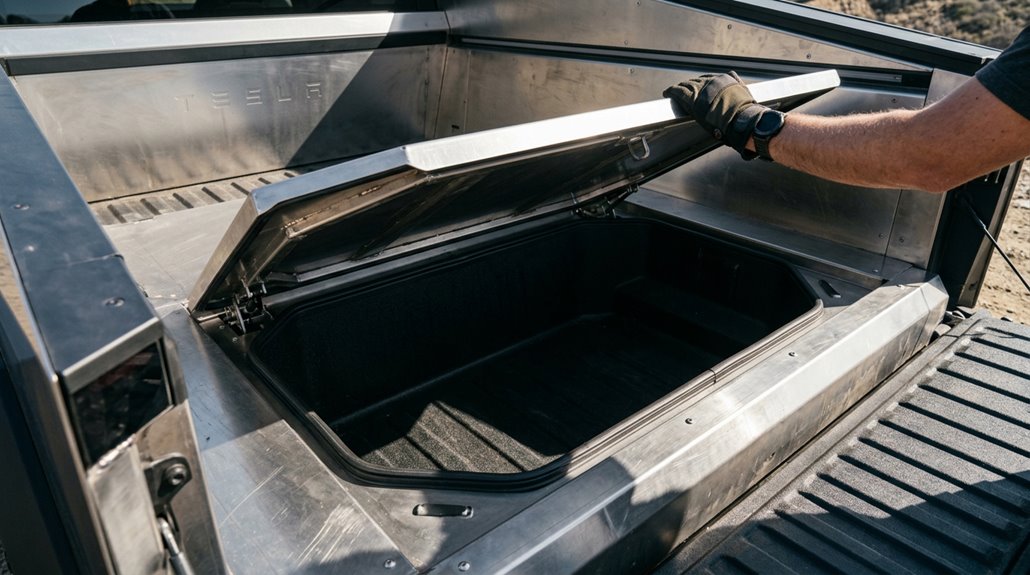
Tesla didn’t just bolt on a truck bed and call it a day — tucked beneath the Cybertruck’s stainless steel floor sits a hidden under-bed compartment that owners have already nicknamed the “smuggler’s bay.” It’s a concealed cavity engineered below the main cargo surface, keeping prized items completely out of sightlines without sacrificing the usable bed volume above.
Tesla engineered a hidden under-bed compartment beneath the Cybertruck’s stainless steel floor — owners already call it the “smuggler’s bay.”
This covert storage space handles real-world utility across multiple use cases:
- Recovery gear — straps, shackles, and traction boards stay organized and hidden
- Electronics and valuables — out of sight means out of reach for opportunistic theft
- Travel essentials — liquids, tools, and compact items stay separated from larger cargo above
Aftermarket systems like Unplugged Performance’s dual-drawer platform (35.2″ x 40.9″) even preserve access to this hidden compartment while the tonneau cover closes overhead.
The 18.5-Inch Central Touchscreen and What It Controls
Once you’ve finished loading the bed and locking down whatever’s hiding in the under-floor compartment, you climb into the cab and face a completely different kind of engineering statement — an 18.5-inch panoramic-oriented touchscreen dominating the center of the dashboard.
Running at 2650×1440 (QHD), it’s Tesla’s largest production display at launch. Touchscreen ergonomics here are deliberate — wide orientation keeps climate controls, drive settings, lighting, and seating functions within a single horizontal sweep rather than buried in submenus. No Apple CarPlay, no Android Auto. Tesla handles routing, streaming, and connectivity natively. Software updates push automatically over Wi-Fi, which means the interface you’re using today isn’t necessarily the one you’ll have next month. Higher trims add a rear 9.4-inch screen for passengers, but this center unit runs everything that matters.
Cybertruck’s interior screens take constant use from navigation, camera feeds, and daily controls, and over time even light contact, dust, and fingerprints can start affecting clarity more than most owners expect. Tempered Screen Protector for Cybertruck Front + Rear adds a clear protective layer that helps keep both displays clean and resistant to scratches, especially in high-use driving and work environments where the cabin gets handled often.
Rear Passenger Touchscreen: The 9.4-Inch Console Display Explained
Mounted in the rear center console, the 9.4-inch touchscreen gives back-seat passengers direct control over the cabin without shouting requests to whoever’s up front.
No more backseat negotiating — the 9.4-inch rear console touchscreen puts passengers in direct control of their own comfort.
It’s a separate unit from the 18.5-inch front display, purpose-built for rear-seat autonomy. Here’s what you can manage directly from it:
- Climate – Adjust fan speed, toggle rear climate power, and redirect airflow from rear vents.
- Seating – Control seat heaters (left and right independently) and move the front passenger seat forward or rearward while stationary.
- Entertainment – Stream video, browse arcade games, or manage media playback.
The console display also supports passenger privacy controls through the Lock Rear Display setting, restricting access when needed.
Customized profiles aren’t stored here, but the rear touchscreen handles everything a back-seat passenger reasonably needs.
What the Cybertruck Cabin Actually Looks Like Inside
The rear 9.4-inch display handles your back-seat experience fine, but step through the front door and you’re confronting a cabin that commits hard to a single design language. That debossed Cybertruck logo on the scuff plate (finished with a welded-texture detail) signals immediately what you’re entering: futuristic minimalism made structural.
Angular surfaces continue the exterior geometry straight into the interior without apology. The high roofline and wide windshield open up the forward visual field considerably, making entry ergonomics feel deliberate rather than accidental. Front seats carry real support for long hauls, and the Foundation Series adds white trim that contrasts sharply against the restrained cabin palette. Physical controls are minimal — Tesla routes nearly everything through the central touchscreen, which is either liberating or maddening depending on your background.
The Cybertruck’s vault is built for serious utility, but once you start loading tools, gear, or groceries, even small items can shift around more than expected during hard braking or uneven roads. EVAAM Truck Bed Cargo Nets for Tesla Cybertruck help keep loose items secured in place so the cargo area stays usable and organized, even when the bed isn’t fully loaded or perfectly packed.
How Cold Weather and Heat Affect Cybertruck Range and Performance
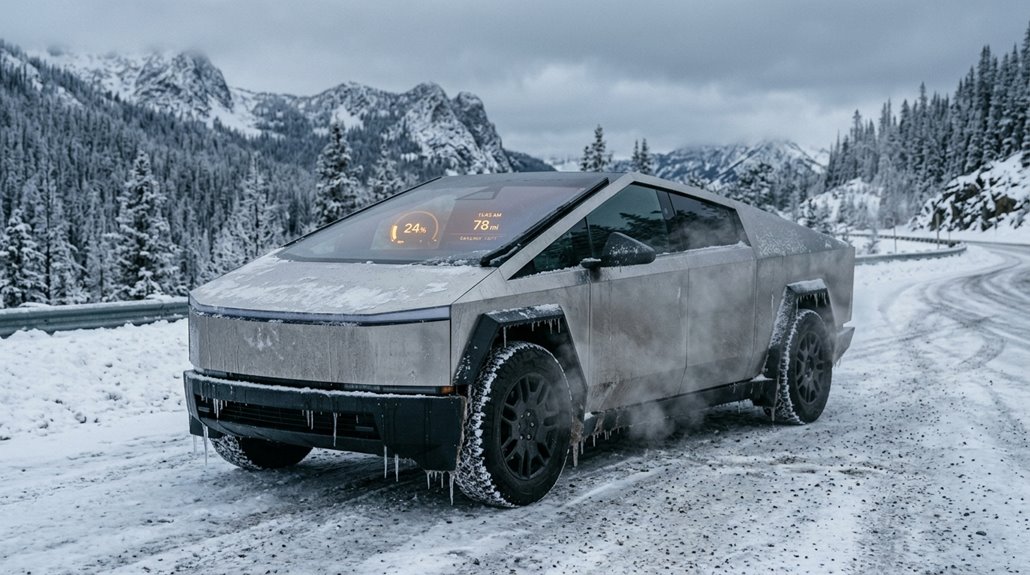
Cold weather doesn’t care how capable your Cybertruck is — lithium-ion chemistry obeys thermodynamics, not spec sheets. Expect real range losses depending on conditions:
- Mild cold (35–50°F): 10–20% range loss
- Typical winter (20–32°F): 25–35% range loss
- Deep freeze (below 10°F): 30–45% range loss, especially with heavy HVAC use
Battery warming during early driving temporarily pulls energy away from propulsion until the pack reaches operating temperature. That’s physics, not a firmware bug.
Cabin efficiency improves substantially using seat heaters instead of full climate control — the Cybertruck’s heat pump helps, but it isn’t magic. One New Jersey owner recorded 2.38 mi/kWh on a freezing 46-mile highway run, translating to roughly 285 real-world miles using a 120 kWh buffer calculation.
How the Cybertruck Handles High-Speed Highway Stability
Because the Cybertruck weighs roughly 6,600–7,000 lbs depending on configuration, you’d expect it to feel like piloting a refrigerator down a freeway — but the underfloor battery pack drops the center of gravity low enough that high-speed lane changes feel planted and predictable rather than top-heavy. That wide stance reinforces straight-line composure, keeping weight effects from overwhelming you during sudden maneuvers.
High speed stability holds surprisingly well in crosswinds compared to taller pickups, though you’ll still notice some sensitivity. The wedge profile creates real aerodynamic tradeoffs: it supports stable cruising but can’t fully escape drag penalties. Lane change behavior benefits directly from that low battery floor — physics working in your favor rather than against you. Lower ride height settings tighten that advantage further on sustained highway runs.
How Cybertruck Corrosion Resistance Compares to Aluminum Rivals
Unlike aluminum-bodied rivals that rely on oxide layers, coatings, and careful joint engineering to stay ahead of corrosion, the Cybertruck’s cold-rolled stainless steel exoskeleton brings a denser, harder surface to the fight — one that’s less likely to expose fresh metal when it picks up cosmetic damage from trail debris or road grime.
The stainless advantages are real, but circumstances matter. Three things you should know:
- Grade matters — 301-grade stainless resists corrosion less effectively than 304 or 316
- Road salt and chlorides still cause pitting over time
- Galvanic mitigation requires insulating barriers wherever stainless contacts aluminum subcomponents
You still need regular cleaning, especially in coastal or winter environments. Stainless isn’t maintenance-free — it’s just harder to beat.
How the Cybertruck Stacks Up Against the F-150 Lightning
Stainless steel that shrugs off trail scratches is an attractive edge, but corrosion resistance won’t settle the argument most buyers are actually having — Cybertruck versus F-150 Lightning.
Stainless steel turns heads on the trail. It won’t turn the tide in the Cybertruck versus Lightning debate.
On real world range, Cybertruck AWD claims 340 miles; Lightning Extended Range hits 320 EPA-verified. Charging infrastructure breaks the tie — Tesla’s Supercharger network gives Cybertruck a meaningful long-trip advantage Lightning simply can’t match natively.
Towing tradeoffs are tighter: Cybertruck pulls 11,000 lbs, Lightning caps at 10,000. Payload follows the same pattern (2,500 lbs versus 2,235 lbs).
Cabin practicality is where Lightning fights back. Familiar F-150 ergonomics, Onboard Scales, and Smart Hitch deliver proven utility. Cybertruck’s flat surfaces look durable; Lightning’s interior actually feels intuitive immediately.
Both trucks are fast. Only one feels immediately familiar.
How the Cybertruck Compares to the Rivian R1T Off-Road

When the terrain gets rough, the Cybertruck and Rivian R1T are the two most capable electric trucks you can actually buy right now — and the comparison is genuinely close. Tire choice alone shifts results dramatically between tests.
Here’s where each truck separates itself:
- Wheelbase behavior favor the R1T on tight rock sections — its shorter wheelbase improves breakover angle on stair-step obstacles.
- Traction management gives Cybertruck an edge at high-speed desert running, maintaining aggressive momentum through g-outs better than Rivian’s conservative torque cuts.
- Durability concerns emerged during hard use testing, including bent suspension links on the Cybertruck.
You’ll find the R1T feels more predictable technically, but the Cybertruck’s raw aggression makes it genuinely competitive on open, fast terrain.
Who Should Actually Buy the Tesla Cybertruck?
The Cybertruck narrows its own buyer pool the moment you lay eyes on it — and that’s actually by design. The angular stainless-steel exoskeleton guarantees image appeal before you even turn the key (metaphorically speaking). If attention makes you uncomfortable, walk away now.
The Cybertruck doesn’t chase everyone — it repels most people on purpose. That’s the whole point.
Performance buyers get genuine substance here: the dual-motor AWD delivers 600 hp, 525 lb-ft of torque, and a 3.7-second 0–60 sprint — numbers that embarrass traditional sport trucks.
You also get steer-by-wire, adjustable air suspension reaching 16 inches of ground clearance, and Powershare bidirectional charging for off-grid or emergency use.
The honest fit? Buyers who want truck utility, EV technology, and visibility — simultaneously. If you need fleet-grade anonymity or conventional aesthetics, this truck isn’t your answer.
