
Tesla’s Camp Mode holds a perfect 65°F all night—so why do so many Tesla campers still wake up sweaty, stiff, and staring at a 20% battery warning? The problem isn’t your car. It’s the nine gadgets sitting between you and a genuinely great night outdoors. Miss even one, and you’re fighting the experience instead of enjoying it. The fix starts with something most people overlook before they even recline their seat.
The Custom Tesla Mattress That Actually Fits Your Model
Sleeping in your Tesla starts with one non-negotiable: a mattress that actually fits the geometry of your specific model. Generic foam pads won’t cut it here. The Model Y accepts a 185 × 110 cm mattress comfortably, giving you enough width to avoid awkward shoulder crowding. The Model 3 Highland runs tighter at 180 × 100 cm, so custom padding becomes essential for maintaining proper sleep posture without pressure points forcing your knees into an uncomfortable bend.
Seat-fold geometry matters more than most buyers realize. Each model folds at a slightly different angle, directly influencing the mattress thickness and support density you need underneath. A custom fit eliminates the gaps between folded seats and sleeping surface edges (gaps that wake you up at 2 a.m., guaranteed). Foldable, multi-panel constructions store cleanly in the frunk or trunk, keeping your daily driving unaffected. Match your model first, then buy.
Before your trip, use cabin preconditioning through the Tesla app to bring the interior to a comfortable sleeping temperature before you even arrive at your campsite.
Window Blackout Shades Built for Tesla’s Curved Glass
Blackout shades are the second half of the Tesla camping sleep equation, and the curved glass that makes a Model Y look so clean on the road is exactly what makes generic shades useless overnight. Flat rectangles leave crescent-shaped gaps along the roofline and door frames, and those gaps destroy both blackout privacy and thermal retention.
Brands like Snap Shades and HALOBLK solve this with model-specific panels shaped to match Tesla’s actual window geometry, covering front, side, and roof glass for a near-dark interior. HALOBLK’s multi-layer construction also cuts heat and UV, which matters when you’re parked in afternoon sun before a late-night sleep. Before purchasing, always verify whether a product explicitly lists your specific model year rather than assuming shared-fit compatibility, since trim changes between years can render even well-reviewed shades incompatible with your exact vehicle.
Install the shades black-side-out for two reasons: it makes the car less conspicuous at rest stops, and it helps flatten previously rolled panels before they seat against the frame. Curved fit isn’t cosmetic—it’s functional. Havenby’s Model Y shade system takes this further with magnets and weighted edges built into the panels to create a tighter seal against the window frame and eliminate the light bleed that stretchy fabric alone can’t prevent.
Tesla camping sounds simple until you try to actually sleep in the back and realize the folded seats create uneven gaps, pressure points, and a restless night. Most owners only discover this after their first night out, when comfort matters more than anything and there’s no quick fix once you’ve already settled in. Set up a proper sleep space in your Model Y with a custom-fit camping air mattress before your next overnight trip turns into a night of shifting, sliding, and no real rest.
Rechargeable Lighting That Won’t Drain Your 12V System
Lighting up your Tesla’s cabin overnight sounds simple until you realize that anything plugged into the car’s accessory circuit is quietly nibbling at the low-voltage battery—a 12V lead-acid unit rated at 45Ah on North American Model 3s that isn’t designed to moonlight as a campsite power source.
Plug something into your Tesla overnight and you’re slowly draining a battery never meant for that job.
Parasitic draw across multiple nights compounds fast, and Tesla’s low-voltage system is sensitive enough that disconnection events sometimes require recalibration afterward.
The smarter play is standalone rechargeable lighting. USB lanterns charged from a power bank before you arrive keep the car completely out of the equation.
Motion sensor lanterns handle those midnight bathroom runs without you fumbling for a switch. Inside the cabin, clip-on reading lights, adhesive LED strips, and compact RGB ambient pucks cover every use case without touching a single vehicle circuit.
Prioritize USB-C charging, warm-white modes, and long runtime ratings over peak brightness—you need endurance, not a spotlight. To further stretch your available power on multi-night trips, preconditioning the cabin while still plugged in at home draws thermal energy from the grid rather than your battery pack. If you do ever wire cabin lighting directly, 16-gauge wire is recommended for the main run to allow headroom for adding future accessories without rewiring.
The Best Portable Power Station for Tesla Camp Mode
Tesla’s Camp Mode is impressively self-sufficient when your battery’s adequately charged, but external devices — phones, laptops, fans, small kitchen gear — create a separate demand that your 12V system and onboard outlets can only partially address.
A portable power station bridges that gap, and sizing it by watt-hours (not just output wattage) is the difference between a unit that lasts the night and one that taps out before midnight; compact 300Wh units handle light electronics, mid-range 768Wh stations cover several hours of mixed loads, and 1000Wh-class models hit the sweet spot between portability and real-world capacity.
If you’re at a powered campsite or Supercharger, fast-recharge capability — like EcoFlow’s X-Stream technology or the Jackery 2000 v2’s 2.5-hour AC top-off — means your power station recovers while your Tesla does, keeping both ready for the next leg without skipping a beat. Tesla’s Supercharger network scale spans over 45,000 chargers globally, meaning most major routes have a stop where you can simultaneously top off both your vehicle and your portable station without significant detours.
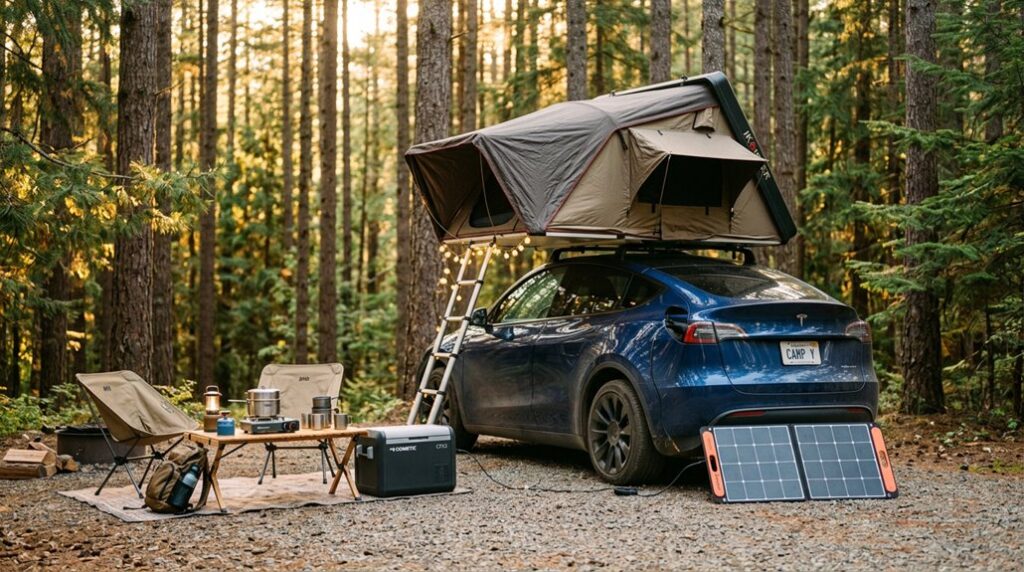
For solar-inclined campers, pairing a station with a compatible panel such as EcoFlow’s 220W option can yield up to 1.8 kWh per day under ideal conditions, effectively giving you a self-replenishing power source that runs without noise, fumes, or fuel costs.
Off-Grid Power Options
When you’re running Tesla’s Camp Mode overnight, the cabin climate system draws directly from the traction battery—and that’s a fight a portable power station simply isn’t going to win.
What a portable unit *does* handle well is everything else: lights, laptops, cameras, fans, and phone charging. Smart battery management means offloading those accessory loads onto a separate power source rather than compounding drain on your Tesla’s pack.
Units in the 1,000 Wh class cover most single-night needs, while 2,000 Wh stations (like the Jackery 2000 v2, at roughly 39 lbs) support multi-day setups without constant recharging.
Solar integration extends your off-grid window considerably—pair a compatible 200W panel, and you’re recharging during daylight instead of hunting for shore power. If you do plan a return route through populated areas, Tesla’s battery preconditioning via route guidance warms the pack before arrival so you reach a Supercharger ready to charge at peak speed rather than waiting for chemistry to catch up.
Tesla camping feels effortless until you realize how quickly food spoils, drinks warm up, and ice coolers turn into soggy messes after just a short trip off-grid. That’s usually the moment the experience shifts from relaxing to constantly planning your next store stop. Keep your Tesla camping setup fully self-sufficient with a portable dual-zone fridge freezer so you’re not cutting trips short just because your food and drinks can’t keep up.
Campsite Charging Compatibility
Choosing the right portable power station for Tesla Camp Mode starts with one honest question: what’re you actually trying to power? Phones, tablets, USB lights, and a small fan don’t demand much—overnight device charging rarely exceeds 300Wh to 500Wh realistically. The Anker C1000 (rated best all-around by Outdoor Gear Lab) hits that sweet spot without unnecessary bulk.
If you’re running portable solar panels to top off during the day, inverter efficiency becomes critical—look for units converting DC-to-AC at 90% or better to avoid wasting harvested energy. Skip anything above 2,000Wh unless you’re cooking full meals; Camp Mode already handles cabin climate. Match capacity to your actual device list, not worst-case anxiety, and you’ll carry exactly what you need. The Tesla Model Y Performance trim adds vehicle-to-load charging capability, meaning it can power external devices directly from the vehicle’s battery without needing a separate station at all.
If your setup grows to include an RV or trailer, you’ll want a unit with a 3,600W inverter at minimum to achieve true 30-amp plug compatibility and the kind of house-like power behavior those rigs demand.
Electric Cooking Gear That Fits Tesla’s Trunk Without Wasted Space
Once you’ve sorted your power situation, the next challenge is fitting an actual kitchen into a cargo area that wasn’t designed to be one.
The Model Y’s folded-rear-seat configuration gives you roughly 68 cubic feet of usable space, which sounds generous until a full-size camp stove, a loose pot set, and an impractical cooler eat through it before you’ve packed a single sleeping bag — so compact, single-burner induction cooktops (typically 1,000–1,800W) paired with nested cookware are the practical move here.
Pre-measured ingredients in resealable bags and a spigoted water container round out a food storage system that keeps your trunk organized instead of looking like a ransacked pantry. The Model Y’s heat pump cabin heating is worth factoring into your energy budget too, since it operates at up to 300% greater efficiency than resistance heating and leaves more battery capacity available for running cooking appliances at camp.
Compact Burner Options
Cooking a real meal at your campsite starts with picking the right burner — and in a Tesla, “right” means compact, low-wattage, and trunk-friendly enough to coexist with your bedding, storage bins, and power gear without turning cargo organization into a geometry problem. Tesla’s 12V outlet won’t handle a 1000W appliance, so you need burners that respect that ceiling.
- A 500W hot plate offers five heat settings and reaches 570°F — enough for eggs, soup, and pasta
- Ultra compact induction units store flat and draw predictable, efficient wattage
- Single-burner formats minimize footprint without sacrificing real cooking capability
- A collapsible windscreen improves heat retention outdoors, reducing cook time and power consumption
Tesla’s over-the-air software updates mean your vehicle’s power management and outlet behavior can change after purchase, so it’s worth confirming your current outlet capabilities before committing to a wattage ceiling.
Match your burner’s wattage to your outlet’s actual capacity before you pack anything.
Efficient Food Storage
Most of your cooking setup lives or dies by what’s keeping your food fresh — and in a Tesla, that problem has a cleaner solution than a bag of melting ice.
A compact 12V fridge fits cleanly into the Model Y cargo area and draws low enough wattage that Camp Mode handles it without sweating your battery range.
Pair that with modular canisterization — stackable, sealed containers for dry goods, spices, and snacks — and your trunk stops being a chaotic pile and starts functioning like an actual pantry.
Vacuum preservation extends perishable life markedly, which means fewer grocery stops mid-trip.
Collapsible containers compress when empty, reclaiming space immediately.
The 12V trunk outlet powers your fridge directly, keeping the whole system self-contained and genuinely road-ready.
The Model 3’s touchscreen gives you direct access to tyre pressure readings and charging settings, so you can keep tabs on vehicle health while your fridge quietly runs in the background.
The Right Adapters for Plugging In at Any Campground
Arriving at a campsite without the right connector is the EV equivalent of showing up to a road trip with an empty tank — avoidable and embarrassing. Adapter diversity matters because campgrounds don’t standardize their pedestals. You might face a NEMA 14-50 (240V, 50A) at one site and a TT-30 (120V, 30A) at the next. Outlet verification with the campground before departure eliminates guesswork entirely.
Build your kit around these four essentials:
- NEMA 14-50 adaptor — handles most RV parks running 50A service
- TT-30 adaptor — covers standard 30A campground pedestals
- Standard 120V adaptor — works for cabin wall outlets and Airbnbs
- Mobile Connector (Gen 2 or Gen 3) — the backbone connecting every adaptor to your Tesla
One critical reminder: lower your charging amperage on the vehicle screen when using TT-30 setups. Skipping that step has literally charred plugs. Tesla’s over-the-air update system can also push charging-related software changes to your vehicle overnight while parked at camp, so your settings and charge scheduling features stay current without a service visit.
Trunk Organizers That Actually Fit Tesla’s Cargo Space
Once your adapters are sorted and your Tesla’s plugged in for the night, the next problem staring you down is the cargo bay — specifically, the chaos inside it. Tesla’s Model Y trunk pockets are awkward voids that swallow loose gear whole, so purpose-built injection-molded bins designed for those left and right side pockets are worth considering first.
For the main cargo floor, universal organizers built from 1680D oxford cloth handle camping loads well. You’ll want rigid dividers that actually prevent a leaking cooler bag from contaminating your entire toolkit — cardboard-based alternatives won’t survive one damp weekend. Nonskid feet matter more in a Tesla than you’d expect; regenerative braking alone will send an unsecured organizer sliding forward repeatedly.
Look for hook-and-loop base strips as backup. Multiple compartments let you separate food, charging cables, and emergency gear cleanly — because digging through one undivided bin at midnight is nobody’s idea of fun.
Frunk Coolers and Food Storage for Remote Tesla Camping
Everything you packed for dinner lives or dies by how well you’ve solved cold storage — and the frunk is where Tesla camping setups either get serious or fall apart.
Tesla’s own Model Y cooler handles passive insulation well enough for weekend trips, but powered options (like TSportline’s DC compressor unit) push temperatures down to -8°F, which is actual freezer territory.
Here’s what separates a smart frunk setup from an expensive mistake:
- Dual zone designs split refrigerated perishables from dry pantry items, eliminating the “everything smells like cheese” problem
- Ice retention materials — specifically 1.75-inch insulation — outperform standard consumer coolers by roughly 50%
- Custom-molded fitment reduces shifting on rough terrain and wasted cubic footage
- Powered coolers connect via your 12V port, maintaining consistent temps without ice dependency
The frunk’s shaped cavity rewards purpose-built gear.
Generic coolers waste space; customized units use every inch.
How to Keep Camp Mode Running All Night Without Killing Your Battery
Camp Mode works beautifully — right up until you wake up at 3 a.m. to a dead cabin and a 18% state of charge staring back at you. That’s not a hardware failure; that’s poor planning.
Waking up to a dead cabin at 3 a.m. isn’t a hardware problem — it’s a planning one.
Start with battery buffering. Arrive at camp with 40–50% charge minimum. Camp Mode automatically kills itself around 20%, so that buffer is your actual working window. In mild weather, expect roughly 5–10% drain over eight hours. Cold nights are brutal — sub-freezing temperatures can pull up to 57% overnight.
Use temperature preconditioning before you sleep. Running the climate system to target temperature while the car’s still warm costs far less energy than maintaining it from scratch. Set a moderate cabin temp (68–70°F is realistic), disable Sentry Mode, and kill cabin overheat protection. Those background features quietly bleed your pack while you sleep.
Better yet, plug into the campground hookup. Problem solved entirely.
Frequently Asked Questions
Can I Use Camp Mode While My Tesla Is Being Serviced Remotely?
Camp Mode isn’t available during remote diagnostics or service override. Tesla’s controls can be restricted mid-session. Significantly, Camp Mode cuts off at 20% battery—so you’d lose it anyway during extended service windows.
Does Tesla’s Camp Mode Affect the Vehicle’s Warranty or Maintenance Schedule?
Camp Mode doesn’t void your warranty or alter your maintenance scheduling—it’s a built-in feature. However, its warranty impact means you’ll want to monitor your HVAC and cabin filter more closely after extended camping use.
Are There Pet-Specific Camping Accessories Designed for Tesla Interiors?
Yes, there are! Think of your Tesla’s interior as your pup’s five-star hotel—pet ramps make entry effortless, while seat protectors shield your upholstery from muddy paws and scratchy claws during every camping excursion.
Can I Legally Camp Overnight in a Tesla at Public Supercharger Stations?
It’s legally murky—you can’t assume it’s allowed. Legal considerations vary by property owner and local ordinances. Practice proper charging etiquette, avoid idle fees, and opt for campgrounds or Destination Chargers instead.
How Does Extreme Cold Weather Affect Camp Mode Battery Consumption Rates?
Extreme cold turns your battery drain into a bottomless pit—you’ll burn through 15–25%+ overnight. Your Tesla’s thermal management works overtime battling freezing temps, so always start with a full charge.