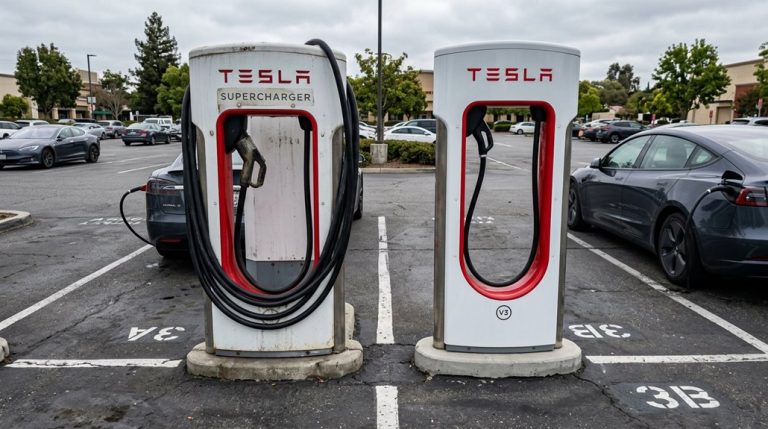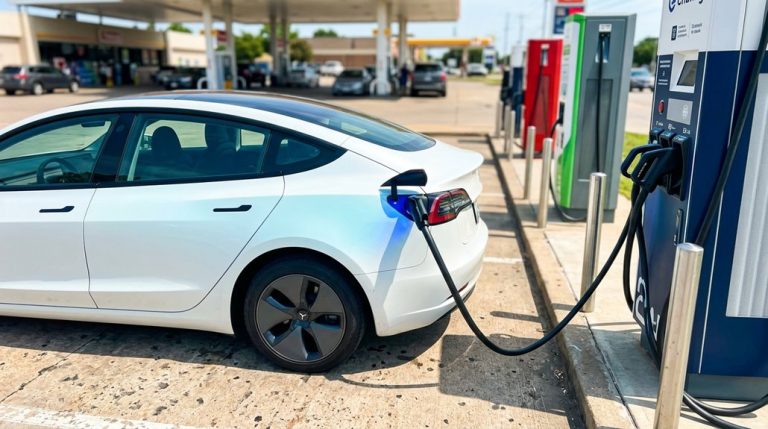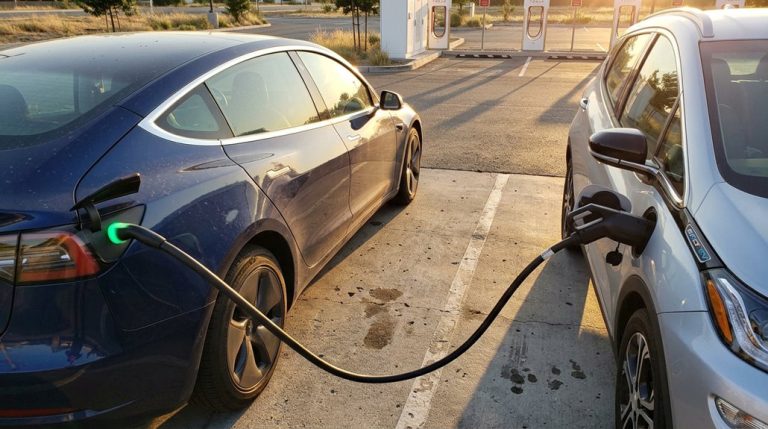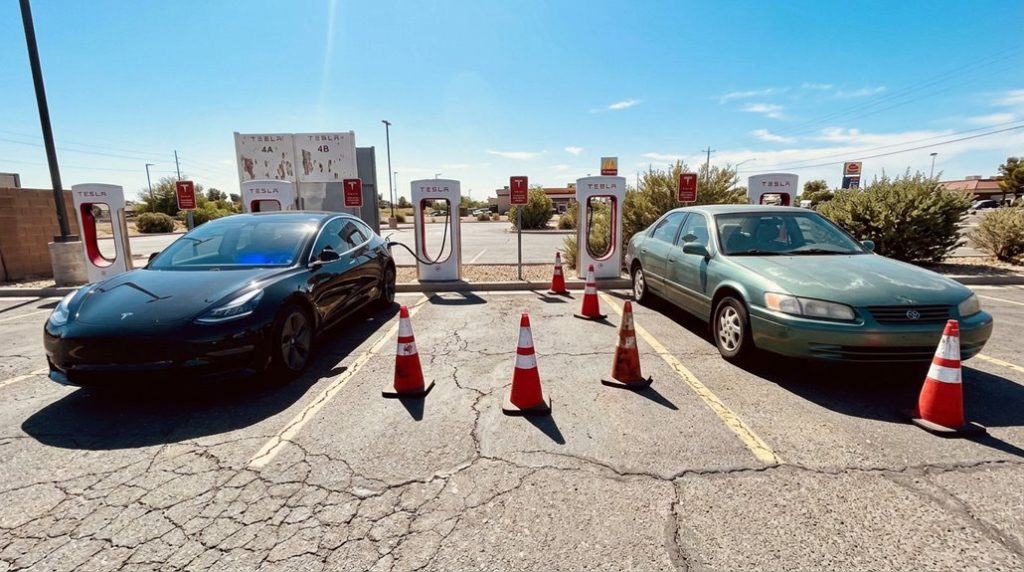

You spot an open stall marked “Tesla Vehicle Only” — but you’re driving a Chevy Bolt. How bad could it really be? As it turns out, that small sign might carry far more legal weight than you’d ever expect. The answer depends on exactly where you’re parked, what the sign says, and who owns that pavement. Ignore the wrong one, and the consequences could genuinely catch you off guard.
What a Tesla Vehicle Only Sign Actually Means
When you pull into a charging lot and spot a “Tesla Vehicle Only” sign, the first thing worth grasping is that the sign is doing two separate jobs at once. It’s identifying a designated charging stall, and it’s carrying Tesla’s branding on that identification. Those two functions aren’t the same thing, and mixing them up creates real confusion.
The “vehicle charging only” portion is the operationally important part. That language tells you the stall exists for active charging, not casual parking. Charging etiquette starts here — the space isn’t a regular spot you hold while you grab coffee without plugging in.
The branding implications are trickier. Tesla’s logo appearing prominently doesn’t automatically mean non-Tesla vehicles are excluded. Some signs are fundamentally “EV charging only” with Tesla’s name attached as a property-management label. Others genuinely restrict access. Situation — specifically the hardware and site configuration — determines which interpretation applies. Tesla’s Supercharger network, which launched in 2012 and has grown to over 75,000 connectors worldwide, was built as a proprietary system from the start, which is part of why site-level access restrictions vary so widely depending on equipment generation and ownership agreements.
Adapters exist that allow non-Tesla vehicles to plug into Tesla destination chargers, though they may not function if the charger has been configured to enforce Tesla-only charging.
Is Parking in a Tesla-Only Stall Illegal?
Many states and cities prohibit occupying a designated charging stall unless your vehicle is actively connected. That’s not just parking etiquette—it’s often a codified traffic or civil infraction carrying real fines.
Enforcement ambiguity enters when signs are vague or local statutes don’t explicitly address brand-specific restrictions. Non-Tesla EVs can now access 17,800+ Tesla Superchargers using a dedicated NACS adapter, which further complicates how brand-specific signage is interpreted and enforced.
Private property adds another layer. Property owners can authorize towing under their own posted rules, creating genuine property liability even where public law stays silent. Some Tesla Supercharger locations, such as Swindon, even enforce parking fees for vehicles that remain beyond 15 minutes after charging ends.
Does Location Affect Whether Tesla Stall Signs Are Enforced?
Whether a Tesla-only stall sign actually carries enforcement weight depends heavily on where that stall sits—and that’s where the legal image gets genuinely complicated.
Public streets and municipal lots tend to operate under explicit local ordinances, giving parking enforcement officers real authority to act. Private property follows different rules entirely.
Sign placement matters more than most drivers realize. California, for example, requires signs posted immediately adjacent to each stall—minimum 17 by 22 inches with lettering at least one inch high. Without that compliant posting, enforcement is described as virtually unenforceable, regardless of Tesla branding.
Enforcement variability also follows jurisdiction lines. States like California, Massachusetts, Arizona, and Florida have specific EV parking statutes, but those laws activate through properly posted signage, not through a Tesla logo alone. A stall at a private shopping center carries different legal weight than one in a county-owned garage. Tesla Superchargers are designed primarily for highway trips and fast top-ups, with V3 Superchargers delivering approximately 250 kW and capable of adding around 200 miles of range in just 15 minutes.
Location genuinely changes everything here. If a block is believed to be an error, drivers seeking clarification on signage disputes can reach out to customerservice@smartsign.com for support.
Tesla Vehicle Charging Only vs. General Parking: What the Difference Costs You
Parking in a Tesla charging stall without actually charging isn’t just bad etiquette—it’s a use conflict with real financial consequences. “Charging only” means your vehicle must be physically connected and actively pulling energy. “General parking” requires explicit signage permitting it—without that, you’re occupying reserved infrastructure, not just a convenient spot.
The financial exposure compounds quickly. A parking citation alone can reach $100 in California. Add towing and impound fees, and you’re well past the original penalty before retrieving your keys. Enforcement trends show both municipal officers and private property managers actively monitoring these stalls, particularly at high-traffic Supercharger locations.
Tesla’s idle fee structure adds another layer: after charging completes, per-minute charges accrue until you disconnect and move (fees are waived during the first five minutes). Busy stations accelerate those costs fast. With over 130,000 chargers across the United States, demand at individual stalls remains high enough that turnover directly affects other drivers waiting to charge. Respecting charging etiquette isn’t optional—it’s financially rational, legally safer, and keeps stall turnover working for everyone. Under California Vehicle Code 22511, parking facilities are expressly authorized to designate stalls specifically for the parking and charging of electric vehicles, giving enforcement actions at these stalls a firm legal foundation.
How ADA Markings Affect Who Can Park in Tesla Stalls
When a Tesla Supercharger stall carries the International Symbol of Accessibility (the blue wheelchair icon), ADA Standards take precedence over any Tesla-only designation, meaning the space operates under federal accessibility rules first. That dual-purpose reality matters because an accessible EV charging space isn’t automatically restricted to placard or plate holders unless state or local law explicitly says so—federal guidance actually discourages slapping ISA signs on EV charging stalls unless a local code requires it.
If you’re parking a non-Tesla EV (or even a combustion vehicle in an emergency) and the stall shows ADA markings without strong reserve language, you’re steering a layered ruleset where the 60-inch-mounted accessibility sign legally outranks the Tesla branding on the pavement. Similarly, just as the Magnuson-Moss Warranty Act prevents a manufacturer from voiding an entire vehicle warranty over a single modification, a single brand designation on pavement cannot override a federally mandated accessibility standard that governs the entire space.
ADA Markings Change Rules
If a Tesla stall has an ADA wheelchair symbol painted on the pavement but no above-ground sign, it doesn’t automatically become a legally reserved accessible space under federal rules. Federal ADA standards require proper signage—mounted at least 60 inches high—before a space carries enforceable reservation status. Pavement symbols alone don’t replace that requirement.
Here’s what this means practically: ADA colors on the ground affect accessibility designation, not your charging eligibility, unless a separate sign explicitly restricts use. Marking enforcement typically depends on your local jurisdiction, which may layer stricter requirements—blue striping, “no parking” text, or curb markings—on top of the federal baseline. Tesla’s direct sales model means there is no dealership intermediary to clarify stall use policies, so access rules and restrictions come directly from Tesla itself.
Dual-Purpose Stall Considerations
Some Tesla Supercharger stalls pull double duty—they’re simultaneously accessible EV charging spaces, meaning ADA rules and Tesla’s vehicle-only designation both apply to the same piece of pavement. That dual purpose design complicates your decision before you even plug in.
Here’s what actually matters: if a stall displays the International Symbol of Accessibility alongside Tesla’s branding, ADA priority can override the vehicle-only restriction for qualifying drivers. Access aisle markings (those diagonal stripes beside the space) signal that the layout serves mobility needs, not just charging convenience. Parking in an unmarked access aisle carries real legal exposure regardless of your vehicle type.
Sites with fewer than four total EV spaces sometimes skip restrictive signage entirely, effectively opening the stall to any compliant vehicle—Tesla or otherwise. Tesla’s Supercharger hardware is paired with a software-first vehicle platform that uses context-aware displays to surface charging session data, energy usage, and stall status directly on the touchscreen the moment you plug in.
Accessibility Signs Override Tesla
ADA markings don’t just add background to a Tesla stall—they rewrite the rules entirely. When you see the international accessibility symbol alongside “EV CHARGING ONLY” pavement text, accessible priority takes over. Tesla’s branding preference becomes legally irrelevant. That stall now operates under ADA jurisdiction, not Supercharger etiquette.
Signage precedence works in a strict hierarchy here. The accessibility designation controls who can legally occupy the stall, regardless of what Tesla’s signage suggests. You can’t justify parking there simply because your Model 3 fits the Tesla-only label. A valid disability placard plus active charging—both conditions typically apply. Without meeting the stall’s posted accessibility requirements, you’re potentially violating federal compliance rules, not just ignoring a preference marker. Tesla’s Autopark feature availability depends on the vehicle tier you own, meaning some drivers relying on assisted parking functions may face additional limitations when accessible stalls are improperly occupied by non-qualifying vehicles. Read every sign before assuming Tesla branding settles the question.
When Can You Actually Get Towed or Ticketed?
Not every “Tesla Vehicle Only” sign carries the same legal weight, and whether you actually face a tow truck or a citation depends almost entirely on what the sign explicitly states and which jurisdiction’s rules govern that lot.
Signs that include specific language like “towing enforced,” “private property,” or “charging only” give property managers clear legal footing to remove your vehicle—especially in states where posted signage alone authorizes towing without additional notice.
Your risk jumps markedly when the sign is unambiguous, well-lit, and consistent with local municipal code, because ambiguity is your only real buffer against enforcement, and that’s a thin one to count on.
Tesla’s Supercharger V4 network is expanding globally, which means more stalls are being installed in higher-traffic locations where property managers and lot operators are increasingly motivated to enforce posted restrictions.
Signs That Authorize Towing
Whether you’re driving a Tesla Model 3 or a beat-up ICE sedan, the rules that actually authorize towing or ticketing at an EV stall hinge on one thing: a properly posted sign.
Towing signage must typically include the towing company’s contact number and explicit tow-away language — without that, removing your vehicle lacks legal standing.
A charger unit alone doesn’t constitute a posted restriction.
Enforcement officers need the sign’s text to match the actual rule being enforced.
Private contracts between property owners and towing companies don’t automatically transfer authority to remove your car unless compliant signage backs them up.
The same principle applies at Tesla Supercharger stalls, part of a 17,800+ station network that non-Tesla EVs like the Chevy Equinox EV can now access using a NACS adapter.
Jurisdiction-Specific Enforcement Rules
Enforcement authority over EV stalls doesn’t operate on a single national standard — it fragments across state statutes, county ordinances, and city codes, which means the consequences you actually face depend almost entirely on where you parked.
Local variances create wildly different enforcement thresholds from one jurisdiction to the next. Florida, for example, mandates that charger signage display maximum applicable fines — without that posted language, a citation becomes legally questionable.
Public spaces generally require enabling ordinances before a sign carries ticketing authority, while private lots skip that formality entirely and lean on towing instead.
Pavement markings alone rarely hold up in court. Your actual risk isn’t just about the sign you ignored — it’s about the specific legal infrastructure (or absence of it) surrounding that particular stall.
A Simple Rule for Every Tesla Stall Sign Type
Reading the exact sign text is your first move, because the wording controls everything else. “Tesla vehicle only” restricts the stall to Tesla vehicles specifically, while “EV only” opens it to any electric vehicle under local signage rules. “While charging only” is the strictest version — it means you’re only authorized to occupy that stall during an active charge session, not just because you pulled up in a qualifying vehicle.
Signage clarity matters more than you’d think, because Tesla etiquette and general charging etiquette both depend on comprehension of what the sign actually enforces versus what it implies. A Tesla logo on a sign doesn’t automatically mean brand-exclusive access — it often marks charging priority rather than ownership restriction.
For practical Tesla placement decisions, follow this pattern: Tesla-only means Tesla-restricted, EV-only means EV-restricted, and while-charging-only means treat that stall like a time-sensitive utility space. Don’t overthink it — just read what’s posted.
Frequently Asked Questions
Can a Tesla Owner Report Your Car for Parking in Their Stall?
Yes, a Tesla owner can report you for parking in their stall. You’ll risk owner notifications to property management, potential towing, and ticket disputes if you’re occupying a charging-only space without actively charging.
Do Tesla Supercharger Stalls EVer Convert to Public EV Charging Use?
Yes, some Tesla Supercharger stalls do convert to public EV charging use. You’ll find select locations support converter compatibility across different connector standards, letting non-Tesla drivers access them through the Tesla app with approved converters.
Are Tesla-Only Stall Signs Consistent Across All Tesla Supercharger Locations?
Imagine pulling into a California Supercharger marked “EV Priority – 60 Min,” while a Texas site still reads “Tesla Only.” No, they’re not consistent—sign variation reflects regional policies and individual property manager agreements you’ll encounter site-to-site.
Can a Non-Tesla EV Legally Use a Tesla Vehicle Only Stall?
You don’t have clear access rights to a Tesla Vehicle Only stall. Charging etiquette and site rules generally restrict non-Tesla EVs, and ignoring the sign can result in towing or ticketing.
Who Is Responsible if Your Car Gets Damaged While Parked Illegally?
You’re responsible for parking liability when you park illegally — 350 dollars minimum fines apply in Arizona. Your insurance responsibility won’t cover damages from your own illegal parking decision.