
Everyone says V4 Superchargers are just “faster V3s.” They’re wrong. The real differences start deep inside an 800–1,000V silicon-carbide power cabinet that fundamentally rewires how current flows through each stall. That longer cable isn’t a convenience feature—it’s a statement about who these chargers were actually built for. Per-stall ratings, non-Tesla compatibility, and those headline speed numbers all trace back to specific hardware decisions most drivers never think about.
What Actually Separates V3 and V4 Superchargers?
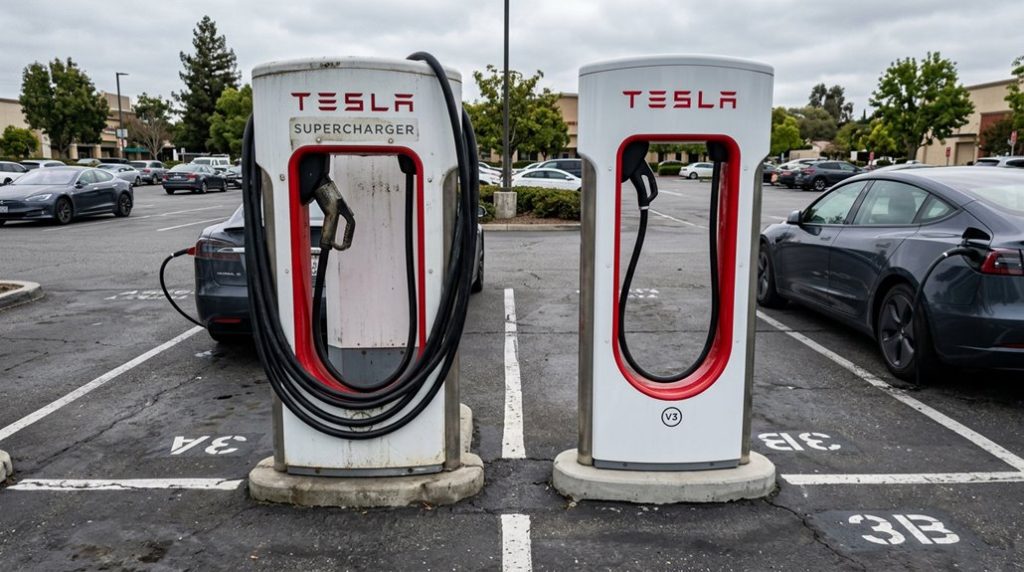
Standing next to a V3 and a V4 Supercharger, you’d notice the difference almost immediately — the V4’s post is visibly taller, its cable noticeably longer (roughly 3 meters, about 400 mm more than V3), and depending on the site, there may even be a payment terminal built into the hardware.
The V4 stands taller, reaches farther, and even takes your payment — you’ll notice before you plug in.
That extra cable length isn’t cosmetic. It’s a deliberate cable ergonomics improvement, giving you real reach for ports on either side of your vehicle or awkward parking angles.
Electrically, V4 sustains higher continuous amperage — some field reports cite up to 615 A — where V3 hits thermal limits sooner despite its liquid-cooled cable.
V3 peaks at 250 kW, but sustaining that’s a different story.
The site design changed too. V4 uses redesigned cabinets (1 MW to 1.2 MW configurations) built for site scalability, replacing V3’s shared DC bus arrangement with something more modular and future-ready. The V4 cabinet’s tray-based modular design houses roughly 16 internal power conversion modules handling AC-to-DC rectification, allowing individual modules to be serviced without taking the entire cabinet offline.
The stall appearance between versions is very different visually, making the physical hardware itself often the most reliable way to distinguish one from the other.
Does V4 Deliver More Peak Power Than V3?
When you pull up to a V4 Supercharger expecting a big jump in peak power, the reality is more subtle—most current Tesla models (Model 3, Model Y, Model S, Model X) are capped at roughly 250 kW, the same ceiling V3 already hits, so the dispenser version doesn’t automatically change your peak number.
V4 hardware does support up to 500 kW for 800V system designs and has pushed Cybertruck sessions to around 325 kW, but those gains only materialize when your vehicle can actually negotiate the higher power. The Cybertruck’s high-voltage battery can split into two 350 V sections, allowing it to charge in parallel and take better advantage of higher-powered dispensers. The Cybertruck’s structural battery pack also doubles as a load-bearing floor element, integrating the high-voltage system directly into the vehicle’s architecture in a way that supports its more advanced charging capabilities.
In practice, real-world V4 sessions for standard Tesla passenger models show initial peaks of roughly 237–248 kW—respectable, but not the leap the hardware specs might suggest.
Rated Power Comparison
Jumping straight to the numbers: V4 Superchargers are rated at up to 325 kW per stall, while V3 hardware tops out at 250 kW—a 75 kW gap that works out to roughly 30% more peak output on paper. That’s the rated ceiling, not a guarantee you’ll actually see those figures sustained throughout a session.
Charger efficiency and peak variability both matter here. Your vehicle’s onboard acceptance limit determines what you actually pull, regardless of what the stall can theoretically push. Most 400 V Tesla models—Model 3, Model Y, Model S, Model X—accept around 250 kW anyway. So for those vehicles, the V4’s higher rating doesn’t change your real-world experience much. Where V4’s extra headroom genuinely counts is with 800 V configuration, like Cybertruck. V4 cabinets are also built to a 1.2 MW total capacity, using 800 V architecture and silicon carbide power electronics to support that ceiling.
V3 Companies, such as the engineering and environmental firm, welcomed 17 new V3 shareholders in 2026, reflecting how the V3 designation carries meaning well beyond EV charging infrastructure.
Real-World Output Variation
On paper, V4 wins the peak power contest—but what actually reaches your battery is a different story. V3 stalls share power infrastructure, so delivered output routinely falls below the advertised ceiling. V4 posts use independent power hardware per stall, which tightens that gap considerably.
The numbers bear this out. NCA vehicles arriving around 20–25% SoC recorded 237–248 kW on V4 versus 205–218 kW on V3 under matched conditions—roughly a 12–15% real-world advantage. Running battery diagnostics before a session matters here because thermal state and battery age directly influence acceptance rates.
For charging economics, the math is sobering: average session power stays well below peak, so that impressive V4 ceiling rarely defines your actual charge time. State of charge does. In a direct 10%–80% comparison on a Cybertruck, the V3.5 versus V3 total session time differed by only about one minute, thirty-five minutes versus thirty-six minutes respectively. Tesla’s built-in trip planner further improves charging efficiency by preconditioning the battery before arrival at a Supercharger, helping vehicles reach higher acceptance rates regardless of which hardware generation they connect to.
Does V4 Charge Faster Than V3 in Real-World Tests?
Real-world tests confirm that V4 is generally faster than V3, but the margin depends heavily on how far into the session you’re and what vehicle you’re driving. Early charging looks nearly identical between both versions. A Cybertruck test showed 0% to 21% took about 6 minutes 34 seconds on V3 versus 6 minutes 28 seconds on V4—practically the same.
The gap widens as your battery heating cycle progresses and cells accept higher sustained current. That same Cybertruck reached 80% in 45 minutes 33 seconds on V3 but only 39 minutes 46 seconds on V4—almost a 6-minute difference. V4 was already pulling over 300 kW while V3 held around 256 kW.
Your vehicle’s acceptance rate matters too. A Model 3 LFP test showed V4 running 11.6% faster overall. Good charging etiquette—arriving with low state of charge—helps you capture V4’s strongest output window. Tesla’s crowdsourced vehicle data also helps optimize proactive speed and charge behavior across the fleet over time.
How V4’s Longer Cable Changes Everyday Charging
Speed isn’t the only upgrade V4 brings to the table. The cable redesign quietly solves a real frustration most EV drivers recognize immediately.
V3 cables measure roughly 6 to 6.5 feet. V4 cables extend to approximately 2.9 to 3.0 meters — enough longer reach to matter when your charge port isn’t where Tesla originally expected it.
V3 cables top out around 6.5 feet. V4 stretches to nearly 10 — and that gap is the whole point.
Here’s what that extra length actually changes for you:
- Parking flexibility improves markedly, reducing the need to hunt for a stall matching your port side
- Larger vehicles with awkward port placement benefit most from the redesigned cable
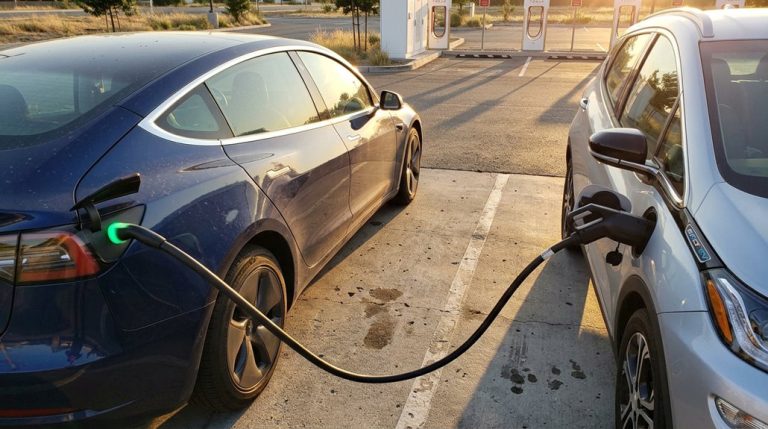
- Non-Tesla EVs with front-fender or rear-quarter ports can charge without contorting your parking approach
- One-handed cable handling remains manageable despite the added length
- Tesla has already modified over 1,500 sites alongside this rollout
When selecting charging accessories like wall connectors or adapters, always verify model-year fitment compatibility before purchasing, as charging ergonomics vary across Tesla models and trim generations.
This is a usability upgrade, not a speed upgrade — but don’t underestimate it.
Which EVs Benefit Most From V4 Superchargers?
Not every EV squeezes the same value out of a V4 stall, and the gap comes down to two factors: what voltage your car runs and whether it can actually accept power beyond 250 kW.
If you’re driving a non-Tesla with NACS access—Ford and Rivian are the clearest current examples—V4 opens up one of the densest fast-charging networks on the road, which matters most when you’re covering serious highway miles.
The real speed winners, though, are 800V platforms like the Cybertruck (roughly 30% faster on V4), Lucid Air, Lucid Gravity, Hyundai Ioniq 5, and Kia EV6, since V4 cabinets support system designs up to 1,000V and can deliver up to 500 kW—power that a standard 400V Model 3 simply can’t use. Tesla’s proprietary Supercharger network was built to address range anxiety across continents, making V4’s expanded capacity a natural evolution of that original infrastructure goal.
Non-Tesla EV Compatibility
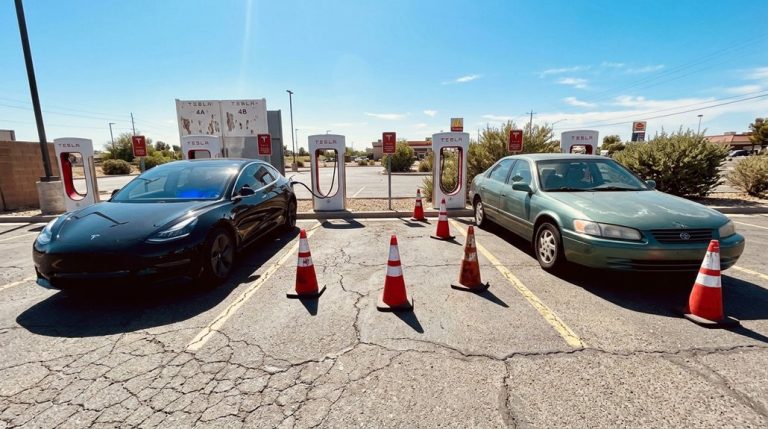
If you drive a non-Tesla EV, the version of Supercharger you’re pulling into matters more than you might expect. V3 and V4 stalls are the ones actually open to you — V1 and V2 hardware isn’t compatible.
These compatible brands include:
- Chevrolet Bolt EV, Equinox EV, and Silverado EV
- Ford Mustang Mach-E and F-150 Lightning
- Rivian R1T and R1S
- Hyundai Ioniq 5, Ioniq 6, and Kona Electric
- Kia EV6, EV9, and Niro EV
Nissan Leaf and Mitsubishi Outlander PHEV owners are out — CHAdeMO simply doesn’t work here. Good adapter maintenance keeps your CCS1 connection reliable, and following proper charging etiquette (don’t linger after full) keeps access fair for everyone sharing these stalls. For Equinox EV drivers specifically, a NACS adapter unlocks access to over 17,800 Tesla Supercharger locations across the country.
High-Capacity Battery Vehicles
Most EVs can plug into a V4 Supercharger, but not all of them walk away with the same benefit. Your vehicle’s battery design determines how much speed you actually gain.
The Tesla Cybertruck, Lucid Air, Lucid Gravity, Hyundai Ioniq 5, Kia EV6, and Audi e-tron GT all run 800V-plus systems, meaning they can absorb V4’s higher output without throttling down. The Cybertruck charges roughly 30% faster on upgraded V4 hardware.
Meanwhile, the Model 3 and Model Y top out near 250 kW regardless, since their 400V packs set the ceiling. Better thermal management in high-voltage designs also supports battery longevity by reducing heat stress during rapid charging sessions.
The Tesla Model X, with its 100-kWh battery pack, benefits meaningfully from V3 and V4 infrastructure, typically completing a 10%–80% road-trip stop in roughly 25–30 minutes on a V3 Supercharger when the battery is properly preconditioned.
The charger isn’t the bottleneck—your pack voltage is.
Should You Go Out of Your Way to Find a V4 Supercharger?
Whether a V4 detour is actually worth your time comes down to one honest question: can your specific vehicle use what a V4 stall actually offers?
The real V4 detour question isn’t about hype — it’s whether your vehicle can actually use what V4 delivers.
For most route planning decisions, the answer shapes everything. Consider these practical filters:
- Your Tesla caps near 250 kW? A V3 stall already delivers that ceiling.
- Your charge port placement makes V3 cables awkward? V4’s longer cable reach solves that directly.
- You’re driving a non-Tesla EV? V4 hardware was genuinely designed with your access in mind.
- You’re on a tight road trip where minutes matter? V4 is worth evaluating.
- The nearby V3 site is open and reliable? The detour rarely pays off.
Charging etiquette also factors in — seeking V4 stalls unnecessarily pulls you from more convenient stops without real gain. Match your vehicle’s actual capability to the stall’s offering, and your decision becomes straightforward. Stopping at 80% state of charge on long trips is also recommended to improve battery longevity, which means even a capable V4 stop doesn’t need to run to full before you’re back on the road.
Frequently Asked Questions
Can V4 Superchargers Charge Two Vehicles at Full Speed Simultaneously?
Usually, you won’t get full speed for both vehicles simultaneously. V4 Superchargers use smart power distribution to support dual charging, but each car’s speed depends on site capacity and how many stalls you’re actively using.
Do V4 Superchargers Require a Different Charging Cable or Adapter?
You don’t need a different charging cable since V4 Superchargers have a built-in cable. However, you might need an adaptor if your EV’s port doesn’t match the station’s different connector for cable compatibility.
Are V4 Superchargers More Reliable and Less Prone to Technical Issues?
You can’t assume V4’s more reliable yet—it’s still expanding. V3’s field history gives it a proven edge. V4 benefits from software updates and ongoing reliability testing, but early rollouts show some mechanical issues still occur.
How Do I Identify Whether a Supercharger Stall Is V3 or V4?
You can identify a V4 stall by its longer cable, distinct connector shape, and modern post design. Check the Tesla app’s site label or look for a payment terminal, as the serial number can also confirm the version.
Will Tesla Eventually Phase Out V3 Superchargers in Favor of V4?
Like an old bridge still carrying traffic, V3 won’t vanish soon. You’ll see gradual retirement without a strict future timeline, as fleet incentives and V3’s solid performance make immediate phase-out unnecessary.