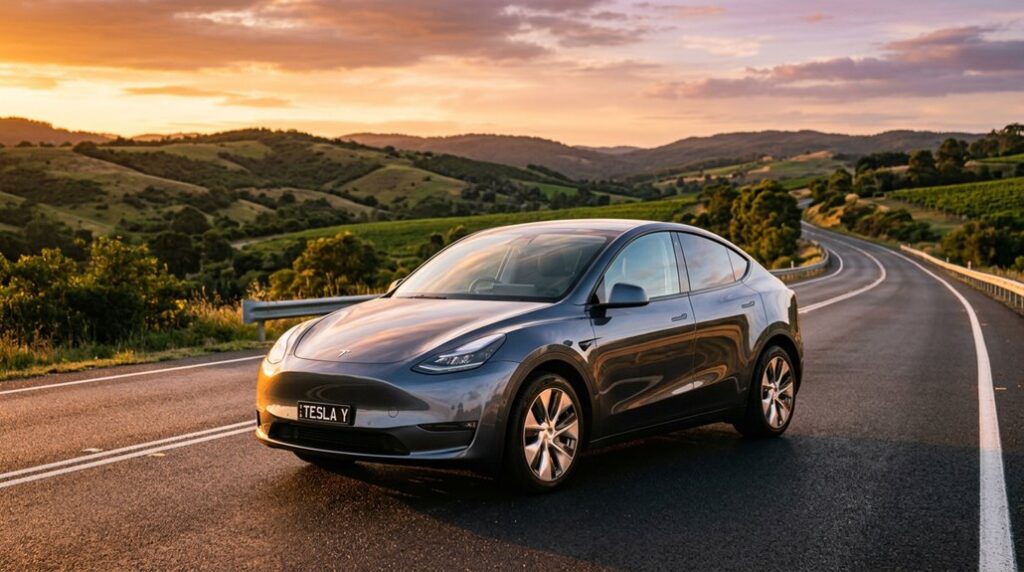

The Tesla Model Y isn’t just winning the EV race — it’s outselling nearly every gas-powered vehicle on the planet. That’s not a typo. A fully electric crossover is beating decades-old combustion engines at their own game, and most people have no idea why. Range, practicality, and performance converge here in ways rivals haven’t figured out yet. But the real story isn’t the headline numbers — it’s what hides beneath the price tag that separates smart buyers from everyone else.
Tesla Model Y: Where It Fits in Tesla’s Lineup
Tesla builds five consumer vehicles, and the Model Y sits squarely in the middle of that stack — not the entry-level option, not the flagship, but the one that outsells everything else combined.
Tesla’s Model Y isn’t the cheapest or the flashiest — it’s simply the one everyone buys.
It shares its architecture with the Model 3 (platform collaboration at its most profitable), giving you sedan-derived bones wrapped in a taller, more practical crossover body.
Above it sits the Model X, a larger SUV commanding a markedly higher price.
Below it sits the Model 3, lower-slung and less cargo-friendly. The Model 3 even offers a dedicated tyre pressure display accessible directly from the internal screen, a small but telling example of how much tech is packed into Tesla’s entry-level platform.
The Model Y functions as Tesla’s mainstream anchor — the vehicle that actually moved 1.2 million units in 2023 alone, making it the world’s best-selling car that year, full stop.
If Tesla’s lineup were a band, the Model Y is the one selling out arenas. It was the first Tesla vehicle to use a heat pump for cabin heating, delivering up to 300% greater efficiency than traditional electric resistance heating.
Tesla Model Y Trim Levels Explained
Every trim in the 2025 Model Y lineup does a specific job, and knowing which one matches your actual driving needs will save you from either overpaying or under-buying.
Three distinct configurations exist, each with different battery options, performance targets, and warranty coverage terms.
- Long Range RWD — 337 miles, single motor, 19-inch wheels
- Long Range AWD — 311 miles, dual motors, optional third-row seating
- Performance — 277 miles, 3.5-second 0-60, lowered suspension, 21-inch wheels
You’re effectively trading range for speed as you climb the lineup.
The AWD trim is the balanced middle ground (traction plus reasonable range), while Performance buyers accept shorter range for quicker acceleration.
Neither choice is wrong — just different priorities. The Premium AWD is the only trim in the lineup that offers a seven-seat layout with third-row occasional-use seats.
Long Range vs. Performance: Which Trim Wins?
Both trims use dual motors and all-wheel drive, so the decision isn’t really about capability — it’s about where you want the trade-offs to land.
Long Range hits 0–60 mph in roughly 4.6–4.8 seconds and delivers 310–327 miles of EPA-rated range. Performance drops that to 3.3–3.7 seconds but sacrifices around 10–15% in range due to its 21-inch wheels, stickier tires, and aggressive motor tuning — classic range tradeoffs.
The track upgrades (lowered suspension, upgraded brakes, rear spoiler) sharpen cornering but stiffen the daily ride noticeably.
Long Range tops out around 135 mph; Performance reaches 155 mph. If you’re chasing road-trip efficiency and comfort, Long Range wins. If acceleration and handling matter more, Performance earns its premium. Performance tires also wear faster and cost more to replace, making total cost of ownership a key factor when choosing between the two trims.
Tesla Model Y Pricing Breakdown by Trim and Configuration
Pricing the 2026 Model Y breaks down cleanly once you grasp how Tesla structures its lineup — three core trims, two drivetrain options on the lower end, and one top-tier configuration that doesn’t bother offering a rear-wheel-drive variant.
Here’s the destination-included breakdown:
- Standard RWD: $41,380
- Standard AWD: $43,380
- Premium RWD: $46,380
- Performance AWD: $58,880
Before chasing trim incentives or running lease comparisons, appreciate what each jump actually buys you.
Standard-to-Premium adds $5,000 for upgraded comfort and tech equipment. Premium AWD costs $4,000 more than Premium RWD — basically paying for the second motor.
Performance sits $8,500 above Premium AWD, which reflects genuine hardware differences, not badge inflation. The Performance variant also includes an upgraded suspension, widened track, and unique 21-inch wheels that distinguish it beyond raw power output alone.
Source-to-source pricing variations (Edmunds lists lower figures) typically reflect different fee treatments rather than actual cost discrepancies.
Federal Tax Credits and Incentives for Model Y Buyers
Federal tax credits can meaningfully reduce your Model Y’s out-of-pocket cost — but only if you qualify, and the rules here aren’t simple. The federal clean vehicle credit reaches up to $7,500, but eligibility timelines matter enormously — legislative changes in 2025 sunset the credit after September 30, 2025. Since 2024, the transferable credit lets you apply savings directly at purchase rather than waiting on your tax return. IRS classification (sedan versus SUV) affects your applicable MSRP cap, so trim and seating configuration genuinely change your eligibility. The IRS reclassified Model Y from sedan to SUV, retroactively extending credit eligibility to purchases made on or after January 1, 2023. Leasing impacts the math differently — embedded incentives can appear in lease pricing even when purchase credits aren’t available. State stacking is real: state and utility programs can layer on top of federal benefits, occasionally doubling your effective savings.
What the Tesla Model Y Costs to Own Over Five Years
Owning a new 2025 Model Y Long Range runs roughly $59,982 over five years according to Edmunds, with depreciation eating the largest single share—somewhere between $20,000 and $30,000 depending on market conditions.
Charging costs stay surprisingly manageable at $3,000–$4,000 over five years (based on $0.16/kWh blended and 28 kWh per 100 miles), which is typically 60%–70% cheaper than equivalent gasoline spending, assuming you’ve got home charging access.
Maintenance and repairs add only $2,000–$3,000 for a new Model Y over that same period, though a used example bumps that figure to $3,000–$4,000 as wear items like tires, cabin filters, and occasional suspension components start demanding attention. Insurance and fees stack on another $8,000–$11,000 over five years for a new Model Y, a range that shifts significantly based on your state, driving profile, and whether you shop insurance annually.
Purchase Price Breakdown
- Taxes and fees add $1,981–$2,289 in year one alone
- Financing costs run $2,885–$3,346 annually depending on trim
- Dealer negotiation bargaining power is limited since Tesla uses fixed pricing
- Warranty transfer applies when buying used, potentially reducing your risk exposure
Recharged projects 2026 out-the-door pricing near $50,000, assuming 10% down on a 72-month loan at 6.5% APR.
That monthly commitment compounds fast.
The cash price looks manageable until taxes, registration, and financing stack on top—then the real number reveals itself. Over five years, the average Tesla Model Y depreciates by over $30,000, making the true cost of ownership far steeper than the sticker price suggests.
Charging Versus Fuel Savings
When you strip away the sticker price anxiety and focus on what the Model Y actually costs to *run*, the math shifts considerably in its favor. Home charging at $0.15–$0.17/kWh puts your energy cost around 4.2–5.1 cents per mile. A comparable 30 mpg gas SUV costs roughly 11.7 cents per mile at $3.50/gallon — nearly triple.
Cover 12,000 miles annually, and you’re spending roughly $504 on electricity versus $1,404 on gasoline. Public charging raises that figure meaningfully, but a blended 80/20 home-to-public split still keeps costs competitive. Over five years, that gap compounds into $4,000–$4,500 in fuel savings (assuming average U.S. electricity rates and typical driving patterns). The pump loses this comparison decisively.
A full recharge of the Model Y’s 79‑kWh battery pack costs just $13.43 at the national average electricity rate of $0.17/kWh, making it one of the more tangible reminders of how far a dollar stretches when you leave the gas station behind entirely.
Maintenance And Repair Costs
The absence of an engine, transmission, and exhaust system doesn’t just simplify the Model Y mechanically — it directly compresses what you’ll spend keeping one on the road. Tesla estimates annual costs between $316–$643, and most owners land closer to $600 yearly across five years.
Four costs dominate that budget:
- Tire replacement — $900–$1,600 per set every 20,000–40,000 miles
- Wheel alignment — $150–$250 per service (skipping this accelerates tire wear)
- Brake fluid checks — minimal early on, thanks to regenerative braking
- 12-volt battery replacement — $150–$400 when warranty claims don’t apply
Monitor battery health consistently. Your ten-year repair probability sits at roughly 18.79% — meaningfully better than comparable luxury SUVs.
Insuring the Model Y carries its own weight in the ownership budget — average annual insurance runs approximately $4,621, adding up to roughly $23,105 over five years of ownership.
Tesla Model Y Range: Real-World Miles You Can Expect
The EPA’s official range numbers look great on paper, but you’ll rarely see them in the real world—highway driving at 70 mph typically delivers about 70–85% of the rated figure, which means a Long Range AWD on 19-inch wheels nets roughly 225–255 miles per charge rather than its 310–330-mile EPA combined rating.
Wheel size compounds the gap further, with the jump from 19-inch to 21-inch wheels shaving another 15–20 miles off a typical leg (bigger wheels aren’t free, physics-wise). AWD versus RWD matters less than most expect at steady highway speeds, but cold temperatures, headwinds, and elevation changes can each independently push real-world range well below even these adjusted estimates. In winter conditions below 25°F, cold weather range can drop to just 60–70% of EPA, making it wise to plan shorter legs of around 120–170 miles between charging stops.
EPA vs. Real-World Range
EPA range is a baseline number, not a promise — and for the Model Y, that distinction matters more than most buyers expect. EPA realism means treating that figure as a comparison tool, not a guarantee. Highway degradation hits hardest, where sustained 75 mph driving pulls real-world range 20–30% below the rated number.
Here’s what the numbers actually show:
- Long Range models typically deliver 280–310 miles in mild mixed driving
- Highway-focused testing drops Long Range results to roughly 220 miles at 75 mph
- Newer variants increasingly meet or exceed EPA estimates (327–337 miles recorded)
- Energy consumption on newer Standard models measured 22.8 kWh per 100 miles
Speed, temperature, and wheel size drive every outcome. Cold weather below freezing routinely causes a 20–30% drop in usable range, making winter trip planning a critical consideration for Model Y owners.
AWD vs. RWD Miles
Choosing between RWD and AWD isn’t just a traction decision — it’s a range decision too, and the numbers are specific enough to matter on a long drive.
RWD typically delivers 210–240 real-world highway miles at 75 mph, while Long Range AWD on 19-inch wheels lands around 200–230 miles under identical conditions. That’s roughly a 15–30 mile gap — modest until you’re hunting for a Supercharger.
Tire optimization effects compound this further: Performance AWD’s 21-inch wheels drop estimates to 175–205 miles at highway speeds.
Cold weather efficiency losses hit both drivetrains, but AWD’s dual-motor draw amplifies consumption faster.
For road trips requiring traction without severe range penalties, Long Range AWD on 19-inch wheels remains the most practical configuration. In everyday mixed driving during mild weather, a healthy Long Range AWD can realistically return 260-plus miles — closer to its EPA rating than pure highway runs suggest.
Factors Affecting Range
Range estimates on any EV are moving targets, and the Model Y is no exception — what Tesla’s EPA number actually means at the charger depends heavily on how fast you’re driving, how cold it is, what wheels you’re running, how degraded your pack is, and whether you’ve got four passengers plus a roof box.
Four variables dominate real-world results:
- Speed: Pushing from 65 to 75 mph cuts range 10–20% via aerodynamics impact alone.
- Temperature effects: Severe cold (0–20°F) with heavy heater use strips 30–40% of usable range.
- Wheels: Swapping 19-inch aeros for 21-inch tires costs roughly 20–30 miles per charge.
- Battery state: Degradation and cold-soaking both shrink available kilowatt-hours before you even leave the driveway.
The updated Juniper generation brings meaningful aerodynamic and thermal management improvements that help deliver more consistent real-world range figures across conditions.
How Fast Is the Tesla Model Y?
The Model Y’s acceleration range runs from “competent commuter” to “genuinely quick” depending on which trim you’re sitting in. Electric launch means instant torque—no revving, no waiting. Software tweaks also shape how aggressively each trim unleashes that torque off the line.
| Trim | Factory Estimate | Tested Result |
|---|---|---|
| Standard RWD | 6.6–6.8 sec | 6.5–6.9 sec |
| Long Range RWD | 5.1–5.6 sec | ~5.3 sec |
| Long Range AWD | 4.4–4.8 sec | 4.1–4.4 sec |
| Performance | 3.3–3.5 sec | 3.3–3.5 sec |
Real-world testing frequently beats Tesla’s published numbers, particularly for AWD variants. Car and Driver recorded a Long Range AWD at 3.9 seconds—quicker than Tesla claimed. The Long Range AWD also delivers strong midrange pull from 60–80 mph, making highway merging and passing feel effortless well beyond the initial launch.
Tesla Model Y Top Speed by Trim
Top speed on a Model Y depends heavily on which trim you’re driving—and, less obviously, which wheels are bolted to it. Different wheel packages and regional software limits can shift published figures noticeably.
Here’s how the 2026 U.S. lineup breaks down:
- Standard RWD – 125 mph, rear-wheel drive only
- Long Range RWD – 125 mph, with 19- or 20-inch wheel options
- Long Range AWD – 125 mph in U.S. specs, though some regional sources list 217 km/h (134.8 mph)
- Performance – 155 mph, the only trim where the ceiling genuinely opens up
The Performance trim earns that number through stronger motors and sport-tuned hardware—not just a loosened software limit. Every other trim sits at the same published cap, which tells you something. The Model Y Performance also pairs its higher top speed with upgraded suspension and tuning, reinforcing that the differences between trims go well beyond straight-line figures alone.
Tesla Model Y AWD vs. RWD: The Honest Difference
Choosing between AWD and RWD on a Model Y isn’t complicated once you strip away the marketing framing—it’s a tradeoff between efficiency and traction, and the numbers make that concrete.
RWD pulls 15.7 kWh/100 km versus AWD Performance’s 18.0 kWh/100 km (roughly 15% worse), and that gap translates directly into range—357 miles versus 327 miles for Long Range variants.
Those efficiency tradeoffs exist because AWD’s second motor introduces parasitic drivetrain losses that RWD simply avoids.
AWD earns its premium through wheelspin mitigation in rain and snow, plus stronger acceleration (4.6 s versus 5.4 s 0–60 mph).
If you drive mostly dry pavement and prioritize range, RWD wins cleanly.
If weather security or quicker response matters more, AWD justifies the penalty. The Performance variant also supports a 250 kW maximum charge rate, making it the third fastest charging EV in the country and significantly quicker to replenish than the RWD’s 170 kW ceiling.
Tesla Model Y Supercharging Speed and Real-World Times
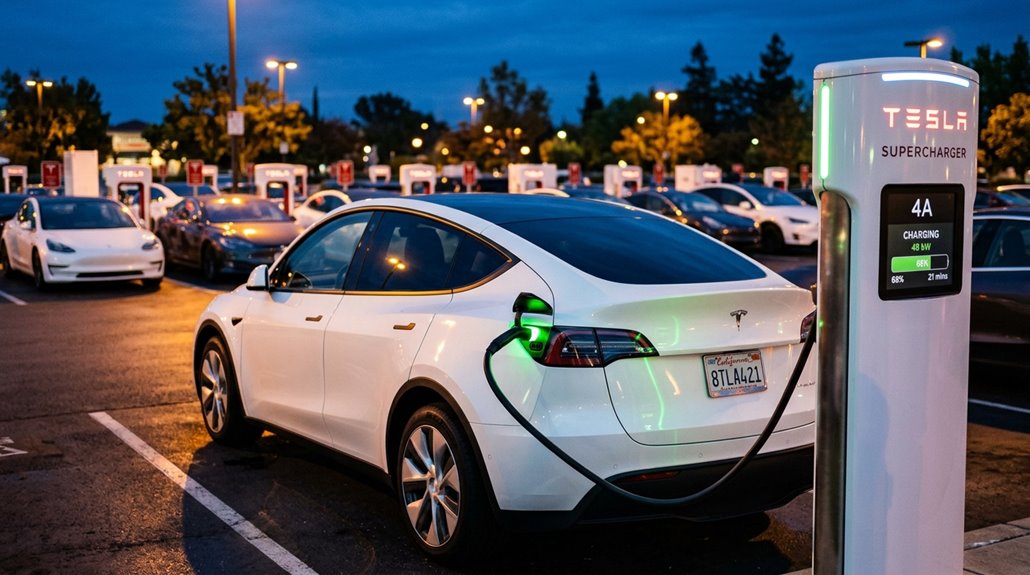
Supercharging a Model Y isn’t complicated, but the numbers vary enough by trim that you need to know which version you’re driving before assuming anything.
Here’s what actually matters:
- RWD models cap around 170 kW DC maximum
- Long Range and Performance hit up to 250 kW on V3/V4 Superchargers
- 10–80% takes roughly 25–31 minutes under favorable conditions
- Battery preconditioning meaningfully improves peak speeds by warming the pack beforehand
The charging curve tapers sharply above 80%, so stopping there makes practical sense on road trips.
Proper supercharger etiquette—arriving with a route-guided preconditioned pack and not idling post-charge—keeps things efficient for everyone.
A 2025 test confirmed over 56 kWh added in a single 31-minute session. Tesla V4 Superchargers now charge at peak rates around 230–235 kW on the 2025 Model Y Long Range, falling short of the 250 kW target but still delivering exceptional real-world performance.
Home Charging Options for the Tesla Model Y
Your simplest home-charging option is a standard 120V wall outlet, which delivers roughly 3 miles of range per hour (about 1.3 kW) — fine for light daily commutes, but painfully slow if you’re regularly driving 50-plus miles.
Upgrading to a 240V Level 2 setup changes the math considerably, with Tesla’s Wall Connector pushing up to 44 miles of range per hour (11.5 kW) and even the portable Mobile Connector on a 240V circuit adding up to 30 miles per hour (7.6 kW).
Installation costs vary depending on your electrical panel’s existing capacity, your parking situation (garage, driveway, or shared lot), and whether you hire a licensed electrician or a Tesla Certified Installer to run the dedicated circuit. Most owners find that home charging supplies 80–90% of their typical driving miles, removing the need for frequent detours to public charging stations.
Standard Wall Outlet
At the bottom of the home charging hierarchy sits the standard 120V wall outlet—the same three-prong receptacle already scattered throughout your house. Tesla’s Mobile Connector pulls roughly 1.3 kW here, translating to about 3 miles of range per hour.
Good charging etiquette matters:
- Verify the outlet is properly grounded before plugging in regularly
- Inspect contacts for wear—degraded outlets generate heat and hurt outlet longevity
- Skip extension cords entirely; undersized wiring creates real fire risk
- Match your continuous load to the circuit’s rated capacity
Overnight sessions realistically recover modest range—fine for short daily commutes, inadequate for anything beyond 30–40 miles.
Think of Level 1 as your backup option, not your primary strategy, unless your driving habits are genuinely light. For better long-term results, keeping your daily charge limit at 80% through the Tesla app reduces battery wear and extends overall pack lifespan.
Home Charging Equipment
Home-charging equipment for the Model Y breaks down into three hardware options: the Tesla Wall Connector, the Universal Wall Connector, and the Mobile Connector—each targeting a different combination of speed, flexibility, and installation commitment.
The Tesla Wall Connector and Universal Wall Connector both deliver up to 11.5 kW (roughly 44 miles of range per hour) on a properly sized 240V circuit. Circuit upgrades may be necessary depending on your panel’s available amperage.
The Mobile Connector handles either 120V or 240V, reaching about 30 miles per hour on the latter.
Good EV etiquette means matching equipment to your actual daily mileage rather than over-engineering the setup. If you’re sharing your property with non-Tesla EVs, the Universal Wall Connector’s J1772 compatibility makes it the pragmatic choice.
To avoid unnecessary battery wear, it is best practice to keep your regular charge limit at or below 80% state of charge.
Installation Cost Considerations
Before you buy a Tesla Wall Connector, realize that the hardware itself (currently around $400) is often the smallest line item on the invoice. Installation is where budgets actually move.
Four factors drive your total cost:
- Panel distance — longer conduit runs mean higher labor bills
- Panel capacity — older systems often need upgrades, pushing costs to $3,000–$3,500+
- Permits — required in most jurisdictions, non-negotiable
- Outdoor charging — weatherproof conduit and enclosures add materials expense
A straightforward garage install typically runs $1,200–$2,000. Complex scenarios easily exceed $3,500.
Smart load management software (built into the Wall Connector) helps enhance draw without tripping breakers — useful if your panel’s already stretched thin. Factor that into your electrical assessment before signing any contractor quote. Keep in mind that a 60 amp circuit breaker is recommended to support the Wall Connector’s maximum 48 A continuous output.
Tesla Model Y Cargo Space: Exact Measurements and Comparisons
Cargo space is one of the first things people actually measure before buying a crossover, and the Model Y holds up well under that scrutiny.
The standard 5-seat configuration gives you roughly 29.0–30.2 cu ft behind the second row, expanding to about 70.8–72.1 cu ft with the rear seats folded flat. Tesla’s own U.S. manual lists 74.8 cu ft maximum total volume with just driver and front passenger occupying space. Those are solid cargo measurements for this vehicle class.
Third row tradeoffs are real, though — the 7-seat layout drops usable rear space to just 13.1–14.8 cu ft behind that third row.
The 6-seat Model Y L recovers impressively, reaching approximately 85.6 cu ft maximum.
Always reference Tesla’s manual directly, since regional figures vary slightly. The frunk adds 4.1 cu ft of additional storage, useful for keeping delicate or messy items separate from the main cargo area.
Frunk Size and What Actually Fits Inside
The rear cargo area gets most of the attention, but the Model Y also gives you a front trunk — the “frunk” — that adds a legitimate 4.1 cu ft (116 L) of storage ahead of the front axle. It measures roughly 37.6 in wide but only 8.8 in deep, so shape matters more than volume here.
The Model Y frunk adds 4.1 cu ft of storage — just know that 8.8 inches of depth shapes everything.
What actually fits well:
- Two carry-on roller bags laid flat
- Grocery bags, particularly cold items benefiting from cabin separation
- Dirty gear — hiking boots, wet towels, beach equipment
- Small bags, chargers, and travel accessories needing frunk organization
Max load sits around 110 lbs (50 kg). For cleaning tips, the smooth liner wipes down easily — genuinely useful after muddy excursions. Depth remains the main constraint. According to a JD Power 2025 survey, 72% of Tesla owners use their frunk at least weekly, reflecting how naturally it fits into everyday routines.
Tesla Model Y Towing Capacity and Hitch Options
The Model Y can tow up to 3,500 lb (1,588 kg) when equipped with Tesla’s factory tow package, which bundles a high-strength steel tow bar, a Class II 2-inch receiver, a 7-pin trailer connector, and the tow mode software suite into a single OEM solution.
Your hitch hardware tucks behind a rear bumper access panel (keeping the back end clean), and Tesla rates that 3,500 lb ceiling across all wheel configurations, though the maximum tongue weight caps at roughly 350 lb.
Pull anything substantial, however, and you’ll need to plan your charging stops carefully — real-world towing slashes range by 50–60%, dropping a 310-mile EPA estimate down to roughly 229 miles under MotorTrend’s road-trip testing conditions. Unlike the Model 3, the Model Y supports trailer brakes, making it a more versatile option for towing small campers and modest boats.
Maximum Towing Capacity
Key thresholds to keep straight:
- 3,500 lbs — maximum trailer weight with factory tow package
- 350 lbs — approximate maximum tongue weight limit
- 750 kg (1,650 lbs) — threshold requiring an independent trailer braking system
- 50–60% range reduction — typical highway towing penalty, where regenerative braking impacts also diminish noticeably
Tongue weight deserves attention because exceeding it stresses the rear suspension and hitch assembly regardless of total trailer weight. The factory tow package includes a receiver hitch, high-strength support structure, and 7-pin wiring harness.
Available Hitch Options
Knowing your towing ceiling is only half the equation — you also need a hitch receiver rated to handle it. Tesla’s OEM tow package delivers a high-strength steel 2″ receiver, a 7-pin trailer cable, and tow mode software integration, supporting up to 160 lbs of vertical accessory load. Installation happens at a Tesla Service Center.
For aftermarket compatibility, the EcoHitch X7409 fits 2020–2025 Model Y with a bolt-on design (no drilling, no bumper modifications) and a 3,500 lb towing rating. Hidden hitches, like those from Stealth Hitches, preserve the vehicle’s clean aesthetic by concealing the receiver entirely when not in use — useful if you’re hauling a bike rack rather than a trailer. Aftermarket installs typically cost less but exclude Tesla’s tow mode software. Unlike the Tesla factory tow package, installing the EcoHitch does not trigger automatic Trailer Mode restrictions on the vehicle.
Towing Impact On Range
Towing almost always costs you range — and with the Model Y, that cost runs steep. Real-world testing confirms losses between 50–60%, which demands serious charging strategies before any trip.
Here’s what’s driving that drain:
- Aerodynamic effects account for as much range loss as trailer weight itself
- A MotorTrend test recorded only 229 miles versus the 310-mile EPA estimate — an 81-mile deficit
- Heavier, taller trailers amplify both drag and energy consumption simultaneously
- Towing near the 3,500 lb ceiling shrinks practical range dramatically versus lighter loads
You’re not just hauling weight — you’re punching a larger hole through the air. Keep trailers low-profile, loads under 3,000 lb when possible, and plan charging stops aggressively. During real-world towing tests, the Model Y consumed 3.1 miles of estimated range for every actual mile driven.
7-Seat Configuration: What You’re Actually Getting
If you’re shopping the Model Y and eyeing the seven-seat option, here’s the honest breakdown: Tesla adds a third row by folding two extra seats into the existing cargo floor, bringing total capacity to seven without stretching the vehicle’s footprint by a single inch. Third row usability is genuinely limited—it’s compact, access requires folding the second row forward, and adults won’t last long back there.
| Feature | Detail |
|---|---|
| Added cost | ~$2,500 package price |
| Third-row charging | USB-C ports included |
| Cargo impact | Reduced with all seats upright |
| Safety coverage | Side airbags extend to third row |
Occasional seating economics make sense for families hauling kids short distances, not daily adult passengers. Third-row seats also include tether anchor points, making compatible car seat installation possible for younger passengers placed back there.
Third-Row Legroom: Who Can Realistically Sit Back There?
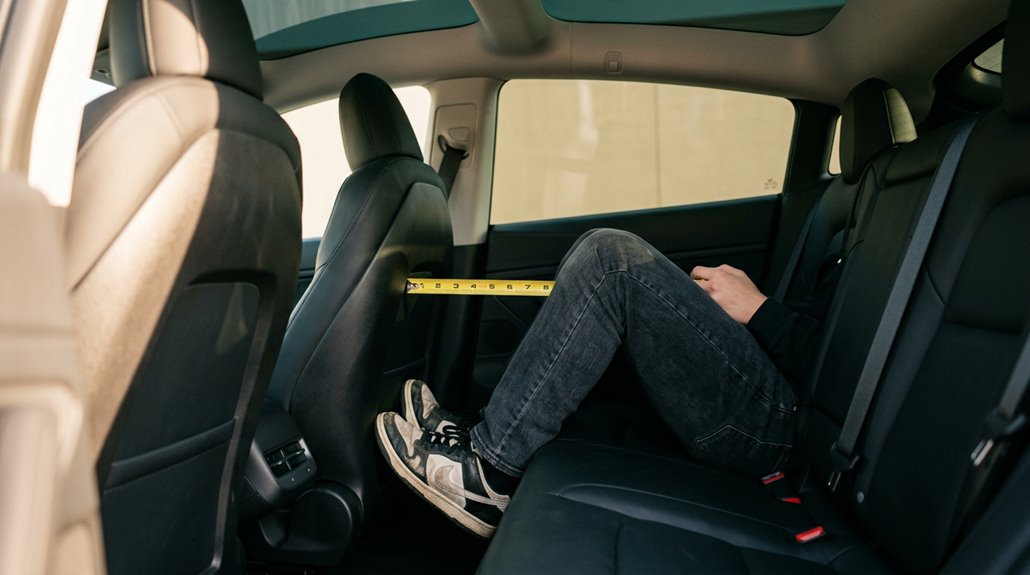
The honest answer is that the 7-seat Model Y‘s third row works best for children and pre-teens, since its 26.5 inches of legroom and 34.6 inches of headroom leave most adults negotiating with their own knees. Smaller adults can tolerate it for 30–60 minutes before the geometry wins, but anyone expecting to stretch out will quickly find that maximizing third-row legroom means collapsing the second row so aggressively that you’ve effectively traded one problem for another.
The Model Y L bumps those figures to 31.0 inches and 38.1 inches respectively, which meaningfully widens the passenger pool without completely solving the fundamental constraint.
The third row does include cup holders and USB-C ports, so younger passengers at least have somewhere to plug in and stow a drink during the short trips this row is realistically best suited for.
Third-Row Space Reality
Tesla officially lists the Model Y’s third-row legroom at 26.5 inches — which, to put it bluntly, is less space than most adults take for granted in a waiting room chair.
You’re looking at a 15.1-inch drop from the second row’s 41.6 inches. Third-row ergonomics simply don’t favor adults.
Here’s what the numbers actually mean for occupant entry and daily use:
- Headroom: 34.6 inches — head contact with the rear window is likely above 5’6″
- Shoulder room: 41.0 inches — noticeably narrower than the second row’s 54.0 inches
- Utility tradeoffs: Cargo behind the third row shrinks to roughly 9.9–12.8 cu ft
- Child-friendly seating: Short-trip use for smaller passengers remains the realistic application
Practically speaking, trips in the third row are best kept to about an hour, as the cramped dimensions leave occupants with no ability to shift weight or change position once seated.
Ideal Passenger Size
With 26.5 inches of legroom and 34.6 inches of headroom, the third row draws a fairly hard line on who can actually use it without suffering. Children fit well here—specifically larger kids and pre-teens who’ve outgrown car seats but haven’t hit a growth spurt yet.
Adults face a different story. A 5-foot-6 adult can technically squeeze in, but Cars.com confirms the experience involves genuine adult discomfort. Push toward 6 feet, and you’re negotiating second-row positions just to survive the ride. At 6-foot-1, it simply doesn’t work. The third row rewards passenger count over individual comfort—useful for short hauls, genuinely punishing for anything longer.
Comfort Versus Compromise
Squeezing a full-grown adult into the Model Y’s third row isn’t impossible—it’s just a negotiation you’ll lose past a certain height. The 34.6 inches of headroom and 26.5 inches of legroom define hard limits quickly.
Here’s how comfort breaks down realistically:
- Under 5’6″ — manageable, still cramped but functional
- 5’6″ to 5’10” — short haul trips only; expect contact with the rear window
- Over 6’0″ — genuinely uncomfortable regardless of seat positioning
- Kids — kid friendly seating at its best; minimal complaints
The second row must slide forward to create usable third-row space, which punishes your middle passengers. Think of this configuration as occasional-use capacity, not a genuine seven-passenger solution.
Tesla Model Y Interior Layout and Cabin Design
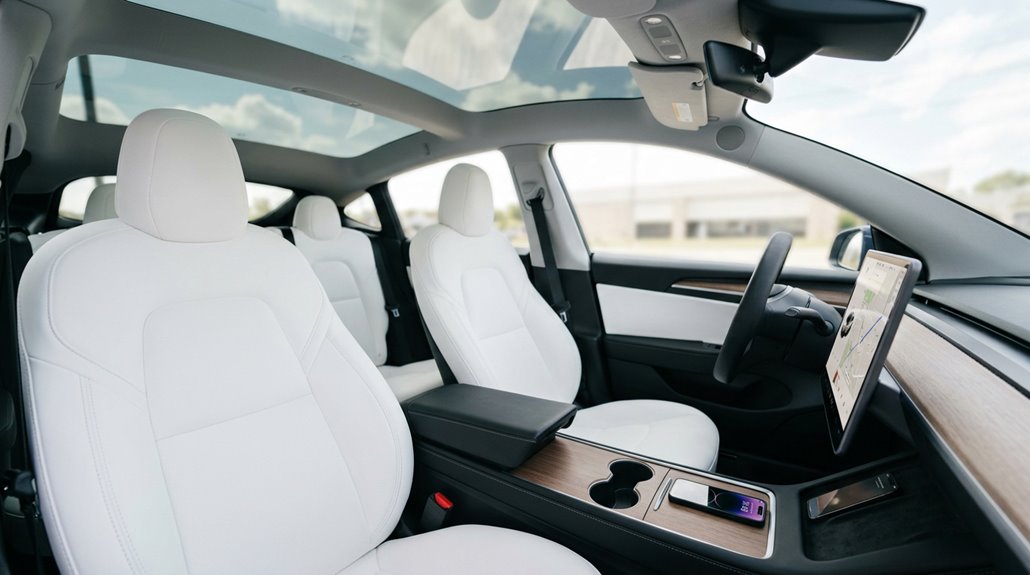
When you open the Model Y’s door for the first time, the cabin hits you with an almost jarring absence of clutter — no traditional buttons, no knobs, no instrument cluster staring back at you. That’s the minimalist cabin philosophy executed completely.
Step inside and everything you expected to find simply isn’t there — just clean, deliberate silence where buttons used to be.
A single indicator stalk sits to one side of the steering wheel; everything else routes through the central touchscreen.
Material craftsmanship shows up in the aluminum accents on door trims, the steering wheel, and the instrument panel, while soft-wrapped components run from headliner to floor with added sound damping underneath. Ambient lighting wraps the beltline in multicolor glow, auto-adjusting brightness to reduce windshield reflections at night.
Storage solutions include 854 litres of boot space (2,138 litres folded flat), plus multi-level center console compartments and fast wireless phone charging.
The Model Y’s interior sees constant foot traffic, from daily commutes to weekend trips, and without proper protection, dirt, spills, and moisture can quickly settle into the carpet and become difficult to fully clean over time. Custom-Fit All-Weather Floor Mats for Tesla Model Y create a protective layer across the entire cabin floor, helping contain mess at the source so the interior stays cleaner and easier to maintain through everyday use.
The 15.4-Inch Touchscreen: What It Controls
That minimalist cabin you just stepped into doesn’t run on willpower — it runs on a 15.4-inch touchscreen mounted at the center of the dash, and that single panel absorbs almost every function a traditional car spreads across dozens of physical controls.
This hardware interface replaces physical buttons for climate, lighting, wipers, and drive mode selection. Here’s what it manages:
- Climate and display — cabin temperature, brightness slider, night modes (Dark/Light/Auto), and Reduce Blue Light
- Vehicle settings — Controls panel overlays the map for quick access
- Accessibility settings — language changes, scroll wheel customization, voice commands
- Driving functions — Park, Reverse, Neutral, Drive selection digitally
Long-press the feedback icon to report issues directly to Tesla. Straightforward, once you stop looking for buttons that aren’t there.
Rear-Seat Screen Features and Entertainment Options
If the 15.4-inch front display handles the driver’s world, the optional rear touchscreen — an 8-inch panel mounted on the back of the center console — hands second-row passengers their own slice of control.
The rear 8-inch touchscreen gives second-row passengers their own dedicated slice of control.
Rear entertainment options include Netflix, YouTube, Disney+, and gaming with paired Bluetooth controllers. That’s genuine passenger privacy; rear occupants adjust seat heating, vent direction, and fan speed without bothering the driver.
Some implementations even surface route guidance data, weather, and energy consumption. Tesla’s software lets you lock rear display access through vehicle settings, so parental oversight isn’t an afterthought.
Content availability varies by region due to licensing restrictions, and streaming depends on active connectivity. Range impact under normal use is minimal — a reasonable trade-off for genuinely autonomous second-row comfort.
Front Seat Comfort, Ventilation, and Adjustability
If you’re spending serious time behind the wheel, the Model Y’s front seat setup rewards attention — ventilated seats (available on select trims and regions) use perforated urethane surfaces and integrated fans to draw air through the cushion and seatback, cutting perceived seat temperature noticeably on drives exceeding 60 minutes in ambient heat above 25–28°C.
Powered adjustability covers the expected range — fore/aft, height, backrest angle, and lumbar support (4–5 stages on the driver’s side) — while Performance trim buyers get an additional powered thigh extension slider that non-Performance owners simply don’t have access to.
Updated VIN batches introduced firmer foam formulations that improve long-term postural support, though owners accustomed to softer seat cushions may need a break-in period before the ergonomic gains become obvious.
Ventilated Front Seat Cooling
Ventilated front seats finally made it into the Model Y lineup with Tesla’s “New Model Y” refresh, and the distinction between factory ventilation and aftermarket retrofits matters more than most buyers realize.
Factory seats pair ventilation with updated glass coatings that reflect 7× more solar energy, reducing the cabin heat load before cooling even starts. Aftermarket ventilated retrofit kits work differently:
- Dual fans install into the backrest and lower cushion
- Perforated eco-leather replaces original seat covers
- Suction airflow pulls heat away from your back and seat
- Independent fan-speed controls adjust each front seat separately
Suction airflow outperforms simple blowers by actively drawing hot air through perforations. Cooling works best once cabin temperature drops moderately—don’t expect instant relief in a heat-soaked Arizona parking lot.
Powered Seat Adjustability
Once you’ve sorted out whether your Model Y has ventilated seats, the next logical question is how much you can actually move those seats around—and the answer depends heavily on trim, region, and whether your car has physical seat buttons or relies on the touchscreen.
Physical buttons handle fore/aft movement, height, cushion tilt, backrest recline, and driver lumbar—all separately. Performance trims add a powered cushion extension. No side buttons? The touchscreen covers both front seats instead.
Quiet adjustments happen through incremental presses; held inputs trigger automatic fold functions on rear switches. Seat memory ties saved positions to driver profiles, so multiple drivers aren’t constantly re-adjusting.
Always check for obstructions before moving any powered seat—Tesla specifically warns against assuming clearance exists automatically.
Ergonomic Comfort Improvements
Tesla’s updated Model Y front seats represent one of the more tangible quality-of-life improvements across refresh cycles—particularly if you’re coming from a pre-Juniper build.
The seat ergonomics have shifted meaningfully, with firmer support holding your torso through corners and powered thigh extensions reducing leg fatigue on longer drives.
Key comfort upgrades worth noting:
- Improved side support minimizes lateral movement during spirited cornering
- Powered thigh support extensions improve blood circulation on extended trips
- Climate ventilation (available on higher-spec trims) actively pulls heat away from contact points
- Combined heated and ventilated seating covers year-round comfort needs efficiently
The Juniper refresh also delivers a quieter cabin overall—which indirectly makes every seat feel better without changing a single stitch.
What’s New for Rear Passengers in the Updated Model Y
The updated Model Y’s rear cabin isn’t just a cosmetic refresh — it’s a focused redesign that addresses the specific complaints long-time owners have logged since the original launch.
Rear comfort gets a measurable uplift: the left and right seat cushions extend 30 mm deeper (the middle seat stays unchanged, oddly).
You also get serious charging upgrades back there — dual USB outlets pushing up to 65W combined, enough to run two laptops simultaneously.
The 8-inch rear touchscreen handles climate, streaming, and gaming, with dual Bluetooth connectivity baked in.
Fold those rear seats and the front seats automatically shift forward — but only when unoccupied.
Occupied seats trigger an on-screen prompt first.
Small details, real improvements.
How Quiet Is the Tesla Model Y Inside?
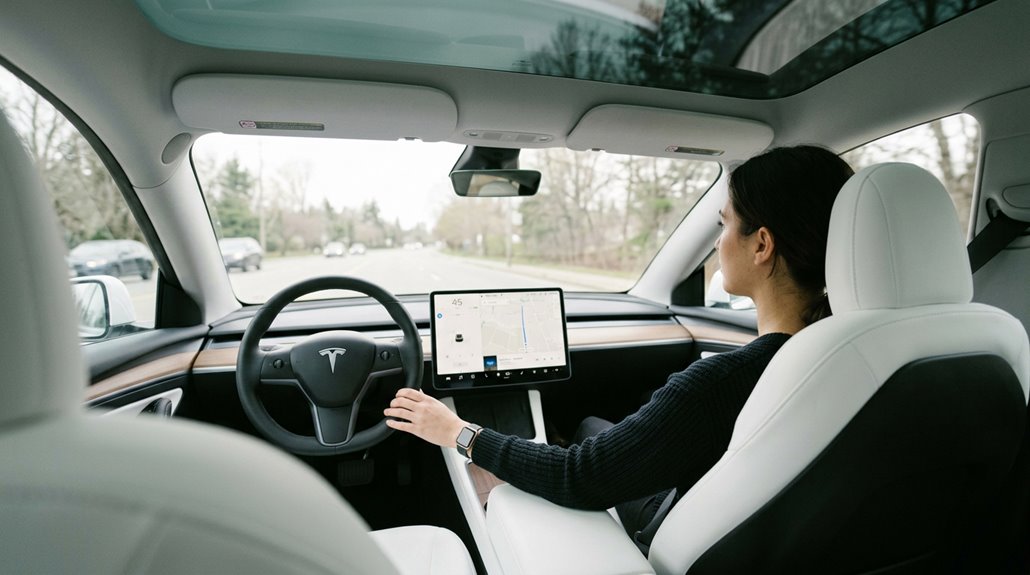
Cabin noise in the Model Y depends heavily on which model year you’re driving and what tires are mounted — early 2020–2022 builds typically register 67–71 dB at 65–70 mph on mixed pavement, while the 2025-updated “Juniper” Model Y on 19″ touring EV tires can dip to 64–66 dB on smooth asphalt, putting it at or below the ~65 dB compact-SUV segment average.
Tesla progressively addressed NVH (noise, vibration, and harshness) by adding wheel-well sound deadening and acoustic front glass through 2021–2024, then pushed further with the late-2024/2025 refresh, which introduced 360-degree acoustic glazing, tightened door and window seals, and revised suspension tuning — reportedly cutting road, wind, and impact noise by roughly 20–22% compared to earlier configurations.
The trade-off is that the quieter the cabin gets, the more you’ll notice the subtle whine of the motor and other mechanical inputs that engine noise used to mask in a conventional vehicle.
Acoustic Glass Noise Reduction
Acoustic glass does more than just block sunlight — it’s one of the primary reasons the 2026 Model Y Juniper feels measurably quieter than its predecessors, with Tesla reporting a 50% overall cabin noise reduction compared to earlier generations. The double-glazed laminated construction sandwiches a dampening acoustic layer between panes, targeting frequency resonance before it enters the cabin.
Here’s what that glass actually does:
- Reduces wind noise by 5–8 dB at highway speeds
- Blocks external humming through sealed dual-pane channels
- Delivers 0.5%–12% noise reduction per panel (varies by location)
- Eliminates the need for aftermarket soundproofing materials on recent builds
Expandable silicone rubber seals reinforce the windshield perimeter, closing the gap where most frequency-specific complaints originate.
Cabin Sound Insulation
While the acoustic glass does a solid job at the windshield and side windows, the rest of the cabin tells a more complicated story. Tesla’s factory insulation balances weight, efficiency, and cost—not maximum isolation.
That tradeoff shows up clearly on coarse pavement. Tire resonance, floor vibration, and trunk resonance become obvious once engine noise disappears entirely. You’ll notice the empty cargo area acts almost like an amplification chamber. Aftermarket upgrades targeting rear damping and hatch sealing address exactly these weak points.
Multi-layer butyl-and-foam kits applied to the rear trunk floor and fender wells can realistically reduce cabin noise by up to 6 dB—a measurable, noticeable difference. Installation quality, tire choice, and road surface still determine your actual results.
Wind And Road Noise
Deadening the rear trunk floor helps, but it won’t do much about the noise that enters through your tires and door seals at 70 mph—that’s a separate problem entirely.
Your four biggest noise variables are:
- Tire choices — touring tires on 19-inch wheels consistently measure quieter than aggressive tread on 21-inch setups
- Pavement type — coarse concrete adds roughly 3–5 dB over smooth asphalt
- Speed — highway cruising amplifies both road and wind intrusion simultaneously
- Wind mitigation — acoustic glass reduces wind noise meaningfully, though road noise dominates overall
Legacy Model Y versions (2020–2022) measured 67–71 dB at 65–70 mph. Refreshed 2025 versions drop to approximately 64–66 dB.
Performance trims with 21-inch wheels on rough pavement can push 72–75 dB—noticeably louder.
How Model Y Ride Quality Improved From 2020 to 2024
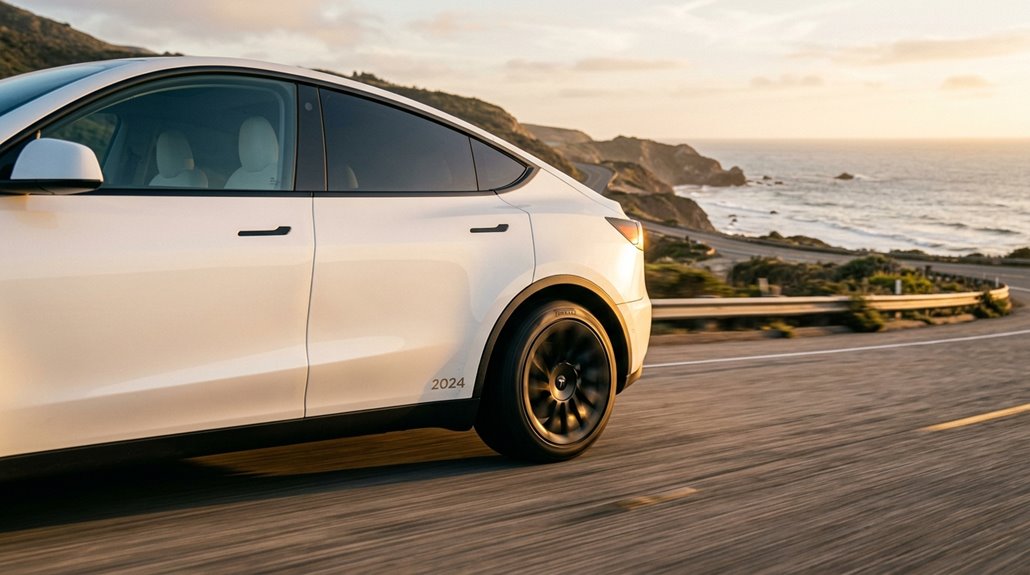
The 2020 Model Y launched with a suspension tune that reviewers and owners consistently described as firm to the point of being busy — road imperfections transmitted straight into the cabin with little filtration. Later versions received revised suspension calibration, featuring softer springs, dampers, and different bushings that reduced abruptness without fully abandoning handling capability.
Tesla also added more cabin insulation and soft-touch materials, which lowered NVH levels and made impacts feel less jarring. Car and Driver still rates the 2024 Model Y as “considerably rougher” than the Model 3, so don’t expect a luxury sedan.
The shift across this generation is best described as moving from “sporty but harsh” to “firm but composed” — a real improvement, just not a dramatic one.
Adaptive Suspension and Road Comfort Improvements
The new Model Y Performance ditches the standard variant’s passive spring-on-strut (MacPherson-style) setup entirely, replacing it with Tesla’s in-house adaptive suspension that adjusts damping in real time based on both driver inputs and road surface conditions.
You get two preset modes to work with — Standard for a more compliant, everyday ride and Sport for faster damping response and tighter cornering behavior — and both modes still actively modify to rough pavement rather than locking into a fixed damping rate.
The hardware supporting all of this includes redesigned springs, stabilizer bars, and bushings, plus rear body structure improvements that increase torsional stiffness, giving the suspension geometry a more rigid platform to actually work against.
Adaptive Suspension System Explained
Tesla quietly changed the game for the Model Y Performance by developing its responsive suspension entirely in-house, which means the control algorithms are tuned specifically for this platform rather than licensed from a third-party supplier. The system uses variable damping that adjusts continuously based on road conditions and your inputs.
Here’s what the system manages in real time:
- Damping force via solenoid-regulated oil flow
- Driver tuning through Standard and Sport presets
- Steering response calibration under Sport mode
- Chassis communication with upgraded springs and stabilizer bars
Sport mode tightens settling times and sharpens road connection without ignoring rough surfaces. Standard mode stays controlled while prioritizing comfort. Rear body structure improvements also increase torsional stiffness, giving the responsive system a more rigid foundation to work against.
Rough Road Performance
Knowing how the responsive damping system works in theory is one thing — feeling it absorb a pothole at 45 mph is another. Tesla’s refreshed Model Y handles road impact mitigation through redesigned springs, stabilizer bars, and bushings that collectively reduce chassis disturbance over broken pavement. The rear body structure’s increased torsional stiffness keeps everything composed when surfaces turn unpredictable.
Standard mode softens noticeably, ironing out city road imperfections without punishing your spine. Sport mode stays compliant enough for extended rough-road use without excessive harshness — a meaningful distinction from the older non-tunable setup. Monitoring suspension wear matters here because degraded components compromise what these calibrated dampers are designed to deliver.
The responsive system reads real-time road and driver inputs, adjusting damping forces continuously to maintain stability across variable surfaces.
Ride Comfort Upgrades
Responsive suspension only comes standard on the new Model Y Performance — lower trims still run fixed-rate damping, so the upgrade gap is real. Tesla’s responsive damping system adjusts shock resistance in real time, responding to both road surface inputs and driver behavior simultaneously.
The chassis tuning package includes four coordinated upgrades:
- Upgraded springs reducing body roll during cornering
- Revised stabilizer bars improving lateral stiffness
- Reinforced rear body structure increasing torsional rigidity
- Redesigned front geometry minimizing road disturbance transfer
Standard mode stays relaxed without feeling sloppy. Sport mode firms everything up, shortening settling times noticeably. Neither Model S air suspension nor aftermarket conversions are necessary here — Tesla’s spring-based responsive system delivers meaningful real-world comfort improvements without the complexity (or cost) of pneumatic alternatives.
Texas-Built vs. California-Built Model Y: Key Differences
Where your Model Y was built isn’t just a trivia question—it’s a meaningful technical distinction that affects the car’s body structure, battery chemistry, build quality, and even what’s sitting in your cargo area on delivery day.
Where your Model Y was built isn’t trivia—it’s a technical distinction with real consequences.
Texas-built units use dual gigacastings (front and rear) plus a structural 4680 battery pack, improving crash performance through tighter integration between the pack and body.
California-built cars retain a rear gigacasting but use conventional front-body assembly with 2170 cells—a format with stronger battery durability track record despite theoretically lower energy density.
Austin’s newer paint booths produce measurably tighter panel gaps.
Texas builds also typically ship with a factory cargo cover; Fremont builds historically didn’t.
Same car, meaningfully different engineering underneath.
Texas-Built Model Y: What the Structural Battery Pack Means for Buyers
This changes several things you should comprehend:
- The floor and battery share structural duty, improving rigidity
- Seat mounting points connect differently than Fremont-built variants
- Repair implications include more complex collision procedures
- Jacking and lift-point protocols require different service documentation
Tesla calls the mass tradeoff “negative mass”—savings elsewhere offset the integrated structure‘s weight. It’s clever engineering, though it means your repair shop needs specific training. Always verify your exact build architectonics through VIN data before assuming specifications.
Tesla Model Y Safety Ratings and Crash Test Results
Every major safety testing organization that’s evaluated the Model Y has handed it a 5-star overall rating—NHTSA, Euro NCAP, and ANCAP all landed there independently, which isn’t coincidence.
NHTSA recorded a rollover risk of just 7.9%, the lowest of any SUV in agency history at that point. IIHS awarded “Good” ratings across small-overlap front crashes, side impacts, and roof strength—its highest tier.
Euro NCAP scored adult occupant biomechanics at 91% and child protection at 93%, reflecting how well the structure manages crash forces around passengers.
Pedestrian mitigation performance sits around 86% through IIHS testing, with AEB successfully avoiding collisions in multiple scenarios.
Weaker zones near pillars and hood edges exist, but the front and rear crumple zones handle energy distribution efficiently.
Standard Safety Features on Every Model Y
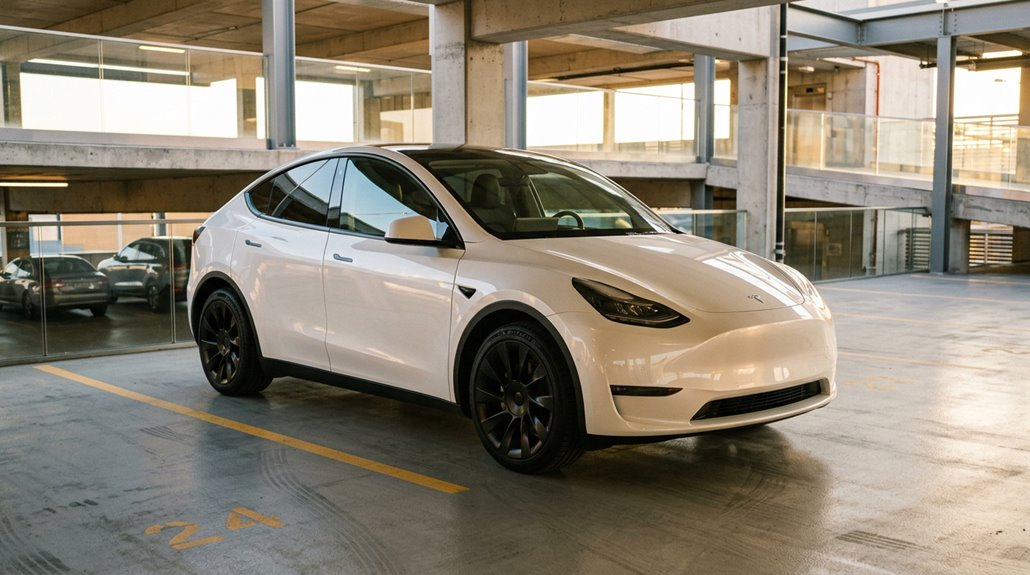
Before you even glance at the optional upgrades, the base Model Y ships with a safety stack that would’ve been considered premium-tier five years ago.
Every trim includes hardware and software working together continuously.
Here’s what’s baked in from the factory:
- Active collision systems — automatic emergency braking, pedestrian detection, and forward collision warning
- Lane management — lane-keeping assist, lane-departure warning, and flexible cruise with centering
- Occupant hardware — front, side, and curtain airbags plus ISOFIX mounts
- Stability controls — ABS, traction control, electronic brake-force distribution, and hill-start assist
The interior sensors handle driver monitoring through the cabin camera, flagging inattention automatically.
You’re not buying optional safety — you’re receiving a validated baseline that regulators have already stress-tested extensively.
Blind-Spot Monitoring and Lane Assistance Features
When you activate a turn signal on a supported Model Y, side-camera feeds appear on the center screen and highlight detected vehicles in red if a lane change poses a risk — a camera-based system that replaces the conventional radar module most other automakers rely on.
Blind-spot detections render as colored lines radiating from the vehicle icon on the touchscreen (white through red, with red indicating closest proximity), and newer Model Y builds add a physical indicator light near the side mirror for a more immediate visual cue.
Lane-keeping functions operate between 40 and 90 mph on roads with clear lane markings, with Emergency Lane Departure Avoidance capable of applying active steering correction, sounding a chime, and highlighting the breached lane marking in red — all while lane centering works in parallel to keep the car tracked within its lane under Traffic-Aware Cruise Control.
Blind-Spot Camera Integration
Unlike traditional radar-based blind-spot systems, the Model Y handles blind-spot monitoring entirely through its camera array, feeding threat data directly into the touchscreen’s vehicle visualization. When you activate a turn signal, the relevant side camera feed appears on the center display, highlighting threats with red markings.
The visualization uses four proximity-based color codes:
- White — distant object detected, no immediate urgency
- Yellow — closing distance, increased awareness required
- Orange — threat is near, caution warranted
- Red — immediate danger, highest alert priority
Worth noting: camera latency is a real consideration here, since processing introduces slight delays versus radar. Some owners also raise privacy concerns around always-active exterior cameras continuously capturing surrounding traffic.
Lane-Keeping Assist Explained
Tesla’s lane-keeping assist kicks in automatically once you’re cruising between 40 and 90 mph on roads where lane markings are clearly visible — no manual activation required beyond enabling it in the settings. The system monitors driver alertness by checking your hands on the wheel during automatic lane-keeping operations, pausing alerts when contact is detected.
| Situation | System Response |
|---|---|
| Drifting toward lane edge | Visual and audible warning |
| Hands repeatedly undetected | Hazard lights activate |
| Emergency departure (30–90 mph) | Corrective steering torque feedback + chime |
| Persistent inattention | Gradual speed reduction (15 mph below limit) |
That last row isn’t a suggestion — it’s the car actively managing risk when you’ve checked out.
Adaptive Cruise Lane Centering
Previously standard, it’s now paywalled behind a $99/month Full Self-Driving (Supervised) subscription — a notable subscription implication for new buyers.
Here’s what you’re actually getting:
- Active steering inputs that maintain lane-center positioning continuously
- Integration with Traffic-Aware Cruise Control for combined speed and steering management
- A 30-day free trial included with new purchases
- Retained access for existing owners who previously purchased Autopilot
The competitor comparison stings slightly — Honda and Toyota bundle lane-centering standard.
Tesla’s pre-owned Autosteer-equipped vehicles still score 10/10 on highway performance, though.
Make of that what you will.
Autopilot vs. Full Self-Driving: What’s the Real Difference?
When you’re configuring a new Model Y, the Autopilot versus Full Self-Driving decision is one of the most misunderstood checkboxes on the order page. Standard Autopilot comes included—it handles lane-centering and adaptive cruise control on highways, nothing more. FSD is the paid upgrade, adding automatic lane changes, Navigate on Autopilot, Autopark, and Summon.
Here’s what neither badge means: fully autonomous driving. Driver supervision remains mandatory for both systems, regardless of which software updates Tesla pushes to your vehicle. You’re still legally responsible behind the wheel.
FSD costs markedly more—either as a large one-time purchase or a monthly subscription depending on your market. Enhanced Autopilot sits between both tiers, offering lane changes and mechanized parking without the full FSD price tag.
Full Self-Driving on City Streets: Turns, Lights, and Limits
Full Self-Driving (Supervised) extends beyond the highway stack—it’s designed to handle the full urban gauntlet: stop signs, traffic lights, left and right turns, roundabouts, and multi-lane route-finding on city streets.
FSD (Supervised) tackles the full urban maze—stop signs, traffic lights, turns, roundabouts, and city-street navigation.
Tesla Vision and onboard neural-network processing interpret your surroundings continuously. Still, driver training matters here—you’re supervising, not napping.
Four urban edge cases that demand your attention:
- Complex intersections with ambiguous geometry often trigger hesitation
- Faded or missing lane markings reduce system confidence measurably
- Construction zones frequently require manual takeover
- Unpredictable surrounding traffic can cause the system to pause and wait
The system stops at red lights and resumes after confirmation—sometimes yours. Urban edgecases remind you that FSD (Supervised) remains an advanced driver-assistance tool, not a replacement for attentive driving.
Tesla Model Y Camera System and Sensor Layout
Eight cameras blanket the Model Y in a full 360-degree field of view—no radar, no ultrasonic sensors (those were phased out), just cameras feeding a continuous stream of high-resolution imagery into Tesla’s onboard neural network computer.
One front-facing camera sits above the grille, while a wide-angle secondary camera mounts behind the windshield near the rearview mirror.
Six side cameras handle blind spot monitoring and fender coverage—two repeater cameras per mirror, plus one per front fender.
A single rear camera activates automatically in reverse, displaying steering-adjusted path lines.
Every feed powers Autopilot, lane-keeping, and emergency braking functions.
Worth noting: dirty lenses genuinely degrade performance, so treat them accordingly.
Some owners raise privacy implications around constant image capture—Tesla processes everything onboard, though that blind camera reality deserves your awareness.
The Model Y’s glass roof gives the cabin an open, airy feel, but it also allows heat and sunlight to build up quickly when parked or during long summer drives, making the interior noticeably less comfortable than many owners expect. Tesla Model Y Roof Sunshade & Windshield Sunshade Set helps reduce that heat and glare by limiting direct sun exposure through the windshield and panoramic roof, keeping the cabin cooler and protecting interior surfaces from prolonged UV wear.
Parking Features and Autopark Explained
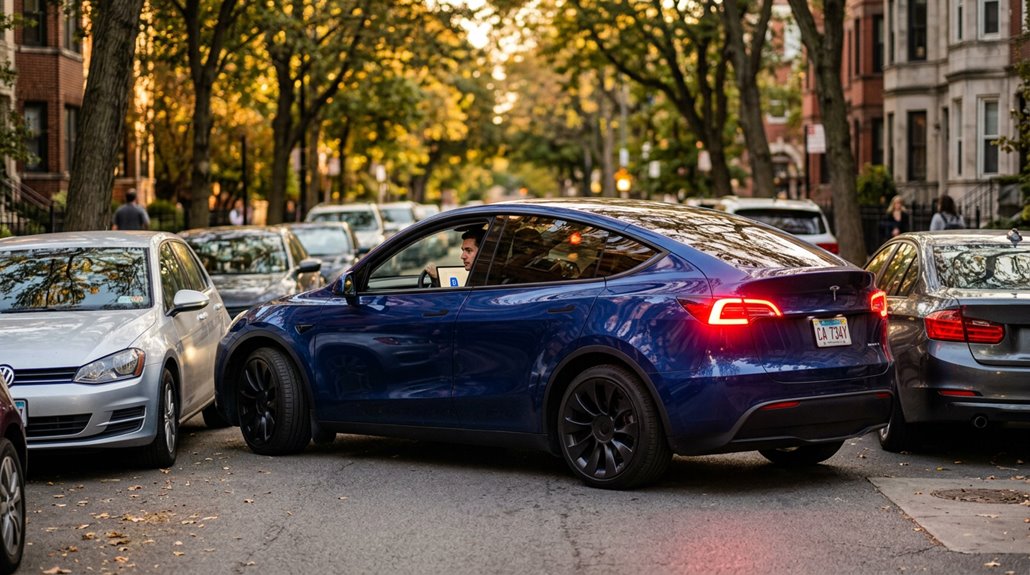
Autopark turns the Model Y into a reasonably competent parallel and perpendicular parker—the system uses the vehicle’s camera array to scan for open spaces as you crawl past them, then handles the steering inputs automatically once you confirm the spot and shift into Reverse. No user training required beyond knowing what to watch for on the touchscreen.
Key operational rules:
- Position roughly one car length ahead of the target space before activation
- Release the steering wheel completely once the sequence begins
- The system cancels automatically if the maneuver exceeds seven moves
- Camera calibration status directly affects detection reliability
HW4 vision-only vehicles detect more locations simultaneously than older ultrasonic-equipped models. Opening a door or touching the steering wheel kills the sequence immediately—no second chances.
How Tesla’s App Replaces Your Car Keys
Once you’ve handed parking duties off to the cameras, it’s worth knowing what actually gets you into the car in the first place—because Tesla’s handled that just as unconventionally. Your phone becomes the primary key through Bluetooth Low Energy (BLE), enabling seamless access without unlocking your screen. The Tesla app manages everything—adding, removing, and assigning keys to driver profiles.
| Key Type | Maximum Allowed |
|---|---|
| Phone Keys | 4 |
| Key Cards | 19 |
| Key Fobs | Multiple |
| Driver Profiles | Per key |
| Backup Options | Card or fob |
Privacy implications exist: BLE constantly communicates your proximity to the vehicle. If your phone dies, you’re locked out unless carrying a key card. Future updates suggest Apple Wallet and HarmonyOS NFC integration.
Remote Features: Locking, Heating, and Diagnostics
The Tesla app doesn’t just open your car—it runs a meaningful slice of the vehicle’s systems from anywhere with a cell signal. Remote diagnostics and smart preconditioning both operate through the same interface, giving you layered control without touching the vehicle.
Here’s what you’re actually managing remotely:
- Lock/unlock all doors and trunks, including remote door unlatching on supported builds
- Climate activation with Cabin Overheat Protection toggleable directly from the app
- Seat heater levels (1–3) adjustable before you even reach the parking lot
- Mode alerts for Dog, Camp, and Keep Climate On—notifications trigger below 20% battery
Each function depends on an active cell connection and sufficient battery reserves. No signal, no control.
Geofencing, Theft Alerts, and Tow-Away Notifications
Remote access handles the climate and convenience side of things, but Tesla’s location-aware features cover what happens when you’re not watching the car at all. Geofencing ties vehicle behavior to saved locations — Home, Work, or Favorites — and that same logic controls when Sentry Mode activates automatically.
| Feature | Where It’s Configured | Key Limitation |
|---|---|---|
| Sentry Mode Exclusions | Safety Settings | Creates coverage gaps |
| PIN to Drive | Security Settings | Required even with phone key |
| Tow Detection | Third-party integrations | Varies by software |
Geofence privacy settings determine how much location data leaves the vehicle. Tow detection isn’t native Tesla firmware, but third-party platforms fill that gap using geofence alerts triggered by unexpected movement.
What Tesla’s OTA Updates Have Changed on the Model Y
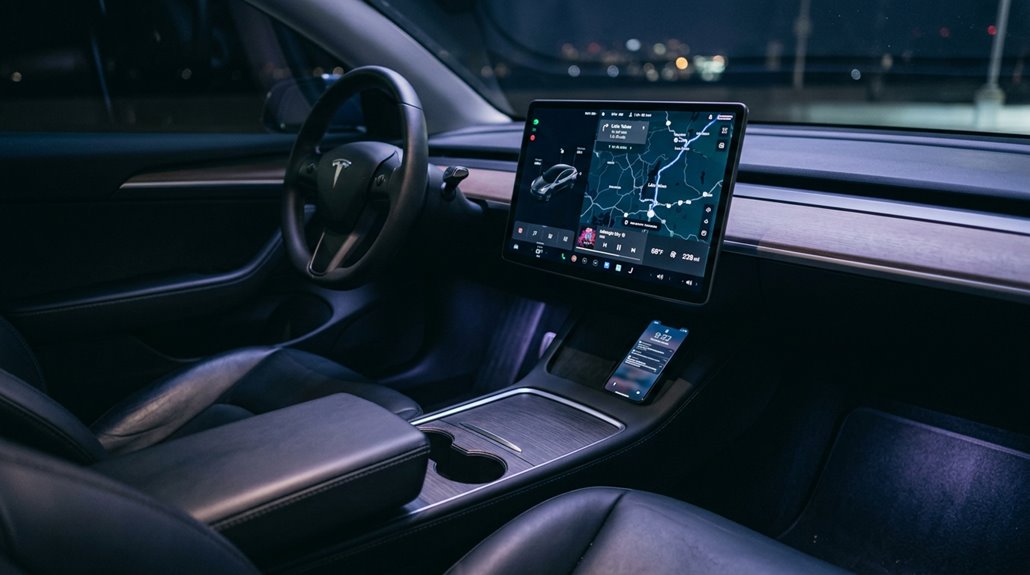
Tesla’s OTA updates have quietly reshaped what the Model Y can do, covering everything from Autopilot braking logic and regenerative braking feel to Spotify playlist behavior and navigation UI controls.
You’re in effect getting a different car every few months — Update 2026.8, for example, added Comfort Braking specifically for the 2025+ Juniper to smooth out deceleration without touching a single physical component.
Over 90% of Model Y fixes and feature additions arrive this way, which means your ownership experience shifts constantly based on whatever Tesla’s latest software branch decides to prioritize.
Key Software Improvements
Unlike most automakers that require dealership visits for feature updates, Tesla pushes software changes directly to your Model Y over Wi-Fi — meaning the car you drove off the lot isn’t necessarily the car you’re driving today.
The OTA cadence follows staged rollouts, hitting roughly 25% of the global fleet before broad deployment. Recent updates delivered meaningful refinements:
- Autopilot renaming — Navigat on Autopilot became Navigat on Autosteer; FSD Computer became AI Computer
- Media polish — swipe-right queuing for Apple Music and Spotify, plus tap-and-hold Favorites controls
- Premium Immersive Sound — expanded soundstage across all streaming sources
- Diagnostic mapping — DTCs now link directly to Drive Unit, HV Battery, Thermal, and Charging panels (Ryzen hardware required)
Set your preference under Controls > Software > Software Update Preference.
Feature Updates Delivered
From the moment Tesla started pushing updates to early Model Y builds in 2020, the car became something of a living document — one where the hardware stayed fixed but the behavior kept developing. The OTA cadence started modest, refining the heat pump, regenerative braking calibration, and traction algorithms.
Tesla Model Y vs. Model 3: Shared Platform, Different Purpose
The Model Y and Model 3 share the same underlying platform — and that’s not an accident or a cost-cutting shortcut, it’s a deliberate engineering decision Tesla made to bring the Model Y to market faster by leaning on the Model 3’s already-tested chassis foundation. The platform differences, however, reveal real packaging tradeoffs you’ll notice immediately:
The Model Y sharing the Model 3’s platform wasn’t a shortcut — it was a calculated engineering decision with real tradeoffs.
- Model Y rides taller with a hatchback opening, prioritizing cargo flexibility
- Model 3 sits lower, tuned for sportier handling and better efficiency
- Model Y offers more second-row headroom and fold-flat rear seats
- Model 3 delivers a more compact, efficiency-focused cabin layout
Same bones, genuinely different purposes. You’re basically choosing between utility-first versatility and efficiency-first sportiness — both built on identical engineering foundations.
Model Y vs. Mach-E and Ioniq 5: Key Differences
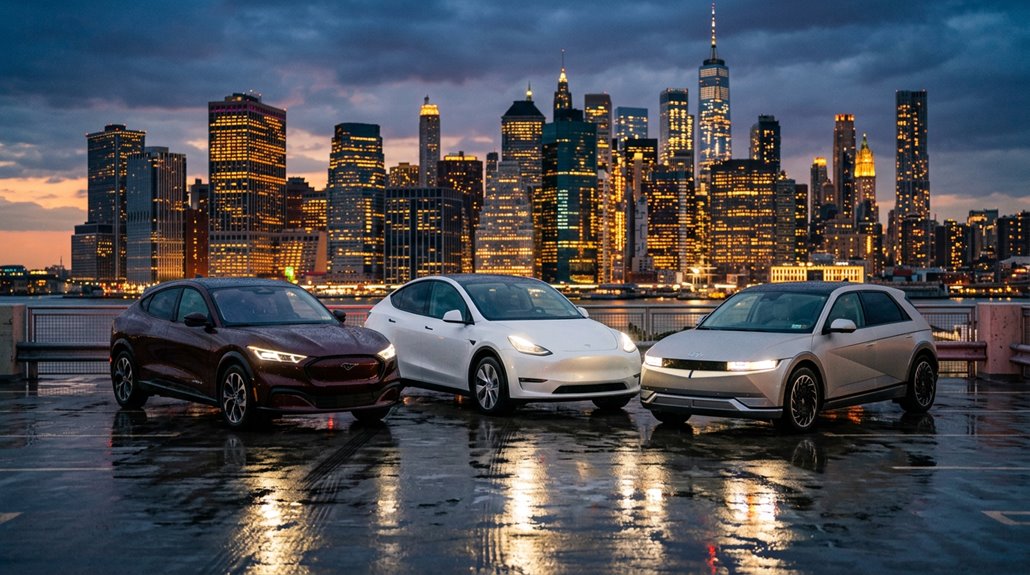
Stacked up against the Ford Mustang Mach-E and Hyundai Ioniq 5, the Model Y holds a clear efficiency and range advantage — but that doesn’t automatically make it the right choice for every buyer. Tesla’s 357-mile EPA estimate beats both rivals outright. You’ll also notice the Model Y charges faster, peaking near 250 kW versus Mach-E’s 150 kW ceiling. However, if steering feedback matters to you, the Mach-E feels more involving. Charging etiquette shifts slightly too — Supercharger access remains Tesla’s trump card, though adapters now broaden competitor access.
| Category | Model Y | Mach-E | Ioniq 5 |
|---|---|---|---|
| EPA Range | 357 mi | ~320 mi | 318 mi |
| Peak Charge Rate | 250 kW | 150 kW | 233 kW |
| Warranty (Basic) | 4yr/50k mi | 3yr/36k mi | 5yr/60k mi |
Most Common Tesla Model Y Problems and Owner Complaints
Despite Tesla’s reputation for over-the-air fixes and rapid iteration, the Model Y carries a well-documented reliability record that’s more complicated than its sales numbers suggest.
Build quality and software reliability remain the two most contested areas among owners. Here’s what you’ll likely encounter:
- Body hardware failures — misaligned panels, faulty seals, and water ingress around the boot, most prevalent in 2020–2021 builds.
- Touchscreen instability — freezes, blank displays, and random reboots affecting 2020–2023 models.
- Phantom braking — unexpected Autopilot deceleration that genuinely erodes highway confidence.
- Heat pump degradation — reduced cabin heat appearing between 15,000–30,000 miles in colder climates.
Some faults resolve through OTA updates.
Others require service visits, suggesting systemic issues rather than isolated incidents.
Tesla Model Y Resale Value Compared to Rivals
Resale value rarely tells the whole story on a vehicle, but it tells enough — and for the Model Y, the numbers are genuinely mixed depending on the timeframe you’re examining.
At three years, well-kept Long Range AWD examples hold around $32,000–$34,000, reflecting roughly 35%–45% depreciation from original MSRP. That’s respectable. By year five, resale trends soften considerably — CarEdge pegs residual value near 38.9%, landing most examples around $19,608.
Competitor analysis reveals a clear pattern: hybrids consistently outperform both EVs and gas SUVs, retaining 55%–60% after five years. Gas compact SUVs hover around 45%–50%. The Model Y beats most EVs but trails those benchmarks.
Tesla’s 2023–2025 price cuts repeatedly dragged used values down — new inventory pricing and used pricing don’t coexist peacefully.
Who the Tesla Model Y Is Built For and Who Should Look Elsewhere
The Model Y hits a sweet spot for tech-forward, upper-middle-income households replacing a compact gasoline crossover (think CR-V or Escape size class) with something that handles daily commuting, family errands, and weekend cargo loads without a second vehicle in the driveway.
If you’re a budget-first buyer, a three-row family hauler hunter, or someone who needs serious towing or off-road capability, you’ll run into the Model Y’s hard limits pretty fast. This section breaks down exactly who fits the Model Y profile and who should redirect their search before signing anything.
Ideal Model Y Buyers
Narrowing down whether a Model Y fits your life comes down to a few honest questions about how you drive, charge, and interact with your car.
You’re likely a strong candidate if you fall into one of these profiles:
- Tech minimalists who prefer app-based controls and single-screen cabin layouts over traditional button configurations
- Road trippers who rely on Tesla’s Supercharger network for predictable, high-speed charging stops
- Performance buyers who want dual-motor acceleration (0–60 in 3.5 seconds) inside compact crossover dimensions
- Efficiency advocates who prioritize one-pedal driving, regenerative braking, and over-the-air software updates
If you’re buying used, target 2022–2025 model years—heat pump standard, updated interior, hardware already sorted.
The depreciation curve works in your favor there.
Who Should Look Elsewhere
Not every buyer fits the Model Y mold, and that’s worth stating plainly. Budget buyers should reconsider — base pricing sits at $44,990, well above the $35,000–$36,000 average new car purchase, and depreciation hits harder than most competitor EVs. Used alternatives start around $25,000, but you’re absorbing someone else’s early depreciation instead of creating your own.
Quality seekers face a different problem. Interior materials feel noticeably cheaper than equivalently priced rivals like the Mazda CX-50, and build inconsistencies appear frequently across owner reports. If ride comfort matters to you, the suspension tuning runs firm — competitors deliver measurably smoother daily driving. Finally, buyers dependent on traditional dealer infrastructure will find Tesla’s service model genuinely inconvenient, particularly outside major metropolitan areas.