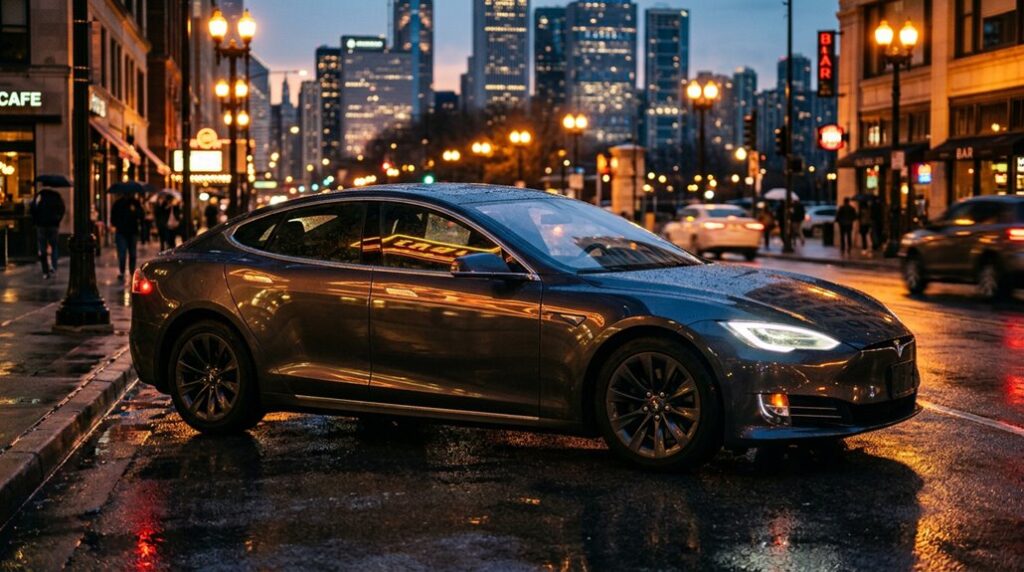

A decade of relentless engineering separates the Tesla Model S from everything else wearing a sedan badge — and most buyers never realize how deep that gap runs. Long Range or Plaid? The spec sheet won’t tell you what actually matters. Carbon-sleeved tri-motors spinning past 20,000 RPM and sub-2-second launches are just the beginning of what this guide breaks down.
What Is the Tesla Model S?
The Tesla Model S is a battery-electric luxury sedan — full-size, four-door, and finished with a hatchback-style liftgate that makes it simultaneously practical and sleek. Tesla designed it as a premium EV from the ground up, not a gasoline car wearing an electric costume. You’re getting Tesla’s flagship sedan, which means it sits at the top of the lineup with respect to polish, range, and raw capability.
It’s classified as a midsize-to-full-size electric sedan across major auto listings, powered entirely by electric motors with no internal combustion engine involved. Grasping ownership costs means factoring in charging etiquette — specifically, how, where, and how often you’ll replenish that battery — since fuel expenses look radically different when electricity replaces gasoline. Drivers transitioning from gas vehicles will find that total cost of ownership shifts considerably once insurance, charging infrastructure, and long-term resale value enter the equation. Production began in 2012 at the Fremont Factory in California, establishing the Model S as Tesla’s longest-produced vehicle and a defining force in the modern electric car industry.
Tesla Model S History: From 2012 to Today
The Tesla Model S traces its roots back to June 2012, when Tesla rolled out the first production units from its Fremont, California factory — supplying 2,650 cars by year’s end and establishing itself as a full-size, four-door battery-electric luxury sedan built to challenge the internal combustion establishment head-on.
Over the next decade-plus, you’d watch the platform absorb dual-motor all-wheel drive (debuted under the “D” designation in 2015), Autopilot hardware, Raven responsive air suspension (2019), and finally the 2021 refresh that pushed EPA-rated range to 387 miles and introduced the Plaid’s tri-motor, 1,000-hp powertrain.
Rather than cycling through traditional model-year redesigns, Tesla ran continuous over-the-air software updates and rolling hardware changes — a strategy that kept early buyers reasonably current while quietly making yesterday’s spec sheet obsolete. The 2021 refresh also addressed long-standing build-quality criticisms, with improvements targeting panel gaps, interior trim alignment, and wind-noise reduction through better-fitted frameless windows.
Early Model S Origins
When Tesla pulled the wraps off the Model S prototype on March 26, 2009, in Hawthorne, California, most of the automotive industry quietly dismissed it as an overfunded science project.
They were wrong.
The early prototypes carried clear design influences from Tesla’s engineering facility, which opened in Rochester Hills, Michigan in January 2007.
Here’s what that early development actually delivered:
- A clean-sheet electric platform (no ICE conversion compromises)
- Range targets of 200–300 miles, audacious for 2009
- Twelve pre-production units built in 2011 for rigorous validation
- The repurposed Toyota NUMMI Fremont plant as manufacturing home
The codename was “WhiteStar.”
The ambition was bigger.
Tesla wasn’t building a curiosity — it was engineering a legitimate luxury competitor from the ground up. If you attempt to research independent reliability data on early Model S performance, you may encounter a Cloudflare security block on sites like jdpower.com that requires contacting the site owner to resolve.
Evolution Through the Years
Unlike most automakers who treat a new model year as a marketing event, Tesla treated the Model S as a living product — continuously updated, occasionally restructured, and never quite finished. Grasping its software evolution means ditching the traditional model-year mindset entirely.
From 2012 onward, Tesla pushed over-the-air updates that rewrote feature timelines mid-ownership — Autopilot arrived as a software activation in 2014, not a new vehicle. By 2021, the Palladium redesign delivered a 0.208 drag coefficient alongside the tri-motor Plaid powertrain. Minor 2025 enhancements added ambient lighting and fascia cameras.
Each production window carries distinct capability ceilings determined by installed hardware, so knowing your build date isn’t trivia — it’s genuinely how you comprehend what your car can actually do. Two cars built in the same year can feel entirely different depending on software version, as updates roll out every few weeks and owners who stay current receive meaningfully different feature sets than those who don’t.
Long Range vs. Plaid: Which Model S Should You Buy?
Choosing between the Long Range and Plaid comes down to one brutally honest question: how much do you actually need 1,020 horsepower? For most drivers, the answer is humbling.
The real question isn’t which Tesla is faster — it’s whether you’ll ever actually need that power.
Consider these deciding factors:
- Range advantages: Long Range delivers 405 highway miles versus Plaid’s 390, despite identical 100 kWh batteries.
- Acceleration: Plaid hits 0-60 mph in 2.1 seconds; Long Range takes 3.1 seconds (still faster than most sports cars).
- Insurance costs: Plaid’s premiums run markedly higher, especially in Canada.
- Price gap: You’re paying roughly $15,000 extra for 350 additional horsepower.
If you’re road-tripping regularly, Long Range’s efficiency advantage (124 MPGe versus 102 MPGe) makes it the smarter daily driver.
Plaid rewards those who genuinely chase track performance. Both models carry an 8-year powertrain warranty covering up to 150,000 miles, giving buyers confidence regardless of which trim they choose.
Model S Plaid Performance Numbers Explained
Once you’ve settled on the Plaid over the Long Range, the natural next question is what those extra dollars actually buy in measurable terms. The tri-motor setup produces 1,020 hp and roughly 1,050 lb-ft of torque, pushing you to 60 mph in as little as 1.99 seconds (with rollout subtracted).
Independent testing lands closer to 2.1–2.3 seconds on street tires, which is still absurd. Launch behavior stays strong well past 100 mph, with quarter-mile passes clocking around 9.23 seconds at 150 mph trap speeds. Unlike most EVs that fade dramatically at speed, the Plaid maintains near-full output through 200 mph. Thermal limits are managed aggressively enough that repeated hard runs don’t immediately punish you with derating, though battery heat eventually demands respect.
Peak figures also depend heavily on conditions, as a warmed battery and preheated tires on a dry road are required before Launch Control activates and delivers the car’s best numbers.
How the Model S Plaid Tri-Motor Powertrain Works
The Plaid’s tri-motor layout isn’t just “more motors equals more power”—it’s a deliberate design decision with real engineering consequences.
The motor configuration places one permanent magnet synchronous motor upfront (7.56:1 gear ratio) and two rear motors sharing a single cast housing, eliminating traditional differentials entirely.
Here’s what that actually means for you:
- Independent torque delivery to each rear wheel replaces mechanical differentials with software-controlled precision
- Carbon-fiber-wrapped rotors spin to 20,000 RPM, sustaining peak power from zero to 200 MPH
- Thermal integration gives each rear motor its own oil pump and heat exchanger, preventing throttling under repeated hard launches
- Combined output reaches 1,020 horsepower—distributed intelligently, not dumped chaotically
The result is controlled, sustained, repeatable performance. That performance translates directly to real-world numbers, with the Plaid completing the quarter-mile in 9.23 seconds at 155 mph.
Model S Plaid Carbon-Sleeved Rotors: What They Are and Why They Matter
If you’ve ever wondered how the Plaid‘s motors spin past 20,000 RPM without tearing themselves apart, the answer sits inside the rotor itself. Tesla wraps the rotor assembly in a high-strength carbon-fiber sleeve (technically an overwrap) that acts as a retaining band, countering the extreme centrifugal forces that would otherwise deform or fragment the rotor at those speeds.
That structural containment isn’t just a safety measure — it keeps the rotor-to-stator airgap tight and stable, which directly supports stronger electromagnetic performance and the kind of sustained high-speed efficiency that makes the Plaid’s acceleration figures possible. For owners looking to build on that performance at the wheel end, aftermarket upgrades like carbon-silicon-carbide ceramic rotors can eliminate 32.2 lbs of unsprung rotational mass compared to factory rotors.
Carbon-Sleeved Rotor Technology
When Tesla calls the Model S Plaid’s motor the first production electric motor with a carbon overwrap rotor, that’s not marketing padding — it’s a genuine engineering milestone.
The carbon sleeve wraps the rotor assembly under extreme tension, replacing metal retainers that’d otherwise grow outward from centrifugal force beyond 20,000 RPM.
Here’s why manufacturing scale-up made this brutally difficult:
- Carbon and copper expand at completely different rates under heat
- The sleeve must survive repeated thermal cycling without carbon fatigue cracking
- Tesla had to build an entirely new machine just to apply it
- Concentricity tolerances are unforgiving at these rotational speeds
The payoff? A tighter air gap, better magnetic efficiency, and a compact motor producing output numbers that genuinely embarrass internal combustion engines. The result is a motor small enough to be picked up by hand while still launching a two-ton vehicle to 60 mph in just two seconds.
Performance Benefits Explained
All that engineering complexity around the carbon sleeve exists for one reason: it liberates performance numbers that a conventional motor physically can’t reach.
You’re looking at roughly 20,000 RPM capability, which directly enables strong power delivery at heightened vehicle speeds—not just off the line. High RPM behavior benefit from the sleeve’s structural containment, keeping the rotor stable under centrifugal forces that would otherwise deform cheaper designs. That stability preserves the tight electromagnetic gap Tesla engineered, maintaining torque responsiveness throughout the rev range.
Thermal management also improves because carbon transmits electricity poorly (unlike metal retainers), reducing eddy-current losses that generate waste heat during sustained high-speed runs.
The practical result: a 0–60 time around two seconds, delivered repeatedly without mechanical compromise. That last part matters more than the headline number. The tri-motor configuration pairs this rotor technology across three motors to sustain roughly 1,000 horsepower even at 200 mph, where most performance cars are already running out of breath.
Model S Long Range Specs and Real-World Performance
Because Tesla’s updated Long Range sits at the top of the efficiency-versus-performance balance for the Model S lineup, it’s worth grasping exactly what you’re getting before you commit to one.
The Model S Long Range leads the lineup where efficiency and performance meet — understand it before you buy.
The numbers tell a persuasive story:
- 670 hp and 723 lb-ft torque launches you to 60 mph in 3.1 seconds
- 405 miles EPA-rated range from a 95 kWh usable pack
- Cold weather range drops sharply to roughly 239 miles on highways
- Real world charging via Supercharger averages 120–125 kW, recovering significant range within 15–20 minutes
The WLTP figure of 449 miles sounds generous until winter arrives.
You’ll realistically plan around 399 miles in mild conditions, accepting that temperature and speed are non-negotiable variables. The Model S uses a Lithium Nickel Cobalt Aluminum chemistry that underpins its ability to sustain both high performance and long-range efficiency simultaneously.
How Fast Is the Model S Plaid Really?
If you’ve ever wondered whether Tesla’s 1.99-second 0-60 claim holds up outside a laboratory, the short answer is: mostly yes, with an asterisk.
MotorTrend’s real-world testing locked in a 2.28-second run (rollout included), sustaining over 1.0 g of acceleration from 0.2 to 2.6 seconds post-launch and peaking at 1.227 g — numbers that make most exotic sports cars look pedestrian.
Pull the rollout measurement and the Plaid cracks the 2.0-second barrier, which means Tesla’s factory spec isn’t pure fiction, just optimistic about the conditions you’ll rarely replicate in your driveway.
At the quarter-mile, you’re looking at 9.2–10.0 seconds at roughly 152–153 mph, a benchmark that demands you take the Plaid’s performance credentials seriously regardless of what the spec sheet says. Independent data also confirms the Plaid hits 100 mph in 4.7 seconds, underlining just how relentlessly it builds speed well beyond the initial launch.
Plaid’s Real-World Speed
Tesla’s marketed 0–60 mph figure of 1.99 seconds for the Model S Plaid comes with an asterisk most buyers miss: it includes a one-foot rollout, the same measurement convention drag strips use when a car creeps forward before the timing beam breaks.
Strip that away, and you’re looking at real numbers closer to 2.1–2.3 seconds.
Four conditions determine where your result actually lands:
- Tire grip — street tires lose significant bite compared to prepped surfaces
- Battery heat management — a cold pack simply won’t deliver full power
- Surface preparation — asphalt texture directly affects launch consistency
- Launch mode activation — skipping it costs you tenths immediately
Still, 2.3 seconds feels genuinely violent.
Car and Driver confirmed 2.1 seconds without rollout.
That’s supercar territory wearing a sedan’s suit.
The tri-motor setup pushes over 1,020 horsepower to all four wheels, which is precisely why those numbers hold up even when real-world conditions work against a perfect launch.
Quarter-Mile Performance Stats
Four numbers tell the real story of the Plaid’s quarter-mile: 9.2 seconds, 9.4 seconds, 152 mph, and 153 mph — the band where independent testing consistently lands.
MotorTrend measured 9.25 seconds at 152.6 mph; Car and Driver recorded 9.4 seconds at 152 mph, matching the Bugatti Chiron Sport. FastestLaps shows 9.2 seconds at 153.0 mph. That’s your realistic ceiling without modification.
Track launches tighten or widen that window considerably.
Minor wheelspin costs you hundredths, and tire compounds matter more than most owners expect — stickier rubber translates directly into cleaner 60-foot times.
Your 0–60 lands around 1.99–2.1 seconds, with 100 mph arriving near 4.2 seconds. Sustained electric torque does the rest. A gutted, weight-reduced Model S Plaid pushed that ceiling even further, recording an 8.56-second quarter mile that remains unmatched at the ~$90,000 price point.
Model S Plaid Top Speed, Torque, and What the Numbers Mean
When Tesla first announced the Model S Plaid, it threw out a 200 mph top speed figure—and then shipped cars that were electronically limited to 163 mph. Top speed myths die hard here. Here’s what actually governs that number:
Tesla promised 200 mph, then shipped cars capped at 163. Top speed myths die hard.
- Motor rpm limits the theoretical ceiling without software releases
- Track Mode raises the cap to approximately 175 mph
- The Track Package (upgraded brakes) enables the full 200 mph
- Independent testing has recorded 216–217 mph in controlled runs
Torque interpretation matters equally. That 1,050 lb-ft figure comes from a tri-motor setup (one front, two rear) spinning carbon-sleeved rotors up to 20,000 rpm. Peak output hits 1,020 hp.
These aren’t marketing estimates—they’re engineering constraints expressed as numbers you can actually feel. The carbon ceramic brakes required to unlock the full 200 mph top speed are only compatible with 21″ Arachnid wheels.
Model S Yoke vs. Round Steering Wheel: Which Should You Choose?
Once you’ve wrapped your head around what 1,020 hp and tri-motor torque actually feel like through the drivetrain, the next question is simpler but surprisingly divisive: what shape do you want your steering wheel to be?
The visibility tradeoffs are real. The yoke clears your instrument cluster view; the round wheel partially blocks it. The ergonomics comparison gets personal fast. Most owners who make the switch find themselves fully comfortable within 1–2 weeks of daily driving.
| Factor | Yoke | Round Wheel |
|---|---|---|
| Visibility | Superior cluster sightlines | Slightly obstructed |
| Low-Speed Control | Awkward U-turns | Natural hand-over-hand |
| Best Use Case | Highway/Autopilot driving | Urban/multi-driver households |
Your driving environment decides this. Frequent parking and dense city routes favor the round wheel. Highway commuters and Autopilot-heavy drivers typically prefer the yoke’s cleaner feel.
Model S All-Wheel Drive System: How It Splits Power Between Axles
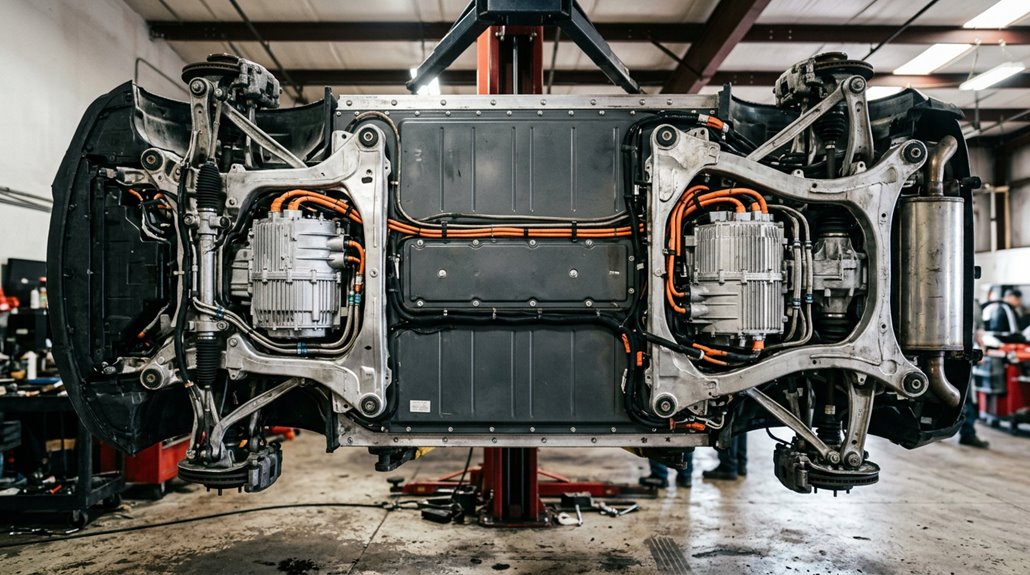
When you’re pushing the Model S through a tight corner or launching from a standstill, the dual-motor AWD system isn’t just spinning all four wheels — it’s independently managing torque across two separate axles with millisecond precision, responding roughly ten times faster than conventional traction control systems.
The front motor (rated at 240 kW in standard AWD configuration) and rear motor (delivering 202 kW) operate as distinct units, each with its own fixed gear ratio — 7.56:1 up front and 9.04:1 at the rear — allowing the system to bias power toward whichever axle has better grip at any given moment.
The practical result is a 0-60 mph time of 3.1 seconds in the Performance variant and a neutral, balanced handling character that rear-wheel-drive setups simply can’t replicate without sacrificing either stability or outright speed. The combined output of both motors reaches 580 kW and 1140 Nm, figures that underpin the system’s ability to sustain consistent performance across high-load scenarios and extended journeys alike.
Dual Motor AWD Basics
Unlike a conventional AWD system built around a mechanical center differential and transfer case, Tesla’s Dual Motor setup splits power between axles entirely through software-controlled electronics—no clutches, no physical torque-routing hardware, just variable frequency drive systems talking to two independent motors in milliseconds.
Here’s what that actually means for you:
- The front motor handles front efficiency at sustained highway speeds using a ~7.56:1 gear ratio
- The rear motor (9.04:1 ratio) dominates everyday acceleration loads
- Torque management shifts approximately 70/30 rear-to-front under hard acceleration
- Traction adjustments happen faster than any mechanical system physically could
You get AWD capability without the mechanical complexity dragging efficiency down.
Two motors, one software brain, zero compromises on response time. When wheel slip is detected, the system instantly redirects power between axles to restore traction without any driver input required.
Torque Distribution Explained
Tesla’s Dual Motor AWD doesn’t split power through a mechanical handshake between axles—it uses independent variable-frequency drive systems at each motor to shift torque electronically, faster than any clutch pack or center differential could react.
Software calibration determines exactly how much torque each axle receives at any given millisecond, adjusting adaptively based on wheel slip, steering angle, and surface conditions.
During a launch, the split often starts relatively even, then shifts rearward as speed climbs and rear grip improves. That’s not random—it’s deliberate traction management, engineered into the firmware.
Plaid adds lateral torque vectoring at the rear axle, pushing more torque to the outside wheel mid-corner to help rotate the car.
Over-the-air updates can tweak this behavior without you touching a wrench. The front axle is powered by an induction motor, while the rear axle uses a permanent magnet synchronous motor—two fundamentally different motor technologies working in tandem under the same software-managed torque distribution system.
AWD Performance Benefits
Splitting power across two motors instead of one isn’t just an engineering flex—it’s the core reason the AWD Model S handles, launches, and grips the way it does. Two independent motors mean no mechanical linkage slowing down torque decisions—just instant, precise adjustments.
Here’s what that actually delivers:
- Launch performance: 0-60 mph drops from 5.4 seconds (RWD) to 4.4 seconds (AWD)—nearly a full second erased
- Winter traction: All four wheels receive active power, eliminating single-axle slip in snow or rain
- Cornering control: Rear-wheel power gets regulated mid-corner, preventing oversteer before it starts
- Efficiency gains: Independent motor management enhances output per axle, reducing unnecessary energy draw
Physics doesn’t negotiate—but two motors give you better terms.
Active Air Suspension Settings on the Model S
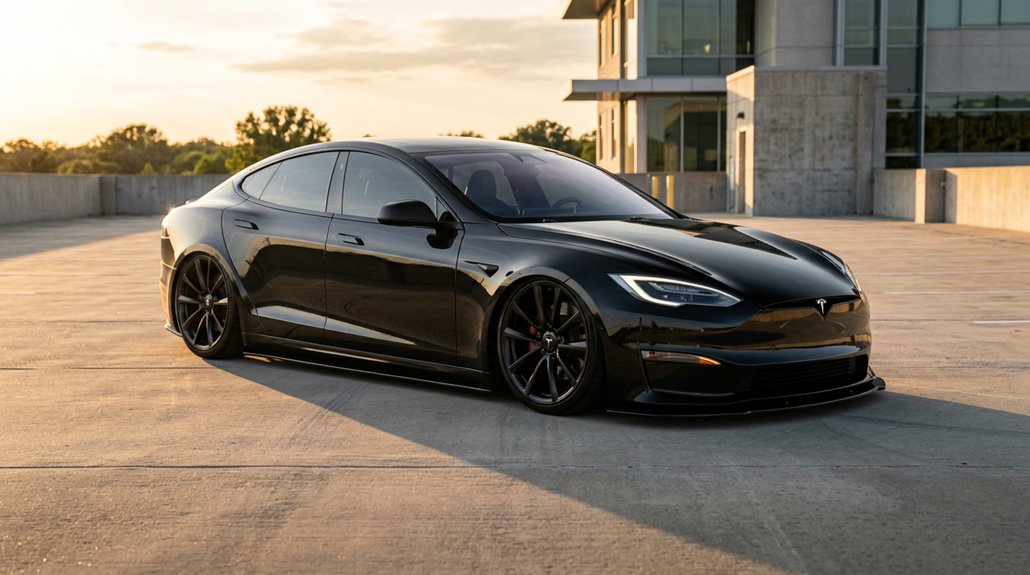
The Model S air suspension does more than absorb bumps — it actively manages ride height, damping force, and load balance in real time using rubber bellows pressurized with compressed air.
Four height settings exist: Low, Standard, High, and Very High, spanning roughly five to seven inches of ground clearance total.
Speed triggers automatic adjustments — Very High drops to High at 22 mph, High reduces further at 35 mph.
GPS memory saves preferred heights per location, eliminating repetitive manual inputs.
Damping cycles through Comfort, Auto, and Sport modes, each tuning road feedback independently. The Advance mode allows independent customization of both ride comfort and handling, with five comfort levels available ranging from soft to firm.
For suspension diagnostics, note the startup compressor sound — prolonged noise signals potential leaks.
Compressor maintenance matters here; ignored wear accelerates bellows failure.
Always activate Jack Mode before lifting.
How to Adjust Model S Ride Height for Different Road Conditions
Adjusting ride height on the Model S isn’t guesswork — it’s a deliberate, condition-specific decision with five discrete settings: Very High, High, Medium, Low, and Very Low. Access manual control by pressing the brake pedal, then sliding the touchscreen control. Your clearance sensors and suspension calibration handle the rest automatically.
Here’s when each setting earns its place:
- Very High — Dense snow or large obstacles; auto-lowers after 30 meters or 24 km/h
- High — Steep driveways and ramps; auto-lowers after 56 km/h
- Medium — City driving’s sweet spot between comfort and handling
- Low — Highway efficiency, reduced drag, sharper cornering response
The system also prevents lowering while doors are open — because physics doesn’t negotiate. You can also configure location-based settings to automatically raise the car to maximum height whenever you park in a specific designated spot, such as a steep driveway.
Track Mode on the Model S Plaid: Full Breakdown
If you own a Model S Plaid and you’re serious about track days, Track Mode is the single most important feature you’ll enable before turning a lap. It rewires how the car’s Vehicle Performance Controller interprets your steering, throttle, and brake inputs, loosening stability control for race-style lateral slip while torque vectoring through the dual rear motors sharpens corner entry with surgical precision.
The cooling system simultaneously ramps up across the battery, motors, and brakes to sustain that aggression across an entire session without thermal throttling killing your pace mid-lap.
Track Mode is enabled through Controls, Pedals and Steering on the touchscreen, where you can also access handling adjustments, regenerative braking settings, and a preset management system that supports up to 20 saved configurations.
Track Mode Explained
Track Mode converts the Model S Plaid from a remarkably fast road car into something you can actually manage at a circuit without it second-guessing every input. It restructures four core systems simultaneously:
- Stability and traction controls shift to race-tuned logic, allowing deliberate tire slip
- The Vehicle Dynamics Controller reads your steering and throttle to anticipate placement
- Independent rear torque split actively rotates the car through corners
- Thermal strategy pre-chills the battery and motors before you even begin lapping
The driver ergonomics piece matters here too. Your touchscreen gains a lap timer, a droppable start/finish pin, live thermals, and a g-meter — tools that actually inform your driving rather than just looking impressive. The mode also gives you the ability to record dash cam footage and telemetry directly from the car, keeping a precise log of every session. This isn’t a gimmick mode. It’s a genuinely engineered track toolkit.
Performance Gains Unlocked
The Model S Plaid was already producing over 1,000 horsepower before Tesla’s Track Package entered the scene — so calling it an “upgrade” almost undersells the point.
What it actually does is remove the hardware limitations preventing you from using that power safely. Carbon-ceramic brakes eliminate brake fade during repeated high-speed stops, unleashing the Plaid’s 200 mph capability (previously capped at 162 mph by braking constraints, not motor output). Cornering consistency improves through tri-motor torque vectoring, independently biasing each rear motor through turns. Regenerative tuning becomes adjustable within Track Mode, letting you dial braking balance for specific circuits. Track telemetry ties everything together — thermals, lap timers, G-meters — giving you real data instead of guesswork. It’s not just faster. It’s finally complete.
The full package pairs those brakes with 20-inch Zero-G wheels and Goodyear Eagle F1 Supercar 3R tires sized specifically for the Plaid’s weight and power demands.
Cooling And Stability
Activating Track Mode on the Model S Plaid doesn’t just flip a switch on power delivery — it restructures how the entire car manages heat, grip, and chassis behavior from the moment you enable it. Four systems work simultaneously:
- Thermal management pre-cools the battery and motors, building a chilled thermal mass before heat loads arrive
- Torque vectoring splits output independently across the rear motors, sharpening turn-in and yaw control through corners
- Adaptive suspension stiffens damping, reduces pitch, and locks ride height to Low
- Regenerative braking increases output, sparing your friction brakes from dangerous heat accumulation
The result is a car that’s genuinely configured for circuit work — not just faster, but mechanically smarter about sustaining that performance across repeated laps. Track Mode also enables a race tune for dynamics that permits greater tire slippage and automatic torque-split adjustments to sharpen cornering response.
How Launch Control Works on the Model S
Launch control on the Model S isn’t a party trick—it’s a precisely engineered sequence that extracts every millisecond of acceleration from a system capable of hitting 0-60 mph in 2.41 seconds. Nail the launch procedure and suspension behavior work together seamlessly—front suspension drops roughly 2 inches (Cheetah Stance), pedal timing must be precise, and thermal limits require ambient temperatures above 37°F.
| Step | Requirement |
|---|---|
| Mode Selection | Ludicrous+ enabled |
| Left Foot | Full brake pressure |
| Right Foot | Accelerator to floor |
| Suspension | Low/Very Low setting |
| Release Window | Within 12 seconds |
Disable traction control’s Slip Start, confirm “Launch Mode Enabled” appears, then release the brake. You’ve got 12 seconds—don’t overthink it. For best results, launch control should only be used on surfaces with good traction, such as pavement or a racetrack, to maintain control during the high-stress acceleration sequence.
Battery Preconditioning for Drag Strip Launches
Executing a perfect launch is only half the equation—getting the battery ready for it’s the other half. Drag Strip Mode handles battery conditioning automatically, but you need to grasp the thermal strategy behind it.
Here’s what the preconditioning sequence actually does:
- Warms the battery to its ideal chemical reaction temperature, reducing internal resistance dramatically
- Boosts power output capacity so every kilowatt reaches the motors without hesitation
- Preconditions the drive unit, ensuring motors and inverters operate at peak efficiency
- Times the three-hour window so launch timing aligns with peak readiness
Smart charge management means staying plugged in during preconditioning (preserving your actual range) and initiating the sequence 15–30 minutes before your run. When preconditioning is active, in-app and on-screen messages will confirm the process is underway so you know exactly where you stand before heading to the line.
Model S Battery Pack: Capacity, Chemistry, and Cooling
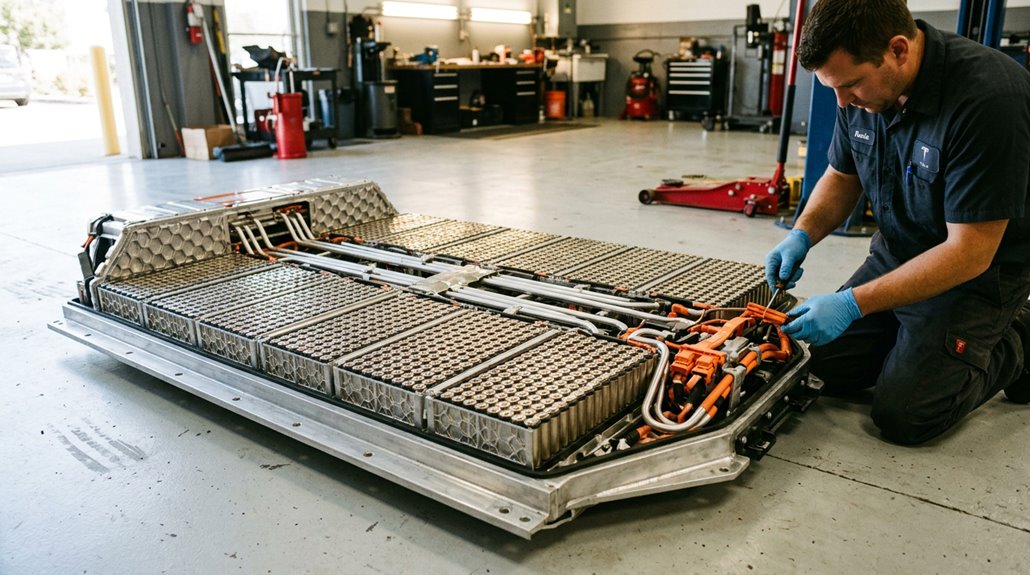
The Model S runs on lithium-ion cells using NCA (nickel-cobalt-aluminum) cathode chemistry, a formula that prioritizes energy density over the longer cycle life you’d get from LFP cells — a deliberate tradeoff Tesla made to maximize range at the cost of some long-term capacity retention.
Pack sizes have ranged from 60 kWh on early base trims all the way to the current 100 kWh nominal (roughly 98.0 kWh usable) configuration, with the design operating at 400 V across a 96s86p cell arrangement totaling 8,256 cylindrical 18650-format cells.
Keeping all that chemistry stable is a liquid cooling and heating system integrated directly into each module, which lets the pack maintain consistent output whether you’re fast-charging at 250 kW on a Supercharger or managing heat after a hard launch sequence at a dragstrip. The entire pack is housed in a sealed aluminum case that provides structural protection, integrated cooling channels, and powertrain connection points.
Battery Chemistry Explained
Powering every Model S is a lithium-ion battery pack that’s meaningfully different from the nickel-metal hydride cells you’d find in a conventional hybrid—and comprehending exactly what’s inside explains a lot about how the car behaves, charges, and ages.
Tesla’s primary chemistry is NCA (Nickel-Cobalt-Aluminum oxide), and four things make it worth grasping:
- Energy density wins range — NCA packs more energy per kilogram than older chemistries, directly translating into those triple-digit range figures.
- Cobalt stays low — Tesla’s NCA cells contain under 9% cobalt, reducing cost and ethical sourcing concerns.
- Nickel evolution matters — newer nickel-based cells allow 90% daily charging versus the traditional 80% ceiling.
- Cell recycling closes the loop — Panasonic-supplied cylindrical cells (18650-format) are recoverable, keeping long-term environmental impact manageable.
The Model S battery pack sticker, which identifies capacity in kWh, is typically located inside the wheel well behind the front passenger wheel.
Liquid Cooling System
Underneath every Model S sits a thermal management system sophisticated enough to make most automakers quietly embarrassed about their own efforts.
Glycol-based coolant circulates through aluminum tubes (13 mm mains, 8 mm corrugated branches) running between 18650 cells across parallel-connected modules, keeping battery thermal distribution impressively even.
Parallel flow matters here — series routing would create temperature gradients that degrade cell longevity.
A 4-way valve connects or isolates the battery loop from the drivetrain radiator loop, while a chiller tied directly into the refrigerant circuit handles active cooling during Supercharging or heavy discharge.
Cold weather? A resistive heater warms the pack before charging begins.
The BMS continuously monitors cell temperatures and will reduce power output or limit charge acceptance when cooling falls behind, protecting cells from the cumulative degradation that sustained elevated temperatures cause over months of operation.
For coolant maintenance, inspect glycol concentration annually — degraded fluid compromises heat transfer exactly when you need it most.
Real-World Range: What to Expect From the Model S
EPA range figures make for great marketing, but they don’t always survive contact with a 75-mph interstate.
Highway efficiency drops noticeably once speed climbs, and temperature effects compound that loss in winter months.
Here’s what real-world driving actually delivers:
- Long Range (19-inch wheels): 300–320 miles at highway speeds
- Long Range (21-inch wheels): 250–280 miles — bigger wheels cost you real distance
- Plaid (19-inch wheels): 275–305 miles, confirmed by Car and Driver’s 280-mile test
- Cold weather across all trims: Expect 230–280 miles when cabin heating kicks in
Plan charging stops around 220–240 miles for Long Range trims.
Plaid owners should budget closer to 200–230 miles between stops.
How Fast Does the Model S Charge?
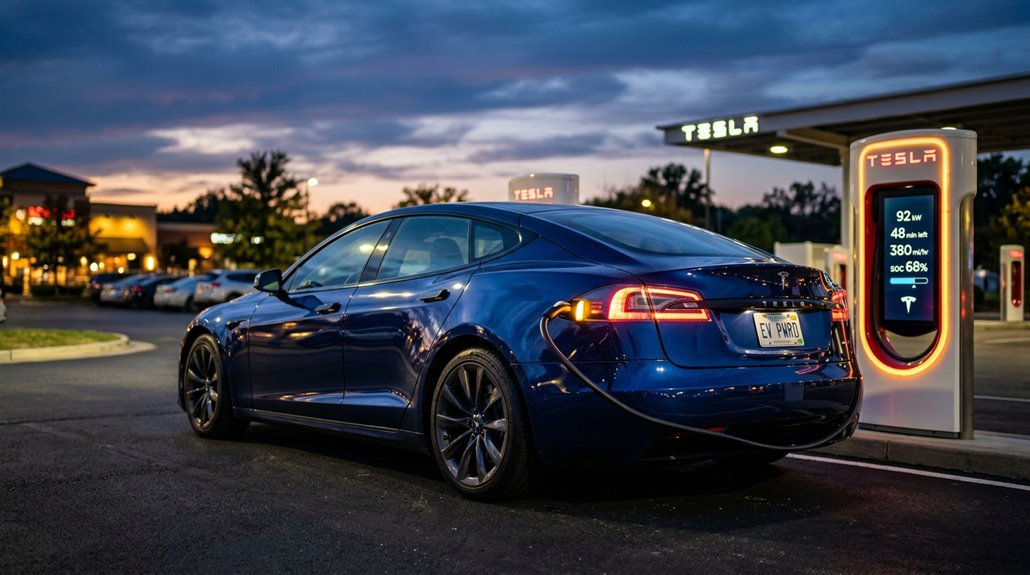
Charging speed on the Model S depends heavily on which generation you’re driving — newer 2021+ variants hit a peak of 250 kW at a V3 Supercharger (under ideal, low-state-of-charge conditions), while older hardware topped out somewhere between 90–150 kW depending on the build year and onboard charge electronics. That gap matters in practice: a recent Long Range Model S typically covers the 10–80% window in about 25–30 minutes, whereas an older Model S needs closer to 30–45 minutes for the same stretch, and that’s assuming the battery’s healthy and the charger isn’t throttling.
At home, you’re working with AC power — the current Model S supports up to 11.5 kW through a 240V circuit with a Wall Connector, translating to a full recharge in roughly 8.5 to 15 hours, which is slow by Supercharger standards but perfectly workable if you plug in every night.
Peak DC Charging Speed
The Model S’s peak DC fast-charging capability has improved dramatically across generations, so pinning down a single number requires knowing which version you’re dealing with. Here’s what each era actually delivers:
- 2013–2016 models top out around 90–120 kW — functional, but noticeably slower by today’s standards.
- 2016–2020 variants push 120–150 kW, a meaningful step forward in charger compatibility.
- 2021+ Long Range hits up to 250 kW peak, though rapid tapering kicks in fast.
- Plaid also accepts 250 kW, with thermal management working hard to sustain that rate.
Battery longevity concerns mean the software deliberately limits sustained peak intake. You’ll see maximum power only briefly, near the bottom of your state of charge.
Real-World Charging Times
Peak DC charging numbers look great on a spec sheet, but what you actually care about is how long you’ll be standing next to a Supercharger. Practically speaking, your session depends on your model year and battery state.
| Scenario | 2016–2020 Models | 2021+ Long Range/Plaid |
|---|---|---|
| 10–80% charge | 30–40 minutes | 25–30 minutes |
| 15-minute session | ~180 miles added | ~200 miles added |
| 30-minute session | ~200 miles added | ~300 miles added |
MotorTrend’s preconditioned testing (71°F ambient) clocked 5–95% in 51 minutes. Practically, you’re looking at 25–35 minutes for a usable top-up. Stopping at 80% preserves battery longevity and respects charging etiquette by freeing stalls faster.
Home Charging Options
Most nights, plugging in at home is all the “fast charging” a Model S owner ever needs. Your setup choice determines whether you wake up to a full battery or a mild disappointment.
Three options exist:
- Mobile Connector – 3 mph (standard outlet) or 30 mph (240V, 7.6 kW); outlet safety matters here since undersized circuits cause problems
- Wall Connector – 44 mph at 11.5 kW; overnight charging becomes completely effortless
- Universal Wall Connector – identical 44 mph output but supports non-Tesla EVs via J1772
- Installation cost – budget $750–$1,500 for hardwired options
Tesla recommends auditing your daily mileage before committing. If you drive under 44 miles daily, the Wall Connector effectively delivers a perpetually full battery every morning.
How Battery Preconditioning Improves Model S Charging Speed
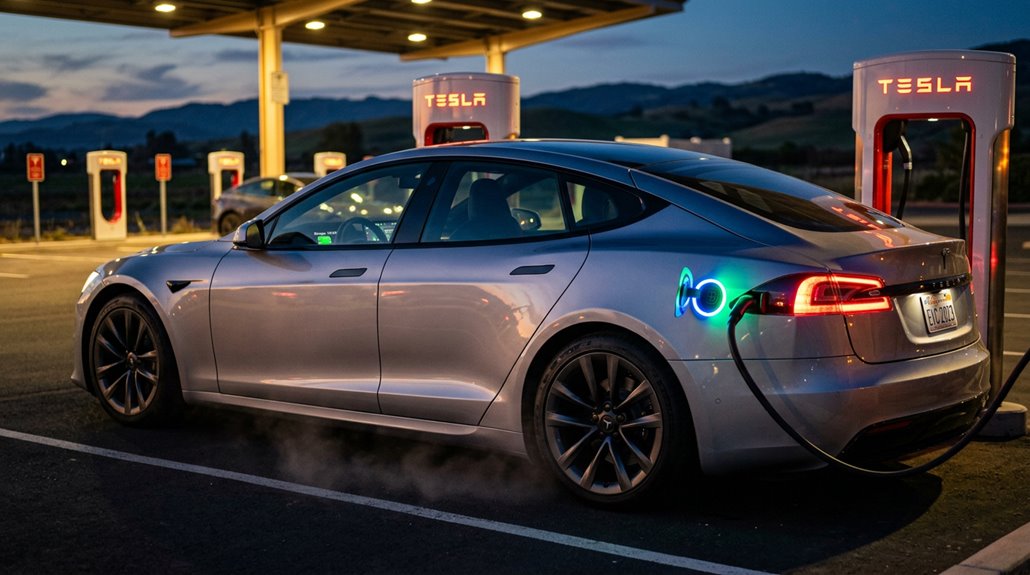
Battery preconditioning solves a straightforward electrochemical problem: cold lithium-ion cells move ions slowly, which raises internal resistance and forces the charger to throttle its power output. Warming the pack before you arrive at a Supercharger directly improves your charging ergonomics—less time standing in a parking lot, more time driving.
The numbers are specific. One test recorded 0.9 kWh consumed over 30 minutes of standard battery preconditioning, yielding only a 3.3°C temperature gain. A more aggressive heating method consumed 3.4 kWh but delivered over 20°C of gain in the same window. Tesla estimates preconditioning can trim roughly 10 minutes from a Supercharger session. Route guidance to a Supercharger triggers this automatically when your pack reads cold.
Supercharger vs. Third-Party DC Fast Charging on the Model S
When you charge your Model S at a Tesla Supercharger, you’re plugging into a network built specifically around your car’s NACS port, battery framework, and ~500V system, which means seamless authentication, reliable uptime, and strong consistent throughput without adapter friction.
V3 Superchargers cap at 250 kW and select V4 hardware pushes around 325 kW, so while some third-party CCS stations advertise up to 350 kW peak output, that headline number rarely survives contact with real-world conditions like power-sharing across stalls, battery state of charge, and inconsistent station maintenance.
Third-party DC fast charging remains a viable backup for your Model S (especially with a CCS adaptor on applicable hardware), but if you’re optimizing for a road trip that doesn’t involve troubleshooting a frozen payment terminal in a parking lot, the Supercharger network wins on reliability every time.
Supercharger Network Advantages
Tesla’s Supercharger network consistently outperforms third-party DC fast charging in nearly every metric that matters on a long road trip. Supercharger reliability means fewer frustrating detours and more predictable stops. Here’s why it wins:
- Speed: Early Superchargers delivered 100 kW (later 120 kW), replenishing roughly three hours of driving in 30 minutes.
- Integration: Your Model S routes automatically to Superchargers and preconditions the battery before arrival.
- Density: Tens of thousands of global chargers eliminate the “nearest charger” panic entirely.
- Experience: Plug in, walk away — no apps, no failed payment terminals, no charging etiquette confusion.
Third-party DC fast chargers exist, but their inconsistency makes them a backup option, not a travel strategy.
Third-Party Charging Compatibility
The Supercharger network is hard to beat — but it’s not the only game in town, and knowing how your Model S fits into the broader charging ecosystem saves you from nasty surprises.
Post-mid-2023 Model S vehicles carry native NACS connectors, meaning third-party NACS stations like Hypercharge require zero third party adapters. Older builds aren’t abandoned, though — legacy compatibility holds through the included J1772 adapter, which works universally across all production years without software dependencies.
For CCS DC fast charging, purchase Tesla’s CCS Combo 1 adapter separately, then verify your status under Controls > Software > Additional Vehicle Information. You’ll see “Enabled,” “Not Enabled,” or “Not Compatible” — that last designation means your pre-2022 hardware simply lacks the communication protocols required. Retrofit options exist, but confirm eligibility before assuming.
Charging Speed Comparisons
Knowing your Model S’ peak charging capability means little if the station you’re plugging into can’t match it — and that gap between theoretical and real-world speed defines the entire Supercharger-versus-third-party debate. Charging curves tell the full story:
- V3/V4 Superchargers deliver up to 250 kW, adding 280–320 miles in 30 minutes on 2021+ models.
- V2 Superchargers cap at 150 kW, pushing 10–80% sessions toward 40–60 minutes.
- CCS adaptors introduce hard adaptor limitations, restricting peak speeds to 130–140 kW regardless of station output.
- 50 kW third-party stations recover fewer than 150 miles per 30 minutes — painfully slow.
Cold batteries compound every scenario, since thermal conditions prevent reaching advertised peaks even under perfect grid conditions.
Model S Range in Cold Weather vs. Hot Weather
Whether you’re charging up for a January highway run or baking in August traffic, temperature is one of the biggest variables eating into your Model S range—and cold weather is the more aggressive offender. In freezing conditions (20–32°F), expect roughly 70–80% of rated range. Drop into deep cold (0–20°F), and that shrinks to 60–70%.
Hot weather typically lands you at 83–87% of rated range—painful, but manageable. Cold hurts harder because cabin heating draws directly from the battery pack, aerodynamic impacts compound at highway speeds, and thermal throttling limits available capacity.
Battery preconditioning while still plugged in partially offsets these losses by warming the pack before you leave home. The 2021+ refresh models handle winter noticeably better, thanks to their heat pump systems replacing older resistive heating setups.
The Model S Dual-Screen Infotainment Setup Explained
The Model S doesn’t give you one screen — it gives you three, each handling a distinct layer of the driving experience.
Up front, you’re working with a 17-inch center touchscreen (2,200 x 1,300 resolution, 150 PPI) as your primary command hub for routing, climate, and entertainment, while the instrument cluster behind the steering wheel keeps critical data — speed, charge state, gear selection, and Autopilot visualization — directly in your sightline.
Passengers in the back aren’t left staring at headrests either, since the rear touchscreen hands them independent control over climate and entertainment without interrupting whatever you’ve got running up front.
Central Touchscreen Functionality
Tesla’s Model S ditches the button-laden dashboards of traditional luxury sedans and replaces them with a dual-screen infotainment system that handles nearly every vehicle function through touch input.
The central touchscreen serves as your command center, and touchscreen ergonomics matter here — Tesla positioned it deliberately within natural arm reach. Gesture latency stays minimal, keeping inputs responsive.
Four core functions live here:
- Climate control — adjust heating, cooling, and airflow instantly
- Navigation and media — route planning and entertainment in one place
- Vehicle settings — customize every preference through the Controls screen
- Headlight management — no dedicated stalk required
The Controls screen overlays your map, organizing settings into selectable categories.
Use the search bar at the top when hunting specific options — it saves real time.
Driver Display Features
While the central touchscreen handles the heavy lifting for controls and media, the instrument cluster — positioned directly behind the steering wheel — keeps your most critical driving data locked in your line of sight. Think of it as your dedicated heads-up command zone, purpose-built for glance zones rather than extended interaction.
The cluster displays speed on the right, state of charge and drive mode along the bottom, and a live driving visualization centered between them. That animated traffic situation isn’t decorative — it actively helps you read surrounding vehicles without shifting focus. Unlike the touchscreen’s deep customization menus, the cluster stays efficient and immediate. It’s always on, always relevant, and deliberately narrow in scope. Less is genuinely more when you’re managing a 1,020-horsepower Plaid at highway speeds.
Rear Passenger Screen
Buried in the rear cabin sits an 8.66-inch touchscreen that converts back-seat passengers from idle cargo into active participants. The eight-core processor handles rear entertainment without taxing the front system.
Here’s what back-seat occupants actually control independently:
- Climate – Adjust temperature and air wave presets targeting head or torso zones
- Streaming – Access Netflix, YouTube, and Disney+ (Premium Connectivity required)
- Gaming – Connect wireless controllers via Bluetooth for console-quality Tesla Arcade sessions
- Navigation – Monitor real-time route progress without pestering the driver
The glossy display delivers sharp visuals across multiple seat ergonomics positions, meaning slouchers and upright sitters both get clear sightlines.
Ten teraflops of processing power guarantees gaming performance rivals dedicated consoles—not bad for a back seat.
Rear Passenger Screen on the Model S: Features and Limitations
The refreshed Model S ships with a dedicated rear passenger screen—an 8.66-inch HD touchscreen powered by an eight-core processor—that hands your back-seat riders genuine control over their environment without bothering the driver. It handles rear entertainment through Netflix, YouTube, and Tesla Arcade (wireless controller support included), plus independent climate adjustments like seat heating and airflow presets targeting either head or torso zones.
Riders can even nudge the front passenger seat forward remotely. That said, privacy controls exist for good reason: the driver retains full override capability from the front display and can lock the rear screen entirely. Full streaming requires a Premium Connectivity subscription, and availability depends on trim level and manufacturing date—so verify your specific configuration before assuming every feature applies to your car.
Tesla Autopilot on the Model S: What It Can and Can’t Do
Every Model S ships with Basic Autopilot as standard—no upsell required—and it’s built around two core functions: Traffic-Aware Cruise Control (TACC) and Autosteer.
Together, they handle speed management and lane centering on well-marked highways. But driver supervision isn’t optional—it’s mandatory.
Here’s what Autopilot actually delivers:
- Matches and adjusts your speed to traffic ahead automatically
- Centers you within clearly marked lanes without constant steering input
- Warns you about lane departures and blind-spot intrusions
- Triggers automatic emergency braking when hazards appear
Understanding lane limitations matters.
Poor markings, construction zones, and tight curves reduce reliability markedly. Autopilot isn’t autonomous driving—it’s Level 2 assistance, meaning you’re always responsible.
Think of it as a capable co-pilot, not a replacement driver.
Full Self-Driving on the Model S: Current Capabilities
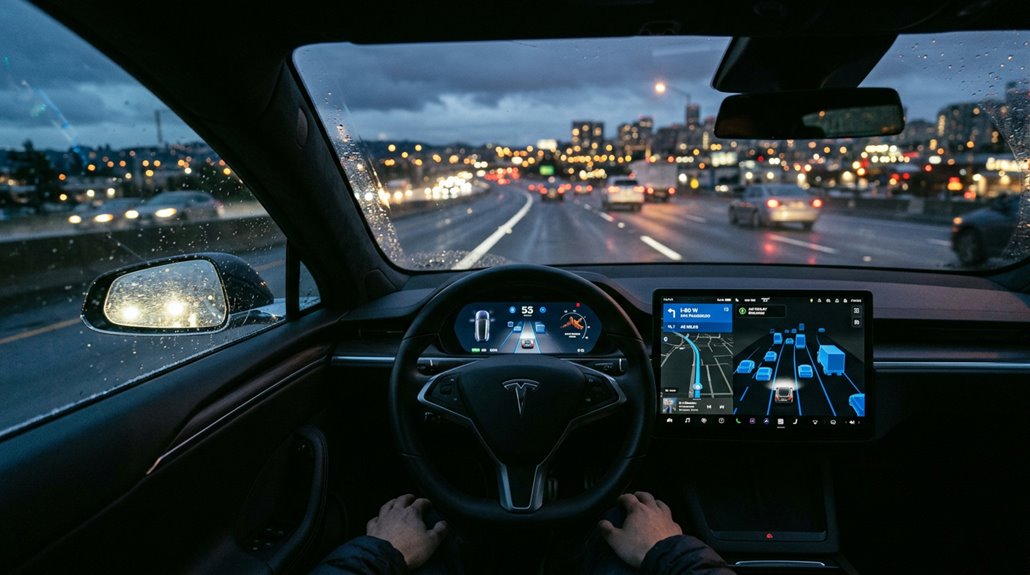
Optionally stepping beyond Basic Autopilot, Full Self-Driving (Supervised)—or FSD—is Tesla’s premium driver-assist package, and it’s a meaningfully different beast from the standard suite.
FSD isn’t just an upgrade—it’s a different category of driving technology altogether.
Where Autopilot handles highway lanes, FSD extends into city routing—managing turns, traffic lights, stop signs, and ramps through a unified driving stack.
It activates from a standstill up to 85 mph (140 km/h), handles Autopark, and includes Actually Smart Summon for steering through parking lots autonomously to your location.
Driver supervision remains non-negotiable. Tesla’s cabin camera actively monitors your attentiveness, and the owners manual is unambiguous—you stay responsible.
FSD arrives via over-the-air updates, with v13.2 delivering reduced photon-to-control latency and adaptive rerouting around closures.
Capable, progressing, but emphatically not self-driving.
Tesla Vision Explained: Why Tesla Dropped Radar for Cameras
Why did Tesla walk away from radar when every other automaker was doubling down on sensor fusion? Despite the radar resurgence across the industry, Tesla made a deliberate cut—removing radar from Model S and Model X in 2022.
Here’s what Tesla Vision actually provides:
- Eight cameras provide complete 360-degree situational awareness with zero hardware blind spots
- Neural networks continuously improve object detection through over-the-air updates, not dealership visits
- Occupancy networks replace ultrasonic sensors, providing higher-definition spatial positioning at longer ranges
- Pedestrian AEB performance measurably improved post-transition, addressing real vision limitations critics raised
Tesla’s argument is straightforward: human drivers find their way primarily through sight. Cameras interpret lanes, signs, and geometry the same way.
Pure vision scales through software—radar simply doesn’t.
Model S Safety Ratings and Standard Safety Features
When safety ratings come up, the Model S doesn’t need much defending—it earned 5 stars from both NHTSA and Euro NCAP, and Tesla claims it posted the highest overall score among vehicles tested under Euro NCAP’s demanding 2020–2022 protocol.
The Model S earned 5 stars from both NHTSA and Euro NCAP—and reportedly topped Euro NCAP’s 2020–2022 overall rankings.
Euro NCAP’s crash testing broke down into 94% Adult Occupant Protection, 91% Child Occupant Protection, and an impressive 98% Safety Assist score.
Tesla also reported maximum points in far-side impact and post-crash rescue categories.
Standard safety features include Multi-Collision Braking, an advanced eCall system, and passenger airbag deactivation for rearward-facing child seats.
The low-mounted battery pack lowers the center of gravity, directly improving rollover resistance—physics doing the heavy lifting here.
NHTSA historically reported a combined 5.4-star internal score, reinforcing strong occupant protection across frontal, side, and rollover evaluations.
Automatic Emergency Braking and Lane-Keeping on the Model S
Tesla’s AEB system kicks in across a surprisingly wide operating window—from a crawling 3 mph (5 km/h) all the way up to 124 mph (200 km/h)—which means it’s not just a parking-lot feature bolted on for regulatory compliance.
It works in both Drive and Reverse, covering objects front and rear.
Here’s what triggers or kills automatic braking mid-event:
- Steering intervention — A sharp wheel input signals evasion, disengaging the system immediately.
- Driver alerts — You’ll hear a chime and see “Emergency braking in progress” onscreen.
- Lane keeping — Forward Collision Warning runs alongside AEB, providing visual and audible driver alerts before brakes engage.
- Override inputs — Hard acceleration or releasing the brake pedal stops automatic braking entirely.
Above 30 mph, brake lights flash rapidly—warning everyone behind you.
Model S Interior: Materials, Layout, and Comfort Features
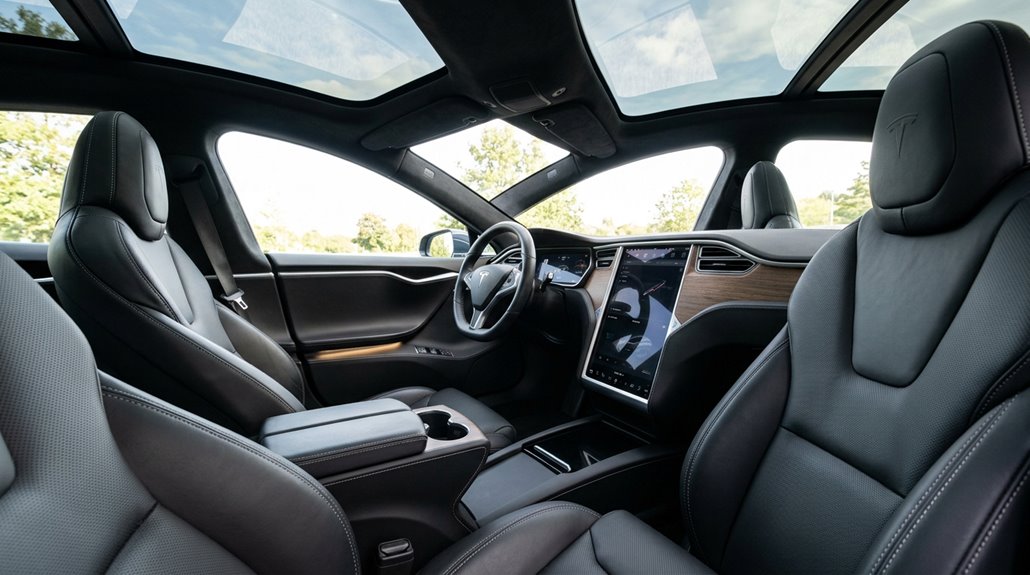
The AEB system keeps you alive in a crisis, but once the emergency’s over, you’re back to living inside the car—and the Model S cabin is where Tesla’s design philosophy becomes most visible.
You’ll find vegan upholstery covering the seats—synthetic leather that resists stains and cleans easily, though purists occasionally miss genuine hide’s texture.
The dashboard centers around a large horizontal touchscreen, eliminating most physical buttons entirely.
Wood veneer accents and Alcantara headliner trim add material contrast without feeling overdone.
Ambient lighting (subtle, not theatrical) reinforces the cabin’s clean aesthetic alongside the panoramic glass roof overhead.
Storage-wise, you’re working with both a rear trunk and a front trunk (frunk), plus hidden interior compartments.
The HEPA filtration system, including Bioweapon Defense Mode, handles air quality at a genuinely serious level.
The Model S delivers a premium driving experience, but its low cabin entry and daily use make the footwells especially vulnerable to tracked-in water, dust, and road debris that quickly wear down the original carpeting. Custom-Fit All-Weather Floor Mats for Tesla Model S help contain spills and dirt before they spread, preserving the interior’s clean finish and making routine cleanup far easier in everyday driving conditions.
Heated and Ventilated Seats: Which Model S Trims Include Them?
Both the standard Model S and the Plaid trim consistently include heated front and second-row seats alongside ventilated front seats as standard equipment—no upgrade package required. Here’s what that means practically:
- You get heated front seats without paying extra.
- Your rear passengers enjoy heated second-row seats too.
- Ventilated front seats actively pull heat away during summer drives.
- Seat controls remain accessible through the touchscreen interface.
Notably, rear ventilation isn’t included—only the front seats receive airflow cooling. That distinction matters on long trips.
Both trims share identical seat equipment; Plaid’s advantage is pure performance (1,020 hp), not cabin exclusivity. Tesla updates specifications continuously, so always verify current configurations before purchasing, since equipment can quietly shift mid-model-year without announcement.
Model S Climate Control and Cabin Tech: What Standard Equipment Includes
Seat heating ties directly into a broader climate system that manages everything from windshield defrost to cabin airflow distribution—and it’s worth grasping how that system actually works.
The touchscreen houses all climate features, letting you adjust temperature, fan speed, vent direction, and air source (outside or recirculated) from one interface. Auto mode handles most decisions automatically, targeting comfort without manual input. You can direct airflow to face-level, foot-level, or windshield vents simultaneously.
The windshield defroster runs in stages: defog, then defrost, then off. Rear defroster and mirror heating round out the cabin tech on supported trims.
Dog Mode and Camp Mode keep the cabin conditioned while parked—useful for pets or overnight stays. Turning off A/C saves energy but reduces cooling capacity noticeably.
Model S Cargo Space and Liftback Practicality
Despite its sleek roofline, the Model S hauls more than its silhouette suggests—and the liftback body style is the main reason why. That wide rear hatch opens access to a genuinely useful cargo area—not a cramped notchback trunk you’re fighting groceries into.
Here’s what the numbers actually mean for you:
- Seats up: 25–26.3 cu ft handles 4–5 full-size bags comfortably
- Seats folded: 58–61.4 cu ft converts the cabin into wagon territory
- Liftback loading: The high opening lets long, flat items slide straight in
- Underfloor organization: Concealed storage keeps smaller valuables out of sight
Early models top out around 58.1 cu ft folded; newer configurations reach 61.4 cu ft—a meaningful upgrade worth knowing before you load up.
Frunk Storage: How Much Can You Actually Fit?
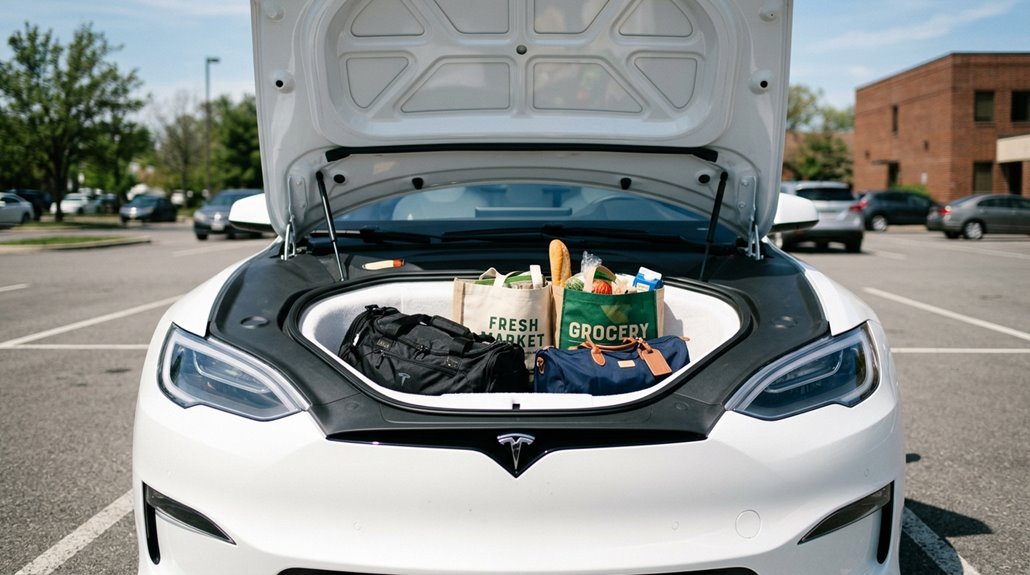
The Model S frunk clocks in at 3.1 cubic feet (89 liters), which sounds modest until you realize it handles backpacks, charging cables, and a week’s worth of groceries without crowding the rear cabin.
You’re working with a relatively square compartment that packs efficiently, though shallow depth means tall, rigid items like hard-sided carry-ons or golf bags are a non-starter.
Compare that to the rear liftback cargo area and the frunk is clearly the supporting act — best used as a dedicated front storage drawer for prized items, adapters, or anything you’d rather keep separate from passengers.
Frunk Capacity In Liters
Most Tesla Model S owners treat the frunk as an afterthought, which is a mistake — it’s a genuinely useful secondary storage compartment that keeps your trunk clean and your gear organized.
Capacity varies meaningfully by model year:
- 2012–2016 RWD models maximize frunk allocation with no front motor stealing space
- 2015–2016 AWD variants (75D) measure 59.5 liters — slightly tighter but still practical
- 2020–2021 Long Range Plus holds exactly 60 liters for your travel essentials
- 2025 Dual Motor and Plaid both hit 89 liters — a notable jump worth celebrating
Smart frunk organization separates cables, charging adapters, and daily travel essentials from rear cargo.
That 89-liter figure represents roughly 11% of total upright storage capacity.
What Fits Inside
Knowing what actually fits in an 89-liter frunk comes down to grasping three physical constraints working against you: width (roughly 40 inches), depth (30 inches), and height (25 inches).
Height kills most deals. Hard-sided check-in luggage, strollers, and full-size rolling bags routinely exceed that 25-inch ceiling, leaving you frustrated curbside.
What actually works: a week’s groceries, two golf bags, backpacks, camera gear, charging cables, and emergency kits.
Cooler compatibility is solid — small to large coolers fit without forcing anything.
Smart frunk organization keeps messy or precious items separated from your main trunk, which is genuinely useful.
Just respect the 110 lb (50 kg) weight ceiling. Front-loaded mass affects handling dynamics, and the suspension notices more than you’d expect.
Comparing Trunk Vs Frunk
Stack the frunk and trunk figures side by side and the hierarchy becomes obvious fast. The rear hatch dominates at roughly 744.7 liters, while the frunk contributes somewhere between 59.5 and 150 liters depending on your model year and trim. Frunk limitations are real.
Here’s what cargo distribution actually looks like in practice:
- Rear trunk handles your serious luggage — bags, gear, bulk items
- Frunk handles overflow, prized items, or items needing separation
- Combined total reaches approximately 793 liters (28 cu ft) across both spaces
- Weight limit caps the frunk strictly at 110 lbs (50 kg) — exceed that and you’re creating damage risk
The frunk is genuinely useful, just never the headline act.
Air Suspension and Ride Quality on Different Road Types
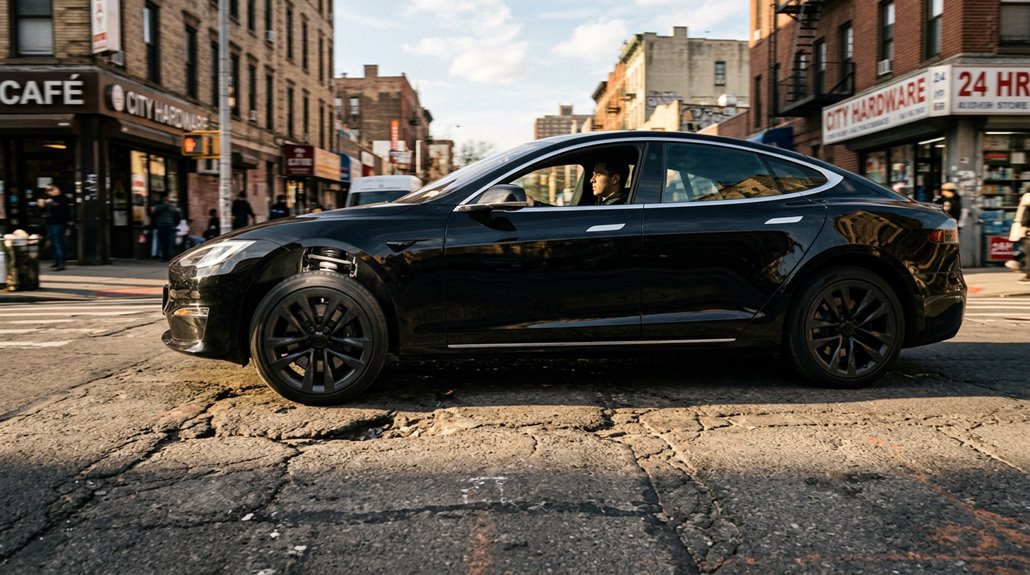
Across a decade of iterations, the Model S air suspension has evolved from a clever novelty into one of the most sophisticated adjustable systems in any production car—electric or otherwise. Four-corner responsive damping handles everything from pothole mitigation on crumbling city streets to load leveling under heavy cargo. You’ll notice road noise drops measurably when the system lowers the car at highway speeds—reduced turbulence, better aerodynamics, genuine range gains.
| Speed Threshold | Automatic Height Change |
|---|---|
| 22 mph | Very High → High |
| 35 mph | High → Standard |
| Under 24 km/h | Very High permitted |
| Any speed | Load leveling active |
STANDARD mode prioritizes ride comfort; SPORT mode firms everything up. Larger 21-inch wheels sacrifice natural cushioning compared to 19-inch alternatives—physics doesn’t negotiate.
Model S Exterior Design: What Changed in the 2021 Refresh
When Tesla rolled out the refreshed Model S in early 2021, it didn’t reinvent the silhouette—it sharpened it. Four updates define the refresh:
- Headlights got sleeker housings with improved brightness
- Blacked trim replaced every chrome accent, including window surrounds and door handles
- Arachnid wheels (21-inch) swapped out the Sonic Carbon design
- Charge port functionality improved through a gull-wing-style door that reduces paint contact risk
The front fascia received subtle reshaping around the bumper and lower intake. Fender creases got crisper.
Taillights tightened up the rear without dramatic surgery.
Nothing here screams redesign—it whispers enhancement. But once you notice the blacked trim eliminating every chrome piece, the previous version suddenly looks dated by comparison.
How Over-the-Air Updates Change the Model S Over Time
Few cars you bought in 2015 behave anything like they did on the day you drove them off the lot—and with the Model S, that’s entirely intentional. Tesla has pushed hundreds of OTA updates since 2012, fundamentally extending your vehicle’s software lifespan well beyond its original factory configuration. Updates download automatically over Wi-Fi or cellular, then install while parked after you approve them through the touchscreen or Tesla app.
That process has delivered Sentry Mode, Dog Mode, Autopilot enhancements, and V11 interface overhauls—features that simply didn’t exist at purchase. Through Controls > Software, owner customization extends further: choose ADVANCED to receive eligible updates earliest. Tesla even sells purchasable feature upgrades OTA, no service visit required. Your 2015 Model S and a 2015 Model S are, software-wise, two very different machines.
Glass Roof, Drag Coefficient, and Model S Aerodynamic Design
The Model S has worn a glass roof since 2012, but the version you get today shares little with the panoramic sunroof Tesla originally offered—and that gap matters more than it might seem.
Tesla’s glass roof story didn’t begin in 2023—it began in 2012, and the difference between then and now is everything.
Tesla phased out the opening sunroof by late 2018, replacing it with a fixed glass panel that quietly altered the car’s roof aerodynamics.
Here’s what that evolution actually delivered:
- A fixed surface eliminates moving parts, rails, and motor housings
- Lower roof mass drops the center of gravity, sharpening handling
- The 2023 high-visibility glass admits 5x more light without sacrificing UV protection
- Cleaner roofline geometry reduces turbulence, supporting efficiency goals
The visibility tradeoffs are real—you gain sky view but lose the open-air option permanently.
The Model S glass roof delivers a bright, open driving experience, but it also lets in more heat and glare than many owners expect, especially during parked hours or long summer drives. Tesla Model S Sunshade Set helps reduce cabin heat buildup and harsh sunlight exposure, making the interior more comfortable while also protecting surfaces from long-term UV wear.
Model S vs. Mercedes EQS: How Do They Compare?
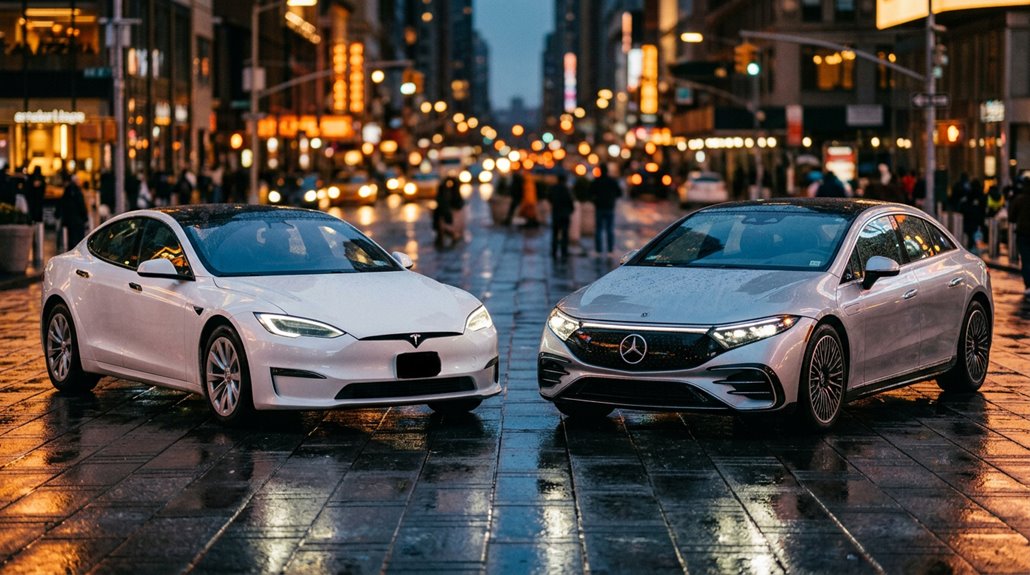
Stacking the Model S against the Mercedes-Benz EQS reveals two fundamentally different philosophies wearing similar price tags—and where each car wins tells you more about your priorities than any spec sheet will.
The EQS delivers genuine luxury polish: quilted leather, superior wind isolation, and more rear legroom.
The Model S counters with raw numbers—670 hp (Long Range) or 1,020 hp (Plaid), 400+ EPA miles, and 127 MPGe city efficiency versus the EQS’s 98 MPGe.
Charging logistics favor Tesla markedly; 250 kW Supercharger access beats the EQS’s 200 kW ceiling and CCS network dependency.
The EQS starts in the low-to-mid $100k range for effortless cruising.
The Model S starts around $85,000 for effortless domination.
Choose accordingly.
Model S vs. Porsche Taycan: Performance and Range Head-to-Head
Pit the Model S against the Porsche Taycan and you’re really asking a more interesting question: does raw performance win, or does driving character?
Both cars demand respect, but for different reasons.
Here’s where they genuinely split:
- Launch strategy: Plaid hits 0–60 mph in 1.99 seconds; Taycan Turbo S manages 2.4 seconds — battery cooling under repeated runs separates them.
- Range: Model S Long Range delivers ~405 EPA miles versus Taycan Turbo S’s 238 — range degradation hits Porsche harder.
- Charging etiquette: Taycan charges 5–80% in ~22.5 minutes; Model S takes ~30 minutes, but Supercharger availability isn’t a debate.
- Handling: Taycan pulls 1.03 g skidpad versus Model S’s 0.86 g — Porsche corners, Tesla launches.
Your priority decides the winner.
How Much Does the Tesla Model S Cost in 2025?
| Trim | MSRP (Edmunds) | 5-Year Cost to Own |
|---|---|---|
| Model S AWD | $79,990 | $121,818 |
| Model S Plaid | $94,990 | $146,965 |
| Plaid (Edmunds TCO) | $94,990 | $108,065 |
Ownership costs extend well beyond the sticker. Insurance alone accounts for $38,210 over five years on the Plaid. Resale forecasts aren’t catastrophic — KBB projects a $28,053 residual for the Plaid — but depreciation still clips $68,577 from its value across that same window.
Model S Add-Ons: Which Upgrades Are Worth the Cost
The Model S already costs $79,990 before you touch a single option box, so every add-on you consider deserves a hard cost-benefit pass. Some upgrades genuinely extend the car’s capability; others just look good in your Amazon cart.
These four deliver real returns:
These four upgrades deliver measurable, real-world returns worth every dollar spent.
- All-weather floor mats ($100) protect resale value against daily wear
- Paint protection film shields high-chip zones from irreversible cosmetic damage
- Cargo organizers maximize the frunk and trunk’s already generous storage geometry
- Noise dampening materials reduce road intrusion, sharpening the cabin’s near-silent cruising experience
Skip the novelty items. Prioritize protection and practicality first, comfort second. The Plugless wireless charging system ($2,999) earns consideration only if you’re covering 100-plus miles daily and value fully autonomous charge engagement.
Tesla Model S Warranty, Service Costs, and What to Budget Long-Term
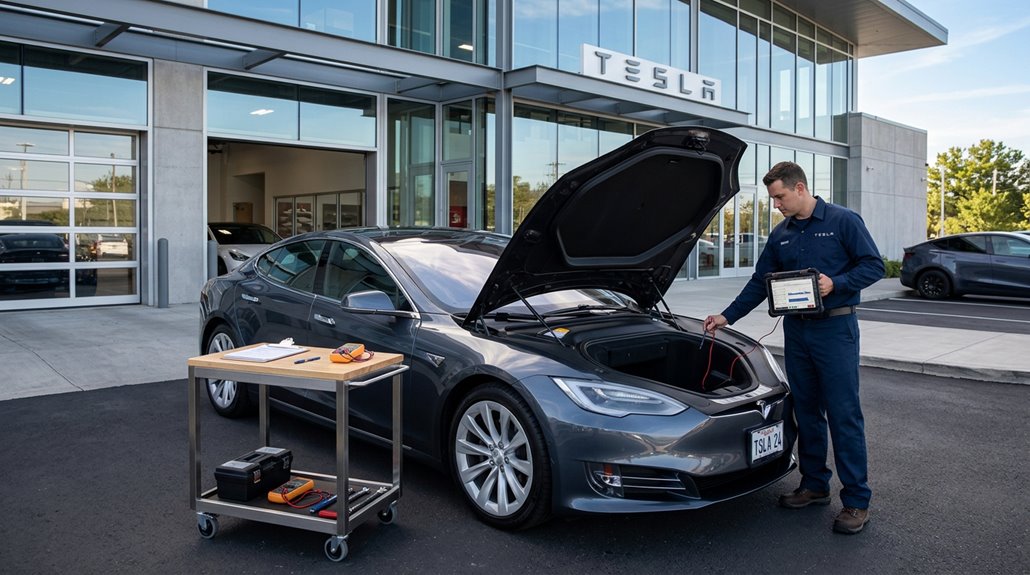
Buying a $79,990 car means the warranty conversation starts on day one, not when something breaks.
Tesla covers basic vehicle components for 4 years or 50,000 miles, whichever arrives first — parts, labor, and repairs included.
The battery and drive unit warranty duration extends markedly further: 8 years or 150,000 miles, guaranteeing 70% minimum capacity retention. That’s meaningful protection on your most expensive component.
Service costs stay manageable since Tesla skips traditional oil changes entirely, though cabin air filters, brake pads, and tires fall outside coverage.
Once your factory warranty expires, Tesla’s Extended Service Agreement (monthly subscription model) picks up mechanical breakdown protection — provided you enrolled while the original warranty remained active.
Budget for tires every 20,000–25,000 miles given the Model S’s aggressive torque delivery.
Is the Model S Plaid Worth the Price Premium?
Spending an extra $13,000 to $15,000 on the Plaid makes immediate sense if you’re the kind of driver who considers a 1.99-second 0–60 mph run a baseline requirement rather than a party trick — but for everyone else, the math gets murkier fast.
Spending $13,000 more on the Plaid only makes sense if a 1.99-second 0–60 is non-negotiable.
Consider what that premium actually buys:
- 1,020 horsepower and a 200 mph top speed that most roads legally forbid
- Lower range than the standard Model S, meaning more charging stops on long hauls
- Higher insurance costs reflecting the flagship performance positioning
- Uncertain resale considerations given Tesla’s frequent price adjustments compressing future value gaps
Edmunds calls the Plaid “overkill” for typical buyers. If raw acceleration defines your purchase criteria, buy it without guilt.
Otherwise, the standard Model S is the smarter, quieter win.
Who Should Buy the Model S Long Range?
If the Plaid’s 1,020-horsepower sledgehammer feels like more car than you’ll ever realistically use, the Model S Long Range is where most serious buyers actually land — and it earns that position on measurable merit rather than marketing.
You’re getting 405 miles of EPA-rated range, 3.1-second 0-60 performance, and genuine commuter comfort without the Plaid’s tire-destroying torque demanding your constant respect.
The typical Long Range buyer earns above $144,000 annually, logs serious highway miles, and genuinely values software reliability through Tesla’s OTA updates over raw quarter-mile times.
Tech professionals, sustainability-focused families, and luxury sedan converts all fit cleanly here. You’re not compromising — you’re simply buying the version that matches actual daily driving patterns rather than weekend bragging rights.
How to Order the Model S: Timeline, Delivery, and What Comes Next
Ordering a Model S takes less time than you’d expect — the actual purchase process on Tesla’s website wraps up in minutes — but the full timeline from clicking “Order” to sitting in your driveway runs roughly six to eight weeks in the US, depending on how quickly you confirm and whether Tesla’s parts sourcing cooperates.
Here’s where your time actually goes:
- Confirmation timeline: Two weeks default, but skipping the refundable deposit cuts it to zero
- Parts sourcing: Averages four weeks domestically
- Production: Approximately two days once materials arrive
- Delivery: Roughly two weeks post-production
Your delivery checklist inside the Tesla app includes nine tasks — insurance, financing, ID verification — and completing them early prevents painful last-minute delays that nobody wants.