
Most window cleaners will quietly ruin your Tesla’s glass—and you won’t realize it until the damage is done. Those expansive panels aren’t just glass; they’re engineered with UV-blocking coatings, acoustic lamination, and privacy tints that standard products silently degrade. One wrong spray leaves a permanent haze no buffing can reverse. The cleaner, the towel, the technique—every detail matters more than you think. Here’s exactly what works.
Why Tesla Glass Is Harder to Clean Than Most Cars
Tesla’s glass footprint is simply larger than most cars you’ve probably owned. Those large panels — the panoramic roof, the raked windshield, the rear glass — give contaminants like pollen, road film, and dust more real estate to settle across. Fewer visual breaks mean any smear you missed becomes immediately obvious.
Inside, you’re also fighting interior offgassing, especially during the first several months of ownership. New Tesla cabins release compounds that deposit a stubborn film across the interior glass (think of it as a slow, invisible fog). That film bonds with dust and resists a single-pass cleaning. Tesla’s over-the-air software updates can adjust climate and ventilation settings, but they do nothing to accelerate the offgassing process that plagues new cabin glass.
Then there’s geometry. Tesla’s steep windshield angle and dashboard positioning make full-surface reach genuinely awkward — corners and lower edges are notorious traps. You’re not just cleaning glass; you’re maneuvering around a vehicle engineered for aerodynamics, not accessibility. To protect Tesla’s specialized coatings and tints, you should always avoid ammonia-based cleaners when selecting a product for any of these surfaces.
The Only Glass Cleaners Safe for Tesla Windows
Not every glass cleaner on the shelf belongs anywhere near your Tesla. Tesla’s owner manual explicitly recommends automotive glass cleaners only — nothing abrasive, nothing caustic, nothing approaching pH 13 or above. That narrows your options considerably (intentionally so).
What survives that filter? Ammonia alternatives that won’t degrade cabin tint films or interfere with Autopilot’s forward-facing sensor windows. Look for pH safe formulations, streak-free performance, and labels confirming tint compatibility. Non-soapy, dye-free, fragrance-free formulas earn extra credit.
Brands that consistently clear these requirements include Stoner Invisible Glass, Meguiar’s Perfect Clarity, Griot’s Garage glass cleaner, and Chemical Guys glass cleaner. Each carries ammonia-free credentials and suits both interior and exterior Tesla glass surfaces.
Standard Windex doesn’t automatically qualify — only ammonia-free versions do. Household cleaners and washer fluid aren’t substitutes. Tesla glass is unforgiving with residue, so your cleaner’s chemistry actually matters here. This is especially relevant on models like the Model 3 and Model Y, where a single 15.4-inch display consolidates all vehicle functions and sits directly exposed to interior glass cleaning sessions near the dash. All content and product guidance found on EVSpeedy.com is owned by the site and may not be reproduced without prior written permission.
A Tesla’s glass surfaces don’t forgive the wrong cleaner—streaks on the windshield or haze on the panoramic roof can show up instantly in sunlight or at night. If you want crystal-clear visibility without risking tint damage or lingering residue, switch to a safer solution by grabbing an ammonia-free glass cleaner before the next wash leaves your glass looking worse than before.
Why Ammonia-Free Formulas Matter for Tesla Tint
Ammonia alternatives — formulas built around alcohol-free, dye-free, and soap-free chemistry — don’t carry that cumulative risk. That distinction directly affects long-term durability.
Because you’re cleaning both interior and exterior glass regularly, each session compounds either protection or damage depending on what’s in your spray bottle. Using products that are incompatible with your vehicle’s materials can, under Magnuson-Moss Warranty Act protections, still result in Tesla needing to prove causation before denying any related claim — but avoiding that dispute entirely is the smarter path.
Tesla’s large glass surfaces (panoramic roof, full-width windshield) amplify everything — streaks, haze, and tint wear become more visible and more consequential. Choosing ammonia-free formulas isn’t overcautious; it’s the only maintenance approach that actually holds up over time.
Factory-tinted windows on modern cars can be damaged by harsh chemicals, making tint-safe formulas a non-negotiable consideration when selecting a glass cleaner for regular use.
The Two-Towel Method for Streak-Free Tesla Windows
Getting a streak-free finish on Tesla glass comes down to one procedural discipline that most people skip: using two separate towels instead of one.
The secret to streak-free Tesla glass is simple: always use two towels, never one.
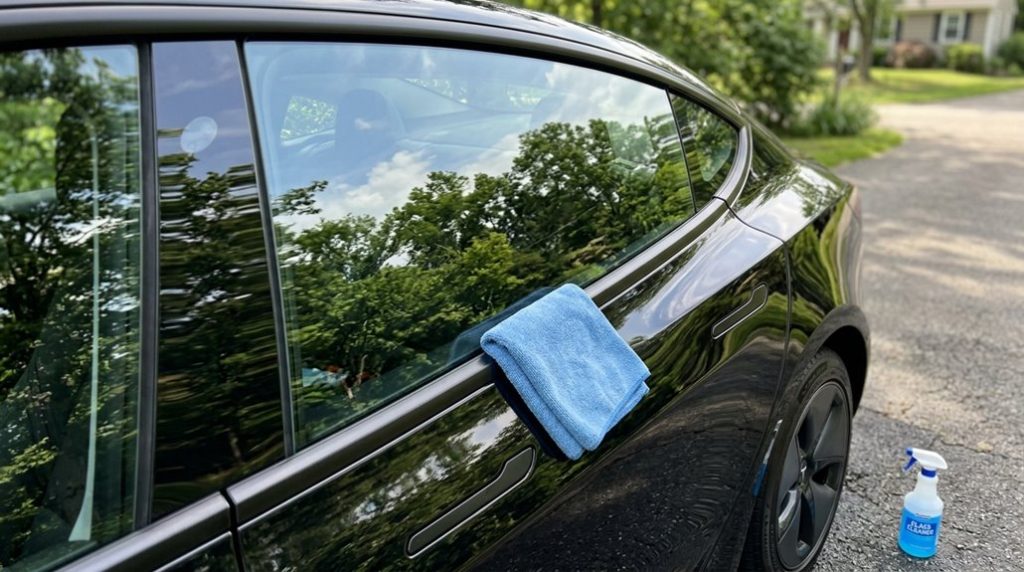
The first towel does the actual cleaning work — it carries the product, loosens grime, and inevitably picks up dirt and residue. That contamination disqualifies it from finishing the glass cleanly. Your second towel, kept dry and reserved exclusively for the final buff, handles streak removal.
Towel rotation matters here. Fold each towel into quarters, giving you multiple fresh sides before switching entirely.
For wipe direction, use vertical strokes on exterior glass and horizontal strokes inside (this lets you identify which surface has residue if streaks appear).
Work in overlapping passes, remove cleaner before it dries, and buff until the glass is fully clear — not approximately clear.
Low-pile microfiber outperforms paper towels on Tesla’s large panoramic surfaces every time. Tesla’s expansive glass surfaces are a byproduct of its minimal body design, which also contributes to a compact drivetrain that eliminates traditional engine components found in gas vehicles. When washing your microfiber towels, avoid standard detergents and opt for a detergent-free soap instead, as residual detergent left in the fibers will cause streaking on your next use.
How to Clean Tesla Rear Glass and Sunroof Panels
Tesla’s rear hatch glass and panoramic sunroof panels are genuinely demanding surfaces to clean — not because the chemistry is complicated, but because the geometry works against you. Curved slopes, tight seams, and wide surface areas combine to expose every shortcut you take.
Start by flushing loose grit before touching the glass. Dragging debris across these large panels scratches quickly. Remove bird droppings, tar, and road salt immediately — corrosive contaminants don’t improve with time.
Use extended reach tools to cover upper roof sections evenly without awkward stretching that causes uneven pressure. Section-by-section wiping beats broad rushed passes on curved glass every time.
Edge detailing matters here. Corners and seams trap residue after the main wipe, so revisit them deliberately. Clean both interior and exterior surfaces separately, since rear hatch glass collects interior haze just as reliably as exterior grime. Finish by buffing with a dry microfiber cloth. Tesla’s panoramic roof panels share the same NACS connector standard design philosophy of unification — one continuous glass surface spanning the roofline rather than segmented panels, which means cleaning mistakes are equally visible across the whole expanse.
Even the best glass cleaner won’t save you if your cloth is leaving behind lint, streaks, or light smears. That “almost clean” look can actually make visibility worse at night or in direct sun, forcing you to redo the job again and again. If you want a truly clean finish that actually lasts, upgrade your setup with a lint-free microfiber glass cloth set so every wipe leaves your Tesla glass clear, sharp, and distraction-free.
Frequently Asked Questions
Can I Use Isopropyl Alcohol Wipes on All Tesla Glass Surfaces?
You shouldn’t use isopropyl wipes on all Tesla glass. For isopropyl compatibility, it’s best for stubborn spots only. Coating safety matters—avoid screens, tinted glass, and interior surfaces where extended alcohol exposure causes damage.
How Often Should Tesla Windows Be Cleaned for Best Results?
Like clockwork, you should clean your Tesla windows every two weeks for best results. Bump that to weekly for daily maintenance during pollen season, and schedule seasonal deep cleaning for stubborn buildup.
Does Cleaning in Direct Sunlight Affect Streak Formation on Tesla Glass?
Yes, cleaning in direct sunlight markedly increases streak risk on your Tesla glass. The heat accelerates chemical breakdown of your cleaner, causing it to evaporate too quickly before you can fully lift and remove grime.
Are Waffle-Weave Towels Better Than Standard Microfiber for Tesla Windows?
Waffle-weave towels often outperform standard microfiber for Tesla glass finishing. With proper wiping technique, they lift residue in fewer passes. Keep up with towel maintenance—you’ll notice cleaner, streak-free results across all your windows.
Can a Squeegee Be Safely Used on Tesla Tinted Windows?
Yes, you can safely use a squeegee on Tesla’s tinted windows if you control squeegee pressure carefully and prioritize edge protection. Always use an ammonia-free cleaner first to lubricate the glass properly.