
Your usual car cleaning routine is actively destroying your Tesla. The touchscreen loses its oleophobic coating. The seats delaminate. Even cleaning in direct sunlight sabotages the products you’re applying. Tesla interiors behave more like consumer electronics than automobiles, and treating them otherwise has consequences most owners never see coming. Before you grab a microfiber cloth or spray anything near that glass, there’s a specific sequence, the right chemistry, and several Tesla-specific modes you need to know about first.
Activate Car Wash Mode and Camp Mode Before You Clean Anything
Before you grab a microfiber cloth or crack open a bottle of interior cleaner, activate Car Wash Mode — a dedicated vehicle state built specifically to lock down the systems that would otherwise interfere with your cleaning session. Tap the car icon, steer to Controls > Service, and confirm. That’s it.
Here’s what you get immediately: windows close for cabin prep, the charge port locks, windshield wipers disable, Sentry Mode suspends, and parking sensor chimes go quiet. No accidental alerts, no wipers launching into your arm, no sensor beeping every time you shift position.
If you’re running a conveyor wash first, Free Roll handles the belt-pull without your parking brake fighting the system. Once the exterior is done and you’ve exited Car Wash Mode (automatically above roughly 9 mph, or manually through the menu), switch to Camp Mode to stabilize cabin climate while you detail the interior. Your current software version is displayed by navigating to the car icon, then Controls, then Software, where the build number appears alongside release notes detailing recent feature changes. Keep in mind that Tesla warranties do not cover damage caused by car washes, so taking the time to activate Car Wash Mode correctly is always worth the extra minute.
Why Tesla’s Vegan Leather and Trim Demand Different Products
Car Wash Mode locks down the systems, but it doesn’t decide what products you grab next — and that’s where a lot of Tesla owners quietly go wrong.
Car Wash Mode handles the car — but it won’t stop you from grabbing the wrong cleaner.
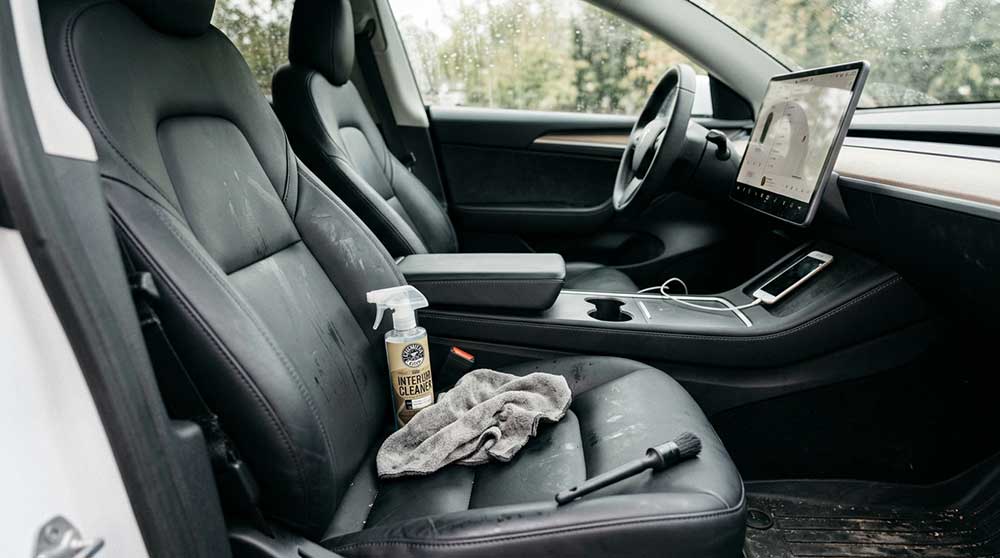
Tesla’s seats aren’t real leather. They’re synthetic vegan leather, and that distinction matters enormously for material compatibility.
Traditional leather conditioners deposit oils designed to penetrate animal hide. On synthetic surfaces, those oils just sit there, leaving residue and altering the finish. Tesla’s own manual recommends mild soap, warm water, and a soft microfiber cloth — nothing more aggressive. Harsh chemicals like alcohol, bleach, or ammonia-based cleaners can cause discoloration and surface breakdown.
Trim, dashboard panels, and door surfaces need a separate product entirely — ideally an ammonia-free interior detailer rather than your seat cleaner. And your touchscreen requires an ammonia-free glass cleaner on a screen-safe microfiber cloth. Replacing a damaged touchscreen at a service center costs around $1,500, making protective cleaning habits a genuinely worthwhile investment.
Finish preservation depends entirely on matching the product to the surface — not grabbing whatever’s closest. Applying a water-based ceramic coating to vegan leather seats can repel future spills and make routine cleaning significantly easier.
Tesla interiors look great when they’re clean, but fingerprints, seat marks, and dashboard haze build up faster than most owners expect, especially with all the touch surfaces and minimal textures inside the cabin. Many owners stay ahead of that wear with Chemical Guys Total Interior Cleaner & Protectant, keeping everything from vegan leather to screens consistently clean without leaving residue or altering the factory finish.
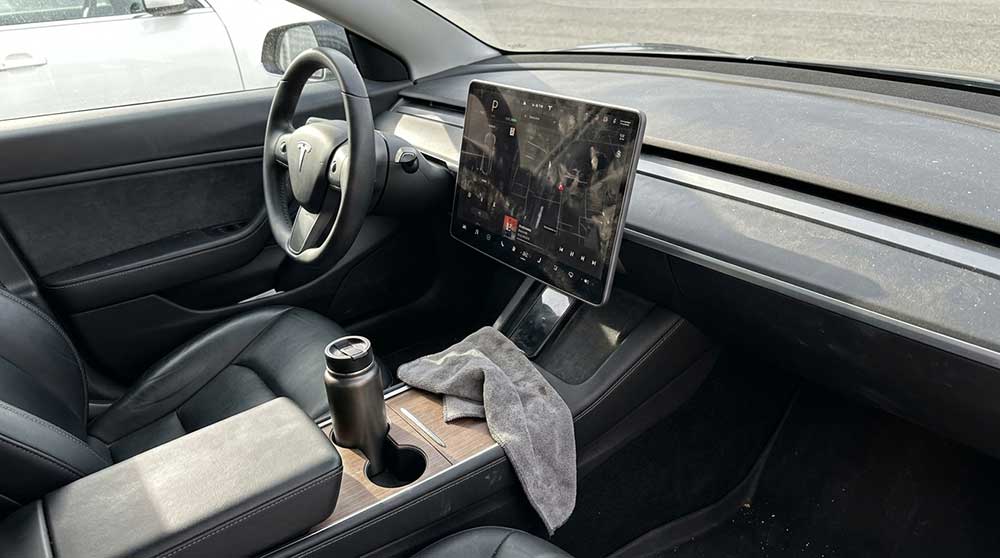
Clean Tesla Seats Without Causing Delamination or Denim Transfer
Tesla’s vegan leather looks premium and feels durable, but it delaminates faster than most owners expect when the wrong products or too much pressure get involved. The protective top coat is thin, and once it’s compromised, stains set faster and cleaning gets harder every time.
Start with warm water and mild soap on a damp microfiber cloth. Use gentle circulars over small sections rather than dragging broadly across the surface. That controlled motion lifts dye transfer (especially from raw denim) without grinding it deeper into the coating.
For stubborn denim transfer on white seats, isopropyl alcohol works as a last resort only. Apply it sparingly, localize it, then follow immediately with a clean damp cloth to remove any residue.
Immediate drying matters more than most people realize. Excess moisture sitting in seams weakens the backing material over time. Wipe dry with a soft lint-free cloth before moving to the next section. Tesla vehicles are also subject to 79 known recalls, many involving instrumentation issues, so keeping the interior in good condition supports overall resale value when it comes time to sell. To stay ahead of buildup and keep the surface protected long-term, schedule cleaning and conditioning every 3–4 months.
Even the best interior cleaner falls short if the towel leaves streaks, lint, or fine scratches behind—something Tesla owners notice quickly on piano black trim and the center display. That’s why many rely on Meguiar’s Supreme Shine Microfiber Towels, giving them a soft, streak-free finish that helps preserve the clean, factory look without adding swirl marks or residue over time.
Clean Tesla Screens, Dash, and Trim Without Causing Damage
The seats are done, so now you’re staring at that massive touchscreen and wondering what’s safe to use on it. Start with Screen Clean Mode (Controls → Display → Screen Clean Mode), which disables touch input so you’re not accidentally ordering a pizza mid-wipe.
Before touching the screen, enable Screen Clean Mode — it disables touch input so you don’t accidentally tap something mid-wipe.
For microfiber techniques, always dry-dust the display first, then address any remaining smudges. Apply distilled water methods by dampening your microfiber cloth lightly — never spray directly onto the screen. Liquid near display seams causes real damage. Work in gentle, overlapping strokes.
Skip paper towels entirely. They scratch. Skip alcohol-based cleaners too — they strip the oleophobic coating faster than you’d expect.
The dashboard and trim follow the same logic. Use a pH-neutral cleaner applied to the cloth, not the surface. A soft-bristled detailing brush handles vents and seams where microfiber can’t reach. Work section by section, keeping the cabin out of direct sunlight to prevent premature drying and streaking. Keep in mind that newer Model S and X vehicles feature a dual-screen architecture, pairing a 17-inch center display with a 12.3-inch instrument cluster, meaning you have more glass surface area to work through carefully. For matte trim specifically, avoid polish or wax entirely — damp microfiber only is the correct approach to prevent surface damage.
Seal and Protect Tesla Surfaces After Every Detail Session
| Surface | Protection Priority |
|---|---|
| White seats | Critical — stains set fast |
| Door panels | High — constant hand contact |
| Rubber seals | High — rubber preservation prevents cracking |
| Dash trim | Moderate — UV exposure accumulates |
| Door jambs | Moderate — overlooked but functional |
For rubber seals, clean with IPA first, then apply a water-based protectant using a soft brush. Wipe excess immediately — residue causes sticking (and nothing’s worse than a frozen door in January). The finish should be dry to the touch. Reinspect regularly, because protection degrades, and neglect compounds faster than interest. Keeping a dedicated detail session in your routine pairs well with tracking other upkeep through the Tesla Maintenance Summary screen, where last-performed dates and recommended intervals are logged so nothing quietly slips past.
Frequently Asked Questions
How Often Should Tesla Floor Mats Be Removed and Cleaned Separately?
You should remove and clean your Tesla’s rubber mats weekly, with a monthly rotation for a thorough wash. Don’t forget a seasonal deep clean to tackle salt, mud, and stubborn buildup effectively.
Can You Use a Handheld Vacuum on Tesla Seat Tracks Safely?
Yes, you can safely vacuum Tesla seat tracks — use a crevice tool, keep the vacuum motor at moderate suction, and maintain track alignment with slow, shallow passes to avoid scratching trim.
What Microfiber Cloth Size Works Best for Tesla Interior Cleaning?
You’ll want a cloth around 11×8 inches—small enough to feel like you’ve got surgeon’s hands near screens. Microfiber folds give you fresh surfaces, and a detailing mitt handles curved trim effortlessly.
Should Tesla Interior Cleaning Happen Before or After Exterior Washing?
You should clean your Tesla’s exterior before tackling the interior. Wash, dry, and handle any pre-waxing steps first, then move inside. This post-detailing sequence prevents exterior splashback from re-soiling your freshly cleaned cabin.
How Do You Prevent Cleaning Products From Spreading to Already-Cleaned Areas?
use barriers like folded microfiber edges and controlled spraying onto cloths—never surfaces—so you’re working zone by zone without dragging grime back into finished areas.