
You traded fuel bills for charging cables — a smart move, until your Tesla needs new tyres. At $230–$480 *per tyre*, the savings narrative gets complicated fast. These aren’t interchangeable rubber rings you can swap at any discount shop; they’re load-rated, torque-engineered, acoustically tuned components that demand a premium. And that’s before labour, alignment, and disposal fees pile on. The real cost of Tesla tyre ownership runs deeper than the sticker price.
Why Tesla Tyres Cost More Than Standard Car Tyres
When you replace a tyre on a Tesla, you’re not shopping in the same market as someone buying rubber for a Honda Civic. Tesla tyres are engineered to specific tolerances — handling instantaneous motor torque, supporting heavier battery pack weight, and maintaining low rolling resistance for range efficiency. That battery impact alone changes the load requirements beyond what standard tyres handle.
Several cost drivers stack quickly. OEM replacements run $444 to $450 per tyre in documented forum reports. Tesla-specific sizing limits your alternatives, shrinking price competition to nearly zero. Acoustic foam liners (standard on some models) add production steps. Tighter aerodynamic and software integration means manufacturers can’t cut corners on materials. When comparing OEM against aftermarket options, aftermarket alternatives are typically 30% to 70% cheaper on sticker price but carry wide quality variation that can translate into accelerated wear under real driving conditions.
There’s also a warranty mismatch worth noting — aftermarket substitutes may void coverage, nudging you back toward premium OEM pricing anyway. You’re not just buying rubber. You’re buying a component engineered inside a system that doesn’t welcome generic substitutions. Tesla vehicles include advanced TPMS integration that continuously monitors tyre pressure and temperature in real time, adding sensor hardware and electronic components that feed directly into the overall cost of the tyre system.
What Makes Tesla Tyres Different From Regular Tyres
Tesla tyres aren’t just regular tyres that happen to fit a different car — they’re purpose-built components engineered around problems that gasoline vehicles don’t create. Three core differences separate them from standard fitments.
First, acoustic foam lines the inner tyre wall. Without a combustion engine drowning out road noise, every hum and rumble reaches your ears — foam dampens that noticeably.
Second, load ratings run higher than typical passenger tyres. Battery packs are heavy (a Model 3 long-range battery alone weighs roughly 1,000 lbs), so sidewalls are stiffened to resist excessive flex under that constant mass. Unchecked flex generates heat, accelerating wear.
Third, instant electric torque punishes rubber faster than a gradual combustion power curve ever would — Bridgestone testing shows EVs wear tyres 30–40% faster than comparable gasoline vehicles. Tesla recommends rotating tyres every 6,250 miles to help offset this accelerated wear rate. This accelerated wear also factors into five-year ownership costs, where tyre replacement emerges as a more significant recurring expense for Tesla owners than it typically is for gasoline vehicle owners.
Standard tyres fit physically. They just aren’t tuned for what a Tesla actually does to them.
How Much Does Tesla Tyre Replacement Actually Cost?
When you’re staring down a tire replacement for your Tesla, the bill can land anywhere from $300 to $500+ per tire depending on your model, trim, and wheel size — so a full set of four typically runs you $800 to $1,500 before labor, alignment, and tax enter the equation.
Larger wheels push costs higher fast: one owner reported a $1,800 quote for a full set of 20-inch tires, while another paid roughly $466 for a single 20-inch tire at a Tesla Service Center. Factor in alignment (which can tip a four-tire job past $2,047, as one owner found), and you’ll quickly see why the sticker price on the tire itself is only part of what you’re actually paying.
Alternatives like Tire Rack can bring the total cost down to around $1,500 for OEM Continental tires on a dual motor Model 3 with 19-inch Sport Wheels, offering meaningful savings over going directly through Tesla. Adding to the overall expense, Tesla’s high torque launches accelerate tire wear beyond what most gas car owners are used to, meaning replacement intervals can arrive sooner than expected.
Most Tesla tire replacements don’t come from bad luck—they come from driving around with PSI that slowly drifts out of range without you noticing. That small gap is enough to wear down expensive rubber faster than it should, especially on heavier EV setups. Keep your tire pressure dialed in and avoid premature wear by checking it properly with this high-accuracy digital gauge before your next drive turns into unnecessary tire costs.
Full-Set Replacement Costs
Discount Tire lists Model Y options at $195 to $450+ per tyre, giving you real flexibility. Used tyre options exist but rarely suit EVs well given the torque demands. Wheel size drives cost sharply — 20-inch setups consistently hit the upper range. Tyres are your vehicle’s only road contact point, making their condition directly tied to how safely your Tesla handles and stops.
Tyre compound also plays a measurable role in your running costs — switching to summer performance tyres can cost you 10–15% range loss compared to standard all-season fitments, effectively increasing how often you charge on longer trips.
Per-Tire Price Breakdown
Costs break down fast once you get into individual tyres — and the numbers shift considerably depending on which Tesla you’re driving.
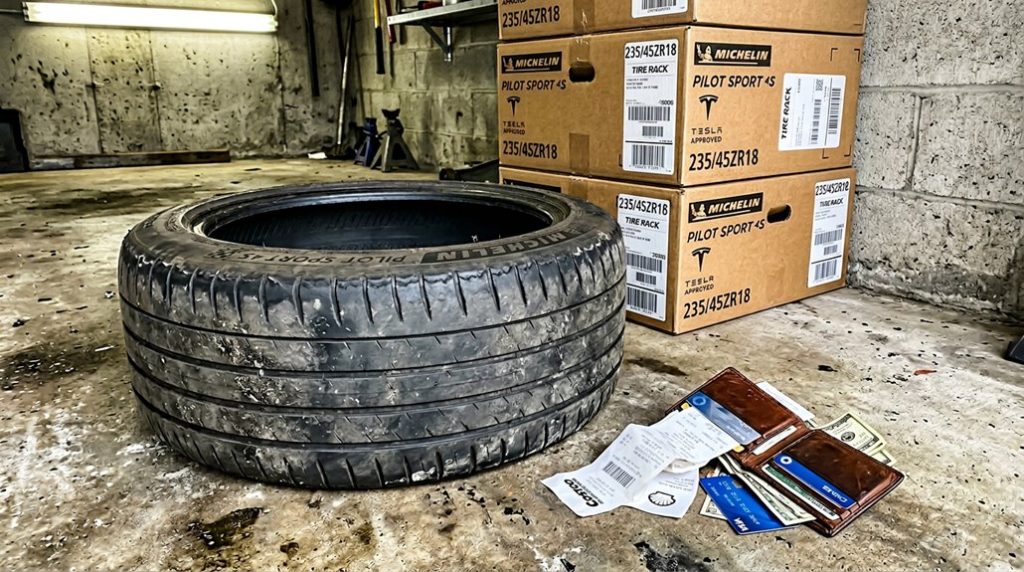
Model 3 owners typically pay $250–$300 per tyre (18-inch 235/45R18 or 19-inch 235/40R19), while Model Y runs $285–$320 per tyre.
Move up to a Model S with its 21-inch 265/35R21 fitment, and you’re looking at $350–$450.
Model X sits highest at $380–$480, largely because larger diameters demand lower-profile, performance-oriented rubber.
EV-specific tyres often include noise dampening foam layers, which genuinely adds to manufacturing cost.
Factor in seasonal rotations, alignment checks, and retailer markup variation — Discount Tire quotes Model Y anywhere from $195 to $450+ — and that single-tyre quote swings dramatically before you’ve touched labor.
Model Y Performance owners face this cost most frequently, as its 21-inch wheels and sport-tuned hardware translate to accelerated tyre wear that shortens replacement intervals to as little as 20,000 miles compared to the longer intervals possible on 19-inch fitments.
Model 3 Vs Model X: Who Pays More for Tyres?
If you’re choosing between a Model 3 and a Model X, the tire bill alone tells you something meaningful about what you’re driving. Model 3 tires run $230 to $300 per tire, engineered around efficiency and range.
The tire bill alone tells you something meaningful about what you’re driving before you ever hit the road.
Model X tires climb to $350 to $500 per tire, and that gap isn’t arbitrary.
The Model X carries considerably more mass, which directly raises load ratings requirements. Higher load ratings demand denser rubber compounds, reinforced sidewalls, and more material overall. Your tire wear pattern on a heavier SUV also accelerates differently than on a sedan, especially under electric torque delivery.
Wheel alignment tolerances tighten too, since improper calibration on a heavier platform destroys tires faster.
Ride comfort doesn’t come free on the Model X either — larger, more sturdy tires cost more to engineer and replace. You’re fundamentally paying for physics. Expect a per-tire premium of roughly $120 to $200 over Model 3 equivalents.
Compounding this further, opting for 22-inch wheels on the Model X can cost you an additional 13 to 26 miles of EPA-rated range compared to the standard 20-inch option, meaning larger wheel choices carry both a tire cost and an efficiency penalty.
The Hidden Costs of Tesla Tyre Replacement
The sticker price on a Tesla tyre is the easy part — what catches most owners off guard is everything stacked underneath it. Instant torque and heavier kerb weights accelerate wear faster than combustion-engine equivalents, shortening replacement cycles before you’ve mentally budgeted for them.
Then there’s roadside downtime. A flat tyre on a Tesla often means towing (many models lack a spare), which adds indirect costs beyond the tyre itself — time, logistics, rental coverage if needed.
Skipping preventive inspections compounds the problem. Uneven wear from torque-heavy launches goes undetected until replacement becomes unavoidable rather than strategic. Tesla recommends maintaining specified pressures and addressing punctures immediately to limit damage escalation.
Service routing matters too. Tesla may direct you to approved centers rather than the nearest budget shop, narrowing your pricing options. Small decisions — pressure checks, rotation schedules, inspection timing — quietly determine whether your tyre bill stays manageable or becomes genuinely painful. Adding another layer of complexity, Tesla’s over-the-air software updates can alter vehicle performance characteristics post-purchase, meaning driving dynamics that influence tyre wear may shift without a workshop visit.
A slow tire leak or gradual PSI drop might not feel urgent in your Tesla, but it quietly eats into your tire life and can turn a simple commute into uneven wear that shortens expensive replacements. Instead of waiting until the warning shows up at the worst possible time, stay ahead of it by keeping a portable inflator in your trunk so you can fix pressure issues instantly.
Can Third-Party Shops Replace Tesla Tyres for Less?
Tesla’s own support pages confirm you can take your vehicle to a third-party tyre shop for repair or replacement, so price shopping isn’t a workaround — it’s an officially supported move.
In one owner-reported comparison, Discount Tire quoted $352 (labor and road-hazard warranty included) against a Tesla Service Center quote of $377 for a single tyre, a gap that widens further when you factor in Tesla Roadside Assistance repair charges reaching $81 for a flat or $420–$550 for a full replacement.
The tradeoffs are real, though — third-party shops may need to order your specific tyre size, which delays completion, and savings depend heavily on your market, the tyre model, and whether the shop bundles balancing or alignment into the total. If you’re unsure which tyre size applies to your exact build, your tyre pressure readings and vehicle configuration details are accessible directly from the touchscreen without needing to consult a separate document.
Third-Party Pricing Advantages
Many Tesla owners assume the service center is their only option for tyre replacement—it isn’t. Independent shops operate on tighter independent margins and face genuine regional competition, which keeps their pricing honest.
One forum thread documented a Tesla quote of $2,059.87 for four Model 3 tyres with alignment; a third-party shop quoted $1,000 for the same Michelin Pilot Sport 4 set, fully fitted and balanced. That’s a $1,059.87 difference for identical rubber.
Independent shops typically run 20–40% cheaper than manufacturer service centers because their labor rates and overhead are lower. Discount Tire even maintains a dedicated Tesla fitment page, so sourcing correct-spec tyres isn’t complicated. Tesla explicitly permits third-party tire shops, meaning you’re not voiding anything by shopping around. Non-Tesla EV owners can now access 17,800+ Tesla Superchargers via a dedicated NACS adapter, a sign that Tesla’s ecosystem is becoming more open to third-party compatibility across the board.
Tradeoffs Worth Considering
Third-party shops can absolutely replace Tesla tyres for less—but whether that’s the right call depends on your specific situation. If you’re covered under Tesla’s Wheel and Tyre Protection Plan, that $25 deductible makes roadside tradeoffs less persuasive—third-party pricing loses its edge fast.
| Scenario | Best Option |
|---|---|
| Active protection plan | Tesla Service Center |
| No coverage, standard replacement | Third-party shop |
| Unsafe driving conditions | Roadside Assistance first |
Without coverage, independent shops offer faster scheduling, broader inventory, and meaningfully lower costs (OEM Hankook pairs running roughly £400–£450 versus Tesla’s $420–$550+ quotes). There are resale implications too—non-OEM tyres occasionally raise questions during inspections. It’s worth noting that Tesla’s broader charging ecosystem reflects the same premium-engineering philosophy, with V4 Supercharger cabinets supporting up to 1.2 MW of capacity through modular, tray-based power conversion architecture that prioritises long-term reliability over short-term cost savings. Weigh your coverage status, tyre specs, and timeline before deciding where to hand over your keys.
Tesla’s Tyre Protection Plan: Is the Subscription Worth It?
If you drive a Tesla with low-profile tires—which most models do—road hazards like potholes and debris aren’t just annoying; they’re expensive. Tesla’s Wheel and Tire Protection Plan addresses exactly that. Available through the Tesla app, it’s a monthly subscription starting at $12 for the Model 3 (non-Performance) and reaching $25 for the Model S Plaid.
Here’s the honest breakdown: unlimited tire repairs are covered, but replacements still carry a $25 deductible per appointment. The plan excludes theft, vandalism, and cosmetic damage like curb rash—so don’t expect miracles. Tires worn below 4/32-inch tread depth also don’t qualify.
Whether the monthly cost makes sense depends on your driving environment. Urban drivers dodging potholes daily? Probably worth it. Suburban highway commuters? Less persuasive. The math only works in your favor when a road hazard event actually happens—and unfortunately, with EVs, that’s a real possibility.
Frequently Asked Questions
How Does Tesla’s Instant Torque Specifically Accelerate Front Tyre Wear Patterns?
Tesla’s instant torque spikes force your front tyres to handle both acceleration forces and steering scrub simultaneously. You’re wearing them faster because they’re constantly biting hard while managing directional corrections at the same time.
Can Incorrect Tyre Pressure Void Any Remaining Tesla Vehicle Warranty Coverage?
Incorrect pressure isn’t a silver bullet for a voided warranty. Tesla treats pressure negligence as a maintenance issue, so it won’t automatically cancel your coverage—but it can affect tire-related claim approvals.
How Often Should Tesla Owners Rotate Tyres to Maximise Overall Lifespan?
You should rotate your tyres every 6,250 miles to maximize lifespan. Factor in seasonal rotations for harsh conditions, and if you’ve got staggered alignments, check tread depth differences of 2/32 in more frequently.
Does Tesla’s Roadside Assistance Cover Temporary Tyre Replacements During Long Trips?
Tesla’s roadside coverage doesn’t include temporary replacements as a standard entitlement. If you’re on a long trip, you’ll get flat-tire service up to 50 miles, but actual tyre costs remain your responsibility.
Are Run-Flat Tyres a Compatible Option for Any Current Tesla Models?
You can investigate run flat compatibility for your Tesla, but it’s not factory-standard. While some sizes may fit, you’ll sacrifice ride comfort and range efficiency compared to Tesla-approved EV tyres.