
Tesla’s factory audio has one dirty secret: it quietly abandons everything below 80Hz. That means every bass drop, every kick drum, every rumbling low-end moment you paid to hear simply disappears. A subwoofer doesn’t just add bass — it restores what was always missing. But not every option fits every trim, and the wrong choice means wasted money or a gutted interior. The specs, compatibility details, and real installation trade-offs are worth knowing before you buy anything.
Does Your Tesla’s Year and Audio Package Affect Subwoofer Compatibility?
Before you drop a single dollar on a subwoofer upgrade, your Tesla’s model year and factory audio package will either open the door or slam it shut on compatibility. Vehicle years matter more than most owners realize. Enclosures designed for 2017–2023 Model 3s often exclude Highland refresh vehicles entirely, and some manufacturers explicitly confirm zero compatibility with 2024 Highland models.
Audio packages create an equally hard boundary. Alpine’s Model 3 kits are engineered specifically for factory premium audio systems equipped with the OEM 8-inch subwoofer. Base audio configurations lack the signal routing and wiring blueprint these kits require. You can’t simply force a premium-tier upgrade onto a base system and expect clean results.
The safest approach is matching your exact production year and refresh generation alongside your specific audio package. Getting both right isn’t optional — it’s the difference between a clean install and an expensive mistake. The Model 3 Highland and Model Y Juniper redesigns broke compatibility for roughly 80% of existing interior accessories, making fitment verification by model, year, and VIN essential before ordering. Loaded enclosures designed for specific vehicles, like the VD-10 D2, come pre-loaded and pre-wired to streamline installation and reduce the margin for error when compatibility is confirmed.
Factory Tesla audio is clean, but the low end can feel thin once you start noticing what the system isn’t delivering on bass-heavy tracks or highway drives. That gap is exactly why some owners move to the Alpine PSS-TSUB-TYA 10” Tesla Model Y Subwoofer & Amplifier Upgrade Kit, adding deeper, controlled bass that the stock setup simply doesn’t produce, especially when the cabin is already masking subtle sound detail at speed.
What Are the Best Plug-and-Play Tesla Subwoofer Kits for Model 3 and Model Y?
Alpine makes two kits worth your attention here — the PSS-TSUB-T3A for Model 3 and the PSS-TSUB-TYA for Model Y — and both take a plug-and-play approach that sidesteps the custom fabrication headache entirely.
Each kit pairs a 10-inch subwoofer with a dedicated amplifier inside a pre-tuned enclosure, so you’re not guessing at box volume or chasing down a separate amp. The 10-inch comparison between both units is straightforward: same driver size, different vehicle-specific wiring looms and mounting geometry. You plug into the factory subwoofer input wire, bolt everything to OEM mounting points, and you’re done.
OEM retention is the real selling point here — your steering wheel audio controls, factory display integrations, and system behavior stay intact. Tesla’s single touchscreen consolidates all vehicle controls and audio functions into one interface, so any upgrade that preserves that integration avoids disrupting the broader system behavior.
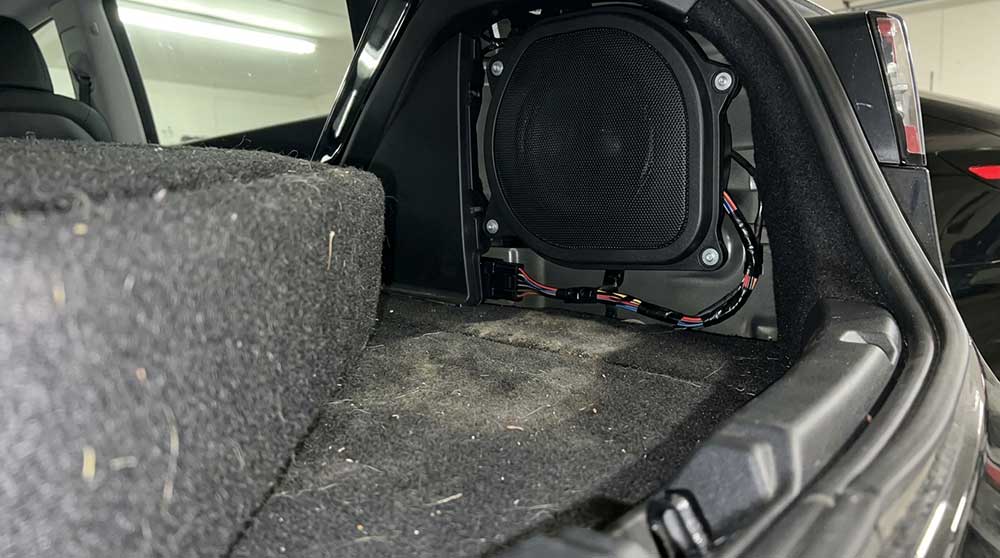
The Model 3 kit covers 2017–2023 Premium Audio trims, while the Model Y kit fits 2020–2025. Verify your trim before ordering; fitment specificity is non-negotiable with these kits. The Model 3 kit is specifically designed to replace the factory 8-inch subwoofer with a 10-inch sealed upgrade that drops into the OEM location without consuming any additional cargo space.
Should You Buy a Plug-and-Play Tesla Subwoofer Kit or Go Custom?
The decision between a plug-and-play kit and a custom build comes down to three variables: how much time you want to spend under the trunk liner, how much flexibility you need, and whether your Tesla’s interior aesthetics are non-negotiable.
Here’s how each path stacks up:
- Installation cost: Plug-and-play kits bundle pre-matched components, cutting labor hours markedly. Custom builds require separate wiring, tuning, and mounting—costs compound fast.
- Sound staging: Custom builds let you position drivers precisely, improving soundstage depth. Kits lock you into fixed placements (not always ideal).
- Flexibility: Custom setups let you swap individual components. With kits, you replace everything or nothing.
If your priority is a clean, factory-style install with predictable results, a plug-and-play kit wins.
If you’re chasing specific output targets or have unconventional trunk constraints, build custom.
Neither choice is wrong—just honest about what you’re willing to manage. Some plug-and-play options, like the Alpine PSS-TSLA-TYA, are engineered specifically for Tesla acoustics and include a pre-tuned subwoofer enclosure so you skip the trial-and-error that custom builds almost always demand. Keep in mind that Tesla’s substantial battery pack weight of 800–1,200 lb means the vehicle’s load-rated tires and suspension are already tuned around a heavier platform, so adding subwoofer mass in the trunk has a comparatively modest effect on overall vehicle dynamics.
The difference between “good enough” audio and a system that actually fills the cabin usually shows up in the low end first, especially when factory setups start struggling to deliver depth at higher volumes. That’s where many Model 3 owners step up to the ANVX UBE-TM3-G1 Boost Box 10” Subwoofer Enclosure, adding tighter, more physical bass that the stock enclosure simply can’t reproduce without distortion or strain.
How Do You Match an Amplifier and Enclosure to Your Tesla Build?
Matching an amp and enclosure to your Tesla build isn’t guesswork—it’s a three-variable equation involving RMS power, impedance load, and available cargo geometry.
Start with your subwoofer’s RMS rating, then select an amp whose continuous RMS output at the correct amp impedance doesn’t exceed that number. A 200W RMS sub wired to 2 ohms needs an amp rated at roughly 200–300W at 2 ohms—not a 1,200W monster running at 1 ohm (that’s how you cook voice coils).
Enclosure choice follows the same logic. Loaded enclosures sized for Tesla trunk wells keep the sub operating within its rated thermal range without improvising. Pay attention to enclosure ventilation, too—a sealed box in a cramped cargo cavity traps heat and degrades long-term performance.
Match the enclosure to the driver’s specs, place the amp nearby to shorten power runs, and let the numbers make the decision for you. The Highland refresh’s revised suspension and chassis geometry also altered trunk floor dimensions, meaning enclosures built for pre-2023 models may not fit newer builds without modification. Compact class D amplifiers are particularly well-suited for Tesla installations where tight cargo space makes efficiency and low heat output non-negotiable factors.
Will a Tesla Subwoofer Upgrade Rattle Your Cabin?
Once you’ve got your amp and enclosure dialed in, the next honest question is whether your Tesla’s cabin is going to start buzzing, ticking, and rattling like a tin can full of loose bolts the moment the bass kicks in. The short answer: it might, but it’s preventable.
Panel resonance becomes a real issue when upgraded bass output exceeds what the factory damping can absorb. Tesla’s premium Model 3 and Model Y systems already push 560W through an 8-inch dual-coil subwoofer, so aftermarket upgrades amplify an already vibration-prone environment.
Tesla’s instant torque delivery puts additional stress on cabin materials and fasteners that are already working harder than they would in a conventional vehicle, making thorough damping treatment even more critical before adding a subwoofer.
Three installation tips that directly reduce rattle risk:
- Apply sound-deadening material to trim panels, cargo plastics, and door skins before finalizing the install.
- Secure all wiring and brackets completely — loose hardware becomes a percussion instrument at 40Hz.
- Set proper crossover points using a DSP to avoid feeding low frequencies to components that can’t handle them.
Frequently Asked Questions
Can a Tesla Subwoofer Upgrade Void Your Factory Warranty?
A subwoofer upgrade won’t automatically void your warranty. Under federal law, Tesla must prove causation before denying coverage. Grasping these warranty implications strengthens your position during dealer negotiations if a dispute arises.
Does a Subwoofer Upgrade Affect Tesla’s Regenerative Braking or Range?
A subwoofer upgrade won’t affect regenerative braking, but it can create minor battery impact through amplifier power draw. Electrical noise remains isolated from drivetrain systems, so your regen efficiency stays fully intact.
How Long Does a Typical Tesla Subwoofer Installation Take?
Expect your installation time to run 2–4 hours for a simple swap or 4–8 hours with an amplifier added. Factor this into your service scheduling, since Tesla-specific trim removal adds real labor.
Can You Remove a Tesla Subwoofer Kit and Restore the Factory Setup?
Yes, you can remove a Tesla subwoofer kit and restore the factory setup. Plug-and-play kits prioritize wiring preservation and aesthetic matching, making reversal straightforward—just reconnect your original components and you’re back to stock.
Do Tesla Software Updates Ever Interfere With Aftermarket Audio Systems?
Funny how it happens right after an update—your bass suddenly sounds off. Tesla’s software conflicts can alter EQ and signal routing, and update patches may shift crossover behavior, affecting how your aftermarket subwoofer performs.