
Most Tesla owners never think twice about which key they’re using — until they’re stranded in a dark parking garage with a dead phone. Your Model 3, Y, S, or X came with two very different tools: a key fob and a key card. They pair differently, operate differently, and each one can save you when the other fails. Knowing the difference isn’t just convenient — it’s the kind of knowledge that quietly rescues your night.
Tesla Key Fob vs. Key Card: Which Access Method Is Right for You
Tesla gives you three ways to access your car — phone key, key card, and key fob — and while that sounds like flexibility, each method behaves differently enough that choosing the wrong one as your daily driver will genuinely frustrate you.
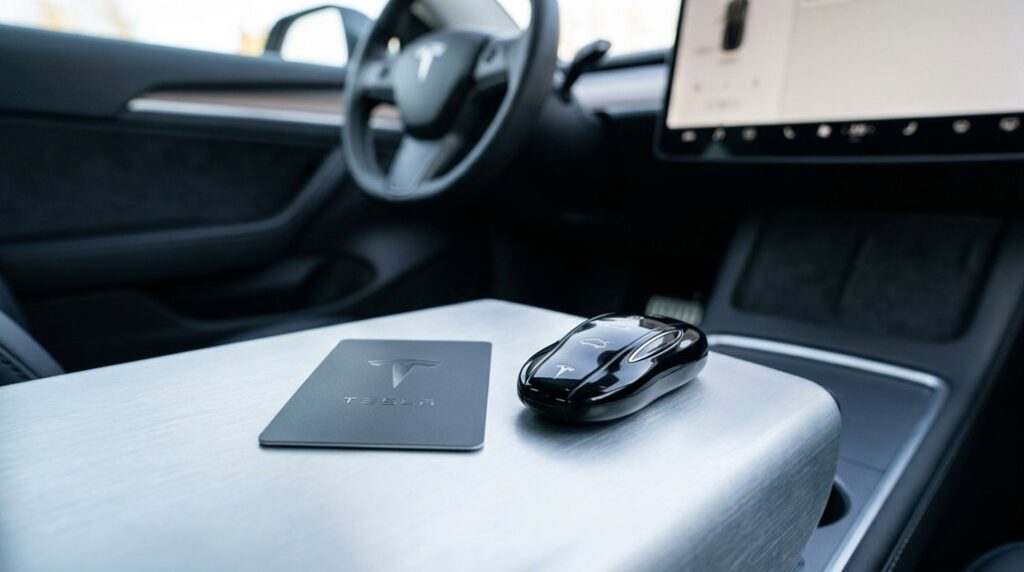
The phone key releases automatically via Bluetooth, which is seamless until battery life or a dropped connection ruins your morning. The key card requires a physical tap on the driver-side pillar to open and another on the center console to start driving — no automation, no hands-free operation.
Phone key works until it doesn’t. Key card always works — just never without effort.
The key fob sits between both, offering button-controlled trunk and frunk access alongside automatic locking where regionally supported.
Privacy concerns also factor in — phone-based access ties your entry behavior to app activity, which not every owner wants.
The key card sidesteps that entirely.
Matching the right method to your actual habits, rather than defaulting to whatever feels premium, makes the real difference. If cost is a consideration, NFC key replacements run around $25 for a set, making them a far more affordable backup than a traditional key fob replacement that can cost hundreds and requires a dealership visit. Keeping purchase receipts and documentation of transactions for any key accessories also supports your position if a warranty-related dispute ever arises down the line.
Tesla key cards are small enough to be forgotten, bent, or scratched in a wallet, and many owners only realize the inconvenience once they’re standing by the car trying to get a clean tap response at the worst possible moment. A simple way to avoid that friction is to keep the card protected and consistently accessible with a premium Tesla key card holder so it stays in proper condition and ready to work without delays when you actually need it.
What Your Tesla Key Fob Does and How to Pair It
Once you’ve decided the key fob fits your workflow better than tapping a card every time you get in, it’s worth knowing exactly what it can do before you pair it.
The fob handles locking, releasing, front trunk, and rear trunk operations. One click on the top button locks everything; two clicks release it. Double-click the front or rear trunk button to pop the corresponding hatch. Hold the rear trunk button one to two seconds and the charge port opens — genuinely useful when your hands are full.
To pair it, open the Tesla app under Security & Drivers, select Add Key Card, then scan the fob at the center console (Model 3/Y) or left phone charger (Model S/X). An existing key card approves the pairing. You can confirm your vehicle’s current software version by navigating to the car icon → Controls → Software screen on the touchscreen, which ensures your firmware supports the latest key pairing features.
Keep the fob battery fresh — a dead cell creates unnecessary security risks by leaving you without a reliable backup access method entirely. If the battery does die, placing the fob near the passenger-side windshield will still let you unlock the car.
Tesla key fobs are built for convenience, but they’re also easy to drop, scratch, or misplace when tossed into pockets, bags, or mixed with other keys—small issues that only become frustrating when you’re standing at the car and trying to get quick, reliable access. That’s why many owners keep theirs secured in a protective keychain-style case designed for everyday carry so the key stays protected, attached, and ready whenever it’s needed without second-guessing where it ended up.
How to Use Your Tesla Key Card to Lock, Unlock, and Start
The key card works as your fallback when your phone dies, your app glitches, or you’re handing off the car to someone who doesn’t need app access. Tap the card on the driver-side B-pillar to release access. You’ll hear a chime confirming success. Placement precision matters here—misalign the card and nothing happens.
| Action | Model 3 / Model Y | Model S / Model X / Cybertruck |
|---|---|---|
| Release access | Tap B-pillar | Tap B-pillar |
| Start | Center console (behind cup holders) | Left phone charger top |
| Lock | Tap B-pillar again | Tap B-pillar again |
| Backup Strategy | Mobile app (2-minute window) | Mobile app (2-minute window) |
| Confirmation | Audible chime | Audible chime |
Once inside, place the card at the model-specific interior reader before pressing the brake. Automatic locking isn’t supported, so tapping the B-pillar manually handles exit. Keep the card in an RFID wallet—your backup strategy only works if you actually have it. The Cybertruck runs on a 48-volt electrical architecture rather than the traditional 12-volt system, which powers the vehicle’s access and authentication hardware with greater efficiency. If you take too long after entering the vehicle, the car may shut down and the display will show you where to tap the key card to reactivate it.
Key Fob and Key Card Tips by Tesla Model
Whether you’re driving a Model 3 or a legacy Model S from 2015, your key setup options differ enough that treating every Tesla the same will cost you time and, and occasionally, access to your own car. Key fob placement subtleties matter here. Card durability holds up well, but knowing your model’s specifics keeps frustration low.
- Model 3 and Model Y owners place key cards and fobs on top of the center console, directly behind the cup holders
- Model S and Model X require placing the card or fob at the top of the left phone charger, front-side down, swiped downward
- Pre-2021 Model S and Model X owners skip phone key entirely, making fobs and cards primary tools, not backups
- Cybertruck follows the Model S card placement approach, not the Model 3 method
The Model 3 and Model Y combine infotainment and Autopilot hardware into one integrated unit, meaning hardware upgrade paths require replacing both systems together rather than swapping components independently like on the S and X.
Test every newly added key before leaving the driveway.
Frequently Asked Questions
Can a Tesla Key Fob or Key Card Be Deactivated Remotely if Lost?
Yes, you can trigger remote deactivation for a lost Tesla key fob or key card through the touchscreen’s Locks menu, following Tesla’s security protocols to immediately revoke vehicle access.
How Many Key Fobs and Key Cards Can One Tesla Vehicle Support?
Like seats at a dinner table, your Tesla’s maximum pairs top out at 4 key fobs and multiple key cards, though spare limits apply within the 19-key total your vehicle supports.
Does Extreme Cold or Heat Affect Key Fob or Key Card Performance?
Yes, extreme temperatures affect your key fob’s battery temperature and cause signal interference. Cold weakens battery output, while heat degrades internal components. Your Tesla key card, having no battery, remains largely unaffected by temperature extremes.
Can a Key Card or Fob Unlock a Tesla During a Software Update?
Yes, your key card or fob can typically open your Tesla during a software update, but a software interruption can trigger card authentication failures, temporarily making your vehicle unresponsive to all paired keys.
What Happens to Key Fob Access if Your Tesla Battery Fully Dies?
Your fob’s the last warrior standing — it runs on its own battery, so it’ll still transmit. But for emergency access, you’ll likely need a battery replacement or the mechanical key blade.