
Your Tesla just quietly downloaded 10 gigabytes of data while you slept — and most owners have no idea it happened. These updates aren’t a simple patch; they’re massive, hardware-specific payloads carrying FSD model files and regional binaries that reshape your vehicle at a software level. The size isn’t arbitrary, and understanding exactly what drives those numbers could change the way you think about your Wi-Fi, your overnight routine, and your car entirely.
How Big Are Tesla Software Updates?
Tesla software updates don’t come in one-size-fits-all packages — owner-reported download sizes range from a few hundred megabytes all the way up to several gigabytes, depending on the vehicle, build, and what the update actually contains.
Tesla software update sizes vary wildly — from a few hundred megabytes to several gigabytes, depending on your vehicle and build.
Setting accurate consumer expectations matters here. Version 2023.44.30.8, for example, measured 671.53 MB on one vehicle and just 335.75 MB on another — same update, noticeably different payloads. Version 2025.2.8.1 climbed to 3.2 GB, and at least one owner reported a prior update pushing around 10 GB. That’s a wide spread.
Update transparency from Tesla is limited in this area. The company doesn’t publish standardized file sizes for its releases, so your download could sit well under 1 GB or quietly consume several. This matters particularly because over-the-air software updates can also unlock or modify vehicle features that were previously gated by software, not just patch existing functionality.
Fleet tracker Teslascope has logged 564 unique versions across 311,476 recorded updates, which confirms that many distinct software builds circulate simultaneously — making a single “standard” size effectively meaningless. If an update fails to download correctly, Tesla’s interface may prompt users with a try again option before the process can resume.
Does the Type of Tesla Update Change How Big It Is?
Yes, the type of update directly determines how much data your Tesla downloads—minor point releases (think version jumps like 2023.44.30.7 to 2023.44.30.8) typically land in the hundreds of megabytes, such as 335 MB or 671 MB, because they’re touching only a narrow slice of files rather than rebuilding the full software stack.
Feature-rich releases, by contrast, can push into multi-gigabyte territory, with EVSpeedy noting that extensive OTA packages commonly reach up to 7 GB, and some Reddit-reported cases clocking in near 10 GB when broader system changes, new UI assets, or expanded FSD capabilities are bundled together.
Regional builds add another layer of variation, since Tesla tailors packages to vehicle configuration and market, meaning two cars running nominally the same version family can still pull down different-sized releases depending on what’s regionally applicable to their hardware and software baseline. If you ever land on a page showing no results found, it’s worth trying a different search to track down specific update size data for your region.
Tesla’s gateway module distributes firmware to specific ECUs locally after the vehicle pulls the initial encrypted bundle, meaning the total downloaded package may span multiple vehicle systems rather than updating a single component.
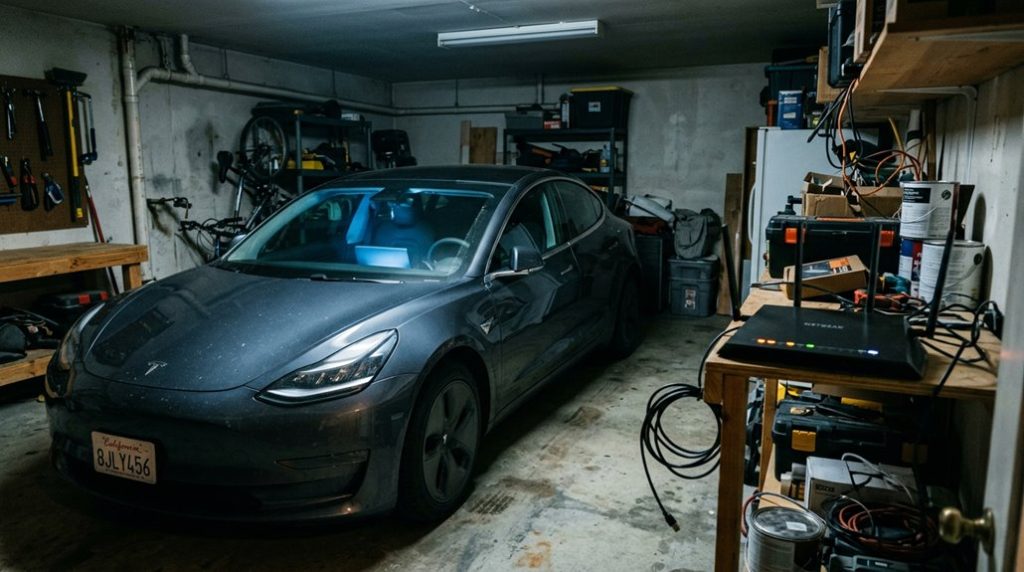
Tesla software updates aren’t actually slow because of the car—they’re slow because your Wi-Fi signal is barely reaching the garage. Before the next update drops, make sure your Tesla stays locked onto a strong, stable connection by setting up this Wi-Fi range extender so you don’t end up waiting hours for something.
Minor Patches vs. Major Updates
Regarding Tesla OTA updates, the short answer is: kind of, but not in the way you’d expect.
Minor patches don’t automatically mean small downloads, and major updates aren’t always massive. User perception often assumes a clean size hierarchy, but reality disagrees.
A 2023.44.30.8 point release weighed in at 671.53 MB — hardly trivial. Meanwhile, one owner’s major update hit roughly 10 GB, confirming that large downloads do happen.
Update frequency complicates this further; Tesla ships incremental builds constantly, and each package’s contents determine its size, not its label. The same version branch can produce a 335.75 MB download one cycle and something considerably larger the next.
Version numbers are genuinely weak predictors of what’s actually arriving on your car. Tesla pushes major feature releases roughly once a month, with smaller patches filling the gaps between, meaning the pipeline rarely goes quiet regardless of package size. Some of these updates refine the neural network processing that handles real-time object detection for steering, braking, and acceleration decisions across the vehicle fleet.
FSD Bundles Increase Size
When you’re talking about Full Self-Driving updates, yes — the type of update absolutely changes the download size, and FSD bundles sit at the heavy end of that range.
Here’s why that matters for your data plan:
- Feature growth compounds payload size — each new capability (intersections, roundabouts, parking) adds model files, calibration data, and executable code.
- Compatibility complexity multiplies the work — HW3 and HW4 require separate code branches, meaning Tesla effectively maintains parallel builds simultaneously.
- Version rewrites aren’t small — v14.3 reportedly involved significant AI architecture overhauls, not routine patches.
Unlike a narrow bug fix, FSD packages the entire autonomy stack. Whether you’re subscribing ($99/month) or purchased outright ($8,000), you’re downloading the same feature-complete bundle either way. The FSD package is transferable, meaning a vehicle sold with FSD already installed carries that full software stack to the next owner without requiring a fresh purchase. Major architectural overhauls like Beta 11 introduced a single city/highway software stack, meaning the update carried an entirely unified codebase rather than separate logic for different driving environments.
Regional Builds Vary Widely
Even within the same version family, the type of update genuinely changes how big the download is — and regional build splitting is a major reason why.
Tesla’s own support documentation confirms that updates are delivered based on your vehicle’s configuration and region — meaning regional fragmentation isn’t a glitch, it’s the framework. TeslaScope’s 564 unique recorded versions illustrate this clearly: one version label can branch into multiple distinct builds. Market specifics drive different code paths, locale optimization trims unnecessary regional assets, and variant testing means your neighbor’s identical-looking Model 3 might pull a completely different payload.
Take version 2023.44.30.8 — one owner downloaded 671.53 MB while another pulled 335.75 MB. Same version family, wildly different sizes. That’s not coincidence; that’s deliberate, segmented distribution doing exactly what it’s designed to do. For example, EU-built Model 3s require different charging code paths than their North American counterparts, as European vehicles use Type 2/CCS2 charging with three-phase AC support up to 11 kW versus the single-phase NACS standard used in the US.
Why Does Tesla Require Wi-Fi for Software Updates?
When a Tesla update lands on your vehicle, it’s not nudging a few kilobytes your way — it’s pushing files that can reach 3.2 GB to 7 GB depending on what’s bundled inside (FSD components alone bulk up the package considerably).
Mobile data can technically handle the transfer, but spotty LTE signals, carrier throttling, and hard data caps turn what should be a straightforward download into a frustrating crawl or outright failure.
Tesla’s own guidance puts it plainly: connect your car to Wi-Fi and leave it connected, because a stable, high-bandwidth connection is the only practical way to move multi-gigabyte files reliably and get you back on the road with the latest software. Meanwhile, the onboard battery management system continuously negotiates with charging hardware in real time, meaning the vehicle’s software layer touches far more than just entertainment or navigation — it governs the core electrochemical safeguards that determine how safely and efficiently your pack charges.
File Size Demands Wi-Fi
Why does Tesla insist on Wi-Fi for software updates? File size. Updates range dramatically:
- Small builds: Around 335–671 MB (manageable but still significant)
- Mid-range updates: Roughly 3.2 GB, like the 2025.2.8.1 release
- Extensive packages: Potentially reaching 7–10 GB
Pushing gigabytes through cellular connections creates real bandwidth costs for you and introduces reliability risks Tesla clearly wants to avoid.
A dropped mobile signal mid-download doesn’t just pause progress — it can corrupt the process entirely.
Tesla’s own manual frames Wi-Fi as the standard delivery route, not a suggestion.
Keeping your vehicle connected whenever possible guarantees the fastest, most reliable updates without privacy implications tied to metered carrier networks monitoring your data consumption.
Home Wi-Fi simply handles the load better.
These updates can deliver meaningful changes to your driving experience, including adjustments to acceleration response and Autopilot logic that would otherwise require physical mechanical intervention on a traditional vehicle.
Mobile Data Falls Short
Cellular data technically works for plenty of tasks your Tesla handles daily — streaming music, route guidance pings, remote app commands — but software updates are a different beast entirely.
Tesla’s documentation doesn’t present cellular as the standard update channel; it points you directly toward Wi-Fi instead. The reasoning isn’t arbitrary. Software updates carry substantial file sizes that expose real cellular limitations fast, and most owners aren’t sitting on unlimited, throttle-free plans immune to data caps.
Tesla’s own language acknowledges that cellular updating exists “in most cases” only as an exception, not a reliable pathway. Wi-Fi handles the heavy lifting because it delivers downloads faster, more consistently, and without burning through your monthly data allowance on a single update. Tesla’s over-the-air update system has grown increasingly capable over the years, with software releases like OTA 2025.2 adding new functionality such as automatic battery preconditioning support for third-party DC fast chargers.
Stable Connections Speed Downloads
Tesla explicitly ties network stability to three measurable outcomes:
- Faster delivery — stable connections sustain throughput across multi-gigabyte files
- Reliable completion — uninterrupted sessions prevent partial downloads that restart from scratch
- Earlier access — consistent connectivity means updates arrive sooner rather than later
Tesla separates downloading from installing deliberately.
Your car retrieves the file first, then you initiate installation separately.
A shaky connection doesn’t just slow things down—it postpones when you can even begin.
Tesla also delivers over-the-air updates that optimize real-world range and vehicle performance without requiring a service visit.
Think of network stability as your update’s foundation, not a bonus feature.
How Long Does a Tesla Update Take to Download?
How long a Tesla software update takes to download depends almost entirely on your Wi-Fi connection — not Tesla’s servers, not your vehicle model, but the strength and reliability of the network your car is sitting on. Tesla doesn’t publish a fixed download window, and for good reason: the same update can finish in minutes on a strong home network or drag on well beyond an hour on a congested one.
Community reports typically land in the 30-to-50-minute range under normal home Wi-Fi conditions. Battery drain and ambient temperature can influence overall update behavior, but your network quality is the dominant variable during the download phase specifically.
Tesla’s own guidance separates downloading from installing — two distinct milestones. The frequently cited “30 minutes to complete” figure covers the full process, not just the download. A quick test: stream video on a phone using the same Wi-Fi. Lag there means slower downloads here. Keeping professional installation records and documentation organized is a broader Tesla ownership habit that extends beyond accessories — it supports smoother service interactions whenever your vehicle needs attention at a service center.
Tesla software updates don’t just affect the car’s system—they also rely on smooth data handling running in the background, and a slow or unreliable drive can lead to glitches or corrupted footage at the worst possible moment. Make sure everything runs without interruptions by using a high-speed USB 3.0 drive so you don’t risk losing data or dealing with avoidable storage issues when it matters most.
Can You Use a Mobile Hotspot for Tesla Updates?
Since your Wi-Fi connection drives the entire download process, a natural follow-up question is whether your phone’s mobile hotspot counts — and the short answer is yes, it does. Both iPhone and Android hotspots work, provided your Tesla successfully joins the network through its touchscreen Wi-Fi menu.
Three things worth knowing before you start:
- Data consumption varies wildly — updates range from roughly 100MB to around 30GB, so unlimited plans are strongly preferred.
- Connection troubleshooting is common — Tesla can be selective about hotspot passwords, and toggling Wi-Fi off and on often resolves visibility issues.
- Hotspot security matters — use a strong, unique password, since public locations expose your wireless traffic to potential interception.
Keep your phone close to the car (signal strength directly affects speed), stay parked, and ideally plug in to avoid draining your battery mid-download.
Why Is Your Tesla Update Stuck?
A frozen progress bar doesn’t always mean something’s broken — your Tesla’s update process includes deliberate pauses for data validation that can make an otherwise healthy download look completely dead. These validation pauses typically hit around 50% and again near 100%, where the system cross-checks downloaded data before proceeding.
Battery management matters here too. Tesla recommends at least 20% charge before updating — staying plugged in eliminates that variable entirely.
| Symptom | Likely Cause | Fix |
|---|---|---|
| Stuck at 50% | Validation pause | Wait 15–20 minutes |
| Frozen near 100% | Pre-install verification | Keep Wi-Fi connected |
| No progress at all | Weak signal or low battery | Reset router or charge vehicle |
| Update disappears | Cache or storage issue | Free 10–50 GB of space |
A soft reset (hold both scroll wheels 10–15 seconds) clears most software glitches blocking download progress.
Frequently Asked Questions
How Many Tesla Software Versions Have Been Released Across the Entire Fleet?
You’ve got at least 564 unique versions in the fleet count, according to Teslascope. Version fragmentation means your car’s build depends on region, configuration, and Tesla’s staged rollout timing.
Does Tesla’s Update Preference Setting Affect the Download File Size?
No, Tesla’s update preference setting doesn’t affect download file size—there’s no download throttling or storage management difference. It only controls when you receive updates, not what’s included in the package.
Can You Monitor Your Tesla’s Software Version Using Third-Party Tracking Sites?
Yes, you can use third-party community sites featuring version dashboards like Teslascope, TeslaFi, and Tessie to monitor rollouts, though you’ll want to weigh privacy implications before connecting your vehicle’s data.
How Often Does Tesla Typically Release New Software Updates for Its Vehicles?
Stay on your toes—Tesla’s update cadence isn’t set in stone. You’ll typically see major updates monthly, but rollout variability means your car could receive patches anywhere from days to several weeks apart.
Does Tesla Send One Universal Update Package to Every Vehicle Worldwide?
No, Tesla doesn’t send one universal package to every vehicle. Regional variations and staged rollouts mean you’ll receive a customized update based on your configuration, purchased features, and market location.