
Your Tesla is quietly holding out on you. Buried inside your center display is a Calendar Sync feature that pulls today’s and tomorrow’s appointments — complete with tappable addresses that drop straight into navigation — and most drivers have never touched it. The setup sounds effortless, yet something keeps going wrong for nearly everyone who tries it. The culprit is almost never where you think it is.
Tesla Calendar Sync: What It Actually Does
Once you grant the Tesla app calendar permission and pair your phone via Bluetooth, Tesla’s Calendar feature pulls your iPhone or Android events directly onto the center touchscreen — no cloud login, no third-party app, just your existing phone calendar reflected in Tesla’s built-in Calendar app. That’s a deliberate design choice, and it sidesteps most privacy concerns by keeping your data local rather than routing it through external servers.
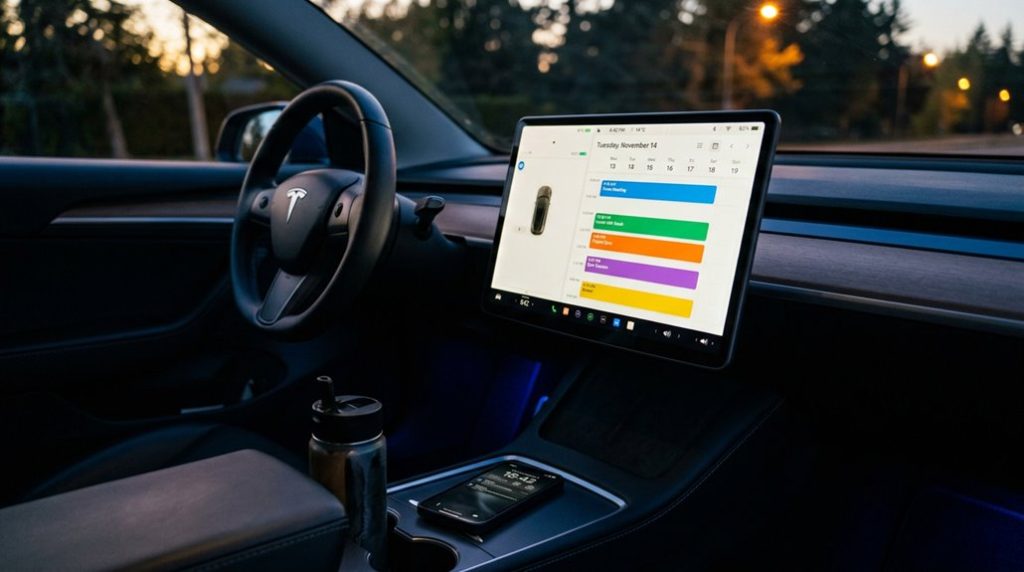
Here’s what you actually see: today’s and tomorrow’s events, each displaying the time, title, and location. Tap an event containing a full address, and Tesla opens route guidance instantly — no manual entry required. The quality and responsiveness of this experience depends heavily on your vehicle’s MCU hardware generation, with MCU3-equipped vehicles delivering faster map rendering and near-instantaneous interface responses compared to older MCU1 or MCU2 hardware.
A few caveats worth knowing: third-party integrations like work productivity suites need to sync into your phone’s default calendar first, or Tesla won’t see them. Bluetooth must stay connected, and the Tesla app needs to run in the background. Straightforward setup; meaningful payoff. For professionals who frequently join remote meetings, Tesla can display conference call dial-in information directly on screen, letting you connect to calls hands-free without touching your phone.
Why Tesla Calendar Runs on Bluetooth, Not the Cloud
When your Tesla displays tomorrow’s meeting on the touchscreen, it’s not pulling that data from Google’s servers or Microsoft’s cloud—it’s pulling it from your phone.
Your paired phone acts as the local data source, pushing calendar events through Bluetooth into the vehicle via the Tesla mobile app (which must stay active in the background to keep that pipeline open).
No direct cloud-to-car account link exists in this system, which means Bluetooth pairing isn’t just a setup step—it’s the actual mechanism keeping your schedule on the dash. The touchscreen serves as central control for a wide range of vehicle functions beyond calendar display, including lighting, mirrors, charging, and driver-assist settings. Once synced, calendar entries with addresses can be tapped directly to launch navigation to that location.
Phone Drives the Data
Most people assume Tesla’s calendar pulls events straight from the cloud—your Google or iCloud account beamed directly to the car—but that’s not how it works.
Your phone owns the data. That’s the essence of phone ownership here: Tesla’s system reads events from your iPhone or Android’s native calendar app, then sends that information to the car over Bluetooth when you’re connected.
Think of your phone as the middleman (a necessary one). The vehicle isn’t reaching out to Google or Apple directly—it’s receiving a data push from your paired device. The entire setup process takes only about two minutes to complete.
That also means your privacy settings on the phone level matter. If your Tesla app doesn’t have calendar access permissions granted, nothing transfers. The car receives only what your phone actively shares. Tesla’s system can also use your calendar data alongside onboard navigation routing to precondition the battery before departure, drawing thermal energy from the grid rather than the pack.
Bluetooth Enables Sync
That phone-as-middleman setup works because of one specific technology sitting underneath it: Bluetooth. Tesla doesn’t route your calendar through a standalone cloud server—it uses a direct, short-range Bluetooth link between your paired phone and the vehicle. This approach actually serves Bluetooth privacy well, keeping your personal appointments off third-party servers entirely.
Here’s what enables reliable sync:
- Your phone must be paired as an active phone key
- The Tesla app needs calendar permissions granted at the device level
- Bluetooth must stay enabled on both the phone and the car
- The Tesla app must run in the background
Connection troubleshooting usually starts here—most sync failures trace back to one of these four conditions quietly breaking down without any obvious warning. Notably, a calendar sync can stop working even when other Bluetooth functions, such as contacts and iMessage delivery, continue operating without interruption. Feature availability can also vary by vehicle, as hardware limitations on older vehicles can restrict which software features remain accessible.
No Direct Cloud Link
Unlike most connected car features that lean on cloud servers, Tesla’s calendar system skips the cloud entirely—your appointments never touch a Tesla-managed server.
There’s no direct Tesla-to-Google, Tesla-to-Outlook, or Tesla-to-iCloud pipeline built into the vehicle. Instead, your phone does the heavy lifting.
Your calendar data originates from your phone’s native ecosystem, travels via Bluetooth to the vehicle, and lives in local storage on the car’s system. That design actually offers a quiet benefit: offline security.
Because events never route through a third-party Tesla cloud layer, your schedule stays between your phone and your car. Tesla effectively sidesteps building separate cloud integrations for every calendar provider by letting your phone—which already handles those accounts—act as the trusted middleman. This philosophy mirrors Tesla’s broader approach of using over-the-air software updates to manage vehicle functionality without requiring physical intervention or third-party infrastructure.
How to Enable Tesla Calendar Sync on iPhone
To get Tesla Calendar running on your iPhone, you’ll need to tackle two quick tasks: granting calendar access inside iOS Settings and flipping the sync toggle inside the Tesla app itself.
Open iPhone Settings, find the Tesla app entry, and enable full Calendar access so the Tesla app can actually read your native iPhone calendar data (third-party apps like Outlook won’t sync unless their accounts appear in iPhone Settings > Calendar > Accounts).
Once permissions are confirmed, open the Tesla app, steer to Settings, and turn Calendar Sync on — your paired Bluetooth connection does the rest, pushing event data directly to your car’s infotainment display.
This is especially useful when coordinating departure times around your scheduled charging, since the Tesla app also lets you set a scheduled departure time so the car finishes charging and preconditions the cabin right before you need to leave.
Enabling Calendar Sync Settings
Before you can see your schedule on the Tesla’s center display, you’ll need to activate calendar sync from two places: the Tesla app and your iPhone’s system settings. Grasping both steps matters for user education and clarifies the privacy implications of granting app-level calendar access.
Follow these steps precisely:
- Open the Tesla app, steer to Profile > Settings > Calendar Sync, and toggle it on.
- Go to iPhone Settings > Tesla and enable Calendar Access for the app.
- Confirm your iPhone is paired via Bluetooth — without it, data transfer won’t initiate.
- If events don’t appear, toggle Calendar Sync off, then back on inside the Tesla app.
Both toggles must stay active for continuous syncing. Once your calendar is synced, you can also use the Tesla app to locate the nearest Supercharger station along your route before heading to any scheduled destination.
Granting iPhone Calendar Access
Think of it as two separate gatekeepers. iOS controls what data leaves your phone (addressing privacy concerns along the way), while the Tesla app controls what it does with that data. Both must say yes.
Also worth noting: calendar backups stored in secondary accounts like Outlook may not surface reliably unless those events are visible within iPhone’s native calendar system first. Tesla’s in-cabin experience is built around seamless integration, much like how key vehicle data such as tyre pressure is accessible directly from in-cabin displays rather than requiring a separate device.
How to Enable Tesla Calendar Sync on Android
Getting Tesla’s calendar sync running on Android takes a few deliberate steps, but the setup logic is straightforward once you grasp what’s actually happening under the hood. Tesla doesn’t pull events directly from Google’s servers—it reads your phone’s native calendar app via Bluetooth when you’re near the vehicle. Comprehending that distinction resolves most confusion immediately.
Here’s your practical setup sequence:
- Install and sign into the Tesla app, then enable Calendar Sync under settings—grant permissions when prompted, noting the privacy implications of calendar access.
- Add your Google account through Settings > Accounts and confirm calendar sync is active.
- Verify your phone’s native calendar displays your events correctly, since Tesla reads from there.
- Enable Bluetooth and Auto Sync, keeping the Tesla app running in the background—event formatting with complete addresses releases navigation routing directly from scheduled events.
Bluetooth stays active; everything else follows naturally. If you ever need to replace your vehicle’s infotainment hardware, used OEM electronics like the MCU often integrate seamlessly where aftermarket alternatives frequently cannot.
How to Confirm Calendar Sync Is Working
Once the setup sequence is complete, confirming the sync actually worked is straightforward—you’re fundamentally checking five interdependent conditions rather than hunting for a single pass/fail indicator.
Start at the vehicle’s center display: populated calendar entries confirm Bluetooth transferred your data successfully. Empty screens aren’t mysterious—they signal a permission, pairing, or toggle problem worth offline troubleshooting before assuming hardware failure.
Next, verify event names, times, and location-based entries appear accurately (mismatched details suggest the wrong calendar source is active). Tapping a location-tagged event should immediately prompt route guidance—that’s your clearest functional test. Multiple calendars appearing is normal if several sources are enabled on your phone.
From the Tesla app side, confirm calendar sync remains toggled on and that calendar access permissions haven’t been quietly revoked—worth noting given broader privacy implications of app-level calendar access. New events should refresh automatically after connection, not require manual intervention.
When a location-tagged event triggers navigation to a Supercharger destination, Tesla can use that route guidance to activate battery preconditioning, warming the pack before arrival so charging begins at peak power rather than at the reduced rates caused by cold battery chemistry.
Tesla calendar reminders are easy to miss in real traffic when your phone isn’t in a clear, stable position for quick checks. Keep your schedule and navigation visible while driving with a magnetic wireless car phone mount so you can stay on track without distraction.
Read Your Schedule and Navigate From the Tesla Screen
With your calendar synced and confirmed, pulling up your schedule on the Tesla’s center display takes a matter of seconds—open the Calendar app from the phone and calendar area of the touchscreen interface, and your current and next day’s appointments populate automatically.
Each event becomes genuinely actionable from there:
- Tap the information icon to expand event notes, including conference dial-ins or embedded phone numbers.
- Tap a phone number to initiate a call directly—no manual dialing required.
- Tap a location to push the address straight into the route guidance system, skipping manual destination entry entirely.
- Tap a web link to open it through the browser (worth considering the privacy implications of accessing sensitive links on a shared display).
Voice commands aren’t native to calendar routing here, so touchscreen interaction handles everything.
Straightforward, efficient, and slightly less exciting than it sounds—but reliably useful.
Tesla calendar reminders only work if your phone stays powered through meetings, navigation, and constant app use—because a dead battery mid-day can mean missed calls, missed directions, and missed plans. Avoid that frustration by keeping your devices charged on every drive with a multi-port USB-C car charger so your schedule never gets cut short by low power again.
Fix Tesla Calendar Sync When Events Stop Showing Up
Calendar sync dropping out is one of those problems that looks random but almost always traces back to a small permission change, a stalled data connection, or an app that quietly fell out of sync after an update. Calendar fragmentation across multiple accounts compounds this—Tesla only reads what your phone’s native calendar already contains.
| Problem | Likely Cause | Fix |
|---|---|---|
| No events showing | Permission revoked | Re-enable calendar access in Tesla app settings |
| Events disappeared after update | Sync toggled off | Re-enable calendar sharing in app |
| Specific calendar missing | Account-level sync off | Enable sync per calendar on Android |
Worth noting: privacy implications exist here—granting full calendar access means Tesla reads all visible entries. Check that Bluetooth stays active, since it’s part of the sync path. Reinstalling the app resets the authorization cycle when simpler steps fail.
Frequently Asked Questions
Can Multiple Drivers Sync Different Calendars to the Same Tesla Vehicle?
Yes, multiple drivers can sync multiple calendars to the same Tesla, but it’s phone-based. Each driver’s connected phone controls which calendar data you see displayed in the vehicle.
Does Tesla Calendar Sync Work With Shared or Collaborative Calendar Events?
Yes, Tesla’s calendar sync can display shared invites and collaborative events. You’ll need to make sure event permissions are granted on your phone first, and that the shared calendar’s visibility is enabled before syncing.
Will Calendar Sync Still Work if My Phone’s Battery Is Critically Low?
If your phone’s battery is critically low, calendar sync will likely fail. Low power mode can shut down background apps, and a phone shutdown cuts Bluetooth entirely, breaking the connection Tesla’s sync needs.
Can I Hide Specific Calendar Categories From Appearing on the Tesla Screen?
Like peeling layers off an onion, hiding categories isn’t that simple—Tesla doesn’t support custom filters or hide categories natively. Instead, you’ll want to separate unwanted events into a dedicated, unsynced calendar for clean results.
Does the Tesla Calendar Feature Work When Driving in Areas Without Cell Service?
Unfortunately, you won’t have reliable offline access in dead zones. Location accuracy depends on internet connectivity for both your phone and car, so sync your calendar events before driving through low-signal areas.