
Most car audio systems are afterthoughts. Tesla’s isn’t — its DSP processes audio at 24-bit/192kHz, a spec that embarrasses dedicated home setups. But here’s what nobody tells you: the way you stream music matters just as much as the hardware. Native apps, Bluetooth, and USB each feed audio to that processor differently, and choosing wrong means you’re wasting the best sound system ever built into a car. The source you pick on every drive is either working for you or against you.
Tesla Music Sources Compared: Native Apps, Bluetooth, and USB
Choosing how to stream or play music in your Tesla isn’t just a matter of taste — it directly shapes the fidelity, convenience, and dashboard experience you get every time you drive. Tesla gives you three distinct paths: native apps, Bluetooth, and USB.
Native apps like TIDAL win on UI Integration, pairing cleanly with steering wheel controls and providing lossless FLAC streams up to 1,411 kbps. Spotify and Apple Music offer familiarity but arrive compressed. Bluetooth earns points for Portable Convenience — it works with virtually any phone app — but stacks wireless compression onto already-compressed audio, making it the weakest fidelity option. USB supplies the best Lossless Playback, preserving full studio-quality WAV and FLAC files without streaming degradation.
The tradeoff? File Management. USB libraries demand manual upkeep, formatted drives (exFAT), and careful organization. Streaming wins on effortless access. Native apps also enable passenger music control directly from the vehicle touchscreen, removing the need to rely on a single driver’s device. Your ideal setup finally depends on where you sit on the convenience-versus-fidelity range. It’s also worth noting that access to cabin entertainment apps through native streaming requires an active Premium Connectivity subscription to function over cellular when away from Wi-Fi.
Which Tesla Music Features Actually Require Premium Connectivity?
Before you hand Tesla $9.99 a month for Premium Connectivity, it’s worth knowing exactly which music features actually depend on it — because the answer is more subtle than Tesla’s marketing implies.
Cellular streaming sits at the heart of what Premium Connectivity actually enables for audio. Without it, Tesla’s infotainment system can’t pull Spotify or Slacker data through its own connection.
Here’s what genuinely requires Premium Connectivity:
- Cellular streaming of Spotify, Slacker, and similar apps through Tesla’s built-in data
- Live maps with real-time traffic visualization layered over route guidance
- Satellite-view map imagery during active routing
- Caraoke and in-car video streaming while parked
What doesn’t require it? Bluetooth audio, USB playback, and Wi-Fi-based streaming all remain fully functional under Standard Connectivity. A phone hotspot covers most gaps efficiently. Premium Connectivity is effectively a cellular access fee — not a music library, and definitely not magic. Tesla’s NACS connector standard unifies charging access across Supercharger, Destination, and home charging under a single plug design, reflecting the same ecosystem-first approach Tesla takes with its connectivity tiers. If cost is a consideration, opting for the annual plan at $100 saves roughly $20 compared to paying month to month.
Tesla’s sound system is strong, but the moment streaming apps lag, playlists fail to load, or signal drops on longer drives, the whole in-car music experience can suddenly feel limited. That gap usually shows up at the worst time—right when you’re expecting a smooth, uninterrupted drive. Add a Tesla-compatible Bluetooth FM transmitter with USB charging and audio streaming so you always have a backup way to play music when apps or connectivity don’t perform as expected.
How to Set Up Spotify, Apple Music, and TIDAL in Your Tesla
Getting Spotify, Apple Music, or TIDAL running in your Tesla is straightforward once you know where to look — and thankfully, Tesla handles all three through the same Media app rather than forcing you into separate workarounds. Open the Media app, select your preferred service, and follow the QR code prompt that appears on the touchscreen. Scan it with your phone, approve the account linking request through whichever app applies, and you’re streaming within seconds.
Each service connects differently under the hood. Spotify uses a direct authorization flow tied to your Spotify account. Apple Music requires your Apple ID plus a permission prompt. TIDAL signs in through the vehicle interface itself.
Worth noting: account linking doesn’t eliminate playback limits baked into your subscription tier. Spotify Free still serves ads. Apple Music still drops Dolby Atmos support entirely inside Tesla. TIDAL performs best on strong Wi-Fi, not spotty LTE. Starting December 1st, Premium Connectivity no longer bundles a Spotify Premium vehicle account, meaning drivers on that plan will encounter ads unless they connect a personal paid subscription.
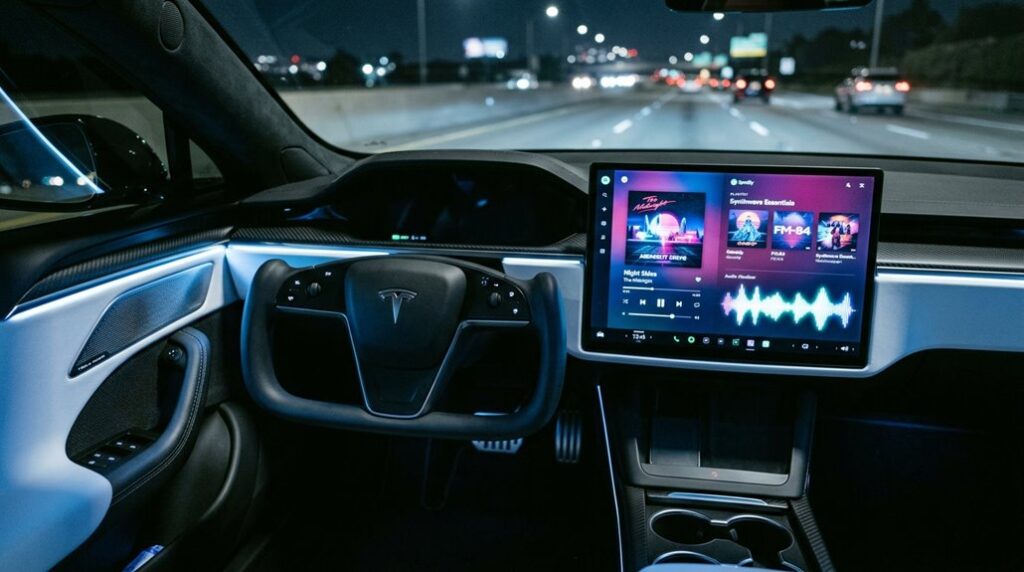
Tesla’s minimalist interior design, centered on a single touchscreen, means all audio controls, service switching, and playback settings are consolidated in one place rather than spread across physical buttons or separate displays.
How to Use Tesla’s Media Controls, Boombox, and Caraoke
Once your streaming accounts are linked and music is actually playing, you’ll want to know what all the physical and on-screen controls actually do — because Tesla’s media system goes well beyond a basic play/pause button. The left steering wheel scroll wheel handles volume, pauses playback on press, and even mutes your microphone during calls. That’s three jobs from one knob.
Here’s what else you can control:
- Passenger access controls let other occupants adjust media on supported configurations
- App launcher customization pins your most-used media sources for one-touch access
- Immersive Sound adds spatial audio depth, with an Auto mode that adjusts to your content
- Boombox and Caraoke (found inside Toybox) pipe sound externally or display lyrics — genuinely useful, occasionally ridiculous
Hide unused sources from your Media Player dropdown to keep the interface clean and navigable without unnecessary clutter. The media center itself can be repositioned across three sizes, and tapping the music-note icon toggles it between your current position and minimized to keep the map in view. Tesla’s broader vehicle ecosystem is similarly engineered around efficiency, much like how battery preconditioning via route guidance warms the pack before arrival at a Supercharger to reduce charge time.
Streaming music in a Tesla is usually seamless—until it isn’t. A weak signal, a stalled app, or a long stretch of road with patchy connectivity can turn your playlist into silence right when you’re relying on it most. That’s when having a reliable offline setup makes all the difference. Load a high-capacity USB flash drive with your favorite playlists so your Tesla always has instant, uninterrupted music ready even when streaming services drop out.
Frequently Asked Questions
Can I Play Music Through Tesla Speakers While the Car Is Parked?
Yes, you can enjoy parked playback through your Tesla’s cabin audio using Camp Mode. It keeps everything active, though wireless charging and silent mode settings may affect your overall experience.
Does Tesla Save My Streaming Login Credentials After a Software Update?
Most Tesla updates preserve your streaming access through token-based account persistence rather than raw credential encryption—so your logins typically survive. However, factory resets or password changes can invalidate those tokens, forcing reauthentication.
Which Tesla Models Support the Highest Audio Speaker Count and Quality?
Your refreshed Model S and X deliver the best sound staging, while Model 3 Performance and Long Range follow closely. Save your preferences in driver profiles to customize your premium audio experience across configurations.
Can Multiple Bluetooth Devices Stay Paired and Switch Automatically in Tesla?
Yes, multiple Bluetooth devices can stay paired on your Tesla. You’ll use Priority pairing to set your preferred phone, and Bluetooth handoff automatically switches to the next available paired device when yours isn’t in range.
Is There a Way to Set a Default Music Source That Launches Automatically?
Tesla doesn’t let you set a true auto launch for a preferred source or default playlist. Your best workaround is keeping your startup app as the last active source before you exit, so it resumes automatically.