
Your neighbor’s Model Y is running software you don’t have yet—and Tesla never told you why. Behind every silent overnight restart lies a deliberate system of VIN-level gating, hardware checks, and staged rollouts that determines exactly who gets what, and when. Update 2024.2.3 quietly rewrote how thousands of drivers experience their cars before most even noticed. Understanding how Tesla’s OTA pipeline actually works changes everything you assumed about owning one of these vehicles.
How Tesla OTA Software Updates Actually Work
Unlike a phone app that nudges you to tap “Update” every other Tuesday, Tesla’s over-the-air (OTA) software delivery system handles the heavy lifting automatically — pushing new features, performance improvements, and even recall-level fixes directly to your car without a single trip to a service center.
Tesla pushes new features, fixes, and improvements straight to your car — no service center, no hassle.
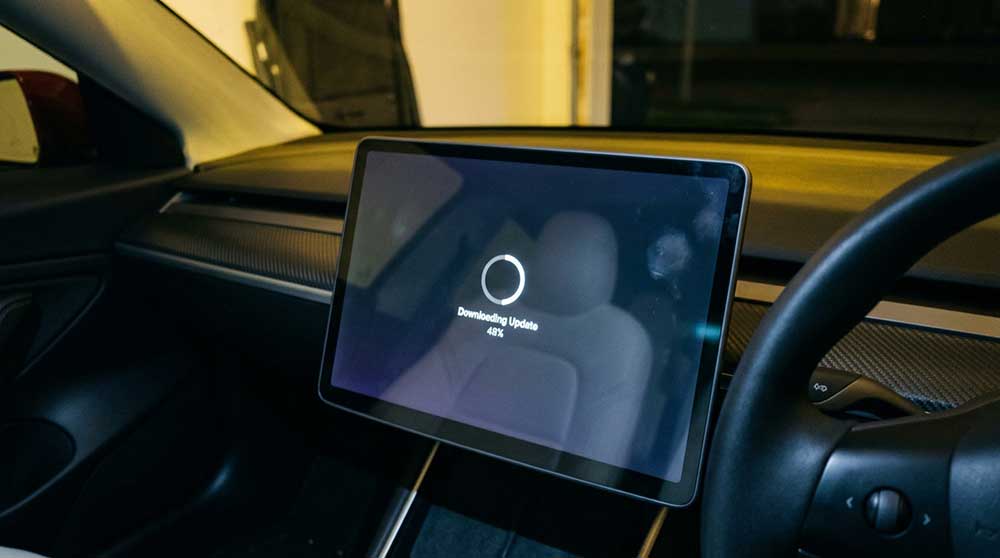
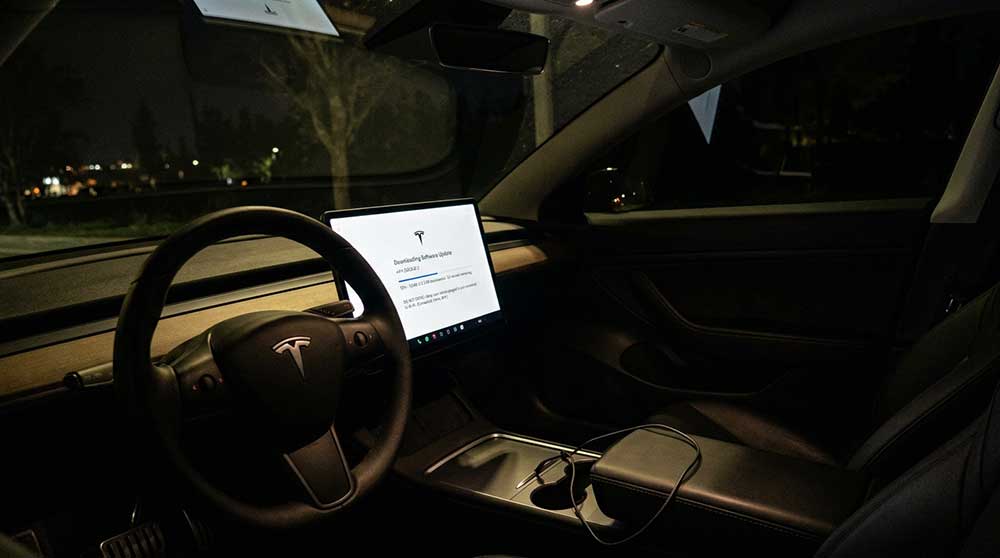
The process splits into two distinct stages: download and install.
Your Tesla checks for available updates automatically when connected to Wi-Fi. Cellular handles some cases, but Wi-Fi keeps bandwidth optimization in check — preserving your data and accelerating transfer speeds.
A green indicator confirms an active download; a yellow icon means an update exists but connectivity conditions aren’t cooperating yet.
Once the download completes, installation requires Park mode and roughly 15–30 minutes of your patience. You can’t drive during this phase.
OTA security protocols make certain each update package is verified before it ever touches your vehicle’s core systems. This same OTA infrastructure gives Tesla the ability to control software-gated feature access — selectively enabling or disabling capabilities like heated rear seats or expanded battery capacity without any physical changes to the vehicle. Smart, seamless, and entirely hands-off.
Owners can choose between Standard and Advanced software update preferences, with the Advanced setting granting earlier access to new releases before they reach wider deployment.
Why Your Tesla Software Update Arrives Later Than Someone Else’s
If you’ve ever watched a friend post about their new Tesla feature while your own car sits quietly on an older build, you’re not being singled out — you’re experiencing Tesla’s staged rollout strategy. Tesla rolls out updates in waves, starting with roughly 1–2% of vehicles before expanding fleet-wide.
| Factor | How It Affects You | Example |
|---|---|---|
| Hardware compatibility | Older hardware receives updates later | HW3 vs. HW4 cameras |
| Regional prioritization | U.S. typically receives builds before Europe or Asia | FSD rollouts |
| VIN sequence | Earlier VINs aren’t always first | Configuration-specific targeting |
Your update preference setting matters too. Switching to ADVANCED mode and staying connected to Wi-Fi puts your vehicle in the earliest eligible wave for your configuration. Tesla’s cautious sequencing isn’t favoritism — it’s risk management. A bug hitting 1% of cars beats one hitting 100%.
Some features within a given update may also be hidden or region-dependent, meaning even after your car installs the same build as someone else’s, certain capabilities like wireless phone mirroring or Grok integrations might not yet appear on your vehicle. For example, Autosteer on City Streets remains unavailable in Europe even for vehicles with an FSD package subscription, despite the broader FSD offering being available there.
Tesla keeps adding new camera features through software updates, but they are useless if your storage fills up right when you need the footage most. The last thing any owner wants is discovering a key recording was overwritten after a parking lot hit-and-run or suspicious incident. Give your Tesla the storage space it needs by upgrading to a high-capacity SSD before your next important clip disappears forever.
Does Your MCU Generation Affect How Fast Updates Install?
Getting the update is one thing — what happens after the installation is where your MCU generation starts to matter. Your MCU handles the center display, route guidance, media, and browser functions that all need to reload once an update applies. That reboot and initialization phase is where MCU performance becomes visible.
MCU1 (found in older Model S and Model X vehicles) runs older hardware, making installation perception noticeably slower. Route guidance tasks that take roughly 9 seconds on MCU2 can stretch to 20 seconds on MCU1 — a controlled comparison confirmed that gap. The background software flashing process isn’t the bottleneck; the UI rendering afterward is.
MCU2’s x86_64-based design handles post-update loading about twice as fast. Software updates can improve MCU1 responsiveness (Elon Musk publicly confirmed optimization efforts), but hardware limits cap those gains. Slower MCU performance won’t block an update — it just delays when your car actually feels ready. The gap becomes especially pronounced in the browser, where MCU1 renders pages so slowly it becomes almost unusable, while MCU2 loads the same content in around 10 seconds.
On newer Model 3 vehicles, you can verify your current software build and confirm hardware details by navigating to Settings → Software → Additional Vehicle Information directly on the touchscreen.
Standard vs. Advanced: Which Tesla Update Preference Gets You Updates Faster?
Tesla gives you two Software Update Preference options — Standard and Advanced — sitting quietly under Controls > Software, and picking the right one can mean the difference between seeing a new feature this week or next. Advanced targets early adopters who want updates as soon as Tesla clears them for their specific vehicle configuration and region, while Standard takes the more conservative lane, waiting for broader rollout after heavier validation.
The honest catch, though, is that the real-world timing gap between the two is often surprisingly small, with many owners reporting little to no noticeable difference during routine rollouts (though Advanced tends to matter more during staged rollout waves, particularly for FSD-related builds). The feature’s continued relevance was recently reaffirmed when Elon Musk confirmed on X that Tesla actively uses the preference setting as a distribution factor rather than treating it as an obsolete relic. It’s also worth noting that regardless of which preference you choose, the OTA process itself works the same way — the vehicle pulls an encrypted firmware bundle via Wi‑Fi or built-in cellular, downloads it silently, and installs it during a scheduled window that requires Park mode and suspends driving for roughly 15 to 30 minutes.
Comparing Both Preference Options
Regarding Tesla’s two update preference settings—Standard and Advanced—the honest answer is that neither one puts you in the driver’s seat of Tesla’s rollout schedule, but one does position you closer to the front of the line.
Advanced delivers updates sooner once your vehicle’s already eligible, while Standard waits for broader rollout coverage. That distinction matters for managing user expectations accurately.
Advanced won’t override Tesla’s staged release system, regional eligibility, or vehicle configuration requirements—it simply reduces unnecessary waiting once clearance exists.
Standard suits cautious owners who prefer letting other vehicles absorb early builds first.
Neither setting carries meaningful privacy implications beyond what Tesla’s standard data collection already involves.
Choose based on how quickly you want eligible updates applied, not on assumptions that either option bypasses Tesla’s gating process entirely.
Be aware that feature rollbacks can occur when Tesla reverses behavior mid-cycle, meaning observable driving differences may appear after an update regardless of which preference setting you selected.
Advanced Preference Rollout Speed
If you’ve already set your preference to Advanced and you’re wondering why your neighbor’s Model Y updated before yours, the answer lies in how Tesla’s rollout system actually works—not in your settings.
Advanced positions you among early adopters, but Tesla’s staged rollout still controls eligibility by vehicle configuration and region. Think of Advanced as raising your hand first—Tesla still decides who gets called on.
Rollout ethics matter here: Tesla deliberately sequences updates in waves to catch bugs before they reach the wider fleet.
Your Wi-Fi connection also affects delivery speed.
Advanced increases your probability of earlier access; it doesn’t override Tesla’s release logic. So yes, Advanced helps—but Tesla’s infrastructure, not your preference alone, finally determines when that update notification appears. Similarly, Tesla’s vehicles benefit from tightly integrated hardware-software coordination in other systems, such as battery preconditioning via route guidance, which warms the pack before a Supercharger arrival to optimize charging speed.
How to Download, Schedule, and Install a Tesla Software Update
Once Tesla drops an update into your vehicle’s queue, you’ve got two distinct jobs to handle: getting it downloaded and then getting it installed — and knowing the difference between those two stages saves you a lot of confusion.
Downloading requires a solid Wi-Fi connection (your car’s cellular connection won’t cut it for a full package), so leaving your vehicle connected to your home network overnight is the most reliable move you can make.
From there, scheduling the install is straightforward — a clock icon appears on the touchscreen when the download is complete, and you can either tap it to install immediately or set it for a specific time when you know the car will be parked. For example, Tesla’s over-the-air updates have expanded Supercharger preconditioning support to include some third-party DC fast chargers, meaning a scheduled overnight install can quietly unlock faster charging ramp-up on your next road trip.
Downloading and Scheduling Updates
Tesla pushes software updates over the air, so the process kicks off automatically the moment your vehicle connects to a Wi‑Fi network and detects an available package. No manual triggering required — your car handles it quietly in the background.
- A yellow icon signals a pending download (usually a Wi‑Fi issue); a green arrow confirms active downloading
- No home network? A cellular hotspot or service center Wi‑Fi works as a legitimate alternative
- Once downloaded, a clock icon appears, letting you install immediately or schedule for later
One critical scheduling note: if you’re driving at your scheduled install time, Tesla cancels it automatically. You’ll need to reschedule — so plan around your parking habits, not your commute.
Many of these updates deliver meaningful improvements without any hardware changes, which is why over-the-air updates are considered one of the core advantages of Tesla ownership — handling everything from bug fixes to brake behavior refinements on models like the Model 3 and Model Y.
Installing and Managing Updates
When the clock icon appears on your touchscreen, the update is downloaded and sitting in your vehicle’s onboard storage — ready to go on your command. Tap it, and you’ll choose between installing immediately or scheduling a later time — genuine user control, not just an illusion of it.
Tesla builds in update transparency here: you see exactly what’s pending and when it’ll run. Schedule it for 2 a.m., and Tesla handles the rest automatically (assuming you’re parked at home).
One hard rule applies — your vehicle must be in Park before installation begins. Charging pauses during installation and resumes afterward, so don’t panic. If you’re driving at the scheduled time, the update cancels and requires rescheduling. Simple, logical, occasionally inconvenient.
Scheduling your update overnight pairs naturally with home charging habits, since off-peak charging rates can reduce your electricity costs to as low as $0.13 per kWh while the vehicle handles both tasks simultaneously.
How the Tesla App and Wi-Fi Settings Affect Update Delivery
If you’re not paying attention to the Tesla app and your Wi-Fi connection, you’re effectively leaving your software updates to chance. App Notifications are your first signal that an update exists — Tesla pushes alerts directly through the app before most owners even glance at their touchscreen.
Cellular Limitations mean that relying solely on mobile data pathways slows delivery and reduces reliability. Wi-Fi isn’t optional; it’s the preferred infrastructure Tesla built this system around.
Here’s what controls your update experience:
- Tesla app: Displays a dedicated “Software Update” section when a package is staged for your vehicle
- Wi-Fi connection: Enables faster, more reliable download compared to cellular pathways
- Update Preference setting: Use Controls > Software > Software Update Preference and select “ADVANCED” to receive updates as soon as they’re available for your specific configuration and region
Ignore these levers, and you’re simply waiting longer than necessary. Keep in mind that model-year hardware differences, such as the removal of ultrasonic parking sensors in newer Model Y builds, can affect which software features are actually delivered to your vehicle even when updates are received successfully.
What to Do When Your Tesla Software Update Is Delayed or Stuck
A stuck or delayed Tesla software update is annoying, but it’s rarely a sign that something is catastrophically broken. Before panic sets in, wait. Seriously — many updates that appear frozen at 50% or 100% are actively validating downloaded files in the background, quietly managing user expectations while your battery health stays unaffected throughout the process.
If waiting feels insufficient, perform a soft reboot by holding both scroll wheels for roughly 10 seconds. That clears minor software glitches without interrupting the update package. Afterward, check the Software tab to confirm whether the process resumed. Keep the vehicle parked and off a charger if temperatures are moderate.
Still stuck after rebooting? Wait another 10 minutes before intervening again. Updates have been documented taking 50-plus minutes with zero visible progress, then suddenly completing. If repeated reboots and overnight attempts both fail, contact Tesla service — they can remotely push the update directly.
Tesla keeps adding new features, menus, and controls through software updates, but if you’re still stretching toward the center screen every time you adjust navigation, media, or vehicle settings, you’re not getting the most comfortable experience possible. A screen that faces the driver simply feels more natural. Turn your touchscreen toward you before another road trip reminds you how awkward the factory position can be.
Frequently Asked Questions
Can a Tesla Software Update Ever Reduce or Remove Existing Features?
Yes, Tesla updates can reduce or remove your existing features. You’re not immune to feature removals, and even safety recalls can trigger software changes that alter or eliminate functionality you’ve come to rely on.
What Happens to a Tesla Software Update if the Battery Dies Mid-Installation?
If your battery dies mid-installation, you’ve fundamentally handed your Tesla a half-finished puzzle. Without battery preservation, it can freeze or corrupt. Fortunately, rollback safeguards often let it resume once you’ve recharged above the minimum threshold.
Does Tesla Notify You if Your Vehicle Is Skipped During a Rollout?
No, Tesla doesn’t send skip alerts or offer rollout transparency when your vehicle’s bypassed. You’ll simply notice no update notification. Check your car’s Software screen or Tesla app manually to confirm your current status.
Can Two Identical Tesla Models Receive Completely Different Software Version Numbers?
Yes, your two identical Teslas can run completely different builds. Hardware variations between units actively determine which updates you’ll receive, meaning your vehicles can legitimately plunge onto separate software version numbers over time.
Is There a Maximum Number of Updates a Tesla Can Receive in One Year?
There’s no hard cap on update limits — Tesla’s delivery cadence is continuous and flexible. You could realistically receive a dozen or more updates in a single year, depending on your region, hardware, and software preferences.