
Tesla owners trigger remote unlocks over 2 million times daily—yet the Start button sits quietly ignored, misunderstood, and critically different from every other app feature. Most drivers don’t even know it exists until they desperately need it. It doesn’t behave like Climate controls, it’s buried where you’d never think to look, and once activated, you have exactly two minutes before it vanishes. If you’ve ever needed to hand off your car fast, this is the one button that matters most.
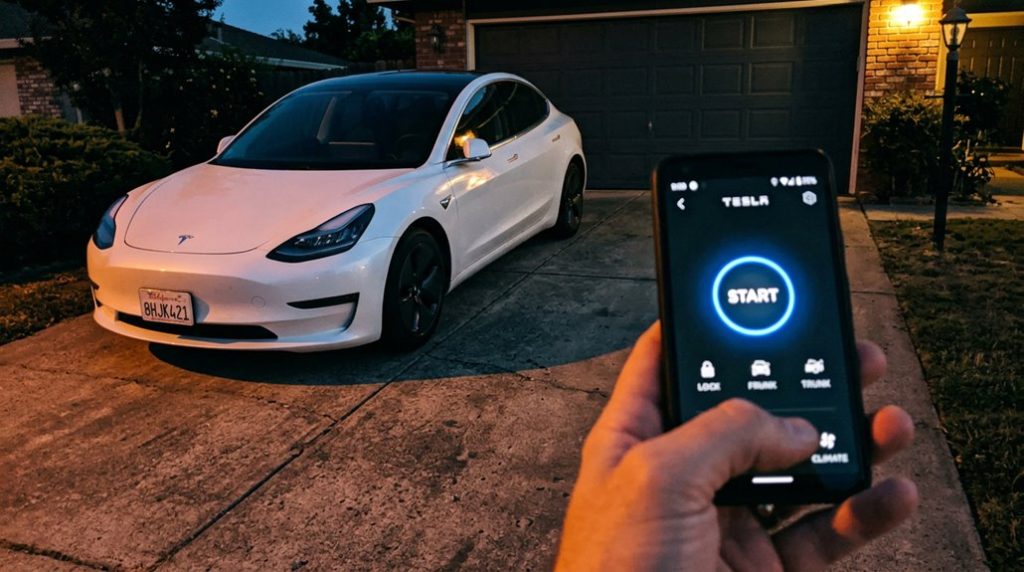
What the Tesla App Start Button Does and When to Use It
Rather than stranding the driver or handing over permanent access, Start grants a tightly controlled window of operation.
Rather than leaving drivers stranded or granting permanent access, Start delivers a precise, controlled window of operation.
The feature suits immediate scenarios — a spouse needing the car, someone moving it from a garage, a valet-style situation — rather than long-term key sharing. Tesla vehicles rely on driver oversight and responsibility at all times, meaning whoever enters the vehicle must be prepared to operate it safely regardless of how access was granted.
Temporary and deliberate, by design. Once the button is pressed, the driver has a two-minute window to enter the vehicle and engage drive before the access expires.
Relying only on your phone to start your Tesla can leave you stuck at the worst possible moment — dead battery, failed app connection, or a phone left behind is all it takes to lock you out of a car that’s otherwise ready to go. Keep a reliable backup on hand by storing your key card in a Tesla key card RFID wallet holder so you always have secure, instant access no matter what happens with your phone.
How to Find and Tap Start in the Tesla App
Knowing what the Start button does is half the battle — finding it is the other half. App routing here follows a straightforward path, but skipping a step breaks the whole sequence.
Open the Tesla app, select your vehicle, then tap Controls. That’s where Start lives — not on the home screen, despite what you might expect.
| Step | Action | Touch Gesture |
|---|---|---|
| 1 | Open Tesla app | Single tap |
| 2 | Select your vehicle | Single tap |
| 3 | Route to Controls | Single tap |
| 4 | Tap Start | Single tap |
One tap activates the session. A visible timer confirms it’s running, giving the driver roughly two minutes to shift into drive. Tapping Start again can cancel the session early (some app versions support this). If Start isn’t visible, verify you’ve selected the correct vehicle — wrong selection, wrong controls. Tesla’s software architecture treats the app as an extension of the vehicle’s software-first platform, meaning remote functions like Start are governed by the same connectivity infrastructure that handles OTA updates and Premium Connectivity features. The same Controls section also provides lock and unlock options, giving drivers full remote access management from a single location in the app.
The Two-Minute Window After You Hit Start
Once you tap Start, a two-minute countdown begins — and that window is everything.
During those 120 seconds, the driver must enter the vehicle and shift into drive. Miss that entry timeout, and the authorization expires completely. No extensions, no grace period.
This matters most during a guest handoff situation, where you’re remotely authorizing someone else to drive. They need to be physically ready — standing near the car, not walking from across a parking lot. The clock doesn’t care about circumstances. The Tesla app displays vehicle and software details on the vehicle home page after authentication, so the authorizing owner can confirm the correct car is being accessed before tapping Start.
Here’s the practical part: once the vehicle is actually in drive and moving, the two-minute limit no longer applies. The driver continues normally until they park again. At that point, the authorization ends, and a fresh Start command would be needed for another session.
Think of the window as a brief permission slip — precise, deliberate, and unforgiving if you’re not prepared for it. The countdown timer is visible on the front screen so the driver knows exactly how much time remains.
How the Start Button Differs From Tesla Climate Controls
While the two-minute window frames Start as a time-sensitive access tool, that framing also hints at what Start isn’t — a cabin comfort feature. Start is a remote authorization function. It grants temporary driving entry when no key card, phone key, or fob is physically present. That’s it.
Climate controls handle everything else — temperature, fan speed, seat ventilation, and cabin preconditioning. You access those through the app’s fan icon or the touchscreen’s temperature display. They’re entirely separate systems serving separate goals.
Here’s where people get confused: both live inside the same app. But tapping Start won’t cool your cabin on a hot day, and opening Climate won’t grant driving entry for someone without credentials. Start is access security; Climate is comfort management. For best results, use the Climate feature to precondition your cabin while still plugged in, so thermal energy from the grid powers the process rather than drawing from your battery pack.
Think of Start as a short-term key substitute and Climate as your cabin’s environmental dial. Neither replaces the other, and confusing the two leaves a problem unsolved. It’s worth noting that in other EVs, like the KIA EV6, app remote start uses the temperature settings configured within the app itself, rather than the climate settings last used in the vehicle.
Why the Tesla App Start Button Is Not Working and How to Fix It
If the Start button isn’t responding, the cause almost always falls into one of four categories: connectivity failure, missing app permissions, a software glitch, or a vehicle-side pairing problem. Work through each systematically.
A non-responsive Start button almost always traces back to one of four fixable causes—work through them systematically.
For connectivity, toggle between Wi-Fi and cellular data, then disable Airplane mode if it’s active. A simple phone reboot often restores dropped network services.
Permission troubleshooting comes next. On Android, confirm location is set to *Always* and that Nearby Devices permission is enabled. Bluetooth must remain active—it’s not optional here.
Suspect app corruption if permissions check out. Force-close the app, reopen it, and clear the cache (Android) or reinstall entirely (iOS). Reinstalling requires logging back in afterward.
Finally, address the vehicle side. Remove and re-add your phone key, then reboot the Tesla itself by holding both scroll wheels. Persistent failures after all four checks warrant a Tesla Support call. If your vehicle has received a recent over-the-air software update, the reboot process resets any update-related conflicts that may interfere with app connectivity.
Your Tesla app is only as reliable as the phone running it, and when it slips between seats, runs low on battery, or isn’t within reach, you end up fumbling at the exact moment you need instant access. Keep your phone powered, visible, and locked in place with a Tesla-compatible magnetic phone mount with fast charging so your “start button” is always ready when you are.
Frequently Asked Questions
Can Multiple Tesla Accounts Use the Start Button on One Vehicle?
Like telegraph operators of old, you can share access — but it’s tied to driver permissions, not shared logins. Owner transfers aside, each account needs individual driver-linking approval before using the Start button.
Does the Start Button Work if the Tesla App Is Offline?
Generally, the Start button won’t work offline—it’s an offline limitation requiring cellular connectivity. For connectivity troubleshooting, make sure both your phone and vehicle have active signals, or use a physical key card as your fallback.
Will the Start Button Authorization Appear in the Vehicle’s Activity Log?
Tesla doesn’t confirm that your start button authorization logs appear in the vehicle’s activity log. While you’ll receive security notifications for account activity, Tesla hasn’t publicly documented a discrete activity log entry for this specific action.
Can the Start Button Be Disabled Permanently Through Tesla Account Settings?
You can’t achieve permanent disablement of the Start button through Tesla account permissions alone. Instead, you’ll need to manage this through your vehicle’s touchscreen under Controls > Safety > Mobile Access.
Does Using the Start Button Drain the Tesla Battery Faster Than Normal?
Like a light switch left on briefly, remote start won’t heavily drain your battery. You’ll notice battery impact mostly from repeated wake-ups, not single presses.