
Tesla locks you out of CarPlay and Android Auto on purpose—and most drivers just accept it. But 40 miles from a Supercharger, watching Tesla’s native routing skip a faster station two exits back, “just accepting it” gets expensive fast. The fix exists, it’s practical, and in some cases it’s completely free. The catch? Which workaround actually works depends entirely on your MCU version.
Why Tesla Blocks CarPlay and Android Auto
If you’ve ever wondered why Tesla hasn’t added CarPlay or Android Auto to its vehicles, the answer isn’t an oversight — it’s a deliberate product decision rooted in control.
Tesla owns its entire software stack, meaning route guidance, media, vehicle settings, and climate all operate inside one unified system. Introducing CarPlay or Android Auto would layer a second operating environment on top, creating user fragmentation — the kind where you’re toggling between a Tesla control and a phone-based window just to adjust your route.
Tesla views that split as a problem worth avoiding.
External platforms like Apple’s and Google’s run on their own update cycles, which can conflict with Tesla’s vehicle-wide software deployments. Supporting two ecosystems introduces coordination complexity Tesla simply doesn’t want.
Software control stays internal, the roadmap stays clean, and Tesla argues its native routing already handles what most drivers need — making third-party projection a redundancy rather than an upgrade. Tesla’s minimalist cabin philosophy reinforces this further, with vehicle settings, climate, and navigation consolidated into a single touchscreen interface rather than divided across multiple control surfaces. Tesla positions itself as both a carmaker and a tech company competitor, placing it in direct rivalry with Apple and Google rather than as a partner to their platforms.
Load Google Maps or Waze in Tesla’s Browser
Without native CarPlay support, Tesla’s built-in browser becomes your most direct path to third-party mapping — and it’s more capable than it sounds. Direct to TeslaWaze (a browser workaround, not an installed app) and you’ll get Waze-style traffic layers covering accidents, police presence, road closures, and construction hazards.
Setup is straightforward. Open Tesla’s browser, load the TeslaWaze URL, and grant location permissions when prompted — that’s what anchors your position on the map. Do your configuration while parked, not moving. Adjust your display toggles (weather, traffic jams, incident markers), then save the page as a favorite for faster access on future drives.
A few honest caveats: Model S and Model X handle browser-based access well, though older Model 3 builds may lack browser availability entirely. Full destination guidance doesn’t behave like the standalone Waze app. Think of it as a strong traffic awareness tool rather than a complete navigation replacement. Tesla’s MCU hardware generation directly affects how smoothly the browser performs, with MCU1-equipped vehicles experiencing noticeable map loading delays and UI lag compared to newer builds. The map also displays Supercharger locations along your route, which adds a practical layer of trip planning directly to your awareness view.
Mirror Your Phone Screen to Tesla via Wi-Fi Hotspot
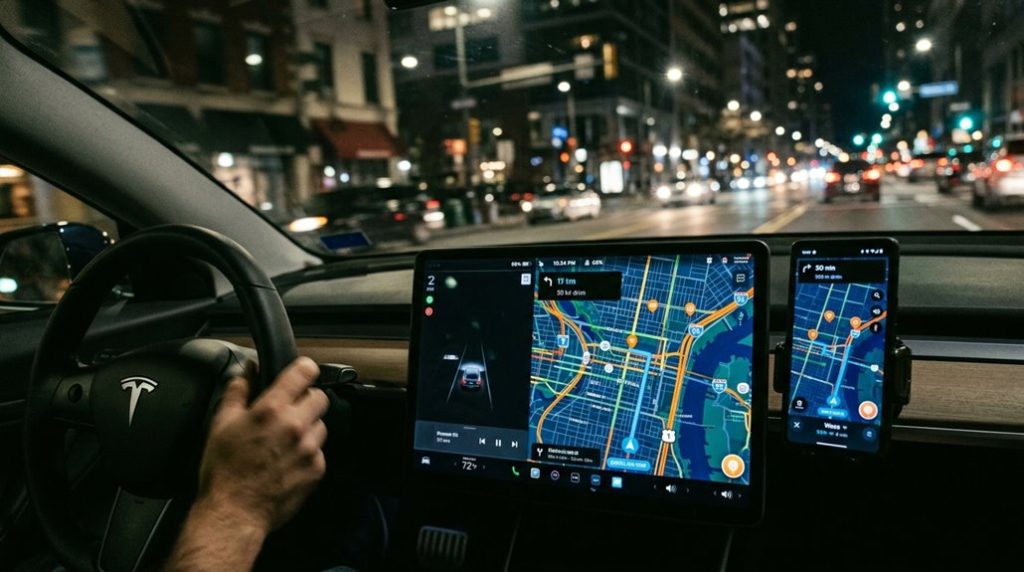
Screen mirroring turns your phone into a broadcast server and Tesla’s built-in browser into the display endpoint, so you’re effectively streaming your phone’s screen over a local Wi-Fi connection rather than through any native CarPlay or Android Auto protocol.
To set it up, enable your phone’s personal hotspot first, launch a mirroring app (like TeslaAndroid or Tesla Mirror), connect the Tesla touchscreen to that hotspot through the vehicle’s Wi-Fi settings, then load the app’s local browser URL on the Tesla display — and if you’re driving, toggle Remain Connected in Drive or the whole stream drops the moment you shift out of Park.
App choice matters more than you’d expect, since H.264/H.265-capable apps can deliver lossless audio directly through the browser, while MJPEG-based apps mirror video only and push audio separately over Bluetooth (more steps, more failure points). Once the app is running and the VPN connection is active, you access the mirrored display by navigating to the app’s URL on Tesla’s browser.
Tesla’s over-the-air software updates, such as OTA 2025.2, have expanded third-party DC fast charger preconditioning support, meaning the vehicle’s navigation and thermal management features are increasingly integrated with non-Tesla charging infrastructure — a sign that Tesla’s software ecosystem continues to evolve beyond its own native tools.
Third-party navigation apps are hard to use safely in a Tesla when your phone keeps sliding or sitting out of view, forcing distracting glances while driving. Keep your route visible and stable with a Tesla-compatible phone mount so you can follow directions without taking your eyes off the road.
How Screen Mirroring Works
Since Tesla doesn’t support native CarPlay or Android Auto, screen mirroring fills the gap — and it works through a surprisingly simple Wi-Fi loop.
Your phone becomes both the hotspot and the source device, broadcasting your screen over a local network your Tesla joins. Once connected, the mirroring app generates a web address you manually enter into Tesla’s browser — that browser then becomes your display endpoint, rendering whatever your phone streams.
Worth noting: this setup carries network security and privacy implications, since your phone’s hotspot is actively broadcasting during the session. Use a strong password.
For best performance, enable 5GHz on your hotspot — 2.4GHz introduces lag that makes route guidance sluggish. Tesla’s built-in trip planner handles Supercharger stop insertion and estimated arrival state of charge, but third-party mapping apps accessed through mirroring can supplement that guidance with broader navigation options.
The entire process is wireless, requiring no cable between your phone and car. After tapping Start in the Tesla Mirror app, broadcast initiation takes approximately 3 seconds before your iPhone screen appears on the Tesla display.
Setting Up Your Hotspot
It’s straightforward, though not without trade-offs. Running a hotspot accelerates battery drain noticeably, so a charged phone isn’t optional — it’s mandatory. There are also mild security risks worth acknowledging; a live hotspot broadcasts your connection publicly, so avoid generic or unsecured network names. Once connected, Tesla saves the network automatically, making future sessions faster to launch. For longer trips, pairing this setup with Tesla’s online routing feature can help the car factor in live traffic and elevation changes to reduce unnecessary energy consumption while your hotspot session runs in the background.
Best Apps To Mirror
With the hotspot connection sorted, the next move is picking the right app — and that choice comes down entirely to your phone’s operating system. Android users should grab TeslaDisplay, while iPhone owners need TslaMirror. There’s no universal option here, so don’t waste time searching.
Both apps broadcast your screen through Tesla’s built-in browser (you’ll load td7.cc or a similar URL), which means you’re effectively using the MCU as a display client rather than a native app host. That browser-first designer introduces wireless latency — expect a slight delay versus native CarPlay. Worth knowing upfront.
On app privacy, both tools require hotspot access and run over your cellular connection, so review their permissions before handing over network control. Keep in mind that used OEM MCU units often integrate seamlessly with the vehicle’s existing software stack where aftermarket display alternatives frequently cannot.
Add Carplay or Android Auto With a Hardware Mod
If you want a more seamless experience than browser workarounds or Wi-Fi mirroring can deliver, a hardware mod is your next logical step.
These aftermarket interface modules physically sit between your Tesla’s touchscreen and the vehicle’s existing infotainment system, inserting a CarPlay or Android Auto input layer while keeping Tesla’s native UI accessible as a selectable source.
The catch is compatibility: no official Tesla hardware kit exists for this, so you’re relying entirely on third-party manufacturers and installer-specific fit for your exact model year. It’s also worth noting that older vehicle hardware limitations can affect which Tesla software features remain accessible alongside any third-party interface you add.
Hardware Mod Overview
Retrofit modules take a different approach entirely—instead of replacing Tesla’s factory head unit (a swap that would gut your climate controls, camera feeds, and vehicle settings along with it), these plug-in interface kits sit inline between the existing display hardware and the factory wiring loom. OEM preservation is the core pitch: your stock screen stays, your factory integrations survive, and CarPlay or Android Auto simply layers on top.
| Feature | Retrofit Module | Full Head-Unit Swap |
|---|---|---|
| OEM Screen Kept | Yes | No |
| Audio Routing | Varies by kit | Replaced entirely |
| Install Complexity | Moderate | High |
Audio routing does vary—some kits need a separate output path. But climate controls and camera feeds? They stay untouched. This matters especially for drivers who rely on Tesla’s native route guidance to trigger battery preconditioning, which warms the pack before arriving at a Supercharger for faster charging speeds.
Third-party navigation apps drain your phone fast in a Tesla, and the last thing you want is your route cutting out mid-drive because your battery can’t keep up. Avoid losing directions or switching off navigation at the worst moment by keeping power steady with a high-speed USB-C car charger so your phone stays charged for the entire trip.
CarPlay Android Compatibility
Hardware compatibility isn’t a coin flip, but it’s not a guarantee either—whether a retrofit module actually adds CarPlay or Android Auto to your vehicle depends almost entirely on which infotainment framework you’re already running.
Head unit compatibility centers on HMI-based systems, specifically IO4, IO5, and IO6 designs. IO5 and IO6 units are retrofit-ready when your vehicle appears on the supported model list. IO4 owners aren’t locked out, but they’ll need a factory 8-inch IO5/IO6 hardware conversion first—an extra step worth knowing upfront.
Wireless dongles add another layer of subtlety: they only function if wired CarPlay is already active in your head unit. Without that foundation, the dongle has nothing to bridge.
Always verify your exact infotainment version before purchasing anything. For Tesla owners exploring third-party mapping options, confirming your hardware version and generation through Settings → Software → Additional Vehicle Information is a reliable starting point before evaluating any retrofit solution.
Plan Smarter Tesla Routes With ABRP and Plugshare
Tesla’s built-in routing handles Supercharger routing competently, but it leaves meaningful gaps once your trip extends beyond the simplest point-to-point drive. That’s where ABRP and PlugShare earn their place in your workflow.
Start with ABRP for route optimization. Select your vehicle model, enter your destination, and ABRP generates a complete trip plan—charging stops, durations, and adjusted estimates for weather or driving style. It recalculates continuously in driving mode, which matters on longer runs where conditions shift.
ABRP builds your full trip plan—charging stops, durations, weather adjustments—and keeps recalculating as conditions change.
Then cross-check each stop in PlugShare for charger verification. You’ll see recent check-ins, photos, and user feedback that confirm whether a station is actually functional before you commit. PlugShare also surfaces backup chargers nearby, so you’re never locked into one option.
Tesla’s pathfinding shows amenities and reroutes around busy Superchargers, but it won’t show you a broken plug someone flagged two hours ago. These tools together fix that. For trip planning accuracy, it also helps to know that stopping at 80% charge on long trips preserves battery longevity and aligns with the charge durations ABRP factors into its stop estimates.
Lag, Data, and Audio Limits You Should Expect
Those two apps solve real planning problems, but they’re not a free lunch once you’re moving.
Real time latency is the first friction point. ABRP is built for planning, not live vehicle UI, so its routing can trail conditions by a meaningful margin when elevation, wind, or cold weather shift mid-trip.
Watch for these three limits before you leave the driveway:
- Charger accuracy: PlugShare’s database is massive, but station-level details vary widely, so cross-check status before you arrive.
- Infotainment conflicts: Third-party apps run alongside Tesla’s native audio stack, meaning voice prompts compete for the same channel as music or factory guidance.
- Voice interruptions: Android Auto can pass vehicle data to ABRP in supported setups, but audio behavior isn’t consistent across configurations.
None of these issues are dealbreakers. They’re platform constraints worth knowing before a road trip exposes them at the worst possible moment.
Frequently Asked Questions
Can Third-Party Mapping Apps Access Tesla Vehicle Data Directly?
Yes, you can grant third-party mapping apps telemetry access through Tesla’s authorization system. You’ll control granular permissions, but consider the privacy implications before linking your account.
Does Tesla’s Warranty Change if Third-Party Mapping Hardware Is Installed?
Tesla’s warranty won’t automatically change — but here’s the catch: warranty implications depend on hardware compatibility and whether Tesla links any failure directly to your installed third-party mapping device.
Which Third-Party Mapping Apps Work Offline Without a Data Connection?
You’ve got solid offline routing options: Google Maps, HERE WeGo, MAPS.ME, Organic Maps, and OsmAnd all support map caching, letting you pre-download regions and route without any data connection.
Can Multiple Third-Party Mapping Apps Run Simultaneously on Tesla’s System?
You can’t run multiple instances of third-party mapping apps with concurrent route guidance natively on Tesla’s system. Tesla doesn’t offer an open app platform, so third-party tools connect through your account externally, not on the display.
Are Third-Party Mapping App Permissions Revocable After Granting Tesla Account Access?
Yes, you can revoke third-party mapping app permissions anytime. Use Tesla’s Privacy Controls via the Account Security page or Third Party Apps section to activate your Revoke Options, immediately cutting the app’s data and command access.