
Tesla tyres cost more than most drivers expect — and the reason starts before the rubber even hits the road. Hidden inside every tyre is an acoustic foam liner, a noise-dampening layer engineered specifically because Tesla’s silent cabin amplifies every road hum a combustion engine would normally mask. That single design decision drives up manufacturing costs before load ratings, torque demands, or OEM calibration even enter the conversation. The full price breakdown is more specific — and more surprising — than you’d think.
Why Tesla Tyres Cost More Than You Think
When you first see the price tag on a set of Tesla tyres, the number tends to land somewhere between “unexpectedly high” and “are you serious right now.” That reaction is completely valid, because Tesla-specific and Tesla-approved tyre lines consistently sit above the pricing bracket for conventional car tyres — and there are real, engineering-driven reasons behind that gap.
Tesla’s battery pack adds significant mass, demanding stronger sidewall construction and more durable compounds. Instant torque accelerates tread wear faster than a combustion engine ever would. Low rolling resistance compounds cost more to manufacture but protect your range — and indirectly, your battery degradation curve. Some fitments include acoustic foam liners (reducing cabin noise in an already whisper-quiet interior), which raises material costs further.
Neglecting proper tyre maintenance doesn’t just cost you today. It quietly chips away at your resale value over time. These tyres are expensive precisely because they’re doing more work than most people realise. Choosing an unsupported tyre size can also create warranty audit triggers that put your vehicle coverage at risk during a claim assessment.
Manufacturers like Michelin, Goodyear, and Pirelli invest heavily in dedicated research, real-world testing, and specialised production processes to meet the unique demands Tesla vehicles place on tyres. Research and development costs for these bespoke fitments are built directly into the price you pay at the point of purchase.
Why Tesla Tyres Aren’t Just Regular Tyres
Slap a standard tyre on a Tesla and you haven’t just made a budget swap — you’ve quietly undermined a system that was engineered from the ground up to function as a single, integrated unit. Tesla tyres aren’t generic rubber shaped to fit a rim. They’re purpose-built components calibrated around EV-specific demands.
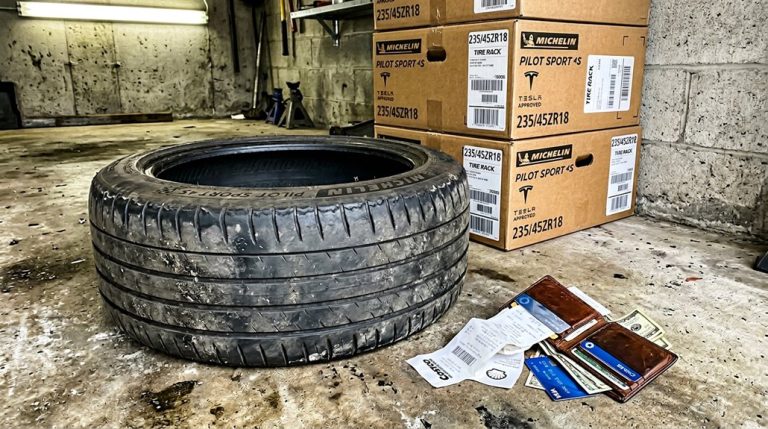
Start with acoustic engineering. Tesla tyres feature foam liners that deliver a measurable 6 dB reduction at 200 Hz — and because decibels operate on a logarithmic scale, that translates to a dramatically quieter cabin (not just marginally quieter). Standard tyres skip that entirely.
Then there’s rolling resistance. Lower resistance directly extends range, and Tesla’s tyre compounds are tuned to support that efficiency without gutting grip or safety. Tesla’s battery pack adds 800–1,200 lb of weight compared to similar combustion vehicles, meaning tyres must be rated to handle significantly higher loads without compromising efficiency or safety.
Finally, software integration ties everything together. Tesla’s vehicle systems are calibrated around OEM tyre behaviour (identified by T0, T1, or T2 sidewall markings). Swap those out, and the entire system works against itself. Tesla collaborates with manufacturers like Bridgestone, Michelin, and Pirelli to co-develop these tyres, meaning every T-marked tyre is fine-tuned specifically to Tesla drivetrains rather than adapted from an off-the-shelf design.
How Tesla’s Weight and Torque Wear Tyres Faster
Your Tesla’s battery pack turns every drive into a weight-bearing exercise your tyres never signed up for — a Model 3 tips the scales at roughly 1,600 kg compared to a comparable ICE car’s 1,400 kg, and that extra 200 kg presses down on four contact patches that are already working overtime.
Unlike a gas engine that builds torque gradually through a rev range, Tesla’s electric motor delivers maximum torque from zero RPM, meaning every hard launch immediately scrubs tread through slip and friction rather than easing into it.
Combined, these two forces — constant heavy loading and instant torque delivery — can accelerate tyre wear up to 20–50% faster than comparable gas vehicles, depending on how aggressively you drive. Because the battery’s mass is distributed evenly across the floor of the vehicle, all four tyres tend to wear at a similar rate, which often means replacing the full set at once rather than individual tyres.
This accelerated wear rate also feeds directly into the five-year ownership costs of a Tesla, where faster-than-expected tyre replacement from instant torque and vehicle weight is flagged as one of the more significant recurring expenses beyond insurance and maintenance.
Weight Accelerates Tyre Wear
Tesla’s battery pack is genuinely heavy — the Model 3’s pack alone adds several hundred pounds over a comparable combustion car — and that extra mass doesn’t disappear once you’re rolling; it presses down on every tyre with greater normal force, increasing contact stress and rubber deformation on each rotation.
Poor weight distribution between axles compounds this further, loading certain tyres disproportionately. More rubber deformation per rotation means more friction, and more friction means more heat.
That heat accelerates thermal degradation, breaking down the tyre compound faster than it would on a lighter vehicle. You’re not doing anything wrong — physics is simply doing its job. Heavier vehicles consume tyres faster, and a Tesla, by design, is a heavy vehicle carrying a very large battery. The Tesla Model S Plaid illustrates this clearly, with a curb weight exceeding 4,800 pounds placing a relentless and substantial load demand on its tyres.
Beyond static weight alone, the Model S Plaid’s tri-motor torque output of approximately 1,050 lb-ft means that enormous rotational force is transmitted through the tyres on every hard acceleration, accelerating shoulder and tread wear at a rate that purely weight-based calculations would still underestimate.
Most Tesla tire costs don’t come from the rubber itself—they come from slow pressure loss that quietly eats tread, reduces range, and shortens tire life before you even notice. A Portable 12V Tire Inflator keeps PSI consistent at home or on the road, helping prevent uneven wear and unnecessary replacements.
Torque Strains Tread Life
Weight might be doing the heavy lifting on tyre wear, but torque is the one actively scrubbing rubber off your contact patch every time you press the accelerator. Tesla’s electric motors deliver near-maximum torque from a standstill, creating instant grip demand that your tyres must satisfy immediately. Even without visible wheelspin, rapid throttle inputs trigger micro slip scrub — tiny shear events where the rubber briefly loses synchronisation with the road surface. You won’t see it happening, but you’ll eventually measure it in millimetres of lost tread.
Rear tyres on rear-biased setups suffer fastest because they carry both acceleration forces and a disproportionate weight share. The Cybertruck compounds this further, as its structural battery pack doubles as a load-bearing floor element, concentrating significant mass low in the chassis and increasing the vertical load pressing down on each tyre during hard acceleration events. Smooth throttle application reduces peak shear forces considerably, preserving rubber without sacrificing the performance that made you choose a Tesla in the first place.
What to Tell Your Tyre Shop Before They Touch Your Tesla
Taking your Tesla to a non-Tesla tyre shop isn’t inherently risky — but walking in without briefing the technicians first absolutely is.
Before anyone lifts the car, confirm they’re using proper lift pucks (those reinforced spacers that protect your battery pack from misplaced jack pressure). Without them, you’re risking expensive underbody damage — the kind that won’t announce itself until something stops working.
Once the tyres are mounted, request a TPMS reset and verify all four pressures match your driver-door placard (typically 40–45 psi for most Tesla models). Cold tyres only — meaning the car’s been stationary for three-plus hours.
Also ask for a full tread-depth report covering inner and outer edges, not just the centre strip. Uneven wear often signals an alignment issue worth addressing before new rubber goes on.
Finally, confirm wheel torque procedures are completed before you collect the car. If you’re unsure which tyre specifications apply to your specific build, your VIN digit 10 identifies your model year and serves as the primary filter for confirming which manual and tyre documentation applies to your vehicle.
One tight parking moment is all it takes to turn a Tesla wheel into an expensive repair bill, and curb rash is one of the most common hidden costs owners don’t budget for. A Wheel Rim Protection Kit adds a simple barrier along the rim edge, helping prevent scrapes that quietly kill resale value and drive up long-term tire ownership costs.
Do Tesla Wheel Choices Affect Range and Tyre Cost?
Your wheel choice doesn’t just shape how your Tesla looks — it directly shrinks your range and inflates your tyre budget.
Stepping up from 19-inch Gemini wheels to 20-inch Induction wheels on a Model Y Long Range costs you roughly 22 miles of EPA range (about 7%), because larger-diameter wheels increase rolling resistance, add rotational mass, and interfere with aerodynamic airflow around the wheel well.
That range penalty compounds at the cash register too, since low-profile tyres fitted to 20-inch or 21-inch wheels cost more per unit, wear faster on hard cornering, and leave you replacing rubber more often than the driver who stuck with the sensible 19s.
For the most practical balance of traction and efficiency, the Long Range AWD on 19-inch wheels remains the standout configuration, capable of delivering 260 or more real-world miles in mild weather conditions.
Wheel Size Affects Range
Choosing bigger wheels for your Tesla isn’t just a cosmetic decision — it’s an efficiency trade-off with measurable consequences for range and, indirectly, tyre cost. Each inch of additional wheel diameter typically costs you 3–5% in range. Step up from 18-inch to 20-inch wheels on a Model 3 Performance, and you’re looking at roughly 7% less range. That’s not trivial on a long highway run.
Larger wheels create more rolling resistance, add unsprung mass, and compromise wheel aerodynamics — three compounding penalties that stack quietly against your efficiency. Urban efficiency suffers less, since lower speeds reduce aerodynamic drag penalties, but the losses are still present. Bigger wheels also demand larger, pricier tyres, meaning the range hit comes bundled with a recurring cost increase at every replacement cycle. For reference, EPA data shows that 22-inch Model X wheels deliver just 81.6% of the range achieved on 20-inch wheels — a roughly 20% penalty that illustrates how dramatically wheel sizing can reshape real-world ownership costs.
Larger Wheels Cost More
When you move up a wheel size on your Tesla, you’re not just paying more at the dealership — you’re signing up for higher costs at every tyre replacement cycle after that.
That sleek spoke design and bold rim color come with a financial commitment most buyers don’t calculate upfront.
Here’s what larger wheels actually cost you:
- Purchase premium — The Model 3 Long Range 19-inch upgrade runs $1,500 (U.S.) or $2,200 (Australia)
- Higher per-tyre pricing — Individual Tesla tyres reach $400–$555 depending on size
- Lower sidewall protection — Less rubber between rim and road means more damage risk
- Staggered fitments — Different front and rear sizes eliminate rotation flexibility, accelerating replacement frequency
On the Model X specifically, upgrading from 20-inch to 22-inch wheels costs you 13–26 miles of EPA range, a hidden efficiency penalty that compounds the higher tyre costs over the life of the vehicle.
Balancing Range Versus Cost
The tyre cost math doesn’t end at the price tag on the rubber itself — those larger wheels you’re paying a premium for are quietly draining your battery pack on every drive.
Upsizing from 18-inch to 20-inch wheels raises rolling resistance by roughly 8–15%, and pairing them with summer performance tyres adds another 10–15% range penalty. On a 300-mile Tesla, that’s potentially 60–75 miles gone.
Proper cost modeling means accounting for more frequent charging stops, higher energy consumption per mile, and accelerated tyre wear at larger diameters.
Range tradeoffs hit hardest at highway speeds, where aerodynamic drag compounds rolling resistance losses.
Lighter forged wheels can recover 2–4% efficiency, but they won’t fully offset the physics. Factor the complete picture before committing to a flashier setup.
Tesla’s over-the-air software updates can adjust vehicle performance parameters post-purchase, meaning energy consumption figures tied to your wheel and tyre configuration may shift without a workshop visit.
Where Tesla Owners Actually Save Money on Tyres
Realistically, most Tesla owners leave serious money on the table simply by defaulting to Tesla’s own service network when their tyres wear out. That single habit can cost you nearly $900 more per replacement cycle compared to sourcing independently.
Here’s where the real savings stack up:
- Buy third-party: SimpleTire’s 18-inch Model 3 fitment runs roughly $470 installed versus $1,358 through premium service channels.
- Choose smaller wheels: 18-inch tyres access broader market inventory, keeping prices competitive rather than niche-dependent.
- Extend tread life: Enabling Chill Mode, maintaining correct inflation, and scheduling DIY rotations dramatically reduces how often you’re buying tyres at all.
- Bundle smartly: Seasonal switching appointments at independent shops frequently include installation discounts that Tesla’s network simply won’t match.
Stack all four habits together, and your cost-per-mile on tyres drops sharply enough to actually notice.
Frequently Asked Questions
Does Tesla’s Wheel and Tyre Protection Plan Cover All Four Tyres Simultaneously?
Tesla’s Wheel and Tyre Protection Plan covers all four tyres, but it doesn’t guarantee simultaneous replacements. You’ll hit coverage limits fast — each tyre needs independent road-hazard damage to qualify for its own claim.
Can You Buy Tesla Tyres Directly Through the Tesla App Before Booking Installation?
Yes, it’s not just a rumor — you can make a direct purchase through the Tesla app before scheduling installs. Browse, buy, then arrange mobile service or service center installation seamlessly afterward.
What Tyre Pressure Should Tesla Owners Maintain for Optimal Performance and Safety?
You should maintain your Tesla’s recommended pressure of around 42 psi, checked cold. Make seasonal adjustments since temperatures drop pressure by 1 psi per 10°F, ensuring peak safety, efficiency, and tyre longevity.
Are Tesla Acoustic Tyres Repairable After a Puncture or Must They Be Replaced?
When your tyre has an unfortunate encounter, repair feasibility depends on puncture location. If it’s in the central tread area, your acoustic lining doesn’t prevent repair — you can often fix it affordably.
How Much Is the Deductible When Replacing a Tyre Under Tesla’s Protection Plan?
You’ll pay a $25 deductible per tyre replacement under Tesla’s protection plan. Watch for coverage exclusions like curb rash or worn treads, and note that deductible variations don’t apply — it’s flat regardless of your model tier.