
Tyre rotation rarely gets the credit it deserves—yet it quietly determines how long your Tesla’s tyres survive. Most owners assume Tesla Service handles it the same way every shop does. They’re wrong. The speed, method, and booking channel all change the outcome in ways that genuinely matter for your wallet. Before you schedule your next service appointment, there’s something specific about Tesla’s process you need to know.
How Fast Is a Tesla Tyre Rotation, Really?
Strip away the anxiety about Tesla service visits and the reality of a tire rotation is pretty straightforward: the job typically wraps up in around 30 minutes for a mobile service appointment, and rarely stretches beyond an hour even when a service center adds torque rechecks, TPMS resets, and a short calibration drive cycle to the workflow.
The core task is basically a wheel swap across all four corners, following Tesla’s standardized pattern for Model 3 and Model Y. A quick inspection of tread depth gets folded in, confirming whether the 2/32-inch difference threshold has been reached. Directional tires or staggered fitments can complicate things slightly, adding inspection time before any wrench turns. Wheel design, center caps, and access hardware also influence pace. Lug nuts must be torqued to 129 lb-ft using a calibrated wrench, rather than an impact gun, to meet Tesla’s specification and avoid fastener damage. Still, this isn’t an all-day commitment — it’s a focused, repeatable procedure that most competent technicians complete efficiently.
Tesla recommends scheduling this service every 6,250 miles, making it one of the more frequent maintenance intervals on the calendar and a routine that technicians repeat often enough to keep completion times predictably short.
Why Teslas Wear Tyres Faster Than Other Cars
Teslas chew through tyres faster than most combustion cars for two compounding reasons: instant torque and serious weight.
When you put your foot down, the electric motor delivers full torque from zero RPM, which loads the contact patch immediately and scrubs rubber before the tyre can gradually build grip the way a petrol engine’s power curve allows.
Add a battery pack that pushes curb weight anywhere from roughly 4,200 lbs on a Model 3 Long Range to over 6,800 lbs on a Model X Plaid, and every rotation of every tyre is carrying markedly more mechanical load than a comparable-size ICE vehicle — a physics reality your tread depth feels on every commute. This accelerated wear is reflected in ownership data, with average annual maintenance costs for Tesla vehicles estimated at $832, a figure that accounts for faster-than-expected tyre degradation driven by instant torque and vehicle weight.
To maximise range, Teslas are also fitted with low rolling resistance tires made from softer rubber compounds that, while efficient, are inherently more prone to rapid wear than the harder compounds found on conventional vehicles.
Most Tesla owners only learn about jack points after something expensive goes wrong—cracked trim, crushed battery edges, or a rushed shop lift done wrong. A proper Tesla Jack Pad Set keeps every lift point protected and makes tire rotation feel far less risky from the start.
Instant Torque Increases Wear
One of the most overlooked realities of Tesla ownership is that your tyres are working considerably harder than they’d on a comparable petrol-powered car — and the culprit is the same feature you probably bought the car for.
Electric motors deliver full torque at zero RPM. That instant launch doesn’t gradually load your tyres — it hits them immediately, creating torque slip before traction stabilises.
This matters because:
- Slip generates heat, and heat accelerates rubber abrasion
- Rear tyres absorb the greatest stress in rear-driven configurations during hard starts
- Performance trims compound the problem using softer-compound tyres that wear faster under repeated high-torque launches
Petrol engines build power progressively. Teslas don’t.
That distinction quietly costs you tread depth faster than most owners realise. A Tesla Model S Plaid can exceed 4,800 pounds curb weight, meaning every acceleration event, braking input, and corner is placing that immense load through four contact patches simultaneously. The Model S Plaid’s tri-motor system generates 1,050 lb-ft torque, delivered with enough force to reach 60 mph in under 2.1 seconds — a repeatable stress event your tyres absorb every time you put your foot down.
Heavy Battery Adds Stress
Instant torque is only half the story — the battery powering that torque is quietly grinding your tyres down from the moment you pull out of your driveway. Tesla’s battery pack adds enormous mass compared to a similarly sized petrol car, and that mass impact never takes a break.
Every corner, every brake, every motorway cruise happens under that extra weight pressing your tyre contact patch harder into the road. That’s battery stress working continuously, not just during hard acceleration. Heavier loads increase tyre flexing, which builds heat and accelerates compound fatigue over time.
Your shoulders and inner edges often show wear first because weight transfers unevenly during braking and cornering. The physics are straightforward: more mass means more normal force, and more normal force means faster tread consumption. Tyre sets on a Model Y typically need replacing every 20,000 to 40,000 miles, a significantly shorter interval than most petrol SUV owners expect.
The Model 3 weighs approximately 1,600 kg compared to around 1,400 kg for a comparable petrol car, meaning that extra 200 kg is pressing down on your tyres across every single mile you drive.
Tesla tires wear faster than most drivers expect, and by the time uneven tread shows up in handling, the damage is already done. A simple Digital Tire Tread Depth Gauge helps you spot wear early, time rotations correctly, and avoid replacing tires before they should be.
What Tesla’s Official Rotation Interval Actually Requires
Tesla’s official service manual calls for a rotation every 6,250 miles (10,000 km) — whichever comes first between that mileage mark and a front-to-rear tread depth difference of 2/32 in (1.5 mm) or greater.
That tread-depth threshold is the part most owners miss, because it means your rotation schedule isn’t purely calendar or odometer-driven; it’s also a physical measurement that can trigger early service well before you hit that mileage.
Both rules work together to keep all four tires at the same wear level, which is exactly what Tesla’s guidance is designed to protect. You can check your tyre pressure readings directly from the touchscreen without needing any additional tools or a separate app.
Mileage Interval Explained
Officially, Tesla pegs its tire rotation interval at every 6,250 miles (10,000 km), and that number applies consistently across multiple current model service manuals, including the Model 3 and Cybertruck. That’s your rotation cadence, and it’s shorter than most traditional schedules—intentionally so.
The service rationale is straightforward: EVs front-load torque delivery and carry heavier battery mass, accelerating uneven wear. This load distribution is compounded by the fact that larger wheels increase rolling resistance and aerodynamic drag, making consistent rotation even more critical for owners who have opted for upsized wheel packages.
Three things this interval signals:
- Mileage-based, not time-based — the clock doesn’t matter; the odometer does
- Proactive by design — rotation happens before wear patterns establish themselves
- Consistent across models — no special exceptions for different trim levels
Follow that 6,250-mile marker, and you’re keeping all four tires wearing at matched rates.
Tread Depth Threshold
Think of it as a parallel trigger. Whichever condition arrives first — accumulated mileage or that 1.5 mm difference — determines when rotation happens.
Uneven wear can develop well before either threshold feels obvious to you.
Proper measurement techniques matter here. A quality tread-depth gauge across several positions per tire reveals variance that eyeballing simply won’t catch.
Tesla’s replacement threshold sits at 4/32 in (3 mm), so rotation ideally happens long before you’re anywhere near that number.
Using unsupported tire sizes can create legitimate warranty audit triggers that compound the risk of skipping or delaying rotation intervals.
The Right Way to Lift a Tesla and Reset TPMS After Rotation
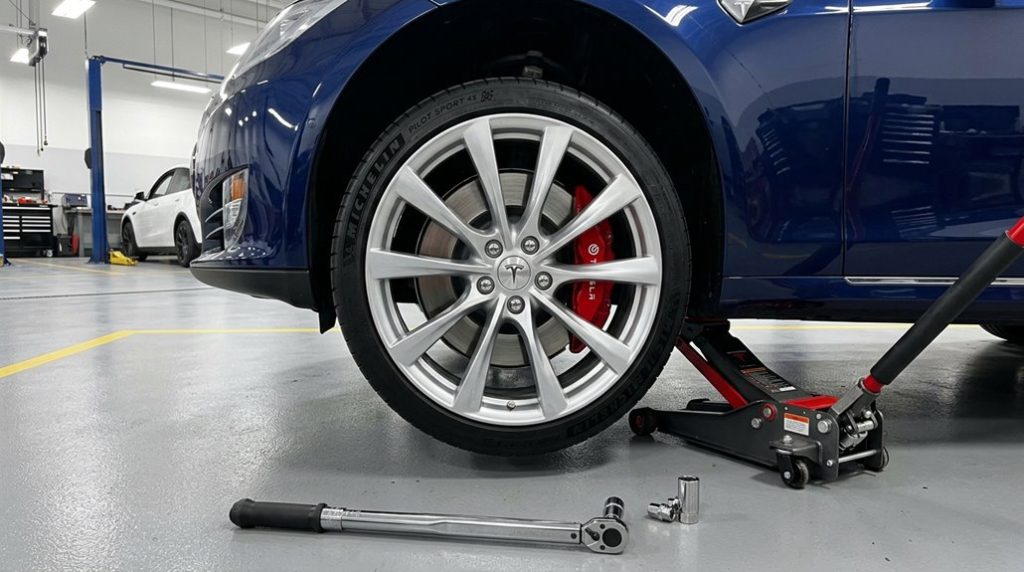
Lifting a Tesla incorrectly doesn’t just scratch the battery pack — it can permanently deform the underbody structure and void your warranty in one careless move. Tesla uses designated lift points with puck adapters that seat securely into the vehicle’s lifting lugs. Position the jack directly under the puck, never off-center.
Lift a Tesla wrong and you risk more than a scratch — you risk voiding your warranty permanently.
- Insert the puck adapter into the lift hole until it seats firmly against the lifting lug
- Center the jack precisely under the puck before applying any upward pressure
- Place a jack stand at the supported lift point before removing any wheel
Once wheels are reinstalled and torqued to 129 lb-ft in a star pattern, the TPMS reset is non-negotiable. Steer to Controls > Service > Reset on the touchscreen. The tire service mileage should display under 500 km post-reset. Then drive above 25 km/h briefly — that’s what actually reactivates your TPMS sensors. Keeping tyre wear even also supports regenerative braking effectiveness, which depends on consistent rolling resistance across all four wheels to recover energy predictably during deceleration.
How Much a Tesla Tyre Rotation Costs Across Every Channel
Cost is rarely a surprise when you’re shopping tyre rotation across Tesla’s service channels — the numbers are tight, documented, and worth knowing before you book. Tesla’s mobile pricing sits firmly around $65 for a standard four-wheel rotation, whether a technician visits your driveway or you drive into a service center. Both channels track closely, so location flexibility doesn’t cost you extra.
Independent discounts, however, can dramatically undercut that figure. Discount Tire and America’s Tire rotate tyres free for their customers — zero dollars, no catches. Some independents add balancing (roughly $50), so verify before you commit.
Bundles shift the math quickly. Add a cabin air filter replacement to your Tesla mobile visit and you’re looking at roughly an extra $57 in parts and labor. Throw wheel alignment into the equation and your total climbs toward $146. Every add-on is legitimate — just know what you’re approving before the technician arrives. Tesla vehicles across all trim levels, including those with hardware limitations on older vehicles, may have differing service needs that could influence which maintenance bundles apply to your specific car.
What to Confirm Before Booking Your Tesla Tyre Rotation
Before you tap “Schedule Service” in the Tesla app, a few quick checks will save you from booking the wrong service, showing up to the wrong location, or worse — revealing mid-appointment that your tyres weren’t candidates for rotation in the first place.
Tire compatibility is your first filter. Directional tyres carry a sidewall arrow locking them into a single rotation direction, which limits cross-rotation options. Confirm tread depth next — if any tyre reads 4/32 in. (3 mm) or less, replacement replaces rotation on the priority list. Tesla’s over-the-air software updates can adjust vehicle settings and service reminders post-purchase, so check the Tesla app for any updated rotation recommendations pushed to your specific vehicle before booking.
Nail these before booking:
- Tread depth difference: 2/32 in. (1.5 mm) or greater triggers rotation immediately, regardless of mileage
- Tyre type: directional or offset designs affect which rotation pattern Tesla can legally perform
- Appointment logistics: check whether your address qualifies for Mobile Service inside the app before assuming you can stay home
Frequently Asked Questions
Can Tesla Mobile Service Rotate Tyres in an Apartment Complex or Restricted Parking Area?
Yes, Tesla Mobile Service can rotate your tyres almost anywhere! Even with space constraints, you can arrange valet access for the technician, ensuring they’ll reach your vehicle in your apartment complex’s restricted parking area.
Does Tyre Rotation Affect Tesla’s Regenerative Braking Feel or One-Pedal Driving Behaviour?
Tyre rotation won’t change your regen feel or pedal response — Tesla’s software controls both. If something feels off afterward, check your tyre pressures first; uneven inflation’s the usual culprit, not the rotation itself.
Will Rotating Tyres Void Any Remaining Tesla Tyre Warranty or Tread Guarantee?
Like a gardener pruning roses to help them bloom, rotating your tyres won’t void your warranty or tread guarantee—it preserves it. Stay consistent with tread depth monitoring and warranty transferability remains intact.
Can You Rotate Tesla Tyres if the Vehicle Has Mismatched Tyre Brands Installed?
Yes, you can rotate mismatched tyre brands, but mismatched wear rates may reduce the benefit. Always check pressure balancing after rotation, since different brands can behave unevenly across all four positions.
Does Tesla Log Tyre Rotation History in the Vehicle’s Onboard Data or Service Records?
Tesla doesn’t store a detailed tyre rotation log onboard, but it does track service logs through your Tesla account. You’ll find your maintenance history there, not on a dedicated vehicle screen.