
Most Tesla Model 3 owners are quietly destroying their tyres — and they don’t even know it. At 1,800 kg with instant full torque delivery, your Model 3 demands far more than standard passenger rubber can handle. The wrong tyre drains your range, compromises handling, and could void your warranty. Load ratings, foam-lined construction, rolling resistance figures — these are the details that actually matter, and most guides never mention them.
Why Tesla Model 3 Tyres Are Nothing Like Regular Car Tyres
When you swap a regular tyre onto a Tesla Model 3 without thinking twice, you’re fundamentally fitting running shoes onto a sumo wrestler — technically possible, but structurally misguided.
Fitting a standard tyre to a Tesla isn’t a compromise — it’s an engineering mismatch dressed up as a solution.
The Model 3’s battery pack adds substantial curb weight compared to most ICE sedans, demanding a battery centric carcass engineered with higher load indexes to manage sidewall flex under sustained stress.
Standard passenger tyres weren’t designed for that mass, and they weren’t designed for instant electric torque either.
Torque induced wear hits differently here — acceleration stress arrives immediately, at full force, every single time you pull away from a light.
That’s not a combustion engine building power gradually through a rev range; that’s physics demanding tyre compliance immediately.
Add low rolling resistance requirements (range lives or dies on tyre design), acoustic foam lining for cabin noise reduction, and compound tuning specific to EV thermal loads, and you’ve got something genuinely different sitting between your rim and the road.
Fitting an unsupported tyre size creates a legitimate warranty audit trigger, meaning Tesla can directly examine whether your tyre choice contributed to any drivetrain or suspension claim you raise.
Tesla recommends fitting approved OE tyres identified by T0, T1, T2 markings on the sidewall, ensuring the tyre has been specifically engineered and validated for electric powertrain demands.
What Tesla Fits at the Factory: and Why Acoustic Foam Matters
Tesla doesn’t just slap any tyre on a Model 3 and call it a day — each trim ships with a precisely engineered fitment tied to wheel diameter (18-inch on Standard Range for efficiency, 19- or 20-inch on Performance variants for grip), load index, and speed rating that reflects the car’s actual curb weight and instant-torque delivery.
What makes these OEM specs particularly interesting is the acoustic foam lining bonded inside the tyre cavity, a polyurethane layer that absorbs the resonant “hum” generated by pressurized air vibrating at highway speeds — a frequency that’s brutally obvious in a cabin with zero engine noise to mask it. The Highland refresh further compounds cabin refinement expectations by introducing acoustic rear-window glass as standard equipment, raising the bar for how quiet the interior should feel at speed.
Get the factory fitment wrong, or swap to a non-foamed tyre on a Highland-era AWD variant, and you’ll likely notice both a compliance mismatch and a cabin that suddenly sounds like you’re rolling over a rumble strip at 70 mph. The Performance trim’s additional mass is a key factor here, as its curb weight of 4,046 lb demands tyres rated to handle both the increased load and the forces generated by its 510-hp dual-motor powertrain.
Factory Tire Sizing Explained
Before you start swapping wheels or chasing performance upgrades, it helps to grasp exactly what Tesla bolts on at the factory — and why those choices aren’t arbitrary.
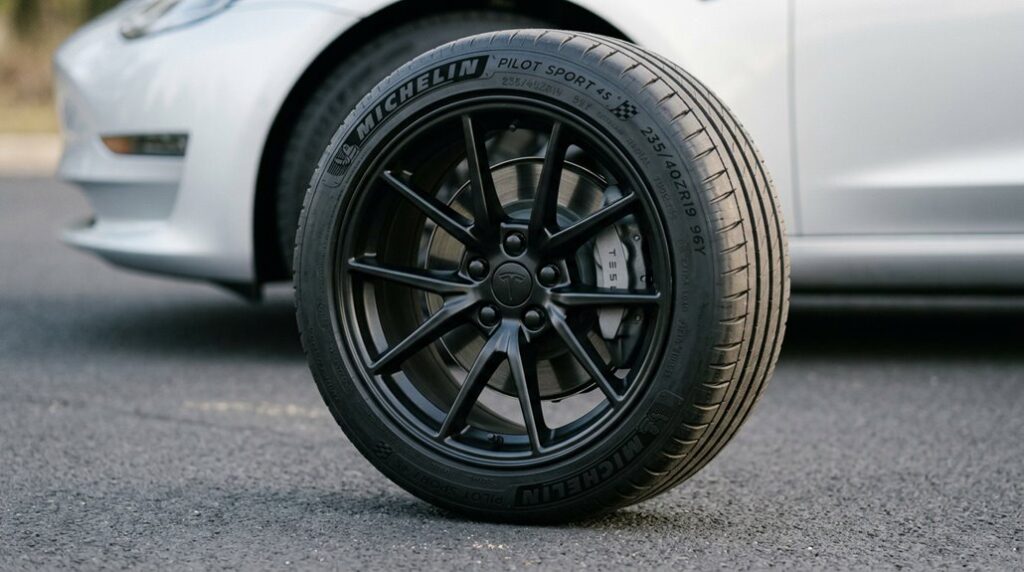
Each wheel diameter Tesla selects directly influences tyre profile, ride quality, and steering feel. The 18-inch setup runs a 235/45R18 (that taller sidewall absorbs bumps generously), while the 19-inch moves to a 235/40R19, sharpening response at the cost of some comfort.
The 20-inch Performance fitment goes staggered: 235/35R20 front, 275/30R20 rear. All wheels share an 8.5J width, except the 20-inch at 9.0J, with offset implications shifting between 38 mm and 34 mm respectively — critical for rim compatibility when you’re considering aftermarket options.
These specs aren’t guesses; they preserve speedometer accuracy, traction control calibration, and suspension geometry simultaneously. It’s also worth noting that the battery pack’s 800–1,200 lb weight penalty over comparable combustion vehicles demands higher load-rated tyres to maintain both safety and efficiency.
Acoustic Foam’s Role
Knowing the exact sizing Tesla bolts to each variant is useful, but the rubber compound and construction inside those tyres matter just as much as the numbers on the sidewall — and one factory feature worth grasping before you start comparing replacements is acoustic foam.
Without engine noise masking interior noise, every road thrum travels straight into the cabin. Tesla’s minimalist cabin design, built around a single central touchscreen, means there are fewer interior components to naturally dampen road noise.
Here’s what you need to know:
- What it does: Polyurethane foam bonded inside the tyre absorbs cavity resonance, cutting interior noise by up to 9 dB.
- Foam longevity: Heat and age degrade the bond, reducing effectiveness over time.
- Material recycling: Foam-lined tyres complicate recycling streams, so disposal requires specialist handling.
Not every replacement tyre includes foam — verify before buying. Many tyre shops lack the knowledge or will outright refuse to repair acoustic tyres, as the foam must be cut away to access the puncture and then glued back in place after patching.
OEM Fitment Considerations
What rolls off the Tesla factory line isn’t a guessing game — each Model 3 variant leaves Fremont (or Giga Berlin or Giga Shanghai, depending on your geography) wearing a specific tyre size matched to its trim, wheel package, and performance targets.
Your configuration determines everything: 18-inch wheels use 235/45R18, 19-inch wheels run 235/40R19, and 20-inch Performance trims fit a staggered 235/35R20 front and 275/30R20 rear.
Every OEM size carries an XL (Extra Load) rating — critical because electric torque hits hard and fast, stressing the tyre carcass beyond what standard-rated rubber handles comfortably.
Factory pressure sits at 42 psi across all fitments.
Charging impact on range also connects here, since properly inflated, correctly rated tyres preserve efficiency between sessions.
Tyre choice compounds directly with wheel size decisions, and moving to larger wheels increases rolling resistance and aerodynamic drag — with wide-tread performance tyres on upsized wheels capable of producing a 20–25% total range loss when both factors are stacked together.
Best Summer, All-Season, and Winter Tyres for Model 3
Choosing the right tyre for your Tesla Model 3 comes down to one question that most buyers skip: what’s the actual temperature range you’re driving in?
Climate dictates everything here.
- Summer tyres deliver elite summer grip in warm conditions. The Michelin Pilot Sport 4S led Tire Rack’s wet-track test at 29.57 seconds — genuinely quick.
- All-season tyres balance dry, wet, and light snow capability. The Michelin Pilot Sport All Season 4 posted 30.46 seconds wet, making it the strongest all-season performer tested.
- Winter tyres prioritize winter handling through softer compounds and deeper sipes that stay flexible below freezing — where your summer tyres effectively quit.
Tesla explicitly warns that summer tyres lose meaningful traction below 45°F and shouldn’t touch snow or ice.
If your winters are real, dedicated winter tyres aren’t optional — they’re the only responsible choice. The Goodyear Assurance MaxLife, for example, is marketed as one of the best 18-inch tyres for the Tesla Model 3 with good range efficiency. It’s also worth noting that the Model 3’s instant torque delivery and heavier kerb weight compared to equivalent petrol cars means tyres wear faster than expected, making tyre choice and replacement frequency a more significant ownership cost than many buyers anticipate.
Most Tesla Model 3 owners don’t think much about tires until the first heavy rain, sudden temperature drop, or long highway drive exposes how much grip and stability actually matter in real conditions. That’s where an all-season option like the Michelin CrossClimate2 for Tesla Model 3 drivers becomes a practical upgrade, offering more consistent traction and confidence across changing road conditions instead of relying on season-specific tire changes or OEM limitations.
How Wheel Choice and Aero Covers Affect Real-World Range
Once you’ve sorted your tyre compound for the season, the next variable that quietly bleeds range is what those tyres are mounted on. Wheel diameter matters more than most people realise — Green Car Reports estimates a Model 3 Performance loses roughly 40 miles of range on 20-inch wheels versus 18-inch wheels at a sustained 75 mph. That’s not rounding error; that’s a meaningful chunk of your battery.
Wheel designs shape efficiency through turbulence management inside the wheel well. Flatter, smoother faces reduce aerodynamic drag measurably — Unplugged Performance’s CFD testing showed their RW wheel delivered a 12.3% drag reduction over the stock 20-inch staggered setup.
Aero covers work on the same principle, smoothing airflow over open spokes and recovering range that prettier wheels surrender. Removing them improves kerb appeal and quietly costs you kilometres at motorway speeds. Your call, but now you’re making it with full information. The same wheel-size penalty applies further up Tesla’s lineup, where stepping from 20-inch to 22-inch wheels on the Model X costs 13 to 26 miles of EPA-rated range depending on trim.
Many Tesla Model 3 owners only notice tire comfort differences once highway noise builds up or longer drives start feeling harsher than expected, especially when factory tires prioritize efficiency over ride softness. A more comfort-focused option like the Bridgestone Turanza EV touring tire for Tesla Model 3 helps smooth out road vibration and reduce cabin noise, making everyday driving feel more settled without changing how the car handles or performs.
What to Know Before Fitting or Jacking a Model 3
Before you swap wheels or change tyres on a Model 3, you need to grasp one non-negotiable reality: the battery pack lives under the floor, and a misplaced jack will ruin your day far more expensively than a flat tyre ever could.
A misplaced jack on a Model 3 will cost you far more than any flat tyre ever could.
Tesla designates four specific lift points at the vehicle’s corners for exactly this reason — battery safety depends on precise contact.
Here’s what to lock in before you lift:
- Use lift adaptors — they distribute load correctly at each jack point, preventing concentrated pressure from cracking the battery enclosure.
- Engage Park and the parking brake — add wheel chocks for good measure.
- Torque lug nuts to Tesla’s specified value — guessing isn’t a strategy.
Never jack under the battery floor pan.
If your roadside equipment can’t reach Tesla’s designated points accurately, call a qualified shop instead.
Simple, unglamorous, essential.
Keep in mind that hardware limitations on older vehicles can affect which software features remain available after a tyre or wheel change that involves a system reset or recalibration process.
Load Ratings, Fitting Costs, and Rotation Intervals for Model 3
When you’re fitting replacement tyres to a Model 3, three practical concerns hit your wallet and your safety simultaneously: load ratings, fitting costs, and rotation intervals.
The Model 3’s kerb weight (roughly 1,600–1,900 kg depending on trim) means you can’t casually swap in a lighter-rated tyre without risking structural failure under load, which is why matching or exceeding the OEM load index (commonly 94 or 98 XL on 18-inch setups) isn’t optional — it’s physics.
Factor in that XL-rated tyres, larger wheel sizes, and add-ons like TPMS service and road-hazard coverage will push fitting costs higher, while a rotation interval around every 6,250 miles keeps the rear-biased torque delivery from quietly eating through your rear tread before you’ve noticed.
Unlike traditional vehicles, the Model 3 combines its infotainment and Autopilot hardware into one integrated unit, meaning any hardware-level upgrade — including tyre pressure monitoring system recalibration after a wheel change — requires careful attention to system compatibility rather than treating each component in isolation.
Understanding XL Load Ratings
If you’ve ever stared at a tire sidewall and wondered what “XL” actually means beyond marketing fluff, here’s the short answer: it stands for Extra Load, and on a Tesla Model 3, it’s not a suggestion.
The Model 3 is heavy. Its battery pack pushes curb weight past 1,600 kg, so each tire carries a serious share. XL tires handle this through reinforced construction and higher operating tire pressure.
Three things distinguish XL from standard (SL) tires:
- Construction differences — reinforced sidewalls that resist deformation under sustained load
- Load safety margins — a 98 XL carries roughly 750 kg versus a standard 94’s 670 kg
- Summer vs winter applications — both seasonal categories offer XL ratings, so swapping seasonally doesn’t excuse dropping load capacity
Match or exceed your OEM specification. Always.
This load capacity consideration becomes even more critical when upsizing wheels, as moving from 19-inch to 21-inch tires not only reduces range by 20–30 miles per charge but also demands tires with sufficient XL ratings to handle the unchanged vehicle weight.
Rotation and Fitting Costs
Choosing the right tyre is only half the job — getting it fitted correctly and maintaining it afterward is where most Model 3 owners quietly lose money and tyre life.
Fitting costs vary based on wheel diameter, low-profile construction, and whether TPMS sensors need servicing. Mobile fitting adds convenience but confirm the technician carries proper rim-protection equipment.
Rotate every 6,000–7,500 miles, adjusting that interval if tread monitoring reveals uneven wear developing faster at the rear (common during high-torque acceleration).
Always match inflation to your door-pillar placard, not whatever the shop defaults to.
Balance matters more on a Model 3 than most cars — the cabin’s near-silence turns even minor vibration into an annoyance you’ll notice immediately. Precision during installation protects both your tyres and your sanity.
Frequently Asked Questions
Can I Mix Summer and All-Season Tyres on My Tesla Model 3?
You can, but think of it like mixing fire and ice — it’s unstable. Summer compatibility and traction differences across axles create unpredictable handling. Keep all four tires matched for safety.
Do Tesla Model 3 Tyres Require Special Disposal or Recycling Procedures?
Your Model 3 tyres don’t need special disposal. You can use standard channels like industrial recycling or tyre derived fuel programs. Drop them at a retailer, municipal site, or collection event — just don’t dump them illegally.
How Does Tyre Pressure Affect Tesla Model 3 Regenerative Braking Performance?
Poorly pressured tyres pummel your performance. Your tyre inflation directly impacts braking efficiency, grip modulation, and energy recovery. Underinflation increases rolling resistance, masking regen gains, while overinflation shrinks your contact patch, making deceleration feel abrupt and unpredictable.
Will Aftermarket Tyres Void My Tesla Model 3 Warranty or Service Agreement?
Aftermarket tyres won’t automatically void your Tesla Model 3 warranty. However, you’ll face service exclusions and warranty implications if incorrect sizing or improper installation directly causes damage to suspension, alignment, or TPMS components.
Can Tesla’s Mobile Service Technicians Replace Model 3 Tyres On-Site?
Tesla’s mobile service technicians can sometimes do on-site mobile replacement, but it’s not guaranteed. Imagine a flat in a parking lot—they’ll assess it, but often you’ll need roadside emergency flatbed support instead.