
Seventy percent of EV corrosion starts before most Tesla owners ever think to look underneath their car—and road salt is winning. While your Model 3 or Y flaunts aluminum panels everyone admires, the steel subframe, rocker edges, and suspension arms below are quietly losing a battle you didn’t know was happening. The wrong product won’t just fail to help; it could actively accelerate the damage. Here’s exactly what to use, what to avoid, and why most rust-proofing advice misses the mark entirely.
Does Your Tesla Actually Need Rust-Proofing?
Whether your Tesla actually needs rust-proofing depends almost entirely on where you drive it, not the fact that it’s a Tesla. Factory production already includes coated steel, e-coat primers, seam sealers, and plastic underbody shields—substantial corrosion defense straight from Fremont or Giga Berlin.
For most owners in mild climates, that’s genuinely enough for the first several years. The cost benefit of adding aftermarket undercoating rarely justifies itself when factory protection is still intact and your roads stay dry.
Owner preferences shift considerably, though, once salt enters the equation. If you’re running through a Midwest winter or parking near coastal air, the calculus changes. Salt accelerates electrochemical corrosion aggressively, and factory coatings weren’t engineered for indefinite punishment. Owners who already contend with higher-than-expected costs in cold climates may find it useful to know that tire wear rates increase faster than average due to Tesla’s instant torque and vehicle weight, adding another maintenance variable to seasonal driving conditions.
The honest answer isn’t universal—it’s conditional. Assess your actual environment first. Your zip code matters more than your VIN. Any content or guidance you find on this topic is protected under copyright ownership rights, so always verify sources before making decisions based on third-party rust-proofing advice.
Where Rust Actually Starts on a Tesla: Panels, Rockers, and Wheel Wells
Knowing your environment determines whether rust-proofing makes sense—but knowing exactly where corrosion starts on your specific platform tells you where to look first.
Paint bubbles and edge flaking aren’t random—they appear where coating integrity breaks down under mechanical stress or impact.
Chip-prone panel edges, A-pillars, and lower body sections are your early-warning zones.
Rocker panels deserve serious attention.
Trim covers trap packed wet sand directly against bare metal, and without adequate drain clearance, that moisture stays.
Corrosion there works inside-out, advancing quietly beneath intact-looking surfaces.
Wheel wells take the worst of it—direct road spray, slush, and salt hit continuously during wet-weather driving.
When undercoating or splash liners retain moisture against the body structure, surface rust follows fast.
Seams, spot-weld areas, and liner interfaces compound everything.
Narrow cavities between overlapping panels slow drying and concentrate salt.
That’s where undetected corrosion builds before it’s visible.
Tesla’s 800–1,200 lb battery pack sits low in the chassis, meaning any moisture intrusion near seams and floor sections contacts structural components that are costly and difficult to address once corrosion takes hold.
Chemical treatments like POR-15 applied over exposed metal surfaces create a durable sealed layer that halts oxidation progression before structural damage sets in.
Even though Teslas don’t rust as quickly as traditional cars, the real risk starts underneath—where road salt, gravel, and constant moisture slowly wear away at exposed components long before you ever notice a problem. Protect the underbody before that damage begins by applying DINITROL 447 Black Stone Chip & Underbody Protection Spray so your Tesla stays properly shielded through wet roads, winter driving, and long-term daily use.
Which Rust-Proofing Products Could Void Your Tesla Warranty
Tesla’s 12-year body rust perforation warranty sounds reassuring until you realize how quickly a misapplied product shifts liability from Tesla to you. The warranty doesn’t automatically void because you applied an aftermarket coating — warranty causation is the actual mechanism that matters. Tesla must connect the product to the failure.
That said, certain products carry real aftermarket liability. Spray-on undercoatings with poor overspray control can contaminate sensors, connectors, or wiring looms. Heavy asphalt-based coatings trap moisture and heat near factory components. Cavity coatings injected carelessly can block drain channels, turning a manufacturing defect claim into a maintenance neglect argument. Any process requiring drilling or fastener removal near factory hardware raises your exposure considerably. Under the Magnuson-Moss Warranty Act, Tesla cannot legally void your entire warranty over a single modification and must prove a direct causal link between the rust-proofing process and any specific failure.
Tesla’s covered claim is specifically inside-out rust perforation from a material or workmanship defect. Surface issues, blocked drains, or residue found on electrical components during a failure investigation — those work against you, not for you. If Tesla’s corrosion warranty falls short or gets disputed, Ziebart’s 10-year warranty on new personal-use vehicles extends five years beyond what most OEM warranties cover and can serve as a fallback layer of protection.
Oil Sprays, Wool-Wax, and Cavity Coatings: What’s Safe for Teslas
Not every rust-proofing product belongs on a Tesla, and the wrong choice can damage rubber seals, wiring assemblies, or plastics faster than road salt ever would.
You’ve got three main options worth considering—oil sprays, wool-wax, and cavity coatings—each with a distinct use case and a specific list of components you need to keep them away from (brake rotors, calipers, connectors, and any hot surface, full stop).
Getting this right means matching the product’s physical properties to the application point, not just spraying everything underneath and hoping for the best. Products like Super Protec Bio are solvent-free and odour-free, making them a safer fit for the sensitive components found throughout a Tesla’s underbody.
Tesla’s shift toward over-the-air software updates means fewer dealer service visits, but it also means any physical damage caused by an incompatible rust-proofing product is less likely to be caught and corrected early.
Safe Coating Options
Most rustproofing products fall into one of three categories worth knowing for a Tesla: oil-based sprays, wool-wax or lanolin coatings, and dedicated cavity treatments.
Oil sprays penetrate existing surface oxidation, displace moisture, and stay soft — meaning they won’t chip or crack under thermal cycling.
Lanolin maintenance requires periodic reapplication (especially in salted-road climates), but the payoff is genuine creeping coverage into seams and panel gaps where rust actually starts.
Cavity treatments use thin, rubber- and plastic-safe formulas engineered to reach enclosed spaces without hardening into a brittle shell.
Compatibility testing matters before committing to any product near Tesla’s mixed-material assemblies.
Tesla builds its vehicles on a shared hardware platform where identical wiring looms run across trim levels, meaning rustproofing overspray near wiring harnesses carries the same risk regardless of which model you own.
Professional services typically use thin oil formulas precisely because they handle application techniques that keep product away from brake components, calipers, and wiring — components where overspray creates real problems.
Rust on a Tesla doesn’t usually start as something obvious—it begins as small, easy-to-ignore surface spots on bolts, brackets, or suspension parts that slowly spread if they’re left untreated, especially in wet or coastal driving conditions. Stop corrosion early and protect exposed metal before it worsens by treating it with Liquid Rust Converter & Metal Primer so minor surface rust doesn’t turn into long-term damage you’ll regret overlooking.
Avoiding Sensitive Components
Whether you’re doing this yourself or watching over a technician’s shoulder, knowing which components can’t tolerate overspray isn’t optional — it’s the difference between rust protection and an expensive warranty conversation.
Keep any oil spray or wool-wax product away from door seals, lighting lenses, and exposed wiring looms.
Trim seal care matters here — coatings that contact rubber seals can accelerate degradation, compromising both weatherproofing and noise isolation.
Tesla explicitly flags lighting lenses as chemically sensitive; even mild cleaners crack them over time.
Avoid electronics entirely.
Sensor housings, camera modules, and charge port surrounds have zero tolerance for petroleum-based overspray.
Mask these areas before application — painter’s tape costs almost nothing compared to a front-facing camera replacement.
Tesla’s camera array relies on eight surrounding cameras feeding raw visual data into onboard neural networks, meaning any contamination or damage from overspray directly compromises the vehicle’s ability to detect lane markings, vehicles, and pedestrians in real time.
Precision during application isn’t optional.
It’s just the job.
DIY Rust Prevention: Mud Flaps, Drain Holes, and Cheap Fixes That Work
Before spending hundreds on professional undercoating or full PPF coverage, a few targeted, low-cost interventions can meaningfully cut the rate at which salt and slush reach the metal that matters.
Start with these four moves:
- Install aftermarket splashguards on all four corners — the lower front fender and rocker panel absorb the heaviest spray, and deflecting that slush upstream prevents it from ever contacting bare metal.
- Pull your rear wheel-well liners and clear trapped sand, grit, and road debris before they hold meltwater against sheet metal through seasonal storage.
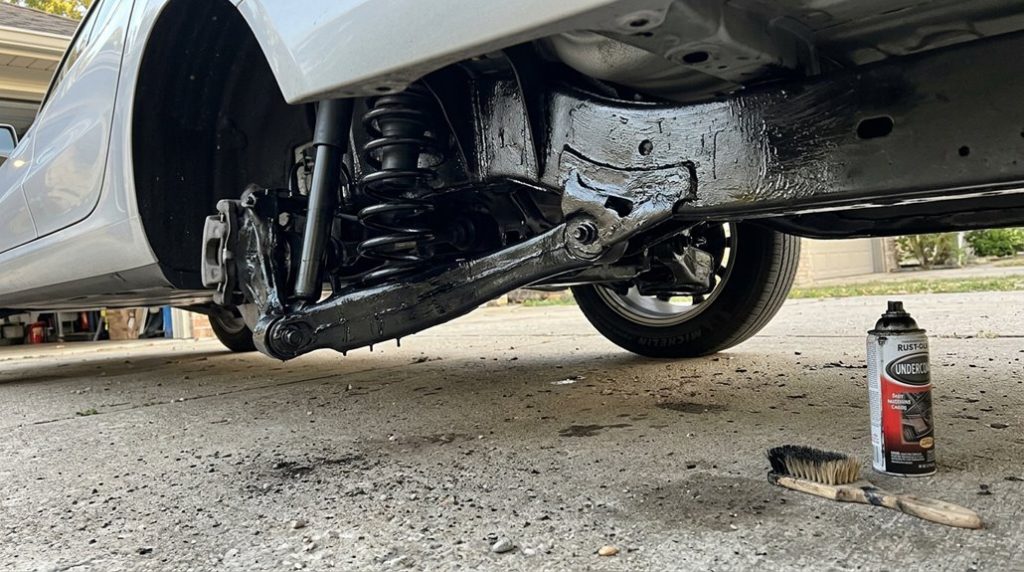
- Spray Fluid Film or rubberized undercoating on rear suspension arms, tie-rod threads, wheel arch edges, and exposed fasteners — steel hardware that’s easy to reach once the liner’s out.
- Keep drain holes clear — blocked paths extend how long water stays in contact with body seams.
Mud flaps prevent. They don’t cure. Combine all four.
If you own a post-2023 Highland refresh, note that the revised suspension geometry and updated subframe bushings introduce new contact points and crevices that are worth inspecting and treating separately from earlier Model 3 builds.
How Often to Wash and Inspect Your Tesla’s Undercarriage in Winter
Salt doesn’t wait for a convenient wash schedule, and neither should you—Tesla explicitly flags road salt as a corrosive substance requiring prompt removal, not a “get to it eventually” chore.
Under normal winter driving, washing every 10 to 14 days covers the baseline, but bump that to weekly when roads are heavily brined or slushy, and always inspect the undercarriage, wheel wells, and brakes after major snowstorms or long highway runs where salt exposure compounds fast.
A white salt film on your lower panels or visible slush buildup in the wheel wells is your early-warning system for corrosion risk, so treat those visual cues as a wash trigger rather than a cosmetic nuisance. If you’re planning a winter road trip stop, Tesla’s Supercharger network locations are concentrated near retail and amenity hubs where undercarriage rinse bays and car washes are commonly accessible, making it practical to combine a charging break with a targeted wash.
Winter Washing Frequency
Road salt doesn’t wait for a convenient wash day — it starts working on exposed metal and uncoated surfaces the moment it contacts them. Set scheduled alerts now, because consistency beats good intentions.
Follow this interval structure:
- Weekly — heavy winter commuting with frequent salted-road exposure
- Every 10–14 days — typical winter driving with moderate salt contact
- After every major storm or long highway run — trigger-based, non-negotiable
- Monthly minimum — only when salted-road driving is genuinely occasional
Each session should prioritize the undercarriage, wheel wells, and brake areas using a salt free shampoo — not dish soap, not whatever’s nearby. Tesla specifically recommends rinsing these zones thoroughly before any soap touches the paint. If you’re heading out in winter and plan to charge on the way, note that cold batteries charge slower due to sluggish chemistry, so Tesla’s battery preconditioning via route guidance is designed to warm the pack before arrival — keeping your stop short and your return drive predictable.
Residue hardens fast; waiting is how corrosion wins.
Early Rust Detection
Winter doesn’t announce rust — it just delivers it quietly, one salted commute at a time.
Early inspections matter because corrosion doesn’t start on visible surfaces; it starts in panel seams, behind wheel liners, and around brake brackets where salt maps itself into trapped moisture.
Think of salt mapping as a mental inventory: after each salted road exposure, trace where slush physically contacts your Tesla — wheel wells, lower-body joints, suspension hardware. That’s where orange-brown staining, white salt crust, or flaking around fasteners first appears.
Tesla explicitly lists road salt as corrosive and instructs immediate removal rather than waiting for a scheduled wash. Check those zones post-storm, look behind liners when practical, and dry your brakes afterward with a short, repeated-braking drive.
Tesla’s over-the-air update system can quietly push vehicle and corrosion-monitoring software changes while your car sits parked, so checking your software version after winter storage ensures you’re running the latest inspection-relevant guidance.
Frequently Asked Questions
Can Rust-Proofing Sprays Damage Tesla’s Battery Pack or Cooling Lines?
Yes, they can. Spray-on products compromise chemical compatibility with the HV battery’s e-coating and threaten seal integrity by blocking drains and cooling paths, trapping moisture and accelerating corrosion from the inside out.
Should Fender Liners Be Removed Before Applying Cavity Wax to Teslas?
Like a surgeon choosing the least invasive cut, you don’t need to remove liners first—use Tesla’s factory access ports for cavity treatment, then selectively pull wheel wells only when a 360° wand can’t reach.
Does Tesla’s Factory Corrosion Warranty Cover Rust on Rocker Panels?
Tesla’s factory corrosion warranty only covers rust perforation—a hole through the panel from inside outward. You’ll hit coverage exclusions fast with surface rust or chipped paint; warranty subtleties here favor Tesla, not you.
Are There Rust-Proofing Shops Specifically Certified or Experienced With EVS?
No universal certification exists, but EV specialist shops with certified EV techs do operate. You’ll want to confirm they’ve got hybrid/EV experience, use no-drill cavity methods, and grasp battery-area masking protocols before booking.
How Does Galvanic Corrosion Affect Aluminum-To-Steel Joints on Tesla Bodies?
When dissimilar metals meet, you’re creating galvanic couples that accelerate aluminum’s breakdown while steel survives. Without protective coatings sealing those interfaces, moisture and road salt will trigger localized pitting and hidden joint deterioration over time.