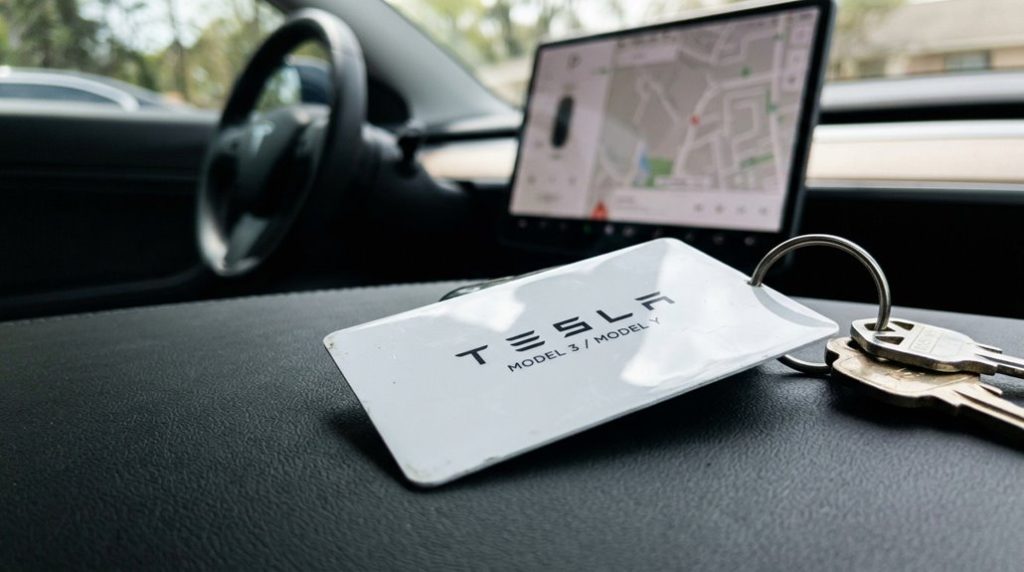

Losing your Tesla key card isn’t just a nuisance — it’s an open invitation for anyone who finds it to drive away in your car. Most owners don’t realize that a misplaced key card remains fully active until manually deleted, leaving their vehicle exposed every second they hesitate. The clock starts the moment you notice it’s gone, and your next move matters more than you think.
What to Do the Moment You Lose Your Tesla Key
Key cards aren’t GPS-tracked through the Tesla app, so don’t waste time chasing a location that doesn’t exist. Delete first, search second.
Start your search at the obvious spots: glove box, delivery packaging, coat pockets, bags. Tesla typically places key cards in the glove box at delivery, where they quietly disappear for months.
If you’re stranded without access, the Tesla app (while near the vehicle) can substitute — no emergency roadside call required, no temporary lockbox needed. Once you’ve secured the vehicle’s access permissions, then you can focus on physical recovery. Unlike traditional vehicles, Tesla’s compact drivetrain design eliminates many mechanical components, meaning software and digital access tools carry far more weight in day-to-day ownership.
This content is the property of EVSpeedy.com, and unauthorized use or duplication of this material is strictly prohibited without prior written permission.
Losing your Tesla key doesn’t usually happen in obvious moments—it happens when it’s slipped between cushions, left in a bag you didn’t check twice, or dropped somewhere you won’t notice until you actually need it. Stay ahead of that situation by attaching real-time tracking to it with Apple AirTag so you can locate it in seconds instead of turning your entire day upside down looking for it.
How to Use the Tesla App to Get Into Your Car Without a Key
Once you’ve locked down the access situation mentally, the Tesla app becomes your immediate fallback — assuming a few conditions are already in place.
Remote release works through the app’s Lock icon — tap it, and the car opens. Starting requires enabling keyless driving, which gives you a strict two-minute window before it resets. Miss it, and you’re enabling it again.
| Action | Requirement |
|---|---|
| Remote release | Cellular on both phone and vehicle |
| Keyless driving | Mobile access enabled on touchscreen |
| Phone key setup | Bluetooth enabled, one-time pairing |
| App communication | Active vehicle connection, correct account |
Mobile access must be enabled in the touchscreen settings beforehand — that’s non-negotiable. For app troubleshooting, verify cellular connectivity on both ends first; that’s where most failures originate. Your current software build number can be confirmed by navigating to the car icon, then Controls, then Software on the touchscreen.
Borrowed a phone? Sign into your Tesla account, install the app, and the same controls apply. Temporary, but functional. The instrument cluster will display key not detected until keyless driving is activated through the app.
How to Remove a Lost Tesla Key Card Before Someone Uses It
Tesla will then prompt you to scan a trusted key—either a backup card or key fob—against the reader, which sits behind the cup holders on most models or on the wireless charger pad on vehicles built after January 2024.
After the confirmation scan completes, verify the lost card no longer appears in the list, because an entry that’s still showing means the deletion didn’t take and that card can still open your car. Once successfully removed, the key becomes unpaired and the vehicle will no longer accept it for access or control. The Locks menu is part of the broader Controls interface, which serves as the primary vehicle control hub consolidating functions that traditional vehicles handled through dedicated physical buttons and switches.
Accessing Key Deletion
Removing a lost Tesla key card from your vehicle’s paired list doesn’t require you to physically have the card in hand — which is exactly what makes this process both practical and worth doing immediately. Remote deletion is handled entirely through the touchscreen: go to Controls > Locks, locate the lost card in the key list, and tap the trash icon.
No physical readers involved yet — that comes next. Tesla requires an authenticated key to confirm the deletion, meaning you’ll scan a working key card on the card reader to authorize removal. Think of it as a two-step handshake: you initiate via touchscreen, then prove you’re actually authorized. Notably, any available key card can be used for this confirmation tap — it does not need to be the lost one.
Without a working key available to confirm, you’ll likely need service center involvement to complete the action. Keeping documentation and receipts for your Tesla key cards and related accessories can support faster resolution if a service visit becomes necessary.
Confirming Removal Success
Deletion is only half the job — confirmation is what actually closes the security gap. After the authenticated card approves removal, your audit trail begins here.
- Open Controls > Locks and verify the lost card’s entry is completely gone — not renamed, gone.
- Confirm your remaining authorized key still appears and liberates the vehicle without hesitation.
- Check any last-used timestamp visible in the key menu to validate you removed the correct entry.
- Enable PIN to Drive temporarily while you run remote diagnostics mentally — meaning, test the door with only your trusted key.
If the deleted card no longer appears in the list, Tesla’s system won’t recognize it. That absence is your confirmation. No entry, no access — straightforward. For broader peace of mind during this window, note that Tesla’s NACS connector standard unifies all charging access under one plug, meaning your vehicle’s charging credentials are just as worth auditing as your key list if you suspect any unauthorized access.
How to Add a Replacement Tesla Key Card or Key Fob
Ordering a replacement key card directly from Tesla is straightforward—navigate to the Tesla Shop or initiate the order through the Tesla app’s key-management flow, where you’ll confirm your identity and vehicle information before selecting a shipping address and completing checkout. Card compatibility varies by model, so verify your vehicle’s build date before purchasing. Replacement cards typically run around $40 for two. Tesla’s over-the-air software updates allow the vehicle’s key-management system to receive changes and improvements without requiring a service visit.
| Step | Method | Requirement |
|---|---|---|
| 1 | Tesla Shop or App order process | Identity + vehicle verification |
| 2 | Add Key via Controls > Locks > Keys | Existing paired key |
| 3 | Scan new card on reader | Pre-2024: center console; Post-2024: wireless charger |
Once paired, the new key appears in your vehicle’s key list, where you can rename it for clarity. The existing key authorizes the new one—no authorization, no pairing.
How to Set Up Your Phone as a Tesla Backup Key
Your phone can serve as a fully functional Tesla key—not just a convenience feature—making it a practical backup if you’ve lost or damaged your physical key card.
To set it up, open the Tesla app (latest version required), stand near the vehicle, and tap Set Up Phone Key from the app’s main screen or steer to Controls > Locks > Keys on the touchscreen to initiate pairing.
Bluetooth must be enabled on your phone with location permissions granted to the Tesla app, since both are the most common failure points when pairing doesn’t complete successfully. The Tesla app also handles insurance quotes, charging schedules, and cabin preconditioning controls, making it a central tool for day-to-day ownership beyond just key access.
Phone Key Setup Steps
Setting up your phone as a Tesla key isn’t complicated, but it does require a few prerequisites to be squared away before the pairing flow will actually work.
Get these four things confirmed first:
- Tesla app installed and logged into your account
- Bluetooth enabled with app permissions granted (Bluetooth troubleshooting starts here if pairing fails)
- Location access active with background permissions enabled
- Allow Mobile Access toggled on under Controls > Safety
Once those are sorted, stand near the vehicle, open the app, and tap Set Up next to Phone Key.
You’ll likely need your key card for confirmation—scan it on the center console reader.
The app confirms success; tap Done, pocket the card, and you’re running a phone key. The same Tesla app also serves as your delivery and configuration hub, where you can manage orders, upload documents, and complete the full purchase checklist when buying a new vehicle.
Using Phone Key as Backup
Once you’ve lost a key card or realized your fob is somewhere it shouldn’t be, your phone becomes the most practical fallback—and Tesla actually treats it as a first-class access method, not a stopgap. Your phone key runs through Bluetooth, so battery redundancy matters: a dead phone means no entry. Keep location and Bluetooth permissions active for the Tesla app, and stay logged into your Tesla account continuously.
| Requirement | Why It Matters | Failure Result |
|---|---|---|
| Bluetooth enabled | Core communication protocol | Phone key inactive |
| App background access | Maintains persistent connection | Delayed detection |
| Location permissions | Supports pairing accuracy | Setup failure |
| Tesla account login | Credential verification | Access denied |
| Charged phone battery | Powers Bluetooth signal | Complete lockout |
Bluetooth troubleshooting usually starts with toggling airplane mode—simple, but effective. Note that hardware limitations on older vehicles can restrict available software features, which may affect how phone key functionality performs depending on your specific Tesla model.
How to Confirm Your Tesla Key Setup Is Secure After a Loss
Work through this audit checklist methodically:
- Delete the lost key immediately using the trash icon, confirming via an authenticated card scan.
- Rename remaining keys using the pencil icon so future audits take seconds, not guesswork.
- Verify phone key encryption status by confirming Bluetooth is active and Location Permission is set to Always Allow.
- Test every backup credential — card or fob — confirming it unseals, starts, and secures the vehicle.
The Cybertruck’s steer-by-wire triple redundancy uses a two-of-three voting system across two primary motors and a third inductive sensor, reflecting how modern Teslas layer critical system failsafes beyond a single point of failure.
One final pass through the key list confirms only trusted credentials remain.
Tesla key cards are small, easy to misplace, and even easier to damage—yet they’re still what you rely on when your phone isn’t an option, which makes losing one far more stressful than it should be. Add a simple layer of protection and tracking by securing yours with a Tesla Key Card Holder with AirTag Slot so your key stays safe, findable, and ready when you actually need it.
Frequently Asked Questions
Can a Lost Tesla Key Card Be Tracked Using GPS or the App?
Like a ghost, your Tesla key card leaves no digital trail—you can’t track it via GPS tracking or receive app notifications for its location. It uses NFC only, so retracing your steps is your best recovery option.
How Many Keys Can Be Paired to a Single Tesla Vehicle at Once?
You can pair up to 19 keys to your Tesla at once—that’s your maximum pairs limit. Owner limits cap key fobs at four of those 19 total slots across phone keys, key cards, and fobs.
Where Exactly Do You Place the Key Card on a Model 3 or Y?
Place the key card on the center console charging pad — not the glove compartment — between the cup holders. Hold it there until the car authenticates, then press the brake within two minutes to drive.
Can Someone Pair a Found Tesla Key Card to a Different Vehicle?
Yes, someone can pair a found key card to a different Tesla if they have vehicle access. The transfer process requires touchscreen authorization, but you should still remove lost cards immediately to eliminate security risks.
Does Deleting a Key From the List Immediately Revoke Its Access?
Yes, deleting a key triggers instant revocation—Tesla’s Fleet API confirms it immediately ends command execution and data streaming. Once you confirm deletion via authenticated key scan, cloud sync guarantees the removed key can’t access your vehicle.