
That tiny rock chip on your Tesla Model 3’s front bumper isn’t just cosmetic damage — it could be quietly sabotaging your autopilot’s forward collision warnings. PPF promises protection, but the wrong coverage is just expensive plastic doing nothing. Front-end kits, full-body wraps, and self-healing films all serve different purposes at wildly different price points. Before you spend a dollar, you need to know exactly which option matches your driving reality.
Why the Model 3 Front End Takes So Much Damage
The Model 3’s front end takes a beating for reasons that go deeper than just bad luck or careless driving. Tesla engineered short overhangs and a compact nose to enhance efficiency and crash performance—but that geometry leaves minimal buffer between everyday road hazards and your structural components. The front bumper sits low, making curbs, parking stops, and steep driveway entrances legitimate threats on every commute.
What makes damage more consequential here than on a conventional ICE vehicle is what’s packed behind the fascia. Crash rails, aluminum bumper beams, and cross-members sit densely arranged just beneath that painted plastic. A 5 mph parking lot tap can compromise components you can’t see from the outside. Rear-wheel-drive variants actually benefit from a large front crumple zone made possible by the absence of a front motor, giving the structure more room to absorb energy before forces reach the cabin.
Then add sensor calibration requirements. Your Model 3’s forward-facing cameras and autopilot hardware live in that same zone. Any misalignment—however subtle—demands diagnostic work beyond simple panel replacement, turning minor cosmetic repairs into technical procedures. The 2024 Highland refresh introduced HW4 higher-resolution cameras rated at approximately 5MP compared to the 1.2MP units on earlier builds, meaning replacement and recalibration costs are meaningfully higher on newer vehicles.
A poorly applied PPF doesn’t usually fail all at once—it starts with tiny misalignments, trapped air, or edges that don’t sit properly, and those small imperfections can slowly ruin the clean finish you were trying to protect in the first place. Make installation smoother and more precise by using a PPF Installation Slip Solution Spray so the film can be positioned correctly before it bonds and sets permanently.
Full Body vs. Front-End PPF: Which Coverage Is Worth It?
Once you’ve seen how aggressively the Model 3’s front clip collects chips and road debris, the next decision is straightforward: do you protect just the high-impact zones or wrap the entire car?
Front-end PPF targets the hood, fenders, bumper, headlights, and mirrors—the panels absorbing the highest kinetic energy from road debris—and it captures most of the stone-chip protection benefit at a fraction of full-body cost, making it the stronger chip-protection-per-dollar choice for budget-conscious owners. When comparing protection options, keep in mind that a pre-cut vs custom fit distinction affects both installation precision and long-term edge adhesion on curved panels like the Model 3’s fenders.
Full-body coverage extends that same film to doors, rocker panels, rear quarters, and every painted surface in between, which adds meaningful defense against door dings, parking-lot scuffs, and side sandblasting, but at a substantially higher material and labor cost that only justifies itself when thorough cosmetic preservation is the actual goal. Both coverage levels use XPEL Ultimate Plus, delivering the same self-healing topcoat and impact resistance regardless of how many panels are wrapped.
Front-End Coverage Benefits
Narrowing down your PPF coverage level comes down to one core question: how much of your Model 3’s front end actually takes damage in the real world? The answer: most of it. The bumper, hood edge, fenders, headlights, and mirror caps absorb the bulk of road debris, sand, and bug impact daily. Full front-end PPF covers all of these zones seamlessly, eliminating exposed shift lines that partial coverage leaves behind.
Beyond chip resistance, you’re also getting UV fade protection, self-healing scratch resistance, and chemical stain resistance — factors that directly support resale protection when it’s time to sell. The Model 3 retains roughly 45–50% of its value after five years, making paint preservation a practical strategy for protecting that remaining equity. There aren’t aerodynamic benefits to PPF itself, but maintaining original paint condition preserves the vehicle’s structural integrity and market value simultaneously. That’s real, measurable return on coverage. For Tesla owners considering the commitment, a full front package serves as a practical entry point before deciding whether whole-car coverage is the right next step.
Full Body Cost Tradeoffs
Choosing between full-body and front-end PPF isn’t really a protection debate — it’s a math problem. Full-body coverage runs $4,500–$6,500, roughly 2–4x the cost of front-end packages ($1,700–$2,500). The installation logistics alone justify scrutiny — more panels mean more labor hours and seam placement decisions that affect color preservation uniformity across every surface.
| Factor | Front-End PPF | Full-Body PPF |
|---|---|---|
| Typical Cost | $1,700–$2,500 | $4,500–$6,500 |
| Panels Covered | Bumper, hood, fenders | All painted surfaces |
| Best For | Highway drivers | Street parkers, long-term owners |
| Resale Impact | Moderate | Up to 15% value retention |
| Paint Repair Offset | Partial | ~$8,000 over five years |
Your ownership horizon makes the decision. Short-term ownership? Front-end coverage wins on value. Long-term? Full-body math eventually closes the gap. Tesla’s high torque launches accelerate tire wear and similarly stress paint surfaces through debris projection, making front-end protection particularly relevant for performance-oriented drivers. If you’re still weighing the upfront investment, platforms that sell PPF packages often let you start a free trial before committing to a full installation quote subscription service.
Choosing Your Coverage Level
The coverage decision fundamentally boils down to one question: where does your Model 3 actually take damage?
Front-end PPF targets the zones absorbing roughly 80% of road debris.
Full-body extends that logic to every panel, including interior preservation of door edges and rocker panels from daily wear.
Consider your situation honestly:
- Highway commuters face constant chip exposure on hoods and bumpers
- City drivers accumulate door dings and scratch damage across side panels
- Winter climate owners need broader coverage against abrasive road salt
- Lease holders rarely justify full-body costs
- Long-term owners benefit from wheel protection and complete cosmetic preservation
Front-end coverage is the intelligent minimum.
Full-body is the commitment to keeping every panel factory-correct indefinitely.
Protecting your Model 3’s finish also pays dividends at resale, particularly given that lower curb weight contributes to the Model 3’s superior efficiency and higher long-term desirability compared to heavier Tesla models.
PPF only performs as well as the surface underneath it, and even microscopic dirt, tar, or bonded contaminants on Tesla paint can lead to poor adhesion, visible imperfections, or early lifting once the film is applied. Ensure a perfectly smooth base before installation by preparing your paint properly with a Clay Bar Paint Prep Kit so the protection film bonds cleanly and lasts the way it’s meant to.
Does PPF’s Self-Healing Film Actually Protect a Tesla’s Paint?
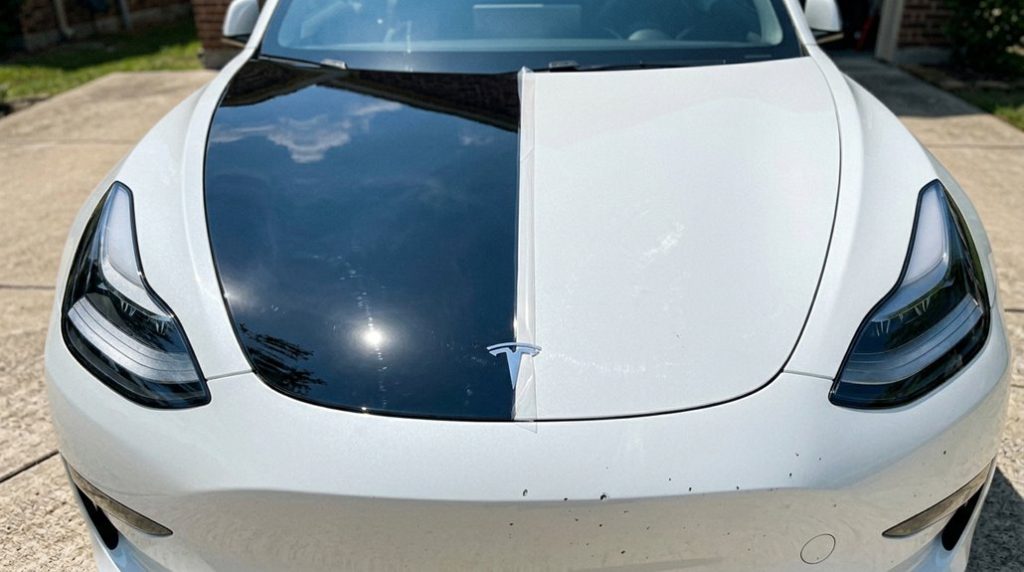
Self-healing PPF sounds like something straight out of a sci-fi spec sheet, but the underlying mechanism is straightforward: the film’s elastomeric topcoat reflows when exposed to heat—sunlight or warm water will do it—closing light swirl marks and fine scratches at the clear-coat level.
Know the self healing limits, though. Thermal activation thresholds handle surface-level damage, not cuts through the film or underlying paint. Tesla’s over-the-air software updates can improve vehicle functionality post-purchase, but no remote update can address physical paint damage once it occurs beneath the film.
| Damage Type | Self-Healing Effective? |
|---|---|
| Light swirl marks | Yes |
| Fine clear-coat scratches | Yes |
| Cuts through film | No |
| Paint damage beneath film | No |
Rock chips, sharp debris, and hard impacts exceed what any topcoat reflow can address. The film still absorbs and deflects those hits—it just won’t erase them afterward. Your protection is real, but calibrated: everyday wear disappears quietly, while severe impacts leave permanent evidence.
How Much Does PPF Cost for a Tesla Model 3?
PPF pricing for a Model 3 breaks down almost entirely by how much of the car you’re covering—partial front packages (bumper, hood, mirrors) run roughly $600–$1,200, full-front coverage climbs to $1,200–$2,299, and a complete vehicle wrap lands between $4,000–$8,000 depending on your market and film tier.
Labor, not material, drives most of that cost, which explains why two shops quoting the same film can differ by thousands.
Whether that spend makes sense depends on how long you plan to own the car, your local repaint rates (typically $3,000–$6,000 for a front-end respray), and whether you’re protecting a $45,000 asset or just its resale story. Paint color choices at the configuration screen also factor in, since premium paint upgrades cost roughly $1,000–$2,500 upfront and can improve resale value by approximately 3–5%, making protection more financially defensible on those finishes.
Coverage Level Pricing
Coverage pricing breaks down into three tiers—partial front, full front, and full vehicle—and the gap between them is wide enough to matter.
- Partial front: $600–$1,350, covering the bumper and leading edges
- Full front: $1,400–$2,500, adding the hood, fenders, and mirrors
- Full vehicle: $4,000–$8,000, with installation complexity driving the higher end
- Film tier and warranty differences shift pricing markedly—5-year films sit lower, 12-year films push toward the ceiling
- Regional labor markets can move any tier 20–30% in either direction
Each jump in coverage isn’t just more square footage—it’s more compound curves, more seams to manage, and more hours on the clock.
For context, a full vehicle wrap on a Model 3 can approach the cost of a full set of Tesla tire replacements, which run $900–$1,600 and are among the most predictable recurring expenses in EV ownership.
Budget accordingly.
Cost Versus Value
Those three coverage tiers give you the structure, but the number that actually stops people mid-decision is the total invoice. Full-vehicle professional installs on a Model 3 run $4,000–$8,000, driven almost entirely by labor, not material. The film itself costs roughly $750–$1,500 installed; everything else is skilled hands and time.
That gap matters when you’re balancing long-term resale value against upfront spend—a well-documented PPF install demonstrably supports resale pricing in used EV markets. Environmental impact compounds the math: road salt, UV degradation, and debris work continuously against unprotected white or red multi-coat paint (both notoriously thin on Model 3s). Spending $2,500 on full-front coverage to protect a $45,000 asset isn’t irrational—it’s straightforward risk management with a measurable downstream payoff. For context on how manufacturers think about long-term ownership protection, Tesla backs the Model X with an 8-year battery warranty covering up to 150,000 miles, a structural commitment that underscores why protecting your vehicle’s exterior value over a similar ownership horizon makes financial sense.
Is a DIY PPF Kit Worth It on a Model 3?
DIY PPF kits for the Model 3 break down to a straightforward tradeoff: you’re swapping labor dollars for your own time, and whether that exchange makes sense depends entirely on your priorities. Kits typically run $1,000–$2,000 versus $4,000+ for professional installation, but expect 14–16 hours of hands-on labor before celebrating those savings.
DIY PPF kits trade your money for your time—and that deal only works if your time is actually free.
- Installation pitfalls are real: stretching film incorrectly tears sections, and wasted material is expensive
- Warranty concerns apply: improper installation can void manufacturer coverage on film performance
- Practice kits aren’t optional: skipping them dramatically increases your error rate
- Edge work determines longevity: poor wraps peel prematurely, defeating the protection goal entirely
- Finish quality varies: results depend heavily on technique, not just product quality
Unlike the Model S and X, which allow infotainment and Autopilot hardware to be swapped independently, the Model 3 integrates both into one unit, meaning even minor hardware upgrade paths are more complex and costly to navigate. If your priority is paint protection on a budget and you’re comfortable with a learning curve, a DIY kit delivers genuine value—just not a guaranteed showroom finish.
How to Maintain Your Tesla Model 3 PPF Long-Term
PPF’s long-term value hinges almost entirely on how you maintain it—skip the basics and you’re accelerating the very degradation you paid to prevent. Use pH-neutral car soap, a two-bucket method, and microfiber tools exclusively. Avoid brush-based mechanized washes; they lift edges and introduce micro-abrasions that compound over time.
| Maintenance Task | Frequency |
|---|---|
| Ceramic spray sealant | Every 3–4 months |
| Edge and defect inspection | Monthly |
| Professional inspection | Annually |
Respect the 48-hour post-installation curing window before any wash, and delay mechanized washing roughly 30 days. Consistent top-care (ceramic sealants, distilled water rinses) can extend film life by 20–25%.
During seasonal storage, garage ventilation matters more than most owners realize—trapped humidity accelerates edge lifting and adhesion failure. Heat helps TPU films self-heal minor surface scratches, so a warm, dry storage environment works double duty.
Frequently Asked Questions
Can PPF Be Applied Over Existing Paint Corrections or Ceramic Coatings?
Like armor over a polished blade, PPF’s paint safe layering thrives on corrected paint. You can apply it over corrections, but coating compatibility demands ceramic goes *after* PPF, never beneath it.
Does PPF Affect Tesla’s Paint Warranty or Factory Finish Documentation?
PPF doesn’t void Tesla’s warranty when professionally installed—warranty implications only arise if installation damages the OEM paint. For factory documentation, you’ll want pre- and post-install photos to protect against future paint defect disputes.
How Does PPF Perform in Extreme Cold Climates Common to Northern States?
Quality PPF’s cold performance holds up well if you choose elastomeric TPU formulations. You’ll want professional installation to maximize peel resistance through freeze-thaw cycles, as thermal contraction exploits any adhesion weakness quickly.
Can Damaged PPF Sections Be Replaced Individually Without Redoing Full Coverage?
Yes, you can replace repair panels individually through localized replacement without redoing full coverage. If damage stays within the film and your paint’s intact, a skilled installer patches or swaps only the affected section.
Does PPF Interfere With Tesla’s Ultrasonic Sensors or Camera Systems?
Standard PPF won’t compromise sensor compatibility—ultrasound passes through thin film easily. Keep camera lens areas cut out to prevent visual distortion, and you’ll preserve full Autopilot and parking sensor performance.