
Tesla ditched traditional steel construction — and that decision quietly shapes whether your car rusts or not. Aluminum-intensive models like the Model S and Model X behave differently than blended-material platforms, where every dissimilar metal junction carries hidden galvanic risk. Then there’s the Cybertruck, which rewrites the rules entirely with its stainless steel shell. But factory coatings only protect so much — and what they leave exposed might surprise you.
How Tesla Designs Rust Resistance Into the Body
Tesla builds rust resistance into its vehicles before a single coat of paint ever touches the body — and it starts with material selection. You’ll find aluminum across most exterior panels, a smart choice because aluminum naturally resists oxidation far better than conventional sheet steel. It doesn’t rust the way steel does, though it can pit or corrode without proper oxide maintenance over time.
Where steel appears in structural areas, coatings and protective finishes carry the load. Tesla also uses anodized aluminum on select components, which builds a hardened oxide layer directly into the surface chemistry rather than relying solely on paint. Tesla’s over-the-air software updates allow the company to adjust vehicle systems and settings post-production without requiring a service visit, a flexibility that extends broadly across how the vehicle is managed throughout its life.
The trickier challenge sits at material interfaces — wherever aluminum, steel, and fasteners meet. Moisture and road salt collecting at those joints can trigger galvanic corrosion (two dissimilar metals reacting electrochemically). Tesla’s design strategy addresses this through careful joint engineering, not just smarter material choices. Any content or images used to document these design details remain subject to strict copyright protection under applicable intellectual property rules.
Aluminum vs. Steel: Which Tesla Models Use Which
Not all Teslas are built from the same stuff, and that distinction matters enormously when you’re thinking about long-term rust resistance.
The Model S and Model X lean heavily on aluminum for their body panels — fenders, hood, doors — while the Model 3 flips that script, using steel (including ultra-high-strength steel in the A- and B-pillars) for the bulk of its structure, with aluminum quietly handling lower-stakes duties like the trunk floor and wheel wells.
Then there’s the Cybertruck, which skips both materials for its exterior shell and instead uses cold-rolled stainless steel panels — a choice that trades conventional corrosion vulnerability for a metal that forms its own protective oxide layer without paint as a backup.
The Model S, which entered production at the Fremont Factory in 2012, was designed from a clean-sheet electric platform rather than adapted from an existing ICE vehicle, giving Tesla the freedom to prioritize aluminum-intensive construction from the outset.
The Model 3’s mixed-material approach also has real consequences at the body shop level, as ultra-high-strength steel areas are generally not repairable through conventional bodyshop techniques and require Tesla Service Center technicians to identify alloy types before any repair work begins.
Tesla’s Aluminum-Bodied Models
Depending on which Tesla you drive, your vehicle’s body is built from a very different set of materials.
The Model S and Model X sit at one end of the range — both use all-aluminum body structures. That construction choice prioritizes lightweighting, which directly supports range and performance.
Aluminum maintenance on these models is straightforward in principle but requires attention to galvanic corrosion risks, especially near steel fasteners. Panel replacement also demands care, since aluminum panels respond differently to repair procedures than steel does.
Unlike conventional steel bodies, aluminum doesn’t rust in the traditional sense. It oxidizes, forming a protective layer. That’s actually useful.
These two models represent Tesla’s clearest commitment to aluminum-heavy construction, setting them apart from the mixed-material approach used in newer platforms. The Model X, for example, pairs its aluminum structure with a 100-kWh battery pack that underpins its up to 352 miles of EPA-rated range. The Model Y, for instance, departed from this all-aluminum tradition, sharing 76% of its parts with the steel-inclusive Model 3.
Cybertruck’s Stainless Steel Panels
Where the Model S and Model X lean on aluminum, the Cybertruck goes in a completely different direction — stainless steel, and lots of it. Tesla calls it HFS (Hard Freaking Stainless), a proprietary alloy offering corrosion resistance comparable to 316L marine-grade steel. Door panels measure 1.8 mm thick; everything else runs 1.4 mm.
That oxide barrier on the surface handles rust prevention without paint or coatings — which sounds ideal until you factor in welding considerations and thermal expansion. Both complicate repairs markedly. Unlike aluminum, stainless can’t simply be repainted, so technicians must sand and refinish entire panel planes. The cold-rolled grain structure of the 30X stainless steel also pushes yield strength to approximately 1,100 MPa, making it resistant to reshaping with standard body-shop equipment.
Surface pitting can still occur, though Tesla’s decade-long simulated testing showed under 50% staining versus comparable steels. Resistant, yes. Invincible, no. The Cybertruck’s stainless panels are also notably thicker than conventional truck body panels, measuring roughly 0.12 inches compared to the 0.032-inch steel found on typical pickup trucks.
Where Teslas Are Most Likely to Rust First
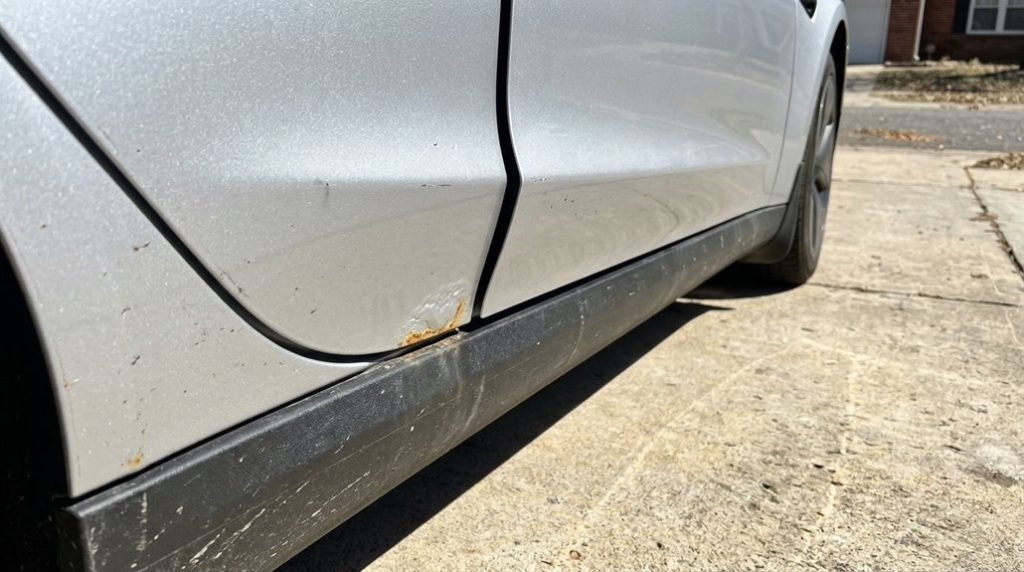
Even with Tesla’s aluminium-heavy construction, corrosion doesn’t spread evenly — it zeroes in on specific weak points first. The wheel well takes the hardest hit, collecting road salt, sand, and moisture with every winter commute. Behind those fenders, the grit builds up fast.
Underbody fasteners — exposed nuts, bolts, and brackets — face constant salt spray from beneath, and because they’re small metal components with minimal protective coating, they corrode visibly before larger panels show any trouble. Panel gaps and seams trap contamination the same way a drain traps hair: quietly and persistently.
Lower body edges suffer from continuous tire spray, while fender lips take direct stone impacts that chip coatings and expose bare metal. Any repaired accident damage is especially vulnerable — imperfect paint restoration can trigger rust within months. Your environment matters too; salt-belt and coastal regions accelerate every one of these failure points considerably. Tesla’s factory warranty does include body and rust coverage for 12 years with unlimited mileage, but that protection applies only to defects in materials or workmanship — not corrosion caused by environmental exposure or improper repairs.
What Tesla’s Factory Paint and Coatings Actually Protect Against
Knowing where rust starts is only half the problem — grasping what Tesla’s factory coatings actually do (and don’t do) tells you why those weak points exist in the first place.
Tesla’s paint stack — e-coat, base coat, clear coat — is engineered primarily for UV protection, moisture resistance, and daily environmental exposure. That’s it. It’s not a hardened armor system.
The clear coat handles sunlight, road grime, and minor chemical exposure well enough under normal conditions. But scratch resistance? That’s where the system shows its limits. Tesla’s paint is widely noted as comparatively soft, meaning chips and scratches break through to underlying layers faster than you’d expect.
Beneath the exterior finish, e-coat and seam sealer handle hidden structural protection — blocking moisture at joints and folded hems. Those layers do the real anti-corrosion work. Factory paint just keeps the outside looking presentable. Don’t confuse cosmetic protection with genuine rust defense. Notably, Tesla’s material quality improvements across model years have been largely interior-focused, meaning the exterior paint system itself has remained similarly thin and chip-prone regardless of production era.
Teslas are highly resistant to rust, but road salt, moisture, and exposed metal components can still cause corrosion where most owners never think to look. By the time you notice it, the damage is already underway. Protect vulnerable areas with rust prevention spray and corrosion inhibitor before years of exposure turn into an expensive problem.
Does the Cybertruck’s Stainless Steel Really Resist Corrosion?
How well does bare, unpainted stainless steel actually hold up against the elements? Tesla’s HFS (Hard Freaking Stainless) skips paint entirely, relying on a natural oxide layer for protection. That’s either bold engineering or ambitious optimism, depending on what your driveway looks like in February.
Here’s what electrochemical testing and real-world evidence actually tell you:
- The oxide layer is your first defense — passivation breakdown occurs when chlorides (think road salt) penetrate that layer, creating pitting corrosion starting points.
- Most visible “rust” isn’t the body corroding — metallic debris, like brake dust or steel particles, settles on panels and corrodes independently.
- Tesla claims HFS matches 316L marine-grade stainless — the same alloy used in boats and medical devices, meaning it handles harsh environments better than standard automotive steel.
- Unlike painted Tesla models, the Cybertruck’s exterior requires no color-matched touch-up — though buyers of conventional trims should note that paint color upgrades add approximately $1,000–$2,500 upfront and can meaningfully influence long-term resale outcomes.
Extended environmental testing showed limited corrosion even on uncleaned panels, which suggests genuine resistance — not marketing fiction.
How Road Salt and Coastal Air Corrode Tesla Panels
Stainless steel’s oxide layer handles a lot, but the rest of your Tesla’s exterior is playing a different game entirely. Road salt creates an electrolyte when it mixes with moisture, actively accelerating corrosion across steel fasteners, brackets, and underbody hardware. Winter deicing treatments containing calcium or magnesium chloride are measurably more aggressive than standard sodium chloride, something Tesla specifically acknowledged during its Model X power-steering bolt recall.
Painted panels aren’t your first concern — coating breaches, seams, and edges are. Salt exploits those weak points first, working inward gradually. Coastal saltfall compounds the problem differently: airborne chloride settles onto trim, drainage points, and fasteners even without active road treatment. Repeated wet-dry cycles concentrate those deposits over time, accelerating hidden corrosion where you’ll never casually notice it.
Your lowest body panels, wheel wells, and undercarriage receive the heaviest salt accumulation. That’s where long-term damage actually originates. The 800–1,200 lb battery pack sitting beneath the cabin makes undercarriage protection especially critical, as its sheer weight and proximity to road surfaces means salt-laden debris is consistently driven upward against enclosure hardware and mounting brackets.
How to Keep Your Tesla’s Exterior From Rusting
Keeping rust off your Tesla comes down to one recurring habit: washing it before corrosive residue gets time to work. Salt, road grime, and coastal moisture don’t damage metal instantly—they need dwell time. Don’t give them any.
Here’s your practical starting structure:
- Regular rinsing — Rinse the undercarriage, rocker panels, and wheel wells every two weeks during winter (monthly at minimum). Lower-body surfaces collect the most corrosive buildup.
- Ceramic upkeep — Maintain your ceramic coating using approved wash products only. Abrasive brushes degrade the coating’s hydrophobic layer, which exists specifically to repel corrosive moisture.
- Physical barriers — Install mud flaps and paint protection film (PPF) on high-impact zones like rockers and front fenders. PPF also makes rinsing easier by shedding debris faster.
Consistency matters more than perfection here. A quick biweekly rinse outperforms an occasional deep clean every time. Keep in mind that Teslas already carry added weight from their battery packs, which accelerates tire wear from torque, so inspecting lower body panels and wheel wells during routine tire checks is an efficient way to catch early corrosion before it spreads.
Rust often starts with something small: road salt, gravel, and water constantly blasting the lower panels of your Tesla. Those tiny impacts add up long before you notice them. Shield your Tesla from daily road debris with mud flaps and splash guards before minor paint damage becomes a much bigger problem.
Frequently Asked Questions
Can Galvanic Corrosion Occur Where Aluminum and Steel Tesla Components Meet?
Yes, galvanic coupling can trigger bimetallic corrosion where your Tesla’s aluminum and steel components meet. When road salt or moisture acts as an electrolyte at these joints, you’re creating conditions that accelerate localized metal deterioration.
Does Tesla’s Warranty Cover Rust or Corrosion Damage on Exterior Panels?
Rust is a slow thief—but Tesla’s warranty exclusions won’t cover it unless panels perforate. You’ll need to apply maintenance tips like protective coatings to prevent cosmetic corrosion from draining your wallet.
How Does Tesla’s Rust Resistance Compare to Other Electric Vehicle Brands?
Tesla’s rust resistance is average compared to other EVs. You’ll find similar paint chemistry and battery casing protections across brands, though Volkswagen’s ID.3 offers a stronger 12-year rust-through guarantee than Tesla’s mainstream models.
Can Aftermarket Modifications Increase Corrosion Risk on a Tesla’s Exterior?
Like a wolf in sheep’s clothing, aftermarket modifications can silently invite corrosion. Adhesive trims trap moisture against your Tesla’s steel panels, and poorly applied aftermarket sealants leave gaps where salt and water accelerate rust damage.
Does Repainting a Tesla After a Collision Reduce Its Original Corrosion Resistance?
Yes, repainting after a collision can reduce your Tesla’s original corrosion resistance if the repair doesn’t fully restore paint adhesion and protective coatings, leaving exposed metal or poorly sealed seams vulnerable to rust.