
Tesla’s Model S has a dirty secret hiding in plain sight — roughly 30% of door handles fail before 100,000 miles. That’s nearly one in three vehicles failing at something you touch dozens of times daily. Wiring faults, worn motor gears, and sensor drift all mimic each other’s symptoms, making diagnosis the real battle. Get it wrong, and you’re staring down a $2,000 repair bill for what could have been a $20 fix. Knowing exactly what’s killing your handle changes everything.
Which Tesla Models Have Door Handle Problems and Why
Although Tesla’s door handles look sleek from the outside, the engineering behind them introduces failure points that vary greatly across the lineup. Each model carries its own risk profile, so knowing where yours falls helps you plan smarter.
Tesla’s sleek door handles hide complex engineering — and each model carries its own unique failure risk profile.
The Model S tops the list for mechanical wear complaints. Its retractable handle system relies on cables, small motors, and linkage components that degrade over time — more moving parts means more potential failure points. Older Model S vehicles especially show broken cables and motor fatigue.
The Model Y faces a different challenge entirely. A federal 12V investigation flagged roughly 174,000 vehicles after reports that low battery voltage caused external handles to stop working — sometimes trapping passengers inside. NHTSA documented 16 complaints by October 2025, with no dashboard warning preceding failures.
Model 3 troubles lean toward software and sensor issues. Model X complications involve its falcon-wing doors and auto-present sensors rather than traditional handle wear.
Tesla’s onboard systems rely on sensor fusion combining multiple inputs — including cameras and ultrasonic sensors — to manage vehicle behavior, yet this complexity also means that electrical or software faults in one subsystem can cascade into unrelated functions like door handle operation.
In some Model Y cases, the door handle failures created urgent safety emergencies, with parents breaking windows to free children locked inside after the low-voltage failure left no accessible manual release.
How to Tell If Your Tesla Door Handle Needs Replacing
Tesla door handles rarely fail all at once — they usually telegraph the problem first. Watch for the handle sitting proud of the door skin instead of flush, uneven depth compared to other doors, or persistent trim gaps that cosmetic adjustments can’t fix.
Movement tells you a lot. A handle that presents slowly, stops mid-travel, or requires repeated release attempts points to a failing motor, gear, or linkage. Sticky operation — where the pull feels gritty or resistance increases gradually — signals internal wear progressing toward full failure.
Electrical diagnostics matter here too. If the handle ignores release commands while the rest of the door works normally, suspect a loose connector, damaged wiring, or failing actuator. Intermittent response is particularly telling (and annoying). When sourcing replacement actuators or handle assemblies, verifying model-year fitment compatibility before ordering is essential, since trim and component specifications have changed across production years.
Adjustment fixes misalignment temporarily, but if the handle won’t hold position afterward, internal components are worn beyond correction — replacement becomes the only practical path forward. When inspecting the harness during replacement, look closely at the wiring beneath the switch area, as internal wire splitting is one of the most commonly observed failure points on these assemblies.
A failing Tesla door handle rarely starts as a big problem—it’s usually a small hesitation that quickly turns into a costly repair if ignored. Most owners only realize how expensive it gets once the handle stops responding altogether. cut repair costs early with a Tesla door handle repair kit before a simple fault turns into a full replacement.
How Much Does Tesla Door Handle Repair Cost?
Repair costs for Tesla door handles swing wildly depending on who does the work, what they replace, and whether Tesla decides to be generous about it. You’re looking at a genuinely wide range:
- Warranty or goodwill coverage: $0 to $38 in parts, zero labor
- Mobile service (standard): Around $308–$327
- Service center replacement: $490 to $1,400+
- Full assembly retrofit kit: Up to $2,117
Warranty negotiation matters more than most owners realize—Tesla has issued revised quotes dropping from $1,400 to $490 on identical repairs. That’s not coincidence; that’s bargaining power.
Aftermarket sourcing offers another escape route. A rebuild kit runs roughly $174.99, and broken internal gears can cost as little as $20 individually. Full assembly swaps cost considerably more because Tesla replaces everything rather than targeting the actual failure point, which is usually just worn internal components.
When Tesla does perform the repair, technicians typically swap in a Gen 3 replacement handle rather than restoring the original, which means finish matching is generally not an issue for owners who have chrome delete applied. Serious structural or electrical failures on newer vehicles may still fall under Tesla’s 8-year warranty coverage, which spans 100,000 to 150,000 miles depending on the model.
How to Replace a Tesla Door Handle Yourself
Knowing what a Tesla Service Centre charges is useful bargaining power—knowing how to skip them entirely is better.
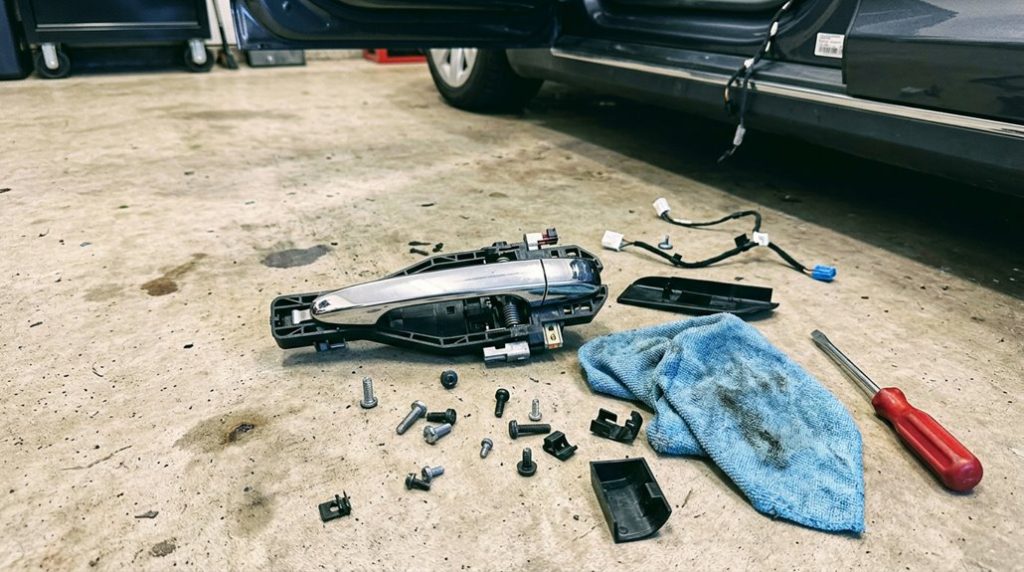
A DIY teardown starts with disconnecting LV power (non-negotiable) and placing the vehicle in neutral with the parking brake engaged. Grab your T30/T27/T25 Torx bits, 10 mm sockets, and a plastic trim tool before touching anything.
Model 3 front handles require removing the door reflector, glass, and closeout panel before three nuts (accessed through two plugs) release the handle assembly.
Model S rear handles demand four bolts on the painted backplate plus careful gasket replacement around sealing surfaces.
Both jobs require releasing plastic retainer clips without snapping them—easier said than done.
Inside the motor assembly, a worn paddle gear typically causes failure; it’s rebuildable using T8 Torx screws and replacement components.
Total part costs run roughly $20–$80, versus hundreds at a Service Centre. Before starting any repair, confirm your exact build by checking your VIN digit 10 to identify the model year and ensure you source the correct handle assembly for your production era. Before buttoning everything back up, the micro switch is a commonly reported failure point worth inspecting and replacing alongside the paddle gear while the assembly is already apart.
How to Keep Your Tesla Door Handle From Breaking Again
Fixing a Tesla door handle once is annoying; fixing it twice is a mechanical failure of habit. Preventive maintenance costs nothing compared to a $400–$700 service bill. Your user habits determine whether this repair becomes a recurring expense.
Cold weather causes most repeat failures, so address it directly:
- Precondition the cabin 15–20 minutes before departure to melt frost around the latch mechanism
- Apply silicone spray (non-petroleum formula only) along the rubber gasket to repel moisture and reduce winter sticking
- Never force a stiff handle—cables snap under hard pulling, turning a $0 problem into a costly repair
- Reboot the system via both steering-wheel scroll buttons if handle response feels sluggish
Keep the sensor area clean using a microfiber cloth. Check for software updates regularly, since Tesla patches door-related firmware bugs consistently. Using the Tesla app to schedule cabin preconditioning before departure not only protects door mechanisms from cold-weather stress but also delivers a climate-controlled interior before you even step outside. Small habits prevent big invoices.
Tesla door handles don’t usually fail overnight—it starts with stiffness, hesitation, or that slight grind most owners ignore until it becomes a real repair bill. A little maintenance goes a long way in preventing that moment. Keep your handles moving smoothly with some silicone lubricant and door seal protectant spray before friction and weather turn a minor issue into an expensive fix.
Frequently Asked Questions
Does Tesla Warranty Cover Door Handle Repairs on Used or Secondhand Vehicles?
Tesla’s warranty can cover your used vehicle’s door handle repairs if it’s still active. Warranty transferability works in your favor, but you’ll need ownership verification and proof the failure stems from a manufacturing defect.
Can a Tesla Door Handle Failure Affect the Car’s Security System?
Yes, a Tesla door handle failure can compromise your lock integrity and entry sensors, leaving you locked out entirely. It’s a power-dependent system, so voltage issues can prevent normal releasing and trap occupants unexpectedly.
Are Aftermarket Tesla Door Handle Parts as Reliable as Official Tesla Components?
While aftermarket parts cost less, they’re not equally reliable. Aftermarket durability depends heavily on fitment tolerances, material quality, and installation. You’re taking on more risk, so choose carefully—poor fitment can compromise both handle function and vehicle security.
Will Tesla Mobile Service Come to Repair a Door Handle at Home?
Tesla’s Mobile Repair service can come to you for door handle fixes. You’ll schedule through the app and receive an Appointment Window, though not every case qualifies for on-site completion.
Does Insurance Ever Cover Tesla Door Handle Repairs Under Comprehensive Policies?
Thorough coverage can apply if vandalism, debris, or storm damage broke your handle. It won’t cover wear or mechanical failure. Always check your deductible impact first—it may exceed the actual repair cost.