
You finally own a Tesla — the pinnacle of modern driving. Then midnight hits, you’re stranded on I-95, and suddenly that sleek touchscreen can’t help you. Tesla’s roadside service sounds reassuring until warranty status, mileage, and incident type quietly rewrite the bill. What you’ll actually pay might completely change how you feel about that purchase. The numbers are far more complicated than Tesla’s marketing suggests.
Is Tesla Roadside Assistance Actually Free?
The short answer is yes — but only while your vehicle is covered under an active warranty or service agreement, which is a distinction worth pinning down before you assume Tesla’s got your back indefinitely.
Tesla’s roadside assistance isn’t unconditional — it’s tied directly to your active warranty or service agreement.
New Teslas come bundled with a Basic Vehicle Limited Warranty, and that coverage includes complimentary roadside assistance at no additional charge. Think of it as included, not free — because “free” implies no conditions apply, and Tesla’s program definitely has conditions.
Warranty eligibility determines whether you pay anything when you call for help at 2 a.m. with a dead 12V battery. Once that coverage expires, you’re looking at per-service billing.
Service limitations also mean not every roadside scenario qualifies, even under active coverage. Flat tire transport, for instance, covers up to 50 miles only when Tesla handles the repair or replacement directly. Know your coverage window, and you’ll avoid expensive surprises.
Coverage can also be extended beyond the original warranty period through an Extended Service Agreement, which keeps roadside assistance benefits active rather than leaving you exposed to out-of-pocket costs after the basic warranty runs out. It’s also worth noting that serious drivetrain failures, such as battery or drive-unit issues, are separately covered under Tesla’s 8-year drivetrain warranty spanning 100,000 to 150,000 miles on most modern models, providing an additional layer of protection independent of roadside assistance coverage.
Towing, Flat Tires, and Dead Batteries: What’s Actually Covered?
When you call Tesla roadside assistance, what actually gets covered depends almost entirely on why you’re stranded — and that distinction separates a zero-dollar rescue from a bill you weren’t expecting.
Towing coverage applies to warranty-covered breakdowns, with Tesla covering up to 500 miles toward the nearest Service Center. Exceed that distance, and you’re absorbing the overage.
For flat tires, mobile tire service kicks in when damage makes driving unsafe, covering transport up to 50 miles — but the tire repair or replacement itself isn’t free. That’s a meaningful cost difference worth knowing before you’re standing on a shoulder at midnight.
Dead battery situations get dispatched through battery diagnostics protocols, but Tesla classifies this as available assistance rather than financially covered service. Whether depletion stems from range miscalculation or extended unplugging, out-of-pocket costs can still apply.
The pattern here is consistent: Tesla dispatches help reliably, but “dispatched” and “covered” aren’t the same word. Services like winching and jumpstarts fall into a category where even an active warranty provides no financial protection, leaving those costs entirely on the owner. It’s also worth noting that unauthorized modifications to systems like wiring or the 12V battery can create additional audit triggers that complicate coverage assessments during a roadside claim.
Roadside assistance sounds reassuring until you’re actually waiting on the side of the road, watching a Tesla sit silent because of a small low-voltage issue that could have been handled in minutes. These situations rarely feel urgent—until they suddenly are, especially when you’re far from help or cell service is patchy. Keep a portable jump starter and power bank ready for the moments when waiting is the only option you don’t want.
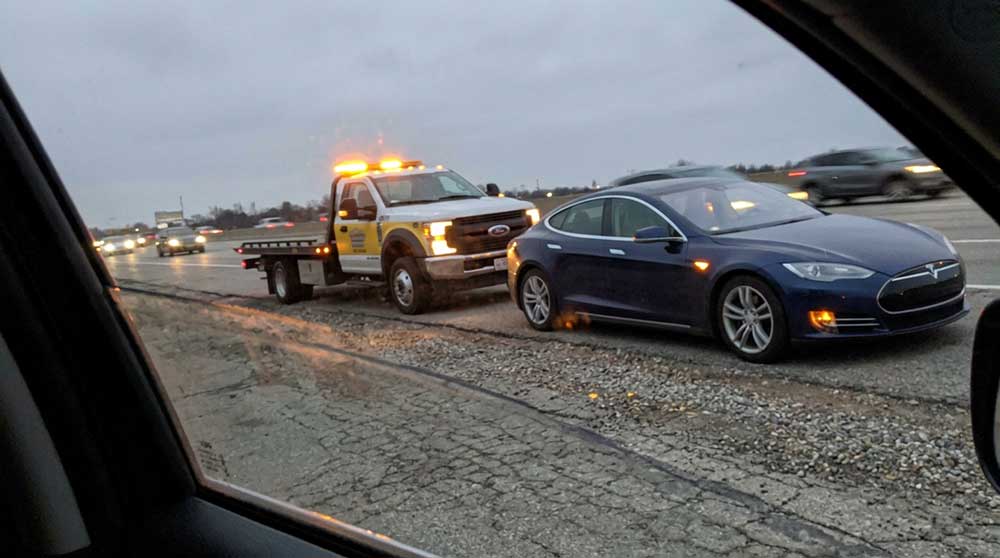
What Tesla Charges Per Incident: Tires, Tows, and Batteries
Breaking down Tesla’s per-incident costs requires separating three distinct service categories — tires, tows, and batteries — because each carries its own billing logic and each can surprise you if your warranty status isn’t what you think it is.
Tire incidents hit hardest because roadside pricing stacks multiple charges simultaneously: the mobile response, the repair labor, and the replacement tire itself. None of that’s complimentary.
Towing follows cleaner emergency protocols — warranty-covered breakdowns get up to 500 miles towed free, but mile 501 becomes your expense. Non-warrantable tow requests get billed immediately on your repair order. Roadside Assistance is intended for genuine breakdowns, not routine towing for poor planning.
Battery-related failures split along the same warranty line. A covered high-voltage defect qualifies for free towing to the nearest Service Center (within Tesla’s mileage cap). Tesla recommends maintaining your battery below 80% state of charge during regular use, as repeatedly charging to full accelerates cell degradation and may complicate warranty conversations around battery health.
A non-warrantable battery issue, however, means you’re absorbing towing plus diagnostic labor costs. Warranty status isn’t just paperwork — it’s the variable that determines your final bill.
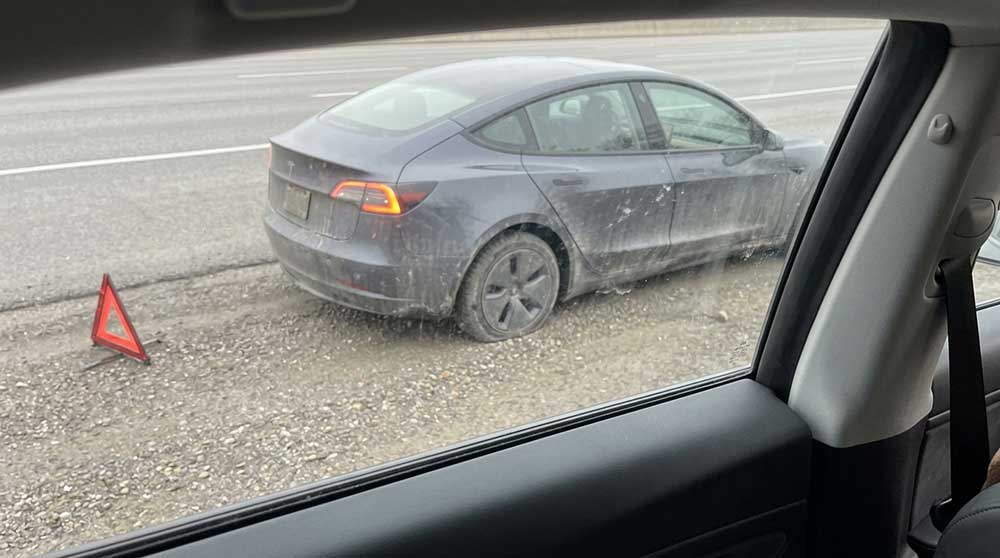
Most Tesla owners don’t think about roadside safety kits until they’re already stuck on the shoulder, trying to figure out how visible they are to fast-moving traffic. What looks like a minor inconvenience in daylight can quickly become a very different situation once visibility drops or you’re waiting longer than expected for assistance. Keep a Tesla-compatible roadside safety kit ready so you’re not relying on luck or timing when you need to stay visible and safe.
How Much Does Tesla Towing Cost Out of Warranty?
Once your Basic Vehicle Limited Warranty expires, Tesla’s complimentary towing coverage drops off entirely — and what replaces it’s a pay-per-service structure with no published flat rate and a cost range wide enough to cause genuine sticker shock. Tesla’s policy ties free towing to warrantable malfunctions only, covering up to 500 miles toward the nearest Service Center. Non-warrantable breakdowns? Those charges land directly on your repair order.
Real-world numbers vary sharply. A short 40-mile tow typically runs $125–$250 in general markets, but one owner reported a $1,600 quote for a long-distance tow connected to a battery dispute — reduced to roughly $1,200 only through Tesla Insurance coverage. Tesla Insurance premiums run 10–20% higher than comparable gas vehicles due to repair costs and parts constraints, a tradeoff worth weighing when evaluating coverage options.
Post warranty budgeting means treating towing as an unpredictable emergency expense, not a fixed line item. Distance to your nearest Service Center is the biggest cost driver. Insurance alternatives — AAA memberships or roadside add-ons through your auto insurer — are consistently worth evaluating before you need them. Reimbursement for towing costs paid out of pocket can also become a prolonged ordeal, with invoice follow-up responses from Tesla taking weeks or longer without resolution.
Tesla Roadside vs. AAA: Which Makes More Sense for Tesla Owners?
Choosing between Tesla Roadside Assistance and AAA isn’t a binary decision so much as a coverage math problem — and the answer shifts depending almost entirely on where you’re in your warranty timeline. While your Basic Vehicle Limited Warranty remains active, Tesla’s roadside coverage costs you nothing, making manufacturer loyalty genuinely practical rather than sentimental. AAA’s annual membership fee becomes harder to justify when Tesla already handles towing up to 500 miles for covered breakdowns at zero cost.
Post-warranty, the calculation flips. Tesla charges per service, and those fees accumulate fast. That’s where membership overlap actually earns its keep — carrying both simultaneously during changeover periods gives you redundancy without gaps. AAA also covers lockouts, broader towing destinations, and non-warranty situations that Tesla simply won’t touch. If you’re driving an out-of-warranty Model 3 daily, AAA’s predictable annual cost beats unpredictable per-incident Tesla billing every time. It’s also worth noting that Tesla’s over-the-air software updates resolve many issues remotely, which can reduce the frequency of roadside calls altogether and shift the true cost comparison further in Tesla’s favor during the warranty period.
Frequently Asked Questions
Does Tesla Roadside Assistance Transfer to a New Owner After Resale?
Tesla’s roadside assistance doesn’t transfer as a separate benefit—it follows the vehicle’s remaining warranty. You’ll receive transferability details tied to ownership requirements, meaning you keep whatever warranty term’s left at resale.
Can Tesla Roadside Assistance Be Used in Canada or Mexico?
You can use Tesla roadside assistance for international coverage in Canada, but cross-border use in Mexico isn’t guaranteed. Coverage depends on local Tesla infrastructure, your warranty status, and distance limits.
Does Filing a Roadside Claim Affect My Tesla Warranty Coverage?
Filing a roadside claim doesn’t affect your Tesla warranty coverage. Your warranty implications depend on the actual defect, not the request itself. Just make certain proper claim documentation exists so Tesla can accurately assess any future repair disputes.
How Long Does Tesla Typically Take to Respond to Roadside Requests?
Tesla doesn’t publish a guaranteed typical wait time—your arrival window depends on your location, traffic, and technician availability. Urban areas resolve faster; remote areas take longer. Always request help through the Tesla app.
Is Roadside Assistance Included With a Certified Pre-Owned Tesla Purchase?
Yes, your certified warranty includes roadside assistance. Tesla covers 24/7 service, 365 days a year under their transfer policy, meaning you’re protected throughout your Pre-Owned Vehicle Limited Warranty term.