
Tesla doesn’t make it easy — and that’s by design. Ordering genuine parts as an independent repair tech means navigating a fragmented system where the wrong move costs you time, money, and credibility with your client. High-voltage components alone follow an entirely different path than standard parts, and your region changes the rules again. Before you place a single order, you need to understand exactly how this pipeline is structured.
Where to Buy Genuine Tesla Parts Directly
Tesla retail locations carry select spare parts as well — useful when you need something immediately rather than waiting on shipping. These three channels (Shop, app, retail) form Tesla’s core direct purchasing ecosystem.
Worth noting: Tesla forums and aftermarket comparisons regularly surface third-party sellers advertising OEM-equivalent parts, but those aren’t Tesla-direct fulfillment. They’re separate supply chains entirely. If genuine provenance matters — and for safety-critical components, it absolutely does — stick to Tesla’s own channels. Under the Magnuson-Moss Warranty Act, manufacturers cannot void your entire vehicle warranty over a single part substitution, but they can deny coverage for the specific system where an unverified component caused a failure.
The part number you confirm through Tesla’s catalog should match exactly what arrives in the box. Some third-party auto parts sites may be blocked by security services like Cloudflare when attempting to browse or purchase, which can interrupt your sourcing process unexpectedly.
One cracked clip or scratched panel can turn a simple Tesla part install into an expensive mistake—most owners only realize it after the damage is done. If you’re ordering parts to upgrade or repair your Tesla, don’t risk forcing panels by hand. Get a Tesla trim removal tool kit that protects your interior while you install new parts before a quick DIY job turns into a repair bill.
Which Tesla Parts Can Be Ordered Online vs. Through Service
Anything outside that approved subset — think complex assemblies or high-voltage components — still requires submitting a Tesla Service ticket through the app.
Consumer eligibility isn’t universal, either; some accounts report business-only restrictions in practice. Worth confirming before you assume access.
On international availability: currently, online ordering ships exclusively to U.S. addresses, so international owners remain dependent on local Tesla Service channels.
Tesla describes the orderable catalog as a growing subset, meaning today’s limitations aren’t necessarily permanent. The program originally launched in November 2024 with a small selection of items like windshield wipers, air filters, license plate brackets, and low-voltage batteries. Non-Tesla EV owners using a NACS adapter can also access Tesla’s broader service network, though parts ordering eligibility follows the same consumer account restrictions.
Use Your VIN to Confirm Fitment Before You Search
Before you search for a single Tesla part, your 17-character VIN is the one piece of information that separates a confirmed fitment from an educated guess—because Tesla’s production revisions can quietly change part specifications mid-model-year without updating the model name itself.
You’ll find your VIN in at least three fast locations: the lower driver-side windshield corner, the driver door jamb label (which also carries build-date data the VIN alone doesn’t encode), and the Tesla app’s vehicle information page. For deeper configuration details that the VIN itself won’t reveal—such as hardware version or MCU generation—navigate to Settings → Software → Additional Vehicle Information on the touchscreen.
Cross-referencing that VIN against a part listing before you order is what keeps you from purchasing a component that fits a Model Y in principle but not *your* Model Y in practice. When using any third-party tool to interpret your VIN, verify the decoder’s last-update date, since many sources predate recent Tesla models and can return outdated fitment data.
Why VIN Matters
When ordering genuine Tesla parts, your VIN is the single most reliable tool for confirming fitment before you search the catalog. Tesla’s system recommends VIN-based lookup specifically because build variations exist across production runs, trim levels, and factory origins. Your 17-character VIN encodes real configuration data—position 10 identifies model year, position 11 identifies manufacturing plant—details that directly affect part compatibility.
VIN decoding removes guesswork. Without it, you’re relying on model names alone, which don’t capture hardware revisions or batch-specific changes. A part that looks identical to yours may carry a different internal code entirely. High-voltage components can even require VIN-tied coding support.
Entering your VIN first narrows the catalog to parts built for your exact vehicle, reducing mismatched orders before they start. Tesla builds vehicles across trim levels on a shared hardware platform, meaning physical components are often identical between variants even when enabled capabilities differ through software. For added privacy when sharing your VIN with third-party sellers, only the first 12 characters are needed to confirm production location, year, and model type.
VIN Lookup Steps
Need a digital option? Log into Tesla.com, open your vehicle page, and look below the vehicle image. If it’s not visible, open your browser source (Ctrl+U or Cmd+U) and search for “5YJ” or “EncodedVIN”—your VIN will surface quickly.
Once retrieved, run it through a Tesla VIN decoder to confirm your model, drive configuration, and build-specific details. That confirmation keeps your parts search aligned with the correct vehicle record. Your VIN also ties directly to your vehicle’s service history records, which log correction codes and indicate whether entries were added by you or by Tesla.
Find the Right Part Number Using Tesla’s EPC
Tesla’s Electronic Parts Catalog (EPC) is where the part-hunting process starts, and getting familiar with it early saves a lot of guesswork later. Accessible through parts.tesla.com, it organizes genuine components using exploded-view diagrams grouped by system—Drivetrain, Exterior, Electrical, and others.
Start by selecting your model, year, and drive configuration. Then enter your VIN. That single filter eliminates a surprising number of mismatches since Tesla frequently updates parts across production runs and trim levels.
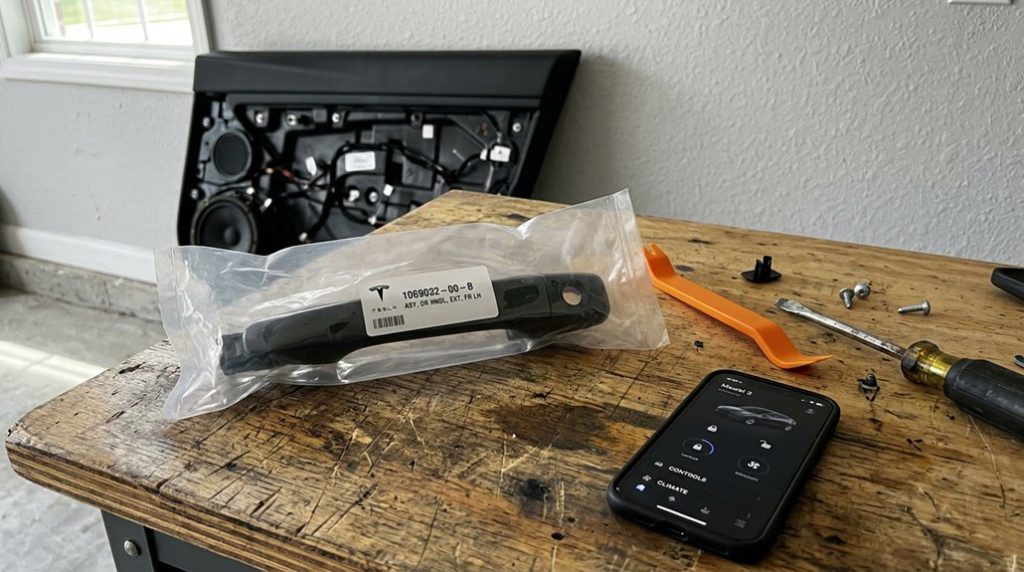
Once you’re inside the correct vehicle profile, navigate to the relevant category and open the diagram. Diagram interpretation is straightforward if you read each callout carefully—every part carries a label showing its parts numbering format (example: 1044234-00-B), quantity required, and a brief description.
Pay attention to whether the diagram shows an individual piece or a complete assembly, because ordering the wrong one means ordering too much—or too little. Unlike traditional vehicles, many Tesla mechanical issues are resolved through over-the-air updates rather than physical part replacements, so confirming the problem genuinely requires a hardware fix before ordering is a worthwhile first step.
Order Tesla Parts Through the Shop, App, or Service Request
Once you’ve identified your part number through Tesla’s EPC, you’ve got three purchase routes available: the Tesla Shop, the Tesla app, or a direct service request.
The Tesla Shop and app handle select parts — think windshield wipers, air filters, and low-voltage batteries — but not every component in the catalog makes the retail cut.
If your part isn’t available for direct checkout, open a service appointment through the app, include the part number and quantity in the request, and let Tesla’s service team handle the order from there. Keep in mind that on Model 3 and Model Y, the infotainment and Autopilot hardware are integrated into one unit, meaning certain component replacements require both systems to be swapped together rather than independently.
Online Shop and App
Ordering genuine Tesla parts directly has gotten easier over the years, though the process still runs through a controlled ecosystem rather than a wide-open parts marketplace.
Tesla gives you three primary access points:
- Tesla Shop – Browse and purchase select components online through Tesla’s official storefront.
- Tesla App – Use mobile checkout directly from your phone, and enable push notifications to track order status.
- Tesla Retail Locations – Pick up select parts in person at participating stores.
- EPC (Electronic Parts Catalog) – Identify eligible parts using the cart icon, then order directly.
Keep in mind that available parts represent a subset of Tesla’s full inventory.
Stock levels, your region, and your vehicle model all influence what’s actually purchasable on any given day.
Tesla’s onboard battery management system, which governs how the pack negotiates power limits during Supercharging, is the same system that influences part compatibility and replacement specifications tied to your specific vehicle configuration.
Most Tesla owners don’t think about emergencies until they’re stuck on the side of the road waiting for help to arrive. A small puncture or unexpected tire issue can quickly turn into hours of downtime and stress. stay prepared on every drive with a Tesla portable tire repair and emergency kit before a simple flat ruins your plans.
Service Request Method
When the shop or app doesn’t carry what you need, the service request method fills the gap. Open the Tesla app, steer to service, tap Request Service, select Other, then Something else. From there, type your request directly.
A parts only request should list each Tesla part number, the quantity needed, and a clear note that installation isn’t required—Tesla staff actually reads these details. Submit the request, and a service appointment gets scheduled or linked to your order. This isn’t glamorous, but it works.
Before submitting, verify fitment using your VIN through Tesla’s parts catalog (login required). Having the exact part number dramatically improves accuracy. If Tesla declines direct sale, your remaining option is typically service-center installation rather than independent purchasing. Keep in mind that hardware limitations on older vehicles can restrict which software features are available, so confirming your vehicle’s hardware generation before ordering electronics or sensor components helps avoid compatibility issues.
Tesla App vs. Tesla Shop: Choosing the Right Channel
Before you track down a genuine Tesla part, you need to sort out which channel actually gets you there—because the Tesla app and Tesla Shop aren’t the same tool wearing different hats.
Here’s how each channel breaks down:
- Tesla App handles Account Management—vehicle data, VIN details, software version, warranty info, and driver settings live here.
- Tesla Shop is strictly retail browsing—accessories, charging hardware, and apparel without touching your vehicle profile.
- Retail Overlap exists because the app embeds a shop section, but that’s just Tesla Shop rendered for mobile; it doesn’t change either channel’s core purpose.
- Parts research starts in the app when vehicle-specific circumstances matter, since you’re working within a tailored ownership environment rather than a public storefront.
Think of it this way: the app manages your Tesla, the shop sells you things. Mixing them up costs you time. This distinction becomes especially relevant when dealing with repair costs, since regional pricing for something like a bumper cover replacement can range from $1,500 to over $4,000 depending on your market.
Shipping Times, Pickup Options, and Warranty Coverage
Delivery reaches residential and business addresses across the 49 continental states, Hawaii, Puerto Rico, Mexico, and Canada—though international restrictions apply, meaning P.O. Boxes and APO addresses are off the table entirely.
Free shipping kicks in on U.S. orders over $100; anything under that carries a flat $10 charge (non-refundable, no exceptions).
For warranty coverage, outcomes depend heavily on part category and repair circumstance, so verify applicable terms through Tesla’s service documentation before assuming blanket protection.
Frequently Asked Questions
Can I Return a Genuine Tesla Part if It Doesn’t Fit My Vehicle?
You can return a genuine Tesla part that doesn’t fit, but verify fitment verification first. Under Tesla’s return policy, you’ll need to submit a claim within 14 days of delivery through parts.tesla.com.
Are High-Voltage Tesla Components Restricted From Direct Customer Purchase?
Ironically, you can’t just “add to cart” high-voltage Tesla components — they’re restricted from direct purchase. Tesla’s safety protocols and warranty implications demand professional handling, so you’ll need to go through Tesla Service instead.
Do I Need a Tesla Account to Browse the Electronic Parts Catalog?
You may get a limited Catalog preview without a Tesla login, but you’ll need an account for ordering and any account-linked actions like fitment checks by VIN.
Can Third-Party Repair Shops Order Genuine Tesla Parts Directly Online?
You can order genuine Tesla parts directly online as a third-party repair shop, but you’ll need a business account. Third-party certification may be required, and warranty transfer terms apply to parts purchased through Tesla’s EPC.
Are Tesla Parts Prices the Same Online as at Service Centers?
Tesla doesn’t confirm that online prices always match service-center pricing. You’ll want to factor in potential price comparison differences and shipping fees, as costs can vary by region, part availability, and ordering channel.