
Every charging standard claims to be the best — but only one has the physics, infrastructure, and official certification to back it up. NACS squeezes AC and DC charging into a connector half the size of CCS, sits behind Tesla’s 17,000-plus Supercharger network, and now carries SAE’s seal of approval. Yet the most compelling argument isn’t the hardware or the logos. It’s buried in reliability data that most comparisons deliberately ignore.
What Is the North American Charging Standard?
No moving parts, a small footprint, and a single standard covering both AC and DC charging — that’s the short version of why it works. Tesla introduced NACS as an open standard in November 2022, based on the proprietary connector design it had used since the Model S launched in 2012. The Supercharger network built around this connector has since grown to over 75,000 connectors worldwide, making it the largest fast-charging platform on the planet.
How the NACS Connector Handles Both AC and DC Charging
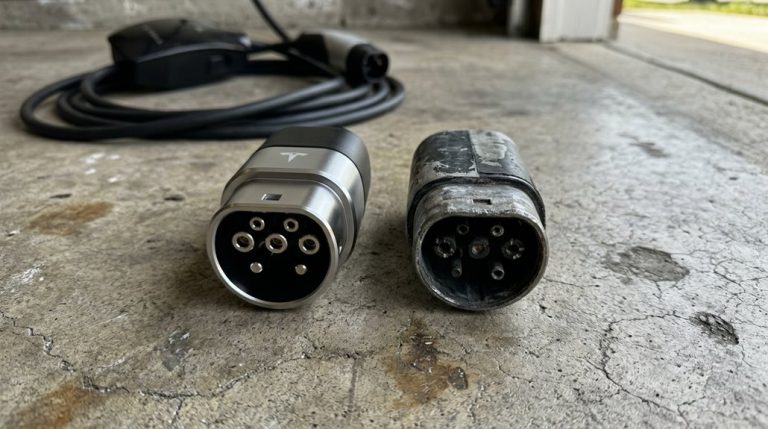
When you plug into a Tesla Supercharger or a Level 2 home charger, you’re using the exact same NACS connector — no adaptors, no swapping hardware. That’s possible because NACS runs both AC and DC current through a shared five-pin layout, where the two primary power pins (labeled DC+/L1 and DC−/L2) pull double duty: Line 1 and Line 2 during AC charging, then positive and negative DC link during fast charging.
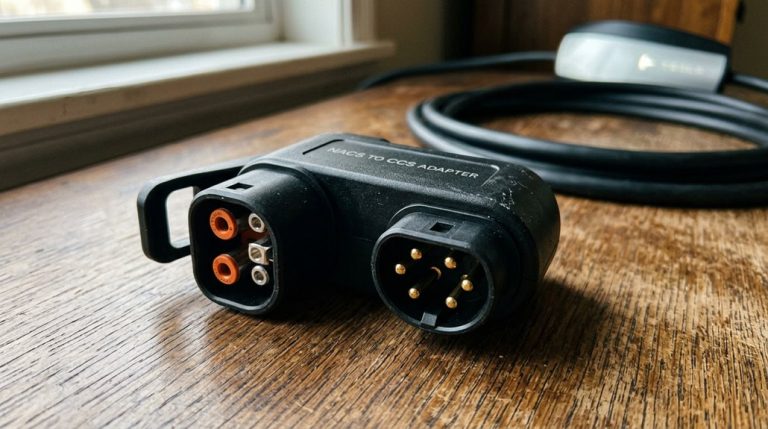
One connector handles everything from 11.5 kW residential charging (48 A at 240 V) to 500 kW+ DC fast charging, which means your vehicle’s single inlet covers your driveway outlet and a highway Supercharger stop without any compromise. The standard was formally adopted as SAE J3400 at the end of 2023, cementing cross-manufacturer compatibility across connectors and inlets from multiple producers. The reach of NACS has expanded well beyond Tesla vehicles, with non-Tesla EVs now able to access more than 17,800 Tesla Superchargers across North America using a dedicated adapter.
Single Connector, Dual Capability
Most EV charging standards force you to juggle two separate connectors—one for AC, one for DC fast charging—but NACS collapses both functions into a single compact plug.
That’s not a minor convenience; it’s a deliberate engineering choice baked into the connector’s five-pin layout. Two large shared pins handle the heavy lifting, switching between AC line delivery and DC positive/negative flow depending on your charging source.
Three smaller pins manage ground and communication.
Single plug ergonomics matter here because you’re handling this interface repeatedly—shared contact durability becomes critical when those same pins carry everything from a standard 48 A Level 2 session to a 900 A DC fast charge.
One connector, two modes, no adaptor gymnastics required. This same philosophy of consolidating electrical functions appears in the Cybertruck’s 48-volt architecture, which delivers identical power at one-quarter the current of a 12V system by reducing resistive heat and enabling thinner copper wiring throughout the vehicle.
Unified Home and Public Charging
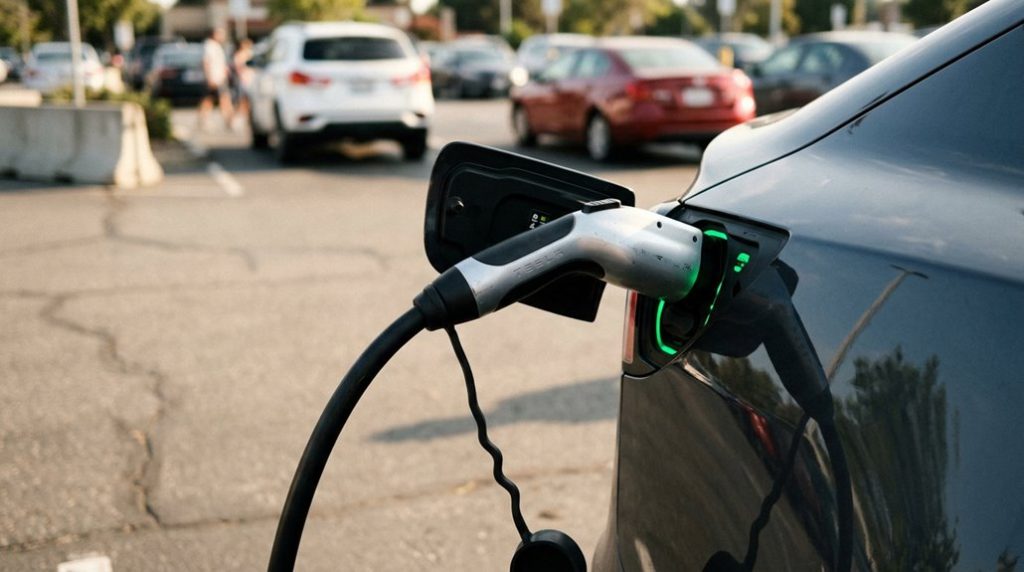
The same inlet that draws power from your garage wall at 240 V on a Tuesday night connects to a 900 A DC fast charger on a highway stop Friday afternoon—no adaptor, no secondary port, no rethinking the handshake. That’s home convenience and charger compatibility solved with one port.
NACS handles Level 1 and Level 2 AC at home (up to 48 A at 240 V for daily use), then shifts to DC fast charging publicly without requiring a separate inlet. The connector’s five-pin layout reassigns its two shared power pins—Line 1/Line 2 for AC, positive/negative for DC.
Other standards force separate connectors for each mode. NACS doesn’t. One inlet, two charging realities, zero hardware compromises between your driveway and the interstate. The NACS port opens access to 30,500+ Tesla Superchargers nationwide, alongside thousands of other DC fast charging stations. Tesla’s Supercharger network was built specifically to address range anxiety across continents, giving drivers confidence that fast charging infrastructure exists well beyond their home region.
Which Automakers Have Adopted NACS?
Virtually every major automaker selling EVs in North America has now committed to NACS, making the old CCS1 port look increasingly like a legacy holdout. Ford moved first in May 2023, triggering a cascade of announcements that reshaped the industry within months.
| Automaker | Announcement Date |
|---|---|
| Ford | May 2023 |
| General Motors | June 2023 |
| Mercedes-Benz | July 2023 |
| Hyundai/Genesis/Kia | October 2023 |
| Stellantis | February 2024 |
Notice how quickly that table fills up. The Subaru adoption (November 2023) and Toyota timeline (October 2023) arrived nearly back-to-back, signaling that even traditionally cautious Japanese brands couldn’t ignore the momentum. Volkswagen Group and BMW followed, effectively ending CCS1’s relevance for new North American models. The expanding Supercharger V4 network is further accelerating this shift, as faster speeds and broader compatibility make NACS access even more compelling for automakers and buyers alike.
One critical distinction: announcement dates and actual Supercharger access dates differ. Ford and Rivian gained physical access in early 2024, while others waited longer for hardware rollouts. The Tesla Supercharger network gives NACS-equipped vehicles access to about 15,000 Superchargers across North America, making compatibility with that standard far more valuable than access to any competing charging infrastructure.
Why NACS Has the Biggest Fast-Charging Network
That kind of scale means you’re far more likely to find a working, high-uptime NACS connector at a travel-relevant stop than any other standard can realistically promise. With over 130,000 chargers available across the United States, the likelihood of finding yourself stranded far from a backup charging option is remarkably low.
Superchargers Dominate Fast Charging
If you’ve ever wondered why NACS holds such a commanding position in North American fast charging, the answer starts with one number: 36,102. That’s how many Tesla Supercharger ports existed in January 2026 — more than three times the combined total of the next three largest networks.
Supercharger Expansion didn’t happen accidentally; Tesla built methodically, prioritizing Urban Rollout along high-traffic corridors before extending into suburban and rural markets. The result? Tesla controls roughly 52.5% of all U.S. DC fast-charging ports. Every competing network combined still can’t close that gap.
Because NACS is native to Superchargers, choosing a NACS-equipped vehicle means you’re tapping into the dominant infrastructure automatically — no converter gymnastics required. That’s not brand loyalty talking; that’s arithmetic. Real-world Supercharging sessions average 120–125 kW of power delivery, meaning a compatible vehicle can recover a significant amount of range in just 15 to 20 minutes at any of those tens of thousands of ports.
Unmatched Network Coverage
Those port numbers tell part of the story — but raw count only matters if the chargers are actually where you need them.
That’s where NACS network coverage genuinely separates itself. Enphase confirms charging opportunities appear every 70 to 120 miles along nearly every U.S. interstate — not randomly scattered, but strategically placed where long-distance routes demand them.
Charger density follows demand logic too: stations concentrate in high-population regions and high-adoption markets, so you’re rarely guessing.
Tesla deliberately built its network around range confidence rather than convenience-store proximity (a meaningful distinction).
The result is infrastructure that handles real-world road trips, not just urban top-offs.
Tesla vehicles using this network also benefit from onboard systems that deliver proactive speed reductions on interchanges and off-ramps, making the driving experience between charge stops as refined as the charging network itself.
When coverage this deliberate meets a footprint this large, “unmatched” stops being marketing language and starts being a measurable fact.
Reliable High-Uptime Stations
High uptime doesn’t happen accidentally — it requires predictive maintenance systems that identify hardware degradation before failure occurs.
Tesla’s infrastructure runs that process at scale, which is exactly why 3.9% of Tesla drivers experienced failed charges versus 21.6% on competing networks. This same commitment to integrated systems extends into the vehicle itself, where Tesla delivers over-the-air firmware updates that silently download and install improvements without requiring a service visit.
Why NACS Chargers Are More Reliable Than CCS
When you’re planning a long drive and need a reliable charge, the last thing you want is a broken station.
CCS networks have struggled with this—one 2022 study found that one in four CCS chargers in the Bay Area wasn’t functional. Some regions report CCS station availability as low as 72.5%.
NACS pulls ahead through three structural advantages:
- Integrated maintenance diagnostics let Tesla monitor, flag, and service hardware remotely before failures compound
- Thermal management built into Tesla’s vertically integrated system keeps charging hardware operating within safe parameters longer
- Unified AC/DC design eliminates compatibility gaps that fragment the CCS ecosystem
Tesla manages the vehicle, charger, and network together—meaning fewer points of failure. That integration isn’t accidental; it’s why Superchargers consistently outperform competing networks.
Tesla’s onboard navigation reinforces this advantage by automatically routing drivers to Supercharger stops while preheating the battery for efficient discharge, ensuring the vehicle and charging infrastructure work as a single coordinated system.
You’re not just plugging into a charger. You’re plugging into a system designed to actually work.
Why NACS Is the Future of EV Charging
The writing’s on the wall: NACS isn’t just winning the connector war—it’s already over. By 2030, industry forecasts suggest over 80% of new North American EVs will be NACS-compatible. That’s not a trend—that’s market consolidation happening in real time.
| Milestone | Figure | Year |
|---|---|---|
| Non-Tesla EVs with native NACS | ~1 in 5 sold | 2025 |
| Open Supercharger stalls | 25,000+ | 2026 |
| EVgo NACS connectors implemented | 500+ | 2026 |
You’re looking at an ecosystem where consumer convenience stops being a selling point and starts being a given. Every major automaker—Ford, BMW Group, Stellantis—has already committed. Charge-point operators are following. Superchargers (three out of four fast chargers in North America) are increasingly accessible to non-Tesla drivers. The adaptor era is winding down. Native ports are taking over. NACS isn’t the future anymore—it’s the present catching up to itself.
Frequently Asked Questions
Can I Use a NACS Adapter With My Existing Ccs-Equipped EV?
Yes, you can use a NACS connector with your CCS-equipped EV, but connector compatibility depends on your automaker’s approval. Always use authorized hardware to avoid warranty concerns and potential damage to your vehicle.
Does NACS Charging Cost More Than CCS at Public Stations?
Contrary to what you might assume, NACS charging fees aren’t higher. Thanks to network competition, you’ll often pay less—Tesla Superchargers typically run $0.28–$0.35/kWh versus CCS networks charging $0.42–$0.56/kWh.
How Does NACS Connector Size Compare Physically to a CCS Plug?
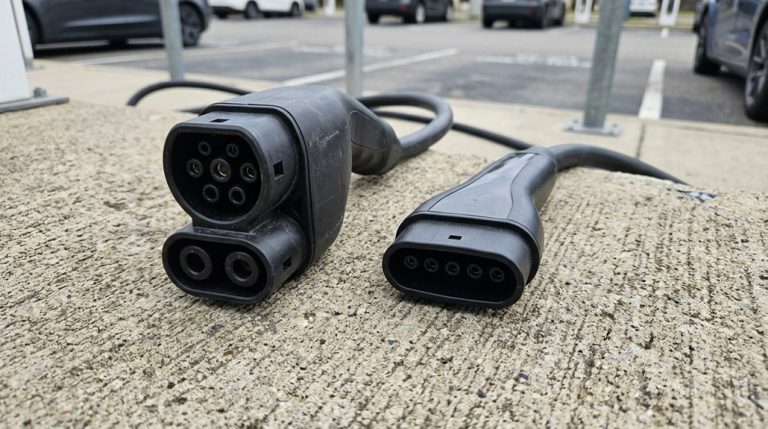
You’ll notice NACS’s physical dimensions are roughly half of CCS’s bulky stacked contact layout. It measures about 42.8 × 45.7 mm, while CCS spans 145.7 × 71.9 mm, making NACS far more compact.
Will Older Tesla Superchargers Support Non-Tesla NACS Vehicles Fully?
Don’t hold your breath—older Superchargers won’t fully support your non-Tesla NACS vehicle. You’ll hit retrofit challenges and firmware compatibility walls, especially at V1/V2 sites. Tesla’s rollout remains staged, so always verify stall access through the app first.
Is NACS Available Outside North America for International EV Travel?
NACS isn’t widely available outside North America yet, so you’ll need international adaptors for global roaming. Europe still uses CCS2, and broader adoption isn’t expected until Japan and South Korea expansions in 2026–2027.