
Most EV drivers assume any NACS adapter will do the job. They’re wrong—and the consequences go far beyond a failed charging session. A non-certified adapter operating at 500V DC isn’t just ineffective; it’s a liability quietly waiting to demonstrate exactly why UL 2252 certification exists. Fault-current failures, thermal runaway, and moisture ingress don’t announce themselves in advance. Knowing which adapters actually survive the tests that matter could save your vehicle, your wallet, and potentially far more.
What Is UL 2252 and Why It Applies to NACS Adapters
When you plug a NACS-to-CCS adaptor into a DC fast charger, you’re trusting a small piece of hardware to safely handle up to 1,000 volts and 500 amps — and that’s exactly the gap UL 2252 was written to close.
Published on March 19, 2025, UL 2252 (formally titled *Standard for Adapters for Use with Electric Vehicle Couplers*) is the ANSI/CAN/UL safety standard governing EV charging adapters. Its regulatory scope covers electrical safety, thermal performance, and mechanical durability — not just plug shape. That distinction matters. Standards evolution in EV charging historically addressed connectors themselves, leaving adapters without dedicated compliance benchmarks. UL 2252 changed that.
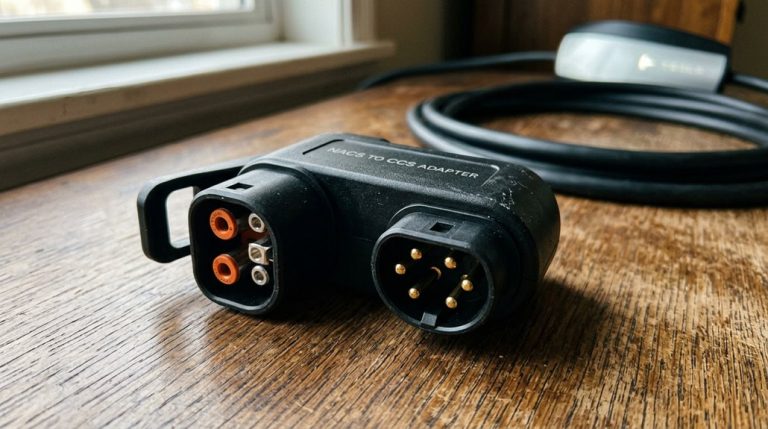
NACS adaptors fall squarely within this standard because they’re coupler adaptors by definition — single devices bridging incompatible connector types like NACS and CCS1. UL 2252 evaluates whether your adaptor actually handles real-world charging conditions safely, which is a reasonable thing to verify before pushing 500 amps through plastic and copper. Certified adapters also facilitate communication between the vehicle and charger control systems, making them more than just a passive connector bridge. This matters particularly as non-Tesla EVs increasingly rely on NACS adapters to access the 17,800+ Tesla Superchargers now open to them.
The Real Risks of Using a Non-Certified NACS Adapter
Skipping UL 2252 certification on a NACS adaptor isn’t just a minor gamble — it’s a shortcut that can expose you to overheating, arc faults, and outright connector failure during high-current DC fast charging sessions where sustained loads push cheap pin materials and weak thermal designs past their limits.
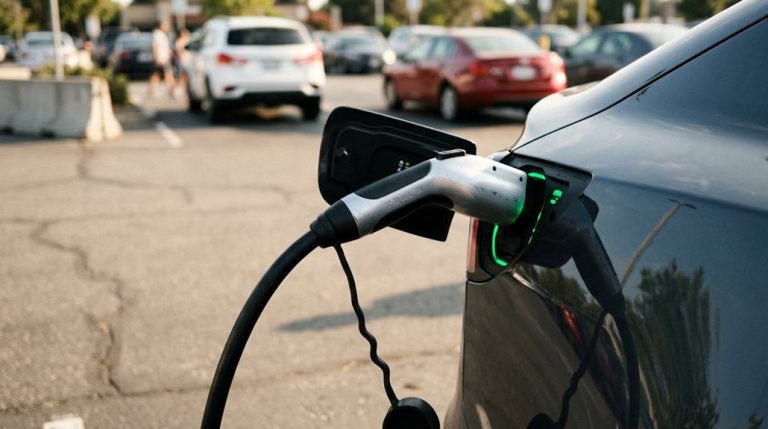
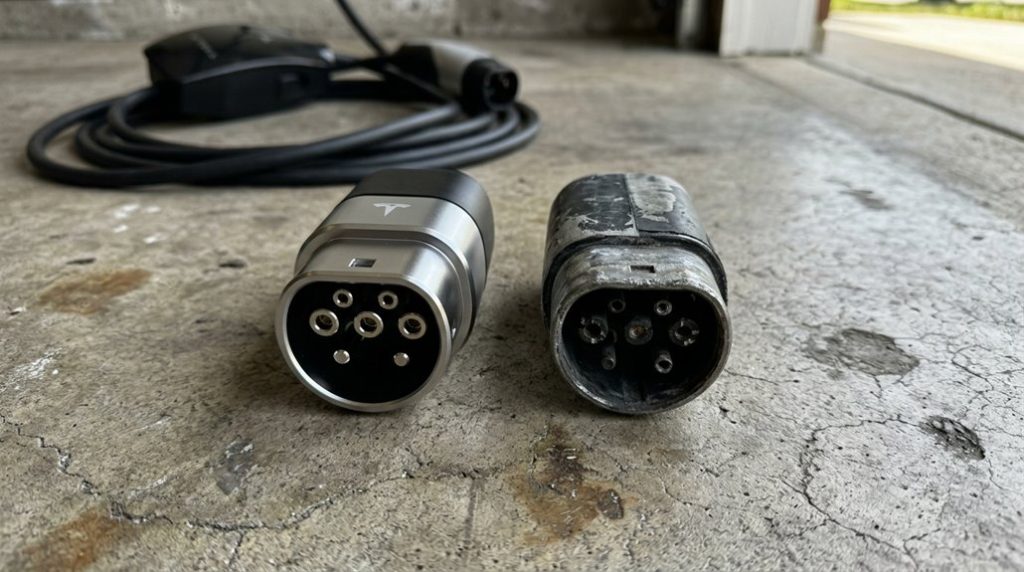
Non-certified adapters have been documented melting into vehicle charge ports, triggering short circuits, and in extreme cases, igniting — damage that can cascade beyond the adapter itself to your vehicle’s inlet, the charging station’s cable, and any connected hardware. At Tesla Superchargers, the station’s onboard power electronics convert grid AC to DC before delivery, meaning the adapter sits directly in the path of that high-current DC fast charging output at potentially hundreds of kilowatts.
Worse, if you’re using uncertified equipment when something goes wrong, your automaker’s warranty (Ford, GM, Rivian, and Hyundai have all weighed in on this), your insurer, and even Canadian safety regulations may leave you holding the bill.
Mercedes-Benz EQB owners have reported that short Supercharger cables can complicate adapter use due to the vehicle’s charge port position, adding physical strain to a connection that already demands a secure, certified fit.
Electrical Hazards and Overheating
Using a non-certified NACS converter isn’t just a gamble on convenience—it’s a direct invitation to some genuinely dangerous electrical failures.
Without proper thermal diagnostics, an adapter can’t detect hot spots developing near the power pins. That matters materially because DC fast charging can push up to 500 kW through that connection point.
Here’s what actually happens: poor-quality contacts generate resistance, resistance generates heat, and heat accelerates insulation degradation across the connector interface.
Once insulation breaks down, you’re looking at potential arc flash conditions—brief electrical arcs that produce intense localized heat. Uncertified adapters frequently lack arc-fault protection to interrupt this sequence.
The documented outcomes aren’t theoretical. Reported incidents describe melting adapters, short circuits, and thermal runaway events.
Your vehicle’s charge port absorbs the consequences too, often requiring expensive repairs. When damage does occur, Tesla evaluates each repair claim individually and must establish a direct causal link between the non-certified component and the failure before determining warranty coverage. Certified adapters address this directly by incorporating temperature sensors that throttle or stop charging entirely if internal thresholds are exceeded.
Legal and Insurance Exposure
The electrical risks alone should concern you—but the legal and financial fallout from using a non-certified NACS adapter can outlast any melted connector. Liability exposure is real: if a non-certified adapter damages charging infrastructure or nearby property, that financial responsibility can shift directly onto you. CharIN confirms that aftermarket adapters can severely damage vehicles, charging stations, and surrounding facilities.
Insurance uncertainty compounds the problem. Canadian industry guidance warns that insurers may question coverage when uncertified equipment violates provincial law—turning your bargain adapter into an expensive mistake. Mercedes-Benz and GM both state that non-approved adapter damage falls outside warranty coverage, leaving repair costs entirely in your hands. Insurers may also invoke policy exclusions, especially when third-party property damage triggers subrogation disputes. Tesla’s software-controlled feature gating demonstrates that manufacturers already reserve the right to selectively disable or restrict vehicle functionality based on compliance with approved components and configurations. Certification isn’t bureaucratic formality—it’s your legal protection. The UL 2252 standard, published and approved on March 19, 2025, now establishes the baseline safety compliance expectations that automakers, suppliers, and retail partners use to evaluate adapter legitimacy.
Compatibility and Connector Failure
Certified adapters don’t just protect against electrical hazards—they’re engineered to guarantee your vehicle and the charger actually speak the same language. Poor connector alignment causes incomplete mating, which interrupts signal handshakes between your EV and the station.
Without mating durability standards, repeated insertions crack housings and loosen contacts.
Non-certified adapters risk:
- Communication errors from failed SAE J3400/ISO 15118-202 protocol handshakes
- Incomplete connector alignment that prevents sessions from starting
- Physical degradation after repeated insertion cycles without impact resistance testing
- Infrastructure damage to both the charger and surrounding equipment (per CharIN’s documented warnings)
UL 2252 evaluates interoperability specifically—not just voltage and current. That means connector fit is treated as a safety variable, not an afterthought. Tesla’s Supercharger V4 network is expanding globally with higher speeds and broader compatibility, making standardized, certified adapter connections increasingly critical to reliable session initiation across the growing infrastructure.
How UL 2252 Prevents Fire, Shock, and Overheating
When you plug a non-certified converter into a Tesla’s NACS port and push it toward 500 amps at 1,000 volts, three failure modes compete to ruin your day: fire, shock, and meltdown. UL 2252 addresses each threat systematically—requiring electrical safety verification that confirms the converter handles high-load current without creating unsafe arc or leakage conditions, enforcing internal pin contact temperatures below 90°C and external touch surfaces below 60°C, and mandating thermal derating (automatic current reduction when heat climbs too high) that escalates to a full charging shutdown if temperatures stay excessive.
The standard also requires mechanical durability testing across repeated plug-unplug cycles and environmental exposure to moisture, dust, and temperature swings, meaning the converter that passed certification on day one should behave the same way on day five hundred. Tesla’s onboard battery management system relies on accurate thermal and current data from compliant charging hardware, making a certified adapter especially critical given that remote software updates can alter charging strategy and thermal thresholds overnight.
Electrical Hazard Prevention Testing
Plugging a non-certified NACS converter into your Tesla’s charge port introduces real electrical risks—fire, shock, and overheating chief among them—and UL 2252 exists specifically to test against all three.
The standard runs adapters through rigorous electrical hazard prevention testing before they reach your hands:
- Insulation verification confirms adapter materials resist current leakage under specified voltage loads
- Fault current analysis evaluates grounding paths, ensuring short circuits route safely to earth rather than through you
- Flammability evaluation tests housing materials against ignition under overload conditions
- Temperature and endurance testing simulates repeated high-current sessions, catching heat-related degradation early
This matters especially because Tesla’s onboard systems, including its sensor fusion architecture, rely on stable, clean power delivery that uncertified hardware can disrupt through voltage irregularities or thermal interference. Each checkpoint targets a specific failure mode. Skip certification, and you’re essentially field-testing an unknown product on a $40,000+ vehicle—an experiment nobody wins.
Thermal Protection Mechanisms Explained
Heat is the silent threat in high-current EV charging—one that non-certified converters routinely ignore until something melts. UL 2252 takes thermal sensing seriously, requiring detection across every high-current path, not just the connector shell.
The placement strategy targets busbar joints, crimp zones, and pin-to-socket shifts—exactly where resistance spikes under load. You’re also getting redundancy design through a dual thermistor setup (one per pin), which eliminates single-point failure risks that cheaper adapters never address.
When temperatures climb, the adapter doesn’t panic—it foldbacks current first, reducing heat generation while charging continues. If temperatures keep rising anyway, it aborts the session entirely.
Amphenol’s certified NACS-to-CCS1 adapter confirmed this two-stage response, rated up to 500 amps and 1,000 volts. That’s engineering, not guesswork. This same commitment to managing heat through structural design is echoed in the Cybertruck’s 48-volt electrical architecture, which reduces resistive heat by delivering identical power at one-quarter the current of a traditional 12-volt system.
Weather and Wear Resilience
Thermal protection handles the internal fight—but your converter lives outside, and that’s a different kind of brutal.
UL 2252 certification requires weatherproof sealing and abrasion resistance built to survive real conditions. Lectron’s certified adaptor carries an IP67 rating, meaning it resists full water immersion and dust intrusion. It operates reliably between -22°F and 122°F—temperature swings most drivers actually encounter.
Physical durability gets equally serious attention:
- Impact and crush resistance testing verifies structural integrity under pressure
- Drop testing from roughly 3–4 feet simulates accidental handling
- Drive-over resistance accounts for parking lot reality
- Vibration testing addresses repeated mechanical stress from daily use
These aren’t cosmetic checkboxes. They confirm your adaptor handles plugging cycles, weather exposure, and physical abuse without compromising the electrical safety underneath. This matters especially for home Level 2 charging, where a Wall Connector operating at up to 48 amps continuous draw makes a compromised adapter far more dangerous than one used occasionally at lower loads.
Which NACS Adapters Actually Hold UL 2252 Certification Right Now?
| Adapter | Direction | Rating |
|---|---|---|
| Lectron Vortex Plus | NACS → CCS | 500 A / 1,000 V |
| Lectron CCS-to-NACS | CCS → NACS | 500 A / 1,000 V |
| Lectron J1772-to-NACS | J1772 → NACS | 80 A / 240 V |
| Lectron NACS-to-J1772 | NACS → J1772 | 80 A / 240 V |
| Amphenol HVCONT1001 | NACS → CCS1 | 380 A / 1,000 V |
Amphenol’s HVCONT1001 holds CSA-issued UL 2252 certification but appears less consistently in retail channels. If you’re shopping today, Lectron’s lineup offers the clearest purchase path with documented certification across both DC and AC applications. A certified NACS adapter is particularly relevant for Chevy Equinox EV owners, since a compatible adapter unlocks access to 17,800+ Tesla Superchargers across the country.
Why NACS Adapters Need to Work Across CCS1 and J1772 Networks
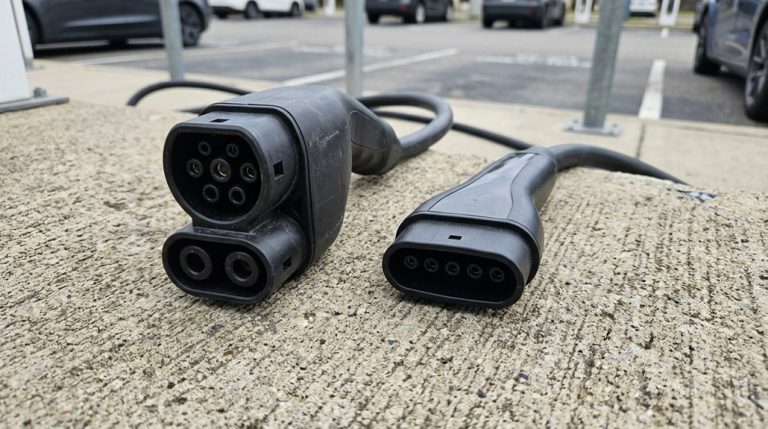
Before you grab any NACS adapter off a shelf, you need to grasp that CCS1 and J1772 aren’t just different connector shapes—they’re fundamentally different electrical designs, and no single adapter bridges both.
CCS1 and J1772 aren’t just different shapes—they’re fundamentally different electrical designs that no single adapter can bridge.
NACS interoperability depends entirely on correct adapter routing, meaning each adapter physically connects specific pins to specific power pathways.
Here’s what network mapping actually means for your charging decisions:
- J1772 stations supply AC power through two AC pins your onboard charger converts
- CCS1 fast chargers deliver DC directly through two additional bottom pins J1772 lacks entirely
- Pin compatibility failures cause charging errors when the car can’t detect the correct power path
- Separate adapters handle each network because combining both modes creates unsafe live contacts
Treat each adapter like a dedicated tool.
Using the wrong one doesn’t just fail—it fails silently, wasting your time at the station.
How UL 2252 Tests Durability and Weather Resistance
Knowing which adapter fits which network solves half the problem—the other half is whether that adapter holds up after the hundredth plug cycle in a rainstorm.
UL 2252 tackles this directly through performance testing that covers temperature, endurance, vibration, and drive-over resistance. After every mechanical test, the adapter must maintain full electrical continuity and stable safety circuit states—no exceptions.
Thermal testing matters especially for DC fast-charging adapters rated up to 500 amps and 1,000 volts, where heat buildup isn’t theoretical. The standard also addresses environmental durability, checking resistance to moisture, dust, and temperature cycling using IP ratings (IPx1 through IPx8 and IP5x/IP6x), which directly measures ingress protection performance under real-world exposure.
Material longevity gets evaluated too—flammability ratings, electrical properties, and marking durability under UV weathering and chemical exposure. UL 2252 effectively stress-tests everything before your adapter ever touches a charging station.
The Legal and Insurance Exposure From Using Uncertified Adapters
Buying a cheap, uncertified NACS converter to save fifty dollars can expose you to legal liability, insurance complications, and warranty voids that make that savings look embarrassing in retrospect.
Uncertified adapters are illegal to sell in Canada, and using one can trigger regulatory fines reaching thousands of dollars depending on your jurisdiction.
The legal exposure doesn’t stop at fines, either. Consider what’s actually at risk:
- Insurance implications: Policies often exclude damage from improper equipment, shifting repair costs entirely to you
- Network violations: Charging operators can ban your account after a single incident involving unauthorized hardware
- Warranty voids: GM and Mercedes-Benz explicitly state non-approved adapter damage isn’t covered
- Third-party liability: If uncertified equipment damages property beyond your vehicle, your personal exposure multiplies markedly
Charging-network Terms of Use reinforce these risks by requiring certified, authorized equipment.
One bad adapter decision can dismantle multiple layers of financial protection simultaneously.
How to Verify UL 2252 Certification Before You Buy
Verifying UL 2252 certification before you hand over payment takes roughly five minutes and saves you from the financial consequences covered in the previous section. Start by physically checking the adaptor body and packaging for a visible UL mark alongside a traceable file number.
| Verification Step | What to Confirm |
|---|---|
| UL mark inspection | Visible mark plus file number on adaptor |
| UL Product iQ search | Certification status and applicable standard |
| Model number match | Exact model, not just brand family |
| Manufacturer documentation | UL file number, ratings, technical specs |
| Retailer verification | Seller’s certification claims match database |
Treat phrases like “UL compliant” as marketing noise unless a listing backs them up. Cross-checking warranty implications matters here too, since uncertified adaptors frequently void manufacturer coverage. Search UL Product iQ using the file number, confirm UL 2252 specifically applies, and verify the listing covers the adaptor itself, not a related component.
Frequently Asked Questions
Can Automakers Void Your Warranty if You Use an Uncertified NACS Adapter?
They can’t automatically void your warranty, but if an uncertified NACS adapter causes damage, dealer policies allow automakers to deny claims. Grasping these warranty implications helps you make safer, smarter charging choices.
Do Certified NACS Adapters Work With All EV Charging Speeds and Levels?
No, certified NACS adapters don’t cover all charging speeds. They’re split by type—AC adapters handle Level 1 and Level 2 charging compatibility, while DC adapters manage fast charging through separate power negotiation, so you’ll need both for full coverage.
How Often Should a UL 2252 Certified NACS Adapter Be Replaced or Inspected?
You should follow inspection intervals before every charging session, checking for damage or wear. For replacement timelines, follow your manufacturer’s guidance, and don’t keep using connectors showing physical damage, poor fit, or thermal marks.
Are UL 2252 Certified Adapters Compatible With Older Non-Nacs Electric Vehicles?
Like a universal travel plug that only fits certain outlets, UL 2252 certified adapters support legacy compatibility through protocol translation, but you’ll need the right connector type matching your vehicle’s specific inlet.
Does UL 2252 Certification Differ Between Adapters Made for Home Versus Public Charging?
UL 2252 doesn’t differ between home installations and public stations—it’s one universal standard. What changes is the converter’s design, power rating, and connector type based on your specific charging use case.