
Two connector standards are quietly dividing the EV world—and picking the wrong one could mean sitting stranded at a charging station with an incompatible plug. NACS packs five pins into a slim design while CCS bulks up with a stacked J1772 combo, yet neither actually guarantees faster charging. The real battle lives in network access, adapter reliability, and where government money is flowing. What most buyers never realize before signing is what makes the difference.
CCS vs NACS: How the Connectors Actually Differ
If you’ve ever stood at a charging station and wondered why one plug looks like it was designed by committee and the other looks like it belongs on a consumer product, that’s fundamentally the CCS vs. NACS debate in physical form.
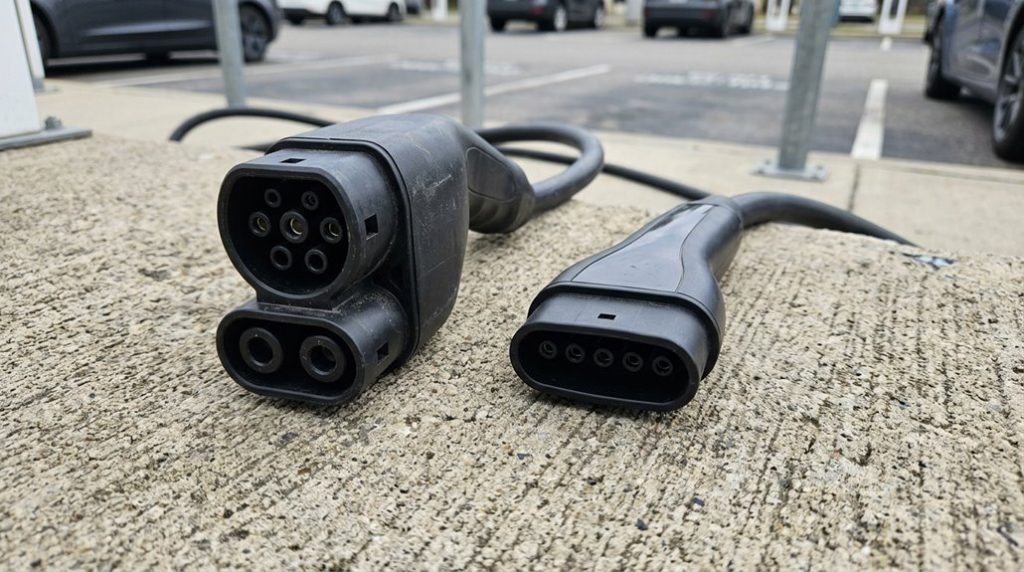
CCS1 stacks a J1772 AC section on top of two dedicated DC pins, creating a bulkier, heavier connector with a noticeably larger physical footprint on your vehicle’s body panel.
CCS1 is essentially two connectors fused together — and that compromise shows in every awkward, oversized plug.
It’s functional, but it’s not exactly refined.
NACS takes a different approach entirely.
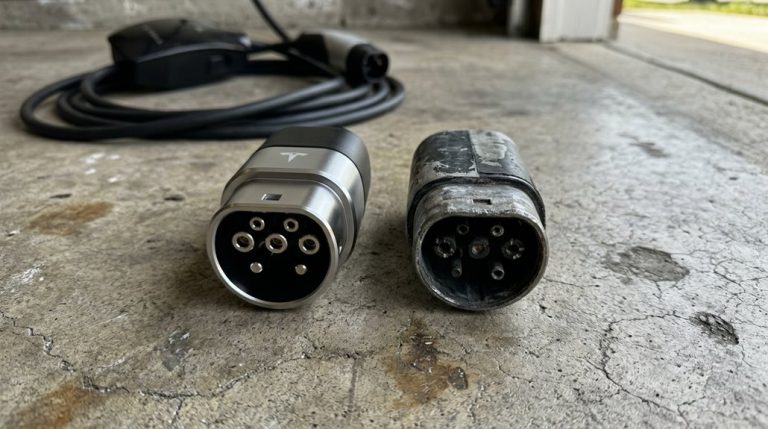
Its five-pin, single-piece design uses contact multiplexing, meaning the same contacts handle both AC and DC charging depending on what the session requires.
No separate sections, no sandwich-style housing.
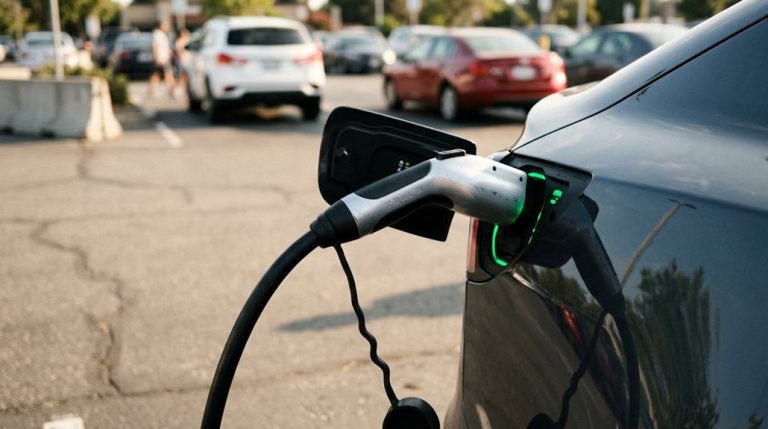
The result is a connector that’s smaller, lighter, and genuinely easier to handle.
You’ll feel that difference immediately, especially in tight parking situations where CCS cables can feel awkward and uncooperative.
Tesla’s broader infrastructure strategy reflects this design philosophy, with its proprietary Supercharger network addressing range anxiety by providing consistent charging access across continents.
CCS relies on Power Line Communication to handle the exchange of data between the vehicle and charger during a session, while NACS uses a CAN-based protocol through its more streamlined connector design.
Which Charges Faster: CCS or NACS: in Real Conditions?
When the question is which standard charges faster, the honest answer is that connector type is almost never the limiting factor. Your battery’s acceptance rate, its current state of charge, and its temperature control system matter far more than the plug shape. Battery aging also quietly reduces peak acceptance over time, so an older pack won’t hit factory-rated speeds regardless of connector.
CCS stations commonly reach 350 kW, while Tesla’s V3 Superchargers cap at 250 kW (V4 hardware closes that gap at 350 kW). Yet most real sessions land between 20% and 80% SOC, taking roughly 20 to 40 minutes either way. The vehicle’s charging curve decides the outcome.
Where NACS genuinely wins is user experience. Tesla’s Supercharger network delivers more consistent uptime and less station-to-station variation, meaning your actual session time often beats a higher-rated but unreliable CCS site. Tesla’s V4 cabinet architecture supports up to 1.2 MW capacity and can distribute power across up to eight stalls simultaneously, reducing per-session wait times at busy locations.
Does Your CCS or NACS Connector Limit Where You Can Charge?
Charging speed means little if you can’t plug in at all, and that’s where connector type actually shapes your day-to-day life. Your port determines which stations you can access natively, and regional availability makes that gap real. NACS vehicles plug directly into Tesla Superchargers, while CCS vehicles generally can’t without special arrangements.
Flip that around: CCS remains standard across Electrify America and EVgo, so NACS drivers face their own limits there.
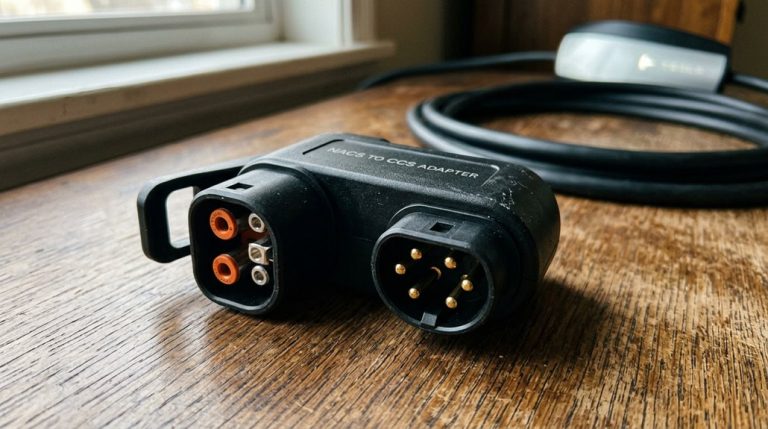
Adapters help, but adapter limitations are genuine. Tesla introduced a CCS adapter in 2022 for compatible models, though older vehicles may need a retrofit first. CCS drivers can access some Tesla locations when site-specific solutions exist, but that’s not universal. Non-Tesla EVs like the Chevy Equinox EV can access 17,800+ Tesla Superchargers via a dedicated NACS adapter where site-specific compatibility has been established.
Geography adds another layer. U.S. government-funded chargers must support CCS, keeping that network strong during the shift. Europe runs CCS2 exclusively, so NACS compatibility means nothing there. Your connector doesn’t just affect speed—it dictates your map. The Alternative Fuels Data Center currently counts 13,188 CCS stations versus just 3,880 NACS stations across the United States.
Can CCS and NACS Adapters Actually Unlock Each Other’s Networks?
Adapters sound like a universal skeleton key, but the reality is more specific than the marketing suggests. Plug shape gets you close — vehicle eligibility and network enrollment get you through the door.
| Adapter Type | Vehicle Port | Station Connector |
|---|---|---|
| CCS-to-NACS | CCS | NACS (Tesla Supercharger) |
| NACS-to-CCS | NACS | CCS DC fast charger |
| Tesla CCS1 | NACS (Tesla) | CCS DC fast charger |
| OEM CCS-to-NACS | CCS (Hyundai, Ford, GM) | NACS V3/V4 Supercharger |
| Dual-cable station | NACS | No adapter needed |
A physically compatible adapter doesn’t guarantee charging access. Tesla Superchargers require confirmed vehicle support — V3 and newer only, no Destination chargers. Hyundai’s 800V architecture hits roughly half capacity on 400V V3 Superchargers, while V4 units push up to 350 kW. Some automakers also authorize only brand-supplied adapters, so third-party options carry real risk.
The naming confusion around adapters runs deeper than most drivers expect. Searching “NACS to CCS adapter” and “CCS to NACS adapter” will surface the same physical product — the difference is only which end of the transaction the driver is mentally standing on. Tesla’s broader charging ecosystem also relies on sensor fusion and camera inputs to verify station compatibility and guide precise positioning during the docking process.
Which Connector Standard Should Your Next EV Use?
Knowing which adaptor works where only gets you so far — at some point, you’re picking a new EV, and the connector baked into that vehicle determines your charging universe for the next decade. Future-proofing tradeoffs and fleet compatibility pull in opposite directions here.
Consider four decision points:
- New platform alignment — NACS (SAE J3400) is where North American automakers are heading.
- Legacy fleet compatibility — CCS1 still covers the largest installed non-Tesla vehicle base.
- Infrastructure access — CCS networks are widespread; Supercharger expansion favors NACS.
- Connector ergonomics — NACS is lighter, more compact, and uses shared AC/DC pins.
If you’re buying new and keeping the vehicle long-term, NACS fits the emerging ecosystem better.
If you’re managing a mixed fleet or prioritizing backward compatibility with existing chargers, CCS remains the practical anchor.
Neither choice is wrong — just honest about what matters most to you. Both standards now share the ISO 15118 protocol, which means NACS and CCS are cross-compatible in communication and can theoretically work across networks with the right adapter.
Tesla’s expanding Supercharger V4 network is increasing global speeds and compatibility, making NACS access increasingly valuable for drivers who prioritize fast, reliable top-ups on long trips.
Frequently Asked Questions
Does Battery Temperature Affect CCS and NACS Charging Performance Differently?
Like two rivers flowing from the same source, battery temperature doesn’t affect CCS and NACS differently. Your battery’s chemistry and thermal throttling drive performance. Battery conditioning before charging helps you maximize speed regardless of connector standard.
Are Older Ccs-Equipped EVS Eligible for Network Upgrades Supporting NACS Access?
Some older CCS-equipped EVs can access NACS networks, but it depends on your automaker’s approval, adapter availability, and whether your vehicle supports the necessary firmware updates to allow compatibility.
How Do Charging Costs Compare Between CCS and NACS Networks Today?
Like a town crier announcing savings, NACS energy pricing typically beats CCS networks. You’ll pay around $0.42/kWh at Tesla Superchargers versus $0.48/kWh at Electrify America, and subscription plans can slash costs even further.
Will CCS Infrastructure Remain Supported as NACS Adoption Expands Through 2026?
Yes, you’ll still find CCS infrastructure supported through 2026, as policy implications from federal NEVI funding require dual-connector stations. Grid upgrades increasingly favor NACS, but CCS remains protected as a legacy compatibility layer.
Can Both CCS and NACS Charge Reliably During Extreme Weather Conditions?
At 45°C, NACS sustains 242A versus CCS1’s 210A—showing real extreme durability advantages. You’ll find winter resilience depends more on station maintenance and network uptime than your connector type alone.