
Your $70,000 Tesla can get ruined with a single improper wash—and most owners don’t realize it until the damage is done. Tesla’s paint is notoriously thin and soft, making it far more vulnerable to swirl marks and micro-scratches than any other vehicle on the road. That sponge sitting in your garage? Put it down. Understanding why Tesla’s clearcoat behaves differently from standard automotive finishes is the critical first step before touching your car.
Why Tesla’s Paint Scratches More Easily Than You Think
Before you grab a bucket and sponge, you need to grasp why your Tesla’s paint is more fragile than you’d expect from a vehicle in this price class. Tesla uses a water-based paint system — environmentally friendlier than solvent-based alternatives, but with a notable tradeoff: water-based softness. The resulting finish is measurably more prone to abrasion than paint found on comparable luxury vehicles.
Compounding this is a thin clearcoat layer. That clearcoat is your paint’s first and only shield against micro-scratches, swirl marks, and friction damage. When it’s thinner than industry standard, it wears through faster — sometimes after just a handful of improper washes. Tesla’s Body and Rust warranty covers corrosion protection for 12 years with unlimited mileage, but it does not cover damage caused by improper washing or abrasion to the clearcoat.
Once the clearcoat’s compromised, the base color layer underneath becomes vulnerable almost immediately. So what looks like aggressive detail work on a Toyota would genuinely damage your Model 3. Comprehending this physics-driven reality is what separates owners who protect their finish from those who unknowingly destroy it. This is precisely why using straight-line motions during hand washing is recommended — circular scrubbing patterns make any resulting marks far more visible and harder to correct.
Activate Car Wash Mode Before You Touch the Car
Tesla’s Car Wash Mode isn’t a gimmick — it’s a coordinated system lockdown that prevents the kind of damage most owners never see coming until it’s too late. Before your pre wash checklist even begins, activate it through Controls > Service > Car Wash Mode.
| Feature | What It Does |
|---|---|
| Windows | Closes all windows automatically |
| Charge Port | Locks to prevent pressure-triggered opening |
| Wipers | Disables auto-activation completely |
| Sentry Mode | Turns off during the wash cycle |
| Walk-Away Locking | Suspends so you can exit safely |
For an automatic wash involving a conveyor, tap Enable Free Roll (or shift into Neutral) so the vehicle rolls without triggering the parking brake. You activate this by pressing the brake pedal, then selecting the option on-screen. Car Wash Mode exits automatically once you exceed 9 mph — no manual reset required. Tesla’s over-the-air software updates mean that Car Wash Mode behavior and available service options can be improved or expanded after you’ve already purchased the vehicle. To access the mode, tap the car icon in the bottom left corner of the touchscreen, select Service, and then choose Car Wash Mode from the available options.
Choose the Right Supplies for Washing Your Tesla Safely
Once you’ve got Car Wash Mode activated, your supplies will either protect your Tesla’s paint or slowly destroy it — and the difference comes down to three core choices.
Start with a pH-neutral car shampoo (Chemical Guys Mr. Pink is a solid, budget-friendly pick) because Tesla explicitly warns against alkaline or acidic cleaners that can damage trim, camera lenses, and lights. Pair that shampoo with a clean microfiber wash mitt and two 5-gallon buckets — one for your soapy solution, one for rinsing the mitt — so you’re not dragging road grit back across your paint with every pass. If your Tesla has a ceramic coating, make sure your shampoo contains no wax additives, since wax-based soaps interfere with the hydrophobic properties that make ceramic protection work.
Pay special attention when cleaning around the front-facing cameras, particularly on newer builds, as HW4 camera lenses are higher-resolution and more sensitive components that warrant extra care to avoid scratching or chemical damage.
pH-Neutral Soap Matters
The soap you choose matters more than most Tesla owners realize — not because washing is complicated, but because the wrong chemistry quietly works against every protective layer you’ve already paid to maintain. pH-neutral car shampoo sits right at 7 on the pH scale (or close enough to it), meaning it won’t behave like a mild acid or a diluted alkaline stripper against your clear coat, wax, sealant, or ceramic coating.
Dish soap, by contrast, sits considerably lower — and repeated use gradually degrades coating longevity without any visible warning until the hydrophobic behavior disappears entirely. A dedicated pH-neutral car shampoo also rinses cleaner, leaving minimal soap residue that would otherwise create drying drag or streaking across your Tesla’s painted panels. This attention to safe washing habits pairs well with other low-effort ownership advantages, since Tesla’s simplified drivetrain design eliminates oil changes, spark plugs, and exhaust components that would otherwise demand regular attention and create messy residues of their own.
Microfiber Mitt Selection
Getting the soap chemistry right is only half the equation — what you put that soap on matters just as much. Your mitt choice directly determines whether you’re washing your Tesla’s clear coat or quietly scratching it.
Skip sponges entirely. They trap grit against your paint like sandpaper on glass.
The right mitt checks three boxes:
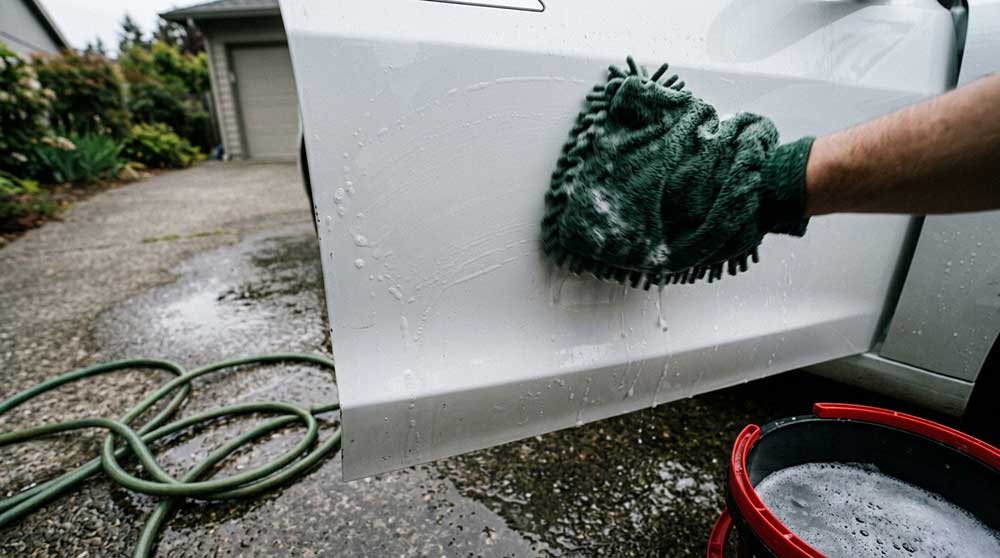
- High-pile chenille microfiber (70/30 blend) — longer noodle fibers bury contamination instead of dragging it across panels
- Elastic wristband with edgeless construction — stays secure during panel-by-panel passes without marring PPF or vinyl wrap
- Reversible design — doubles usable surface time before bucket-dipping, which matters on larger Model X or Y surface areas
Color options help you designate separate mitts for wheels versus paint. Storage hacks like mesh bags keep dedicated wash mitts contamination-free between sessions. Tesla’s instant torque and vehicle weight accelerate tire wear faster than expected, so keeping a dedicated wheel mitt separate from your paint mitt also prevents brake dust and rubber contamination from transferring to your panels.
Even a careful Tesla hand wash can start to cause fine swirl marks over time if dirt isn’t lifted away cleanly, especially when paint contaminants get dragged across the surface instead of being safely trapped during the wash process. An ultra-soft microfiber car wash mitt helps reduce that risk by holding more soapy water and gently lifting debris away from the paint, making each wash safer for the finish rather than slowly wearing it down.
Two-Bucket Wash Setup
Your mitt’s prepped, your soap’s dialed in — now you need somewhere to actually put all of it. Two five-gallon buckets handle this: one holds your shampoo solution, one holds clean rinse water only. Bucket placement matters — keep the rinse bucket closest to your working panel so mitt rotation stays efficient and cross-contamination doesn’t creep in.
| Bucket | Contents | Purpose |
|---|---|---|
| Wash Bucket | Shampoo + water | Loads mitt with clean solution |
| Rinse Bucket | Water only | Releases trapped dirt from mitt |
| Wheel Bucket | Wheel cleaner + water | Isolates brake dust contamination |
Drop a grit guard into each bucket. After washing every panel section, rinse the mitt thoroughly before reloading soap — that single habit eliminates most swirl marks before they start. When rinsing your mitt, agitate it firmly against the grit guard to dislodge trapped contaminants before returning it to the wash bucket.
Master the Two-Bucket Method to Protect Tesla’s Clear Coat
Once you’ve got your supplies sorted, the two-bucket method is the single most effective habit you can build to protect Tesla’s notoriously soft clear coat from the swirl marks and micro-scratches that ruin a finish over time.
The setup is exactly what it sounds like: one bucket holds your diluted car shampoo (follow the product’s ratio, typically 1–2 oz per gallon of water), while the second bucket holds clean rinse water used exclusively to agitate and release grit from your microfiber mitt before it ever touches paint again.
Grit guards in both buckets add a physical barrier that traps heavier contaminants below the mitt zone, so you’re not dragging road debris across a panel that cost you a small fortune to respray. This is especially worth keeping in mind with newer Tesla models like the Model 3 and Model Y, where the single 15.4-inch touchscreen consolidates all vehicle controls, meaning you won’t find a dedicated physical button to quickly activate the rear camera rinsing cycle the way you might on older vehicles with traditional control layouts.
A proper Tesla hand wash isn’t just about soap and water—it’s about how you manage the dirt once it comes off the paint. Without a controlled rinse setup. A complete car wash bucket system with grit guards helps prevent that by separating clean wash water from trapped debris, keeping contaminants at the bottom of the bucket so they don’t end up back on your Tesla’s paint during each pass.
Two-Bucket Setup Basics
Becoming proficient in the two-bucket method is the single most effective habit you can adopt to protect Tesla’s clear coat during a handwash.
You’ll need two 5-gallon buckets, each serving a distinct role in bucket hygiene:
- Wash bucket – filled with water and car wash soap for panel cleaning
- Rinse bucket – filled with plain water exclusively for mitt maintenance between passes
- Grit guards – placed at the bottom of each bucket to trap abrasive debris below the waterline
After washing each section, dip your mitt into the rinse bucket first, agitating it against the grit guard to release trapped dirt.
Only then do you reload from the wash bucket. This sequence keeps abrasive particles from recycling back onto Tesla’s finish. This is especially worth noting for non-white finishes, as white paint resists fading longer under UV exposure and may show swirl marks less prominently than darker paint upgrade options costing $1,000–$2,500 more.
Protecting Clear Coat
The two-bucket method isn’t just a detailing ritual—it’s the mechanical reason your Tesla’s clear coat survives repeated washes without accumulating a web of fine scratches visible under direct sunlight.
Tesla’s paint is remarkably soft, meaning abrasive grit dragged across the surface mars it faster than harder finishes. The rinse bucket intercepts that grit before your mitt returns to paint, keeping contamination suspended away from the clear coat rather than reintroduced onto it.
Environmental factors—road salt, brake dust, industrial fallout—compound the problem by embedding sharp particles into your wash media.
Without separation, every panel becomes a sandpaper pass in slow motion. Long-term preservation depends on this one structural habit: rinse the mitt after each panel, every wash, without exception. Tesla vehicles use a NACS connector standard that unifies charging across platforms, reflecting the same philosophy of systematic consistency that applies to safe paint care—one reliable method, applied without deviation.
Wash Your Tesla Top to Bottom Without Swirling the Paint
Gravity’s doing half the work for you here — start at the roof and work your way down, and you’re letting physics move loosened grit away from surfaces you’ve already cleaned rather than dragging it back over them. Roof sequencing isn’t optional on a Tesla; it’s structural to avoiding swirl marks.
Gravity is doing half the work — let it carry loosened grit down, not back across clean paint.
Follow this order every time:
- Roof and glass first — least contaminated, so your mitt stays cleanest longest.
- Upper doors and hood next — moderate contamination; downward rinsing between sections prevents redeposition.
- Lower rockers, bumpers, and rear valance last — heaviest road film lives here, so you want your dirtiest mitt contact happening at the finish line, not the starting line.
Keep your motions straight and horizontal. Circular scrubbing traps grit and grinds it into Tesla’s notoriously soft clear coat — exactly the outcome you’re working this hard to avoid. This is especially worth noting on the Model Y, which sits at the top of Tesla’s sales lineup as the world’s best-selling car in 2023, meaning more examples of this paint are on the road and worth protecting than any other Tesla model.
Dry and Protect Your Tesla’s Exterior After Every Wash
Washing top to bottom keeps grit moving in the right direction, but stopping there leaves your Tesla half-finished — and water is surprisingly destructive when you let it sit. Minerals in tap water etch clear coat and glass within minutes, especially under direct sunlight.
| Area | Tool | Priority |
|---|---|---|
| Roof, hood, trunk | Microfiber drying towel | First |
| Seams, mirrors, trim | High-speed blower | Second |
| Door jambs, lower edges | Dedicated wiping cloth | Last |
Dry top-down, panel by panel. Inspect your towel before each pass — dragging trapped debris destroys paint maintenance progress fast. For ceramic-coated Teslas, use a drying aid so the towel glides safely without stressing the hydrophobic layer. Skip wax; it undermines sealant longevity on coated surfaces. Finally, open doors and wipe jambs and weather seals. Water hiding there drips onto your freshly dried paint the moment you drive away. Pay extra attention to the Model X’s falcon-wing rear doors, as their complex hinges and seams trap significantly more water than conventional doors and can drip onto lower panels long after drying appears complete.
Keep Your Tesla Clean Between Full Washes
Between full washes, contamination rarely waits for a convenient schedule — bird droppings start etching clear coat within hours in direct sun, bug splatter hardens into a bonded film after a few heat cycles, and road tar bonds to paint almost immediately after contact. Waiting for wash day isn’t a strategy; it’s a gamble.
Contamination doesn’t wait for wash day — and neither should you.
Keep contamination manageable with three targeted habits:
- Spot-clean immediately — apply a quick pre soak of rinseless solution directly onto bird droppings, sap, or bug splatter before wiping with a folded microfiber using straight-line strokes.
- Separate your tools — keep dedicated towels for wheels and lower rockers away from upper paint panels to avoid brake dust transfer.
- Use garage parking — it reduces dust accumulation, UV degradation, and tree debris between sessions.
A ceramic coating or sealant makes these quick cleanups faster by improving surface slickness, so grime releases with minimal effort.
Frequently Asked Questions
Can I Wash My Tesla in Direct Sunlight Without Causing Damage?
You shouldn’t wash your Tesla in direct sunlight. It won’t cause immediate damage, but you’ll risk streak formation and rapid drying that leaves mineral deposits behind. To avoid fading risks, always wash in shade or cooler conditions.
How Often Should I Fully Detail My Tesla Each Year?
Most drivers detail 2–3 times yearly. For seasonal timing and paint preservation, you’ll want a full detail every 4–6 months—or quarterly if you’re parking outdoors, daily driving, or facing harsh climates.
Is It Safe to Pressure Wash Around Tesla’s Charging Port?
You can pressure wash near the charge port, but you shouldn’t aim directly at it. Pressure risks forcing water past seals, accelerating seal degradation. Use a wide fan spray and keep your distance.
Does Tesla’s Warranty Cover Paint Damage From Touchless Car Washes?
Tesla’s warranty won’t cover paint damage from touchless car washes. You’ll face tricky warranty subtleties if caustic chemicals caused the harm, and Tesla can deny your service claims if improper washing conditions contributed to the damage.
Can I Use the Same Wash Mitt on Wheels and Painted Panels?
Forsooth, don’t do it! Wheel mitts harbor brake dust and metallic grit that’ll savage your clearcoat. Cross contamination prevention means keeping wheel tools strictly off painted panels — always use dedicated mitts for each surface.