
Tesla batteries don’t just “explode” — but calling them fireproof is equally wrong. The reality sits in a grey zone most people never think about until a crash forces the question. Tesla engineers multi-layered containment, thermal circuits, and pressure-relief venting specifically to resist ignition — not eliminate it. Fire resistance and fireproof are two very different things, and that distinction carries real consequences. Here’s exactly what separates them.
Are Tesla Batteries Actually Fireproof?
Tesla batteries are fireproof. That’s a myth, and a legally dangerous one worth debunking immediately. Tesla never claims its battery packs are fireproof—not in its safety documentation, not in its marketing, and undeniably not in any language that would survive legal implications if something went wrong.
What Tesla *does* claim is more precise: its packs are engineered to spread heat away from the occupant cabin, reducing injury risk during rare damage events. That’s fire *resistance*, not fire *immunity*. The distinction matters.
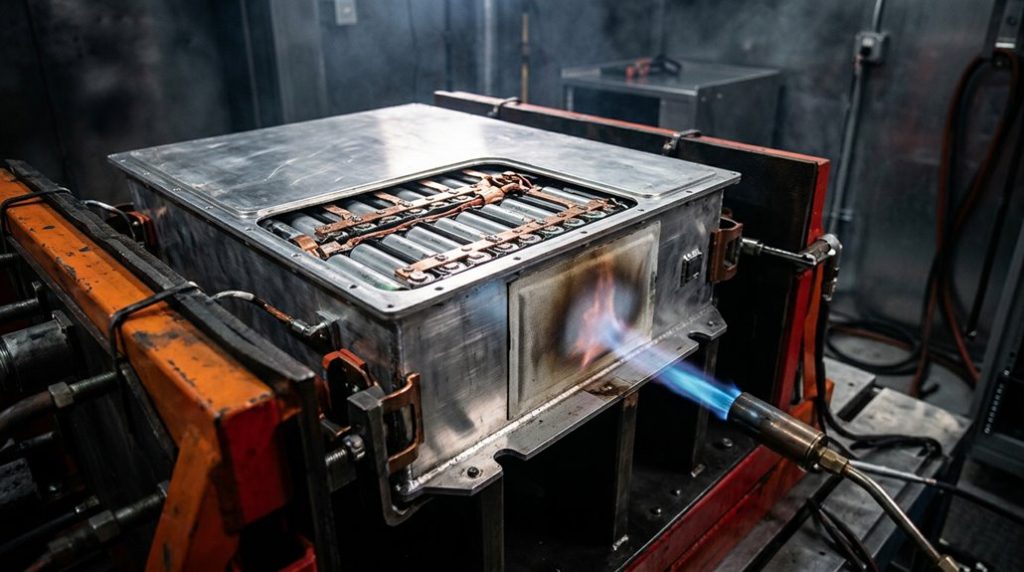
Lithium-ion cells can still undergo thermal runaway—a self-sustaining electrochemical chain reaction—when severely damaged or defective. Once that process starts, it’s difficult to stop.
Early Model S incidents confirmed that Tesla fires can reignite after appearing fully extinguished, which is why Tesla publishes dedicated first-responder protocols. Fireproof systems don’t need emergency handling guides. Lithium-battery fires are notably more challenging to extinguish than gasoline fires and require special firefighting techniques that most standard emergency responders must specifically train for. Tesla’s onboard systems rely on sensor fusion technology to detect hazards in real time, but no onboard system can prevent thermal runaway once a cell is critically compromised.
EV fires are rare in Teslas, but when they happen they behave differently from fuel fires and escalate fast once thermal runaway begins. A lithium-rated fire extinguisher gives you a first-response option designed for electrical and battery-based fires, not just general flames.
How Tesla Builds Fire Resistance Into Its Battery Packs
Building fire resistance into a Tesla battery pack isn’t a single design choice—it’s a layered engineering strategy that addresses the same problem from multiple angles simultaneously. Tesla combines cell containment framework, controlled vent pathways, physical shielding, and active electronic monitoring to prevent one failing cell from triggering a pack-wide catastrophe.
Cell containment works through deliberate weak points between cells that break during a failure event, releasing pressure before it cascades. Controlled vent pathways then direct hot exhaust gases out through designated exit points rather than letting pressure build inside the enclosure. Meanwhile, a reinforced metal housing (with titanium underbody shielding on select models) blocks external impacts from reaching the cell stack.
None of this operates blindly. Tesla’s battery management system continuously monitors temperature and cell health, catching overheating conditions before thermal runaway even starts. It’s mechanical protection and electronic vigilance working together—because relying on just one layer would be optimistic engineering. Tesla’s over-the-air software updates can also refine battery management system parameters post-purchase, allowing monitoring thresholds and protective responses to be improved without requiring a physical service visit. A proposed fill port design would also allow first responders to inject thermal-control liquid directly into the sealed pack to terminate runaway fire events more efficiently.
What Real Crashes Reveal About Tesla Battery Fire Risk
When a Tesla actually catches fire after a crash, the data points to one consistent culprit: direct, high-impact intrusion into the battery pack itself. A Seattle-area incident confirmed this — a large metallic object breached a Model S pack, yet fire stayed contained to a small front section. That’s the pattern: severe structural compromise triggers thermal runaway; ordinary driving doesn’t.
| Crash Fire Factor | What It Means |
|---|---|
| High-impact intrusion | Primary trigger for cell rupture |
| Thermal runaway propagation | Heat spreads to neighboring cells |
| Toxic gas emission | ~35 gases released, complicating responder training |
| Re-ignition risk | Requires post crash monitoring for hours or days |
You’re not dealing with spontaneous combustion here — you’re dealing with physics. Breach the pack violently enough, and lithium-ion cells cascade into runaway reactions. The Tesla battery pack weighs 800 to 1,200 pounds, a mass that contributes to the structural forces involved when intrusion occurs and underscores why high-load-rated components are essential to the vehicle’s design. The real danger isn’t the initial crash; it’s what happens after flames appear extinguished. Firefighters in the Kent incident spent roughly two and a half hours on scene, ultimately having to cut access holes with a circular saw just to direct water into the battery pack’s interior before the fire was fully controlled.
Do Tesla Batteries Catch Fire Less Often Than Gas Cars?
Approximately 5 EV fires per billion miles driven versus 55 for gasoline vehicles — that gap isn’t marketing spin, it’s the data. Tesla’s fleet specifically logs roughly one fire per 130–200 million miles, placing it well below the U.S. vehicle average. You’re statistically driving something far less likely to combust than a conventional car.
Per-vehicle comparisons sharpen that point further: roughly 25 EV fires per 100,000 vehicles sold versus 1,530 for gas-powered cars. That’s nearly 60 times safer on a fleet-wide basis. Driver behavior still matters — aggressive charging habits and post-collision battery damage raise individual risk — but the baseline probability remains low.
These numbers carry real insurance implications. Lower fire incidence influences how actuaries assess EV risk profiles, which increasingly reflects in policy pricing. Tesla’s own proprietary insurance tracks driving behavior data through vehicle sensors to adjust monthly premiums, reflecting how closely risk modeling ties to real-world performance rather than assumptions alone. Hybrids, by contrast, report approximately 3,475 fires per 100,000 units sold, making them statistical outliers that sit well above both BEVs and conventional gasoline vehicles. The evidence is consistent across multiple metrics: Tesla batteries catch fire less often than gas tanks. Considerably less.
In a high-heat emergency, seconds matter more than assumptions—especially when battery-related incidents can escalate quickly and unpredictably. A fire-retardant emergency thermal blanket adds a simple layer of protection during evacuation, helping shield against heat exposure when there’s no time to think, only move.
Why Tesla Batteries Are So Hard to Ignite
Those fire statistics don’t emerge from luck — they’re backed by deliberate engineering. Tesla builds cell resilience into every layer of the pack, starting at the chemistry level. Material coatings on individual cells act as thermal barriers, slowing heat transfer between neighbors before runaway can propagate.
| Protection Layer | Function |
|---|---|
| Cell-level coatings | Slow inter-cell heat transfer |
| Cooling channels | Regulate operating temperature |
| Battery Management System | Monitors voltage and temperature |
| Structural enclosure | Absorbs mechanical impact |
| Thermal fuse design | Isolates failing cells electrically |
Each layer addresses a specific failure pathway. Crash damage, charging faults, and manufacturing defects all represent real ignition triggers — but Tesla’s stacked defenses intercept most events before a single bad cell becomes your entire pack’s problem. You’re not relying on one safeguard; you’re relying on five working simultaneously. The Model S Long Range uses NCA cell chemistry, which influences how the pack responds to thermal stress and informs how each of these protective layers is engineered to interact with it.
What Happens When a Tesla Battery Fire Does Occur?
When a Tesla battery fire does occur, it almost always begins as thermal runaway—a chain reaction where one compromised lithium-ion cell overheats, destabilizes adjacent cells, and rapidly escalates into a self-sustaining pack-wide fire that can burn for hours.
The flammable electrolyte inside each cell effectively keeps feeding the reaction, meaning you’re not dealing with a localized flame you can smother but rather a deeply embedded, chemically driven heat source that standard extinguishers can’t touch.
Firefighters respond by flooding the pack with massive volumes of water to cool it down rather than extinguish it outright, and even after flames appear controlled, reignition can occur hours or days later—which is exactly why re-approaching the vehicle before crews declare it stable is a genuinely bad idea.
Tesla’s battery chemistry, including the NCA chemistry used in many of its vehicles, is particularly sensitive to high states of charge, where elevated cell voltages can accelerate degradation and increase the risk of instability under stress.
Thermal Runaway Explained
The term “thermal runaway” sounds dramatic, but the physics behind it are straightforward — and genuinely worth grasping if you own a Tesla.
Cell initiation is where everything starts. One compromised cell overheats, triggering a self-accelerating loop of rising temperature and chemical decomposition. Here’s the cascade:
- A single cell shorts internally from overcharge, crushing, or penetration
- Heat exceeds what the pack can dissipate, accelerating reactions
- Venting gases release — flammable, toxic, and pressure-building
- Adjacent cells absorb that heat and enter runaway themselves
That fourth step is the dangerous part. You’re no longer dealing with one cell — you’re watching a chain reaction propagate across a pack containing thousands of cells.
The stored energy scale makes stopping it genuinely difficult once it’s established. Tesla’s battery management system continuously monitors cell-level temperature and voltage to catch dangerous deviations early, which is why the BMS negotiates power limits in real time during charging rather than simply delivering maximum power on demand.
Firefighter Response Methods
Once a Tesla battery fire takes hold, first responders aren’t just dealing with a burning car — they’re managing a high-energy electrochemical system that doesn’t care about conventional fire suppression logic.
The defensive approach comes first: maintain distance, protect nearby structures with fog patterns, and avoid opening any panels.
Water cooling is the primary weapon here, and the numbers are sobering — Tesla’s Model 3 guidance estimates 3,000–8,000 gallons to fully suppress and cool a battery fire.
CO2 or dry chemicals work temporarily if water isn’t immediately available, but they’re stopgaps, not solutions.
Even after visible flames stop, cooling continues for up to 24 hours.
Responders won’t release the vehicle until it’s shown no fire, smoke, popping, or heat for at least 45 minutes.
The specific battery and thermal management behavior can also vary between vehicles depending on the assembly plant and hardware generation, as Shanghai-built and Fremont-built Model 3s use different cell configurations and cooling thresholds.
The Powerwall Recall: Do Tesla’s Home Batteries Share the Same Fire Risk?
If you own a Powerwall 2 manufactured between November 2020 and December 2022, you’re directly in the crosshairs of a CPSC-acknowledged recall covering roughly 10,500 units — units that Tesla confirms can overheat, smoke, or catch fire due to a third-party battery cell defect. The chemistry culprit is the lithium-ion cell pack inside the Powerwall 2, the same fundamental electrochemistry that powers Tesla’s vehicle battery packs, but the fire risk here is model-specific, not a systemic indictment of Tesla’s entire home energy lineup.
Powerwall 3 is explicitly excluded from the recall, so if you’re running the newer unit, you’re clear — though you should still keep your Powerwall 2 online so Tesla can remotely discharge the affected system and coordinate a no-cost replacement through the Tesla app. Unlike Tesla’s vehicle batteries, which benefit from over-the-air software updates that can address certain battery management issues without a physical service visit, the Powerwall 2 defect requires a full hardware replacement to resolve.
Recall Details and Scope
When Tesla’s Powerwall 2 made headlines in late 2025, it wasn’t for a pioneering firmware update or a record-breaking energy density milestone — it was for a recall.
The recall scope covered roughly 10,500 units sold between November 2020 and December 2022. Here’s what defined the affected units:
- Sold online or through certified Tesla installers
- Identified by “Powerwall 2” on the unit nameplate
- Contained third-party lithium-ion cells with a confirmed defect
- Used for self-consumption, time-based control, or backup power
This wasn’t a sweeping indictment of Tesla’s entire energy portfolio. It targeted a specific production subset — a meaningful distinction you shouldn’t overlook when evaluating broader Tesla battery safety. Under the Magnuson-Moss Warranty Act, manufacturers are required to prove a direct causal link between a specific defect and any resulting failure, rather than issuing blanket coverage denials across an entire product line.
Shared Chemistry, Different Risks
Just because two products share the same battery chemistry doesn’t mean they share the same fire risk — and that distinction matters enormously when you’re trying to assess whether the Powerwall 2 recall says anything meaningful about your home energy system.
Tesla confirmed that the Powerwall 3 wasn’t affected by that recall, which traces directly to a third-party cell defect — not a systemic chemistry failure.
Cell variability between suppliers and manufacturing batches creates meaningfully different risk profiles, even within the same brand.
Your installation placement adds another layer entirely; a unit mounted near combustibles behaves very differently under thermal stress than one properly separated from living spaces.
Same chemistry, different outcomes. That’s not a contradiction — it’s just how real-world engineering works.
Frequently Asked Questions
Can Extreme Cold Weather Increase the Fire Risk of Tesla Batteries?
Like a car left in a blizzard, extreme cold strains your Tesla’s battery insulation and thermal management, but it won’t directly spark a fire — performance drops, not flames.
Does Fast Charging Significantly Raise the Chance of a Tesla Battery Fire?
Fast charging doesn’t materially raise your fire risk under normal conditions. Poor charging etiquette, hidden defects, or battery degradation can create dangerous overheating scenarios, but Tesla’s battery management system actively monitors and controls temperatures during charging sessions.
Are Older Tesla Battery Packs More Prone to Fire Than Newer Ones?
Older packs do carry more risk due to thermal aging and earlier design limitations. You’re dealing with less polished thermal management, so if your Tesla is an early Model S or X, stay vigilant.
Can a Tesla Battery Fire Start While the Car Is Parked and Idle?
Like a sleeping volcano, your parked Tesla can still erupt—thermal runaway or software faults can spark a battery fire while it’s idle, though such events are genuinely rare.
Does Saltwater Exposure After Flooding Make Tesla Batteries More Dangerous?
Yes, saltwater exposure makes your Tesla battery markedly more dangerous. It accelerates corrosion acceleration across terminals and promotes electrolyte contamination, increasing your risk of short-circuiting, delayed thermal runaway, and potential fire long after the flooding event.