
Tesla’s closed operating system wasn’t built with Waze in mind — and yet, thousands of drivers use it every single day. The combination sounds impossible on paper: a locked ecosystem that refuses third-party apps paired with the most beloved crowdsourced navigation tool on the planet. But impossible and inconvenient are two very different things. Several real workarounds exist, each carrying its own trade-offs that could make or break your daily commute.
Understand Why Tesla Has No Native Waze Support
Before you start hunting for a Waze icon on your Tesla’s touchscreen, grasp why it isn’t there: Tesla’s operating system doesn’t support third-party route guidance apps at all.
Unlike Android Auto or Apple CarPlay vehicles, Tesla runs a closed navigation framework built entirely around its own routing stack. There’s no app store, no sideloading pathway, nothing.
Two structural barriers explain this gap. First, licensing barriers exist at the platform level — Google hasn’t released a public Waze API that automakers can actually license, meaning no manufacturer currently embeds Waze natively. Tesla isn’t uniquely stubborn here; it’s simply subject to the same industry-wide constraint.
Second, privacy concerns complicate deeper integration, since Waze’s crowd-sourced data model requires persistent user account connectivity that Tesla’s closed ecosystem doesn’t accommodate cleanly.
The practical result: Waze data reaches your Tesla only through workarounds (browser access, phone mirroring, external hardware adapters), not built-in functionality. Tesla’s minimalist interior design, centered on a single touchscreen for all in-cockpit data access, further reinforces a self-contained software environment with no accommodations for external navigation frameworks. Tesla has also not announced plans to release an API for third-party navigation apps, leaving the door firmly closed to any official future pathway.
Use Waze in Tesla’s Built-In Browser
Pulling up Waze on Tesla’s built-in browser is genuinely possible, but set your expectations straight before you start tapping: you’re getting browser access, not a native app.
Browser limitations mean slower rendering, no deep system integration, and occasional lag on live map updates. That said, it works.
Here’s how to get started:
- Open Tesla’s browser and navigate to TeslaWaze.com, teslawaze.azurewebsites.net, or teslanav.com (community-built clones designed specifically for Tesla’s display).
- Sign into your Waze account to enable session persistence, saving your routes and preferences across visits.
- Bookmark the page immediately — retyping URLs on a touchscreen gets old fast.
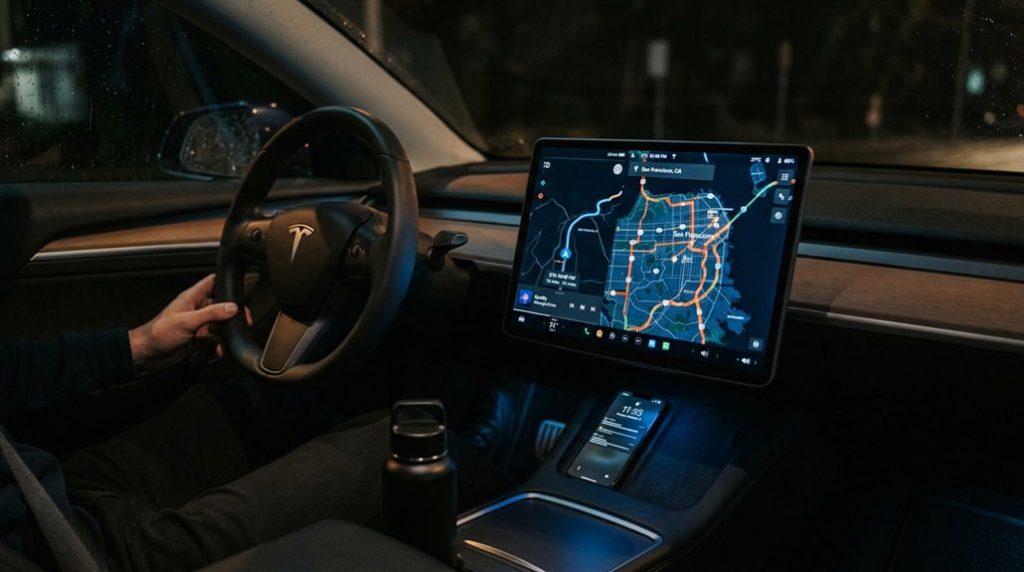
Your center touchscreen handles all interaction, and the vehicle’s internet connection drives live traffic data. For the most stable connection, using a phone hotspot is recommended over relying solely on the vehicle’s built-in connectivity.
These tools aren’t official Waze products, so expect occasional changes. Tesla’s 17,800+ Supercharger locations are also discoverable through the official Tesla app, in-vehicle route guidance, and the Tesla Find Us map — making it worth cross-referencing stops when planning longer drives. Bookmark early, sign in once, and you’ve effectively built your own workaround.
Using Waze in a Tesla quickly becomes frustrating when your phone is sliding around, overheating, or constantly dropping out of view right when you need real-time traffic alerts most. Keep your navigation steady and fully charged by setting up a Tesla-compatible MagSafe wireless charging phone mount so Waze stays visible, powered, and ready to guide every turn without interruption.
Run Waze Audio Alerts Through Tesla Speakers
Getting Waze audio through your Tesla’s speakers isn’t as seamless as CarPlay or Android Auto (neither of which Tesla supports natively), but Bluetooth handles the job well enough.
Pair your phone to the Tesla’s Bluetooth system and set the car’s active sound source to your phone, which routes Waze voice prompts and alert tones directly through the vehicle’s speaker array.
Before you drive, open Waze’s sound settings and confirm the mode is set to Sound on (not Alerts only or Sound off), then raise the Guidance volume slider and check that your phone’s media volume isn’t muted or suppressed by Do Not Disturb—because a silenced phone will make the whole setup look broken even when Bluetooth is connected. Some drivers prefer to have Waze alerts routed through the iPhone speaker instead, keeping car audio uninterrupted while still catching navigation prompts.
The Tesla app also lets you precondition your cabin before entry, so by the time Waze is loaded and your Bluetooth audio is confirmed, the interior is already at your preferred temperature—a small but practical part of the broader Tesla morning routine that helps you leave prepared rather than troubleshooting on the road.
Enable Bluetooth Audio
Routing Waze’s voice alerts through your Tesla’s speakers takes one deliberate configuration step on your phone before anything else works. The culprit is usually one toggled setting that sends audio to the wrong destination.
- Open Waze, tap Settings, then steer to Voice and sound (or More sound options, depending on your version).
- Confirm “Play sound to phone speaker” is off — this single switch determines whether alerts reach your Tesla or stay trapped in your pocket.
- Make sure your phone’s Bluetooth connection is active *before* Waze starts piloting.
For solid pairing tips, connect your phone as a headset-style device rather than streaming-only. Volume management follows naturally — Tesla treats these alerts like incoming calls, temporarily overriding your media playback. Tesla’s built-in navigation also supports smart Wh/km routing by factoring in live traffic and elevation changes, making it worth running alongside Waze for energy-conscious trips. To set the correct volume level, trigger a Waze prompt and then adjust with your phone’s volume buttons while the sound is playing.
Configure Waze Sound Settings
Different voices carry different clarity levels, so switching voices often resolves prompts that sound muffled or unusually quiet.
Also verify your phone’s physical volume is raised; Waze can’t override a device muted at the hardware level.
Finally, disable Do Not Disturb — it silently kills audio output regardless of your in-app settings.
Tesla’s Premium Connectivity subscription costs $9.99/month and gates certain audio-dependent streaming features, so confirm your plan isn’t limiting background audio routing through the vehicle’s speakers.
Mirror Your Android Screen to Tesla via Wi-Fi
Compared to the USB cable approach, mirroring your Android screen to Tesla over Wi-Fi feels almost graceful — no dongle, no dangling wire, just your phone’s hotspot doing the heavy lifting. This hotspot workflow relies on screen casting through Tesla’s built-in browser, not native Android Auto integration. Think of it as a DIY stream: your phone broadcasts, Tesla receives.
Here’s the core sequence:
- Install a mirroring app (like Tesla Display) on your Android phone and open it first
- Enable your phone’s personal hotspot, then connect Tesla to it via Wi-Fi settings
- Load the app’s streaming address in Tesla’s browser to initiate the cast
One critical setting you can’t skip: enable “Remain connected in Drive” inside Tesla’s Wi-Fi menu. Without it, the mirror session drops the moment you shift into Drive — which defeats the entire purpose. Keep in mind that using non-invasive mounts and wireless accessories for your phone setup falls under low-risk upgrade territory, meaning these additions are unlikely to trigger any warranty disputes with Tesla.
Add Carplay or Android Auto to Your Tesla With an Adapter
If Wi-Fi mirroring feels like a workaround, a dedicated CarPlay or Android Auto adapter is the closest thing to a proper solution — these plug into one of Tesla’s USB ports, create their own wireless network, and project a full smartphone interface onto the centre touchscreen through the Tesla browser. Hardware integration here is minimal but effective.
| Feature | CarPlay Adapter | Android Auto Adapter |
|---|---|---|
| Waze Support | ✅ Full | ✅ Full |
| Wireless Setup | Bluetooth + Wi-Fi | Bluetooth + Wi-Fi |
| Tesla Browser Required | Yes | Yes |
Setup involves connecting your phone via Bluetooth, joining the adapter’s broadcast network (typically labelled “Autokit”) through Tesla’s Wi-Fi settings, then launching the interface through the browser. Enable “Remain Connected in Drive” — skip that, and your wireless adapter disconnects the moment you shift into gear. Expect minor display latency; the browser isn’t purpose-built for real-time projection. Many issues that once disrupted third-party integrations like these are now resolved through over-the-air updates, eliminating the need for service visits.
When to Use Waze Over Tesla Navigation
Tesla’s built-in route guidance handles straightforward trips just fine, but once you’re dealing with unpredictable traffic, speed traps, or roads you don’t know well, Waze pulls ahead fast.
It’s drawing on crowdsourced reports from other drivers in real time, so you’re getting hazard alerts, police presence warnings, and real-time rerouting that Tesla’s system simply doesn’t match in alert density.
If your route involves heavy commuter congestion or enforcement-heavy stretches of highway, Waze gives you the kind of proactive, community-driven intelligence that turns a stressful drive into a manageable one.
One advantage Tesla’s native navigation does retain is battery preconditioning, which warms the pack before you arrive at a Supercharger so you can charge at peak speeds rather than waiting for a cold battery to catch up.
If you’re relying on Waze in your Tesla, the last thing you want is a phone tucked away in a cup holder or slipping off the dash right when you need a sharp turn or traffic alert. Make your setup safer and more usable by mounting your phone at eye level with an adjustable dashboard screen-edge Tesla phone mount so your navigation stays visible, steady, and exactly where your attention already is.
Real-Time Traffic Alerts
Both route guidance systems handle real-time traffic, but they don’t do it equally well across every scenario. Tesla’s Online Routing updates ETAs and reroutes around congestion, but it lacks two capabilities Waze delivers consistently:
- Crowd-sourced alerts — Waze aggregates live reports from millions of drivers, flagging crashes and slowdowns faster than passive sensor data alone.
- Enforcement reporting — Police positions and speed cameras appear in Waze through user submissions, a feature Tesla guidance doesn’t currently offer.
- Rapid rerouting — Waze recalculates aggressively when conditions shift, prioritizing detour speed over route familiarity.
If your commute involves stop-and-go corridors or enforcement-sensitive stretches, Waze gives you information Tesla simply isn’t collecting yet. That gap matters when conditions change mid-drive. Tesla’s own navigation does benefit from crowdsourced fleet data, which refines behaviors like proactive speed reductions on interchanges and off-ramps, but that collective input doesn’t translate into the real-time hazard alerts Waze surfaces to drivers directly.
Complex Route Planning
Real-time traffic alerts are only part of the story. When your route involves urban detours or waypoint sequencing across multiple stops, Waze often outperforms Tesla’s native route planner.
| Scenario | Tesla Route guidance | Waze |
|---|---|---|
| Multi-leg trips | Strong charging integration | Better app-level flexibility |
| Urban road complexity | Can miss local roads | Crowdsourced street data |
| Route constraints | Aligned with car logic | More manual control |
Tesla’s system handles major corridors and arrival logistics well, but it can stumble on finer-grained road awareness (think poorly mapped suburban cut-throughs). Waze’s crowdsourced model surfaces street-level detail that Tesla’s routing simply doesn’t prioritize. If you’re switching route strategies mid-trip or need granular toll and constraint adjustments, Waze gives you more levers to pull. For drivers also managing EV-specific logistics, pairing Waze with a vehicle that supports NACS adapter compatibility can further expand your access to charging stops along complex routes.
Frequently Asked Questions
Does Using Waze in a Tesla Browser Drain the Car’s Battery Faster?
Using Waze via Tesla’s browser has minimal battery drain on your car’s battery. The browser impact is small compared to driving energy use, but you’ll still want to dim your screen to conserve power.
Can Waze Voice Alerts Overlap With Tesla’s Built-In Music or Podcast Playback?
Yes, you can experience voice overlap between Waze alerts and Tesla’s audio playback. Waze supports audio ducking, briefly lowering your music or podcast so you’ll hear guidance clearly without fully stopping entertainment.
Will Screen Mirroring Waze Affect My Android Phone’s Mobile Data Usage?
Your phone’s practically running a marathon—yes, screen mirroring Waze absolutely affects your mobile data usage. Waze’s data consumption and background syncing stay active on your Android device; Tesla’s screen only displays the stream.
Are Third-Party Carplay Adapters Covered Under Tesla’s Vehicle Warranty Terms?
Third-party aftermarket adaptors aren’t covered under Tesla’s warranty coverage. Your basic vehicle warranty won’t automatically void, but Tesla can deny claims if they prove the adaptor caused the specific component failure you’re reporting.
Can Passengers Control Waze Navigation on the Tesla Screen During Driving?
Yes, your passengers can control Waze on the Tesla screen during driving, but only through mirroring or adapter setups that enable passenger interaction and grant proper control permissions—there’s no native touchscreen support built in.