
Tesla’s audio system is smarter than most owners realize—but also pickier. Load the wrong file or exceed a hidden bit-rate ceiling, and your carefully curated playlist turns into silence or distortion. Most drivers assume any USB drive works fine. It doesn’t. The difference between crystal-clear audio and a frustrating dead signal often comes down to one overlooked technical detail about codecs and format compatibility that Tesla never prominently advertises.
USB Drive Setup for Tesla: Format, Folders, and File System
Before you plug in any USB drive and expect Tesla’s infotainment system to recognize it, the formatting has to be right—because NTFS, despite being Windows’ default file system, isn’t supported. exFAT reliability makes it the obvious choice here, and Tesla’s touchscreen can handle the formatting automatically through Controls > Safety > Format USB Drive.
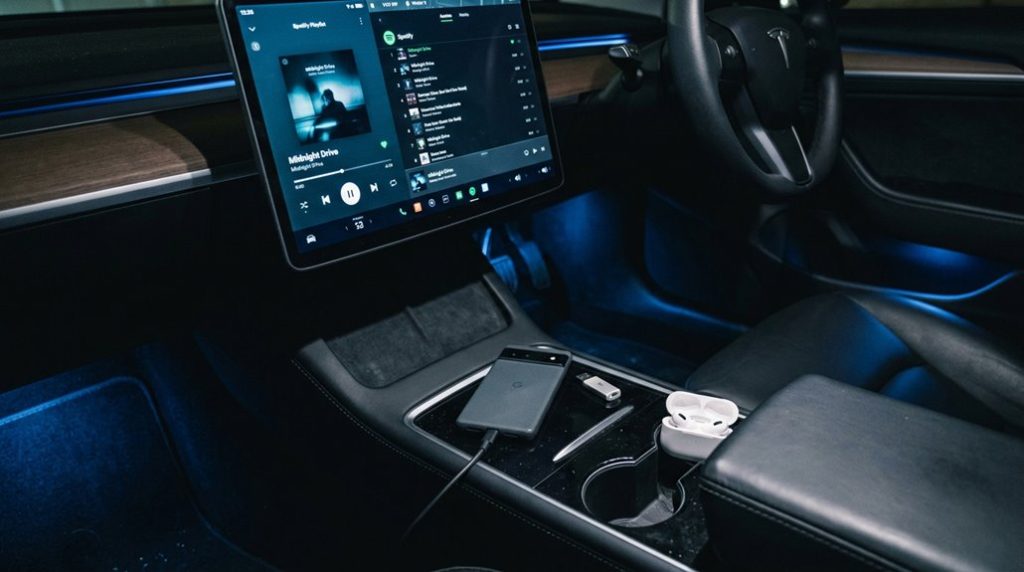
USB compatibility depends on more than just format, though. Front USB ports support recording and media playback; rear ports only charge devices (a distinction that trips up more people than it should). Cybertruck owners should use the glovebox port specifically. Tesla’s NACS connector standard unifies the charging ecosystem across vehicle types, but the same attention to hardware compatibility applies to USB ports—not all ports on the vehicle serve the same function.
For folder naming, precision matters—Tesla expects exactly TeslaCam at the base level, not “tesla cam” or “TeslaCam folder.” A partition strategy becomes useful if you’re storing audio files alongside dashcam footage, since exFAT supports multiple partitions on one drive. Aim for at least 64 GB and a sustained write speed of 4 MB/s minimum. USB 3.0 drives are acceptable, but only if they maintain USB 2.0 backward compatibility—a detail easy to overlook when shopping for higher-speed drives.
USB vs. Streaming vs. Bluetooth: How Tesla Audio Formats Compare
Once you’ve got your USB drive formatted and ready, it’s worth stepping back to grasp how USB stacks up against Tesla’s other two audio paths—Bluetooth and streaming—because each one handles format support differently, and that difference has real consequences for audio quality.
Here’s what separates them:
- USB gives you direct codec control, supporting FLAC, MP3, WAV, M4A, and OGG locally
- FLAC is exclusively a USB advantage—neither Bluetooth nor streaming delivers lossless files the same way
- Bluetooth hands format control to your paired device, and Bluetooth latency can subtly affect perceived audio timing
- Streaming subscriptions govern their own codec pipelines entirely, independent of any removable media compatibility
- Each path abstracts differently—USB exposes raw files, Bluetooth mirrors your phone, streaming serves compressed online catalogs
Choose USB when file-level precision matters. Choose Bluetooth for convenience. Choose streaming subscriptions when catalog depth outweighs format control. Streaming features like Netflix and YouTube require a Premium Connectivity subscription, which is gated behind a $9.99/month or $99/year paywall and is separate from any local or Bluetooth audio path. USB playback is also the only path that works reliably in areas with spotty connectivity, making it the most dependable option when a network signal isn’t guaranteed.
Maximum Bit Rate and Sample Rate Tesla USB Playback Supports
Tesla doesn’t publish a hard ceiling for USB audio bit rate or sample rate in its official documentation—which sounds like an oversight until you realize that the formats themselves carry the real limits. MP3 tops out around 320 kbps. FLAC, being lossless, scales with the source file’s bit depth and sample rate rather than an arbitrary cap.
What you’re working with are inferred limits, not official thresholds. Tesla‘s USB guidance emphasizes a sustained write speed of at least 4 MB/s for video features—that’s a hardware constraint tied to Dashcam performance, not audio playback. Nobody’s confirmed a documented sample-rate ceiling (say, 44.1 kHz versus 192 kHz) from Tesla directly. The hardware generation running your vehicle’s compute stack—whether HW3 or HW4—may influence audio processing capability, though Tesla does not document specific audio decoding differences between the two. For music storage, the drive must use FAT32 formatting, with MP3 files placed in the root directory or organized in folders on the volume.
If you’re relying on USB playback in your Tesla, a slow or low-quality flash drive can cause skipped tracks, long loading times, or frustrating interruptions right when you want your music to run smoothly. Avoid that hassle by upgrading to a high-speed USB 3.0/USB-C flash drive so your lossless files and playlists load quickly and play without delay every time you drive.
Tesla USB Playback Errors: Missing Art, Wrong Format, No Sound
When USB audio breaks in a Tesla, the failure usually lands in one of three buckets: missing album art, a format mismatch, or complete silence. Each has a distinct cause worth addressing directly.
Missing art often traces back to metadata inconsistencies—embedded tags that are absent, malformed, or sourced from mixed libraries. Folder-level images won’t help if Tesla reads only embedded tags.
For format problems, FAT32 is your target filesystem. NTFS causes failures reliably. Back up your files before reformatting. Keeping professional installation records and receipts for any hardware changes can also support your case if a related warranty claim arises.
For silence, start with port troubleshooting:
- Reseat the drive firmly into a different USB port
- Reboot the car before assuming hardware failure
- Confirm the media source is actively selected
- Check whether Tesla detects the drive but simply won’t index it
- Remove dashcam folders, which can conflict with music visibility
A clean, music-only drive eliminates most detection guesswork immediately. Drives larger than 32GB may also cause formatting failures, so verify drive capacity before attempting a FAT32 conversion.
Tesla’s built-in Bluetooth works fine for casual listening, but once you notice slight compression, lag, or inconsistent clarity between tracks, it’s hard to ignore the gap in audio quality. Upgrade your wireless audio experience with a premium Bluetooth audio receiver so your music stays cleaner, more stable, and closer to studio quality every time you drive.
Frequently Asked Questions
Can Tesla Play Audio Files Stored on an External Hard Drive?
Tesla doesn’t confirm external storage like hard drives for playback—only flash drives work. File indexing relies on FAT32 formatting. You’ll want a standard USB flash drive to avoid compatibility issues.
Which Tesla USB Port Is Recommended for Music Playback?
Use the Front USB port for music playback—it’s Tesla’s recommended data-capable connection. Avoid the Rear USB C ports; they’re charging-only and won’t recognize your drive as a media source.
Does Tesla Support Gapless Playback Between Consecutive Audio Tracks?
Tesla’s gapless playback is a moving target—you can’t count on seamless track shifts across all sources. Support varies by app and software version, making the experience inconsistent rather than reliably smooth.
Can Tesla Remember Playback Position After Removing a USB Drive?
Tesla doesn’t reliably resume tracking your exact playback position after you remove a USB drive. It won’t save metadata tied to where you left off, making consistent position memory unavailable—though the “switch to USB” voice command may help.
Does Tesla Support Playlist File Formats Like M3U or PLS?
Tesla doesn’t officially support playlist compatibility formats like M3U or PLS on USB drives. You’ll get better results loading audio files directly. For playlist-style streaming integration, you’re better off using Tesla’s built-in streaming apps instead.