
Everyone assumes setting up a public EV charging station means buying a charger and flipping a switch. It doesn’t. Between Level 2 and DC fast charging options, costs swing from manageable to staggering — a single DC fast charger alone can quietly drain $300,000 before a single customer pulls in. Trenching, utility upgrades, and network fees are where even well-funded budgets fall apart. The real numbers behind public EV infrastructure are far more brutal than the industry lets on.
What Does a Public EV Charging Station Actually Cost to Install?
Installing a public EV charging station isn’t a single line-item expense — it’s a stack of costs that can range from surprisingly manageable to genuinely eye-watering depending on charger type, site conditions, and how cooperative your local utility decides to be.
Level 2 public chargers typically run $3,000 to $12,000+ per unit installed, while DC fast chargers can push $50,000 to $250,000+ once electrical upgrades enter the picture.
Your site selection matters enormously here. A parking lot sitting 200 feet from an undersized panel costs dramatically more than one adjacent to sturdy electrical infrastructure.
Factor in trenching, permitting, inspections, and networking software, and the budget expands quickly. Community outreach during planning also affects your timeline and, indirectly, your costs — delays mean carrying costs.
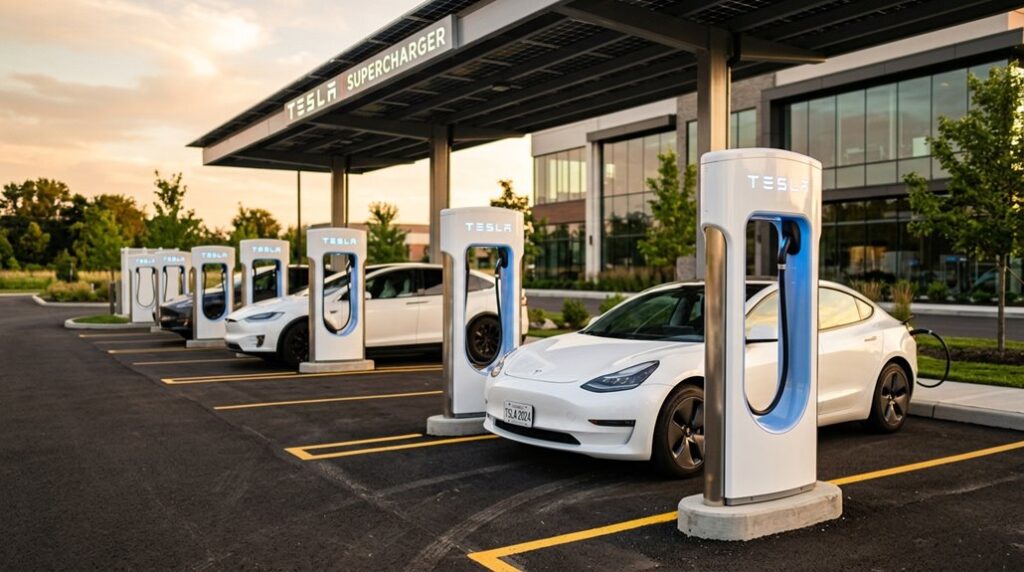
For context on what high-end infrastructure looks like, Tesla’s V4 Supercharger cabinets support up to 1.2 MW capacity and are often paired with Megapack battery storage to buffer peak demand and reduce grid strain — a scale that illustrates why electrical infrastructure decisions drive so much of any fast-charging project’s budget.
Bottom line: grasping the full cost stack before breaking ground separates successful charging projects from expensive regrets.
Equipment vs. Installation: Where the Real Money Goes
When people budget for a public EV charging station, they typically fixate on the equipment price — which is the wrong instinct. The charger itself is just the beginning. Electrical infrastructure, load management systems, and site aesthetics (think pedestals, conduit runs, and pavement cuts) quietly pile onto the final bill.
| Cost Category | Level 2 | DC Fast Charger |
|---|---|---|
| Equipment (per connector) | ~$3,500 | $38,000–$90,000 |
| Installation (per connector) | ~$2,500 | $20,000–$60,000 |
| Infrastructure Upgrades | $12,000–$15,000 | Tens of thousands |
| Pedestal Mounting | $1,500+ | $1,500+ |
| Dedicated Circuit Work | ~$100/hr (labor) | High-voltage premium |
Notice how installation frequently rivals equipment costs. A 480-volt dedicated circuit alone can run tens of thousands before you’ve bolted a single charger to anything. Your equipment budget is the headline — but infrastructure is the actual story. DC fast chargers capable of 250 kW peak output require substantially more robust electrical infrastructure than Level 2 alternatives, driving up both equipment and installation costs significantly. A federal tax credit of 30% is available on qualifying charging infrastructure through June 30, 2026, which can meaningfully offset these upfront costs.
What EV Charging Station Maintenance and Network Fees Actually Cost
Buying the hardware is only half the financial story — once your charging station is live, you’re on the hook for ongoing maintenance and network fees that most buyers never fully account for upfront.
For Level 1 and Level 2 units, expect to budget roughly $300 to $400 per charger annually for routine upkeep, while DC fast chargers can run $2,000 to $3,000 per year due to their more complex cooling systems, filters, and higher-wear components.
Layer on top of that the software subscriptions (typically around $28 per month for energy management platforms) and the network connectivity fees required for payment processing and remote monitoring, and your annual operating costs climb faster than a Model S Plaid off the line.
For context on what drivers actually pay on the other side of the meter, home Level 2 charging typically costs between $11 and $23 for a full charge depending on the vehicle model and local utility rates, which helps illustrate the margin operators work with when setting public session pricing.
Annual Maintenance Cost Breakdown
Owning a public EV charging station looks straightforward on paper until the annual maintenance bills start arriving. Expect to budget roughly $400–$500 per charger annually for Level 1 and Level 2 units, according to AFDC and Qmerit estimates. DC fast chargers run markedly higher — sometimes double that figure — due to cooling systems, filters, and complex hardware demands.
Predictive maintenance matters here; catching a corroded connector early costs far less than replacing a failed power module later. Routine upkeep covers cleaning, cable management, seal inspections, and firmware updates — nothing glamorous, but skipping it compounds costs quickly. Smart warranty strategies also protect your investment, since extended DCFC warranties alone can exceed $800 annually once manufacturer coverage expires. Higher utilization simply accelerates everything.
Network and Software Fees
Once your charger is physically installed and humming along, the billing doesn’t stop — network and software fees layer on top of hardware, installation, and electricity costs as a recurring operating expense most first-time operators don’t fully anticipate.
These fees cover the infrastructure keeping your station connected, managed, and monetized:
- Data plans fund cellular or Wi-Fi connectivity for real-time communication
- User authentication tools (RFID cards, apps, credit card readers) require network platform licensing
- Remote monitoring and analytics are software-tier features, not hardware defaults
- Usage reporting for site hosts often carries separate or bundled software costs
- Low-utilization stations absorb higher per-session fee burdens, making volume critical
EVgo’s plans range from $0.99 per session to $12.99 monthly — choose your structure carefully. When evaluating which network to plug into, it’s worth noting that the Chevy Equinox EV is compatible with EVgo and Electrify America, giving drivers — and station operators courting them — a clear picture of where demand is likely to concentrate.
Is Public Charging Really More Expensive Than Charging at Home?
The short answer is yes — public charging almost always costs more than plugging in at home, sometimes by a wide margin. Home convenience carries real financial weight here.
Residential rates average $0.16–$0.18 per kWh, while public stations commonly run $0.20–$0.60 per kWh. That gap reflects equipment overhead, site access, and profit margin — not just electricity.
Your charging behavior determines how much this difference actually matters. Drivers who rely on public charging daily can spend $1,500–$1,900 annually versus roughly $700–$750 for home-first charging. That’s nearly double, sometimes triple, the cost.
Grid impact also shapes pricing. DC fast chargers draw substantial power, triggering demand charges that networks pass directly to you. Factor in the time value of faster sessions, and public charging starts resembling a premium convenience service — not a budget-friendly fueling strategy.
Home charging setups, like a dedicated 60-amp Wall Connector, can deliver up to 44 miles of range per hour, making overnight top-ups a practical and cost-effective alternative to frequent public station visits.
For most Tesla owners, the real comparison isn’t just public charging prices—it’s the time and unpredictability that comes with them. Waiting around for availability or paying peak rates adds up faster than expected. A Level 2 EV home charging station gives you a steady, lower-cost charging setup at home, making it easier to avoid public charging dependence and keep your Tesla ready without planning your day around charging stops.
What Drivers Pay Per Charge: Level 2 vs. DC Fast Charging
When you pull up to a public Level 2 station, you’re typically looking at around $0.25/kWh on average — meaning a 72 kWh battery runs you roughly $18 for a full charge, though rates can swing anywhere from $0.20 to $0.60/kWh depending on the network and location.
DC fast charging (the kind that actually gets you back on the road in under an hour) costs considerably more, averaging around $0.47–$0.48/kWh, which pushes that same charge on a 75 kWh battery to about $36. The price gap between these two options isn’t arbitrary — DC fast chargers carry markedly higher equipment and site infrastructure costs, and those expenses land squarely on your receipt. For Tesla drivers, the Supercharger V4 network is expanding globally with improved speeds, making fast charging sessions more efficient and widely accessible than ever before.
Public charging stations don’t always play nice with a single standard—missing cables, incompatible plugs, or broken units can leave you waiting longer than planned. That’s where having your own backup setup changes the experience. A portable EV charging cable with public charging adapter compatibility helps ensure you can connect across a wider range of stations, reducing downtime and avoiding the frustration of arriving ready to charge but not being able to plug in.
Level 2 Per-Charge Costs
Plug into a public Level 2 charger and you’re typically looking at $0.20 to $0.25 per kWh, though Blink’s network data shows commercial station pricing can climb as high as $0.60 per kWh depending on the operator and location. That pricing variability means your actual per-charge cost shifts considerably based on network, region, and operator markup. Consider it a convenience premium for charging away from home. Upgrading your home setup with a Tesla wall connector or wireless charging pad can reduce your dependence on public charging costs while improving daily usability.
- A 72 kWh charge at $0.25/kWh costs roughly $18.00
- A 75 kWh battery runs about $18.75 at the same rate
- Home charging averages $0.18/kWh, making public Level 2 roughly 39% pricier
- Some operators bill by the hour, not kWh
- Free Level 2 charging exists at select workplaces and retailers
DC Fast Charging Rates
DC fast charging almost always costs more than Level 2 — sometimes substantially more. Expect to pay roughly $0.35 to $0.60 per kWh at most U.S. public DC fast chargers, with networks like Electrify America reaching $0.64 per kWh during peak pricing periods.
Compare that against home charging’s typical $0.16 per kWh, and the math gets humbling fast. A 75 kWh battery charged from 10% to 80% costs approximately $25 to $45 depending on network and location.
Tesla Superchargers tend toward the lower end ($0.25–$0.55 per kWh), making them genuinely competitive. Good charging etiquette — meaning you don’t hog a stall beyond your needed state of charge — also keeps session costs controlled. Tesla vehicles equipped with FSD Supervised can handle highway routing autonomously under driver supervision, but the cost of that optional package is separate from any charging fees you’ll encounter at Supercharger stalls.
Speed costs money; that’s simply the convenience premium baked into every DC fast-charge transaction.
Hidden Costs That Inflate Your Public EV Charging Station Budget
Public charging looks straightforward on paper—plug in, pay, drive away—but the actual bill rarely matches that clean mental model. Activation fees, idle penalties, and peak-hour surcharges quietly stack on top of the base rate before you’ve moved an inch.
Hidden costs worth tracking include:
- Activation fees ranging from $1–$6 per session before a single kWh transfers
- Idle fees that trigger once charging completes, penalizing you for staying plugged in
- Per-minute billing that punishes slower sessions or degraded charging speeds
- Peak-hour surcharges that can nearly double your effective rate compared to off-peak windows
- Poor signage clarity, which undermines behavioral incentives to unplug promptly, creating avoidable overstay charges
At highway corridor stations—where demand charges and land costs run highest—these add-ons compound fast. A session priced at $0.47/kWh can realistically cost 20–30% more once every fee layer settles. Some automakers offset these costs through built-in connectivity features, such as Tesla’s Premium Connectivity subscription at $9.99/month, which surfaces live traffic visualization that can help drivers route toward off-peak charging windows and avoid the highest-surcharge periods.
Frequently Asked Questions
Can Tesla Owners Use Non-Tesla Public Charging Networks Without Adapters?
Coincidentally, your Tesla’s NACS port already matches many newer stations — so you can skip the converter marketplace entirely. You’ll charge without converters wherever Tesla compatibility aligns with the station’s native NACS connector.
Do Public EV Stations Charge Differently Based on Time of Day?
Yes, public EV stations do charge differently based on time of day. You’ll encounter time-based pricing, peak surcharges during busy hours, demand pricing fluctuations, and idle fees once your session ends.
How Long Does a Typical Public Charging Session Actually Take?
Unlike a gas station’s 5-minute miracle, your charging duration stretches 20–45 minutes for DC fast charging or several hours on Level 2—without the battery degradation that rushing causes. Plan accordingly.
Are Public Charging Stations Covered Under Any Government Subsidy Programs?
Yes, you can offset public charging station costs through federal incentives like the Alternative Fuel Vehicle Refueling Property Credit, plus utility rebates that cover equipment, installation, and make-ready work, though rarely the full amount.
What Happens if a Public Charger Malfunctions While Your Car Is Connected?
Over 20% of public charging attempts fail. If a charger malfunctions while you’re connected, it’ll typically halt power transfer automatically. Remote diagnostics flag the fault, though liability questions around billing disputes mean you should document everything immediately.