
Most Tesla owners assume washer fluid is the last thing worth overthinking — pour it in and move on. But Tesla’s system has a specific capacity, approved fluid formulas, and filling techniques that quietly determine whether your windshield stays crystal clear or your nozzles freeze mid-highway. One wrong move and you could be staring at a voided warranty over something that costs three dollars. Here is everything you need to know before you touch that reservoir.
What Is the Total Tesla Washer Fluid Capacity?
Tesla’s washer fluid capacity isn’t a one-size-fits-all number — it varies by model, and getting it wrong just means you’re standing in a parking lot with half a jug of fluid and nowhere to put it.
Tesla’s washer fluid capacity varies by model — get it wrong and you’ll be left with nowhere to put it.
The Model 3 holds 3.2 liters total, while the Model Y steps up to a 4.5-liter reservoir. That’s a meaningful difference when you’re planning a refill or mixing a concentrate solution at the right ratio.
This reservoir comparison matters practically. If you’re buying pre-mixed fluid by the liter, you need to know your model’s total capacity before you grab bottles off the shelf. Both figures come directly from Tesla’s service documentation for topping up windshield washer fluid, making them the most reliable numbers available.
Keep in mind that total capacity assumes a completely empty tank. A partial top-up will naturally accept less, so don’t panic if your jug runs out before you hit the published number. It’s also worth noting that the Highland refresh Model 3 introduced significant mechanical and structural changes beginning in 2024, so always verify your specific build year before referencing any service documentation.
Why Washer Fluid Is the Only Reservoir You Fill at Home
When you pop the frunk on your Tesla, you’ll notice something conspicuously absent: dipsticks, coolant caps, and transmission fluid reservoirs that traditionally crowd a combustion engine bay.
Tesla’s drivetrain runs on sealed, maintenance-free fluid systems (brake fluid, coolant, and gear lubricants) that the company deliberately locks away from owner access, routing those service intervals exclusively through Tesla-certified technicians. Unlike traditional vehicles, Tesla’s compact drivetrain design eliminates spark plugs, timing belts and exhaust systems, removing dozens of conventional fluid-dependent components from the equation entirely.
The washer fluid reservoir is the one exception — a clearly labeled, easily accessible filler neck designed specifically for routine DIY top-ups without any special tools or technical knowledge. Depending on which model you drive, the reservoir capacity differs — the Model 3 holds 3.2 litres while the Model Y holds 4.5 litres.
Tesla owners often don’t think about washer fluid until visibility suddenly drops and the system runs dry or underperforms at the worst possible moment. It usually happens in rain, road spray, or early morning glare—when clean windshields matter most and there’s no time to second-guess what’s in the reservoir. Keep winter-ready windshield washer fluid on hand so your visibility stays consistent when the road conditions don’t cooperate.
Tesla’s Sealed Fluid Systems
Unlike a traditional gas-powered car that practically invites you to open the hood and fiddle with a half-dozen different reservoirs, Tesla’s fluid design is deliberately sealed and service-center-oriented — meaning your driveway maintenance duties are, by design, almost nonexistent.
Tesla’s sealed fluids cover everything critical: powertrain cooling, brake hydraulics, and thermal management circuits. Owner access to these systems simply isn’t part of the ownership equation. Tesla engineered it that way intentionally, reducing the risk of incorrect fluid selection in sensitive systems. In fact, annual maintenance costs for a Tesla average around $832 per year, largely because so many traditional service touchpoints have been eliminated or pushed to certified technicians.
The sole exception? Your windshield washer reservoir. It’s the one point where owner access is both expected and explicitly documented in Tesla’s official manuals. Everything else stays sealed until a Tesla-certified technician handles it — which, honestly, is probably for the best. Tesla’s manual explicitly warns against using fluids containing water repellent or bug wash, as these can cause streaking, smearing, squeaking, or other noises.
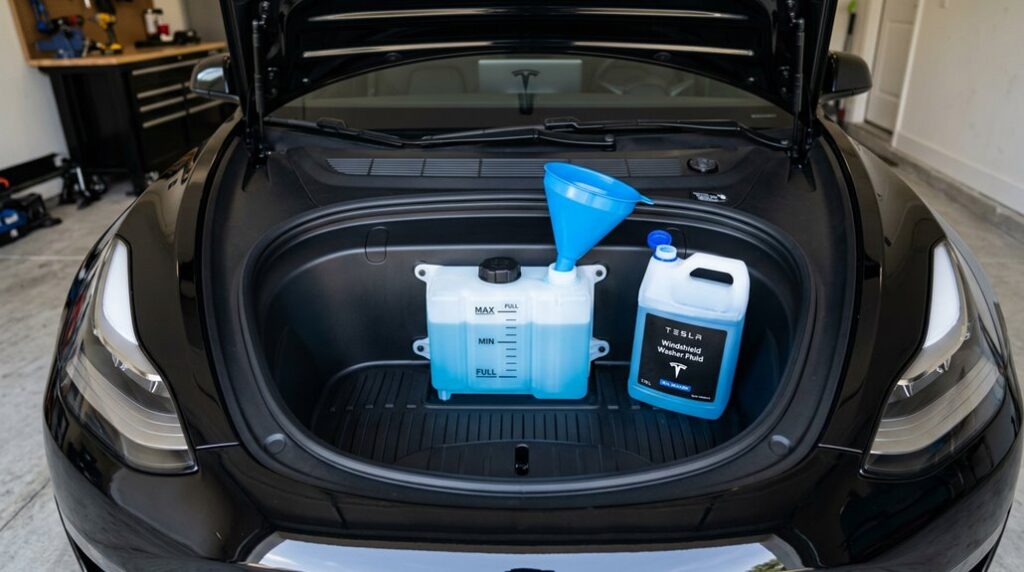
Tesla’s washer reservoir is tucked deep inside the frunk, which makes a simple top-up surprisingly easy to overpour if you’re not prepared. What should be a quick maintenance task can quickly turn into a messy cleanup if fluid spills around tight edges or runs into areas that are difficult to reach. Use a long-neck automotive funnel to keep washer fluid fills clean, controlled, and spill-free every time.
Washer Reservoir Access Explained
Out of every fluid system packed into a Tesla, the windshield washer reservoir is the only one you’ll ever touch yourself — and that’s entirely by design. Tesla’s front trunk ergonomics position the filler neck exactly where you’d expect an engine bay to be, making access intuitive. Pop the hood, locate the cap, and inspect the cap seal materials before opening — debris contamination ruins reservoirs fast. Unlike traditional vehicles, Tesla’s sealed battery and drivetrain systems require no oil changes, coolant top-offs, or transmission fluid checks, leaving the washer reservoir as the sole fluid maintenance task for owners. The NACS connector standard unifies Supercharger, Destination, and home charging under one plug design, reflecting Tesla’s broader philosophy of simplifying the ownership experience.
| Detail | Model 3 | Model Y |
|---|---|---|
| Capacity | 3.2 liters | 4.5 liters |
| Fill Level | Below filler neck | Below filler neck |
| Access Point | Front trunk | Front trunk |
Add fluid slowly until it’s visible just beneath the neck. Overfilling wastes product and stresses the cap seal materials unnecessarily. When the dashboard displays a “windshield washer fluid low” message, that’s your cue to refill before the reservoir runs completely dry.
No Other DIY Fluids
Now that you know where to find the washer reservoir and how to fill it, here’s the part that surprises most new Tesla owners: that’s it. Washer fluid is the only reservoir Tesla’s manual designates for routine owner top-off. Full stop.
Owner misconceptions run deep here. Many drivers assume they’ll be topping off brake fluid, coolant, or transmission oil the same way they did with gas-powered cars. They won’t. Those systems are either sealed or strictly service-only, meaning DIY access isn’t part of your maintenance routine. Under the Magnuson-Moss Warranty Act, manufacturers cannot void your entire warranty over a single modification or improper fluid use, but Tesla can still deny coverage for the specific damage caused by it.
This matters beyond convenience. Adding unapproved fluids carries real warranty implications — Tesla explicitly excludes damage caused by improper fluid use. Your job at home is simple: fill the washer reservoir correctly, then leave everything else to Tesla Service. The washer reservoir holds 4.5 liters total, giving you a clear and fixed limit for how much fluid the system can actually take.
What Tesla Approves in Your Region
Where you live determines exactly which washer fluid Tesla will sign off on, and the differences aren’t trivial. Regional approvals exist because local restrictions, chemical regulations, and climate conditions vary markedly across markets.
Where you live dictates which washer fluid Tesla approves — and the regional differences are far from minor.
In North America, Tesla approves ethanol-based fluids like part 1973926-00-A (available in one-gallon and 55-gallon drum formats). Europe, Middle East, and Africa prohibit methanol-based fluids entirely, so Tesla specifies ethanol alternatives rated down to -40°C, including parts 1508086-99-A and 1508086-98-A.
Asia-Pacific markets outside China use Wurth-branded fluids (1119197-00-A, 1089984-00-A), while China operates on a completely separate approval list featuring Delian-branded fluids rated for -25°C and -40°C conditions.
Cross-referencing parts.tesla.com or contacting Tesla Service confirms exactly which fluid applies to your vehicle’s region. Don’t assume a fluid approved elsewhere automatically qualifies where you’re — Tesla’s regional distinctions are deliberate and specific. This same principle of manufacturer-controlled specificity extends broadly across Tesla’s platform, where software-controlled feature gating determines what a vehicle will do versus what it can do physically, reflecting how deliberately Tesla manages regional and functional differences at every level.
Which Tesla Washer Fluid Won’t Freeze in Cold Weather
If you live somewhere that dips below freezing, the fluid in your washer reservoir needs to match those conditions — summer blends freeze solid and leave you with a blocked pump, clogged lines, and zero visibility when you need it most.
Look for a winter-rated fluid labeled for protection down to at least -20°F to -40°F, and pay close attention to whether you’re buying a pre-mixed formula or a concentrate that requires dilution (a 2:1 concentrate-to-water mix typically gets you to around -20°F, while a 1:1 mix only holds to about -6°F).
Methanol-based fluids generally outperform ethanol-based ones at the lowest temperatures because methanol has a lower freezing point, though ethanol formulas are often the safer household choice if you’re concerned about toxicity near pets or kids.
Cold Weather Fluid Picks
When temperatures drop below 40°F (4°C), standard washer fluid becomes a liability — it can freeze in your reservoir, lock up your nozzles, and smear a half-frozen mess across your windshield at the worst possible moment. Winter blends use methanol or alcohol-based compounds to stay liquid in sub-zero conditions while cutting through salt and slush. Use these de-icer comparisons to choose wisely:
| Product | Freeze Rating | Best For |
|---|---|---|
| Rain-X Platinum | -27°F (-33°C) | All-around winter use |
| Rain-X De-Icer | -25°F (-32°C) | Heavy frost removal |
| Rain-X 2-in-1 De-Icer | -20°F (-29°C) | Ice and grime |
| Rain-X All-Season | -20°F (-29°C) | Mild winters |
| Reflex Winter Blend | -40°F (-40°C) | Extreme cold climates |
Avoid bug wash or water-repellent additives — Tesla flags those for streaking and squeaking. Unlike conventional vehicles, Teslas skip oil changes and rely heavily on over-the-air updates to address maintenance issues, making it even more important to handle the few fluid-based maintenance tasks — like your washer fluid — correctly from the start.
Freeze Protection Temperature Ratings
Not all washer fluids handle cold weather equally, and the difference between a -20°F-rated blend and a summer formula isn’t just a number on the label — it’s the difference between a functional spray system and a frozen reservoir at 6 a.m.
Standard fluid freezes at 32°F (0°C), making it useless the moment temperatures drop. Winter blends typically hold liquid to around -29°C, while severe-cold formulas push protection to -30°C or -40°C.
For a solid freeze rating comparison, match your fluid to the coldest expected overnight low — then go lower. That overnight temperature margin matters because your reservoir sits exposed for hours.
Tesla-approved fluids for cold regions carry explicit temperature ratings on the label. Check the number before winter arrives, not after your nozzles stop responding. Unlike climate control adjustments, which Tesla has moved entirely behind the touchscreen as part of its software-first interface, washer fluid selection remains a straightforward physical maintenance task with no digital shortcut.
Ethanol Versus Methanol Performance
Both methanol and ethanol can keep your Tesla’s washer fluid from freezing, but they don’t behave identically once they leave the nozzle and hit cold glass. Methanol evaporates faster, which sounds useful until you realize that rapid ethanol evaporation is actually slower by comparison—meaning ethanol lingers longer on the windshield and maintains freeze protection while the wipers work.
Methanol flashes off quickly, leaving a more water-rich film that can refreeze at speed. That’s a problem at highway cruising velocity.
For the toxicity comparison, methanol loses badly. It’s harmful through inhalation, skin absorption, and ingestion. Ethanol is markedly safer to handle.
Methanol-based fluids dominate store shelves purely on cost, while ethanol-based alternatives cost slightly more but deliver reduced VOC output and meaningfully lower health risk. Just as Tesla’s battery management system regulates electrochemical conditions to protect cell longevity, your choice of washer fluid chemistry directly affects how well your vehicle performs under sustained cold-weather exposure.
Why Methanol, Bug Wash, and Plain Water Are Off the List
Tesla’s washer fluid spec isn’t just a suggestion buried in the owner’s manual—it’s a chemistry requirement that actively rules out three commonly used alternatives: methanol-based fluids, bug wash or water-repellent formulas, and plain water. Each fails for a distinct reason:
Tesla’s washer fluid spec isn’t a suggestion—it’s a chemistry requirement that actively eliminates the most common alternatives.
- Methanol-based fluids dominate U.S. retail shelves but carry real methanol toxicity concerns and don’t match Tesla’s stated ethanol preference—close isn’t compliant.
- Bug wash formulas contain surfactants and specialty cleaners that cause film buildup on glass over time, producing streaking, smearing, and squeaking wipers.
- Water-repellent additives leave coating residue that hazes your windshield and interferes with visibility—exactly what a washer system shouldn’t do.
- Plain water freezes in cold climates, blocking lines, damaging pumps, and cracking components (distilled water works only in warm-weather seasons).
Stick with plain ethanol-based fluid. It evaporates cleanly, resists freezing, and keeps your system running without unwanted chemistry surprises. A clean windshield is especially critical in Tesla vehicles because the eight surrounding cameras that feed the Autopilot neural networks rely on unobstructed visual input to detect lane markings, vehicles, and road hazards in real time.
How to Fill Your Tesla Washer Fluid Reservoir Cleanly
Now that you know what goes into the reservoir, let’s talk about how to get it there without making a mess.
Open the front trunk (or powered frunk on Cybertruck) using your vehicle controls or app. Before touching the filler cap, do your microfiber prep: wipe the surrounding area clean so no grit falls into the reservoir when you open it. Dirt inside the system can clog spray nozzles fast.
Next, apply the funnel technique. A basic funnel eliminates splash risk and gives you precise control during filling. Add fluid gradually, watching the level rise toward the filler neck. Stop just below it — overfilling causes spills when the cap compresses the fluid column. Model 3 holds 3.2 liters, Model Y holds 4.5 liters, and Cybertruck holds 4.2 liters, so know your target.
Close the cap securely, wipe any drips immediately, and confirm your touchscreen warning clears.
Tesla Washer Fluid Mistakes That Could Void Your Warranty
Filling your Tesla’s washer reservoir with the wrong stuff isn’t just a minor inconvenience — it’s the kind of mistake that can turn a straightforward warranty claim into a drawn-out dispute you’re unlikely to win. Tesla’s warranty explicitly excludes damage from unapproved fluids, and fluid contamination from the wrong formula hands Tesla a clean argument to deny your claim.
Avoid these four mistakes:
- Using plain water — untreated water invites bacteria growth and sediment buildup
- Mixing incompatible brands — conflicting chemistries create residue that clogs pumps and nozzles
- Adding homemade solutions — vinegar, soap, or solvents degrade seals and hoses
- Overfilling the reservoir — spillover reaches nearby components, creating secondary damage
Warranty disputes become harder to win when Tesla can point to maintenance neglect rather than a manufacturing defect. Keep receipts for approved fluids — that paper trail matters more than you’d think.
Frequently Asked Questions
Can I Mix Two Different Approved Washer Fluids in the Reservoir?
You can mix two approved washer fluids, but you’re risking chemical compatibility issues and potential performance degradation. It’s safer to stick with one consistent formula for peak results.
How Long Does a Full 4.5-Liter Washer Fluid Reservoir Typically Last?
Your 4.5-liter reservoir’s typical lifespan stretches from weeks to nearly a year—it’s wildly unpredictable. Seasonal variation drives everything; winter salt and summer bugs can drain it faster than you’d ever expect.
Does Tesla’s Touchscreen Show Exact Fluid Level or Just a Warning?
Your Tesla’s touchscreen doesn’t offer touchscreen accuracy through a gauge—it only hits warning thresholds when fluid runs low. You’ll see a simple alert, not an exact level readout.
Will Using Washer Fluid Affect My Tesla’s Range or Energy Consumption?
Ironically, you’d barely notice the energy impact. Using washer fluid won’t meaningfully drain your range—the pump’s draw is tiny. However, climate effects in winter can indirectly increase energy use through heavier defrost demands.
Can I Use the Same Washer Fluid for Both Front and Rear Washers?
Yes, you can use the same fluid for both front and rear washers. Tesla’s single shared reservoir automatically supplies all nozzles, so whatever fluid you add serves the entire system equally.