
Your Tesla’s carpet is one muddy boot away from permanent damage—and most owners don’t realize their floor mats are failing them until it’s too late. Not all seven options for Model 3 and Y protect equally. OEM liners, WeatherTech, and 3D MAXpider each make bold promises, but sidewall height, channel depth, and anchoring systems tell the real story. One of these mats dramatically outperforms the rest, and the answer isn’t what most Tesla owners expect.
The 7 Best Tesla Floor Mats Ranked
Picking the right floor mat for your Tesla isn’t as straightforward as it sounds — the wrong choice means pooled water sneaking under the mat, ill-fitting edges leaving bare carpet exposed, or a liner that shifts underfoot every time you brake. Seven options consistently rise above the noise, each earning its spot through fitment precision, material durability, and real-world owner validation.
The contenders span a wide range: Tesla OEM All-Weather Mats, WeatherTech FloorLiner, 3D MAXpider Kagu, 3W Floor Mats, West Liners, SUPER LINER, and the WeatherTech FloorLiner HP. Some prioritize color customization, letting you match your interior exactly.
Others reward owners who follow simple installation tips — like anchoring retention hooks before pressing edges down — to eliminate mat creep entirely. Whether you’re battling Michigan winters or California mud, one of these seven fits your exact use case. Because floor mats are a non-invasive upgrade, they carry virtually no risk of triggering warranty disputes or requiring Tesla to prove causation between the accessory and any vehicle failure. For owners on a tight budget, the Temu mat at $60 delivers surprisingly functional coverage and spill containment that closes the gap with far more expensive alternatives. Let’s break each one down.
Fit, Coverage, and Material: What Actually Separates Good Mats From Bad
Not all Tesla floor mats are created equal, and the gap between a $30 universal set and a premium model-specific option comes down to three things: fit, coverage, and material.
Tesla’s footwell geometry is unique enough that a mat without laser-measured or digitally scanned contours will gap at the edges, curl against door sills, or slide toward the pedals—none of which you want while you’re braking at 60 mph.
TPE (thermoplastic elastomer) has become the dominant material in quality Tesla mats because it stays rigid in summer heat, doesn’t crack in winter cold, resists liquids without absorbing them, and won’t fill your cabin with that chemical off-gassing smell that cheaper rubber alternatives are notorious for.
The added battery pack weight in Teslas—ranging from 800 to 1,200 pounds more than comparable gas vehicles—puts greater stress on the vehicle floor structure, making a properly fitted, non-slip mat more than just a cosmetic choice.
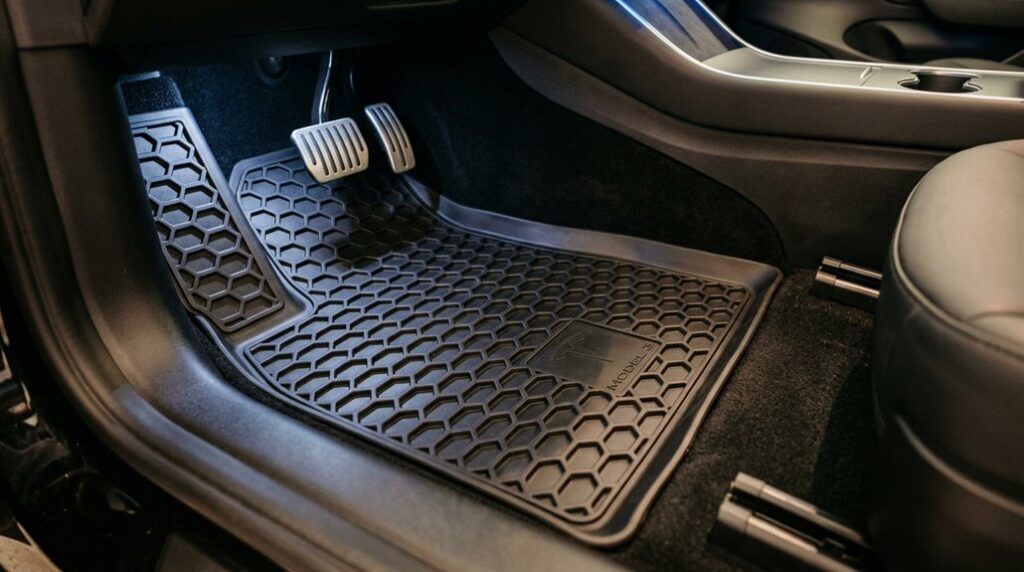
Tesla interiors look premium on day one, but without proper protection, everyday use quickly shows up in the form of stains, grit, and wear that are difficult to fully reverse later. Tesla all-weather custom fit floor mats create a full-coverage barrier against water, mud, and debris, helping keep the cabin cleaner and preserving the original interior condition for longer, especially in daily driving or harsh weather conditions.
Why Fit Matters
Regarding Tesla floor mats, fit isn’t a preference — it’s a functional requirement. A mat that shifts under braking or bunches near the accelerator pedal isn’t just annoying — it’s a genuine safety concern.
Tesla’s Model 3 and Model Y cabins have specific contours, seat rail placements, and pedal arrangements that generic templates simply can’t accommodate. Precision-cut mats (ideally laser-measured or 3D-scanned) conform to these exact dimensions, directly supporting driver ergonomics by keeping surfaces stable and positioned where your feet actually land.
Better fit also means installation ease — no forcing, trimming, or guessing whether the anchor clips align. You drop them in, they sit flush, and they stay there. That’s the standard worth demanding. This matters especially given that 70–90% of charging occurs at home, meaning your Tesla is parked and re-entered daily — putting consistent, repetitive foot traffic on those mat surfaces from day one.
Material Performance Differences
Once you’ve locked in the right fit, material becomes the next variable that actually determines whether your mats earn their price tag or just occupy floor space. TPE (thermoplastic elastomer) dominates premium Tesla mat options because it balances thermal stability across freezing winters and hot parked cabins without warping or off-gassing into your interior. Rubber competes well on liquid resistance but heavier compounds add unnecessary weight and occasionally smell like a tire warehouse. Carpet looks factory-correct but absorbs everything, making spills a permanent commitment.
Abrasion resistance separates daily drivers from mats that degrade within a season—textured TPE surfaces hold up under repeated boot contact where smooth finishes scuff and dull quickly. Material choice isn’t cosmetic; it’s structural. The Highland refresh interior upgrades, including ventilated front seats and refined cabin materials, raise the baseline expectation for what the floor area should look and feel like, making low-quality mats more visually out of place than ever before.
Tesla owners often focus on protecting the cabin, but the trunk and frunk take just as much abuse from groceries, luggage, gym gear, and the occasional spill that can seep into carpet and leave lasting marks. A Tesla trunk + frunk cargo liner set adds waterproof, full-coverage protection to both storage areas, helping contain spills and debris before they reach the factory carpet and keeping the vehicle’s interior cleaner and easier to maintain over time.
Best Tesla Floor Mats for All-Weather Protection
Regarding Tesla interiors, all-weather floor mats aren’t a luxury — they’re a logical investment for anyone who drives in rain, snow, mud, or salty winter slush. Raised sidewalls and waterproof TPE construction do the heavy lifting, containing spills before they ever touch factory carpet. Textured surfaces also improve footwear traction, keeping your feet planted during hard braking. Tesla’s low-maintenance ownership profile — with no oil changes and regenerative braking reducing brake wear — makes interior protection one of the few recurring upkeep costs worth prioritizing from day one.
| Mat Option | Coverage Level | Best For |
|---|---|---|
| Tesla OEM Liners | High | Precise fit, daily use |
| WeatherTech | High | Heavy-duty winter protection |
| 3D MAXpider | Medium-High | Sleek look, lightweight build |
| SUPER LINER | Maximum | Harsh weather, seasonal maintenance |
Each option targets a slightly different priority. If you live somewhere with brutal winters, maximum sidewall height matters most. Milder climates? A lightweight TPE liner with solid edge coverage handles the job without added bulk.
Model 3 vs. Model Y: Which Brands Fit Each Best?
Not every floor mat brand fits every Tesla equally well, and the gap between Model 3 and Model Y fitment comes down to real cabin geometry differences — the Model 3’s narrower, more sculpted sedan footwells demand tighter, generation-specific moldings (especially post-2024 Highland owners, who’ll find pre-Highland mats simply don’t conform correctly), while the Model Y’s wider footwells, flatter floor geometry, and cargo-heavy interior reward brands that offer broader, multi-zone coverage packages.
For the Model 3, brands like 3D Maxpider, 3W, and Tesla’s own all-weather liners consistently deliver the contour-matching precision that keeps exposed carpet around the seat rails to a minimum. The Model Y, on the other hand, pulls its strongest fitment results from brands like 3W, Lasfit, and 3D Maxpider — particularly when you’re buying a full set that covers the front rows, rear rows, trunk, and frunk rather than patching together mismatched pieces. Unlike traditional vehicles where cabin layout is fixed by hardware retooling, Tesla’s over-the-air updates can alter interior feature behavior and display configurations without changing the physical footwell geometry that determines mat fitment.
Whichever model you’re outfitting, look for mats that include tabs and locking nubs on the passenger side, since these features actively prevent mat migration across the carpet rather than relying solely on friction or Velcro alone.
Model 3 Brand Picks
Most Tesla owners shopping for Model 3 floor mats quickly find that the Model Y‘s wildly popular mat listings don’t translate to a clean fit — and that’s not a minor inconvenience, it’s a geometry problem.
The Model 3’s sedan-specific footwells, narrower rear shifts, and broader front center console area demand purpose-built coverage.
For Tesla-specific aesthetics and genuine fit confidence, 3W leads most comparisons, particularly for first-row edge height and footprint coverage. TuxMat follows closely as a premium option.
WeatherTech offers reliable molded protection with straightforward installation tips — typically drop-in placement with anchor clip alignment.
If you’re running a 2024+ Highland, verify your listing explicitly calls out Highland compatibility, because pre-Highland mats won’t hug the revised floor geometry correctly.
Model Y Brand Picks
Shifting from the Model 3 to the Model Y isn’t just a body-style upgrade — it’s a fundamentally different floor geometry problem, and the brand hierarchy shifts accordingly.
Trim variations matter here more than with the Model 3, since Juniper 2025/2026 models carry updated floor contours that earlier-generation mats won’t fully cover. Tesla OEM liners remain the benchmark for exact fit. WeatherTech offers a dedicated Model Y listing, so you’re not guessing on coverage.
SUPER LINER specifically calls out 5-seat Juniper fitment, which saves you a headache at checkout. RPM Tesla covers 2020–2025 separately, which tells you something about how much the designer changed.
Installation tips: always confirm your seat count and production year before ordering — rear coverage gaps are the first thing reviewers flag when fitment’s off. The Model Y’s seven-seat optional layout on the Long Range AWD trim adds a third row that requires its own liner set, so verify your configuration before purchasing.
TPE vs. Rubber vs. Carpet for Tesla Mats: Which Wins?
Regarding protecting your Tesla’s factory carpet, you’ve got three main contenders: TPE, rubber, and carpet — and the differences between them aren’t just cosmetic. Each material makes a distinct trade-off between comfort, durability, and practicality.
Carpet mats feel premium underfoot but absorb spills, trap odors, and wear down faster under heavy foot traffic. They’re the aesthetic choice, not the smart one.
Rubber mats handle moisture well and clean up easily, though rubber off-gassing can introduce unwanted chemical smells into your cabin — worth noting if you’re sensitive to odors.
TPE wins on nearly every measurable front. It’s waterproof, recyclable, and free from harmful compounds like PVC and lead. TPE longevity typically runs five to seven years without cracking, fading, or deforming.
It balances rubber’s toughness with moderate underfoot comfort. If you want one material that covers all-weather performance, easy maintenance, and long-term value, TPE is your answer. Tesla’s broad lineup — from the Model 3 and Model Y to the heavier Cybertruck and Model X — each carries different interior dimensions and foot traffic patterns, making a precise mat fit all the more important.
Why Sidewall Height and Coverage Matter in a Tesla
When you’re pouring water, mud, or melted slush into your Tesla’s footwell — intentionally or not — the only thing standing between that mess and your factory carpet is the sidewall of your floor mat. Height is everything here. TuxMat targets 3+ inches for maximum liquid containment, while the deepest aftermarket liners reach roughly 2 inches. That vertical barrier handles liquid routing during braking and cornering, where fluids slosh toward low edges and escape onto carpet.
Entry protection matters just as much as height. Wet boots drag moisture across door sills and dead pedal zones — exactly where exposed carpet wears fastest. Custom-fit mats extend coverage into these high-contact corners, closing gaps where gravel and salt otherwise collect. Deep channel patterns reinforce the system, directing liquid away from foot placement zones into recessed pockets. Flat mats can’t do that.
Tesla’s battery preconditioning system warms the pack before Supercharger arrival, which means snow and slush clinging to wheel wells and undercarriage can melt and track into the cabin more aggressively in cold-weather driving scenarios.
Tesla Mat Price Tiers: OEM, Premium, and Budget Compared
Coverage and containment are only half the equation — what you actually pay for them shapes the decision just as much. Tesla’s OEM all-weather liners run roughly $240 for front and rear rows, climbing higher once you add trunk and seat-back pieces. That’s the premium you pay for factory branding and guaranteed fitment consistency.
Premium aftermarket brands (3W, TuxMat, WeatherTech) often undercut OEM by nearly half while providing laser-measured coverage that matches or exceeds factory specs. Many include aftermarket warranties covering material defects, which OEM sets don’t always offer competitively. Regional pricing also shifts the math — import duties and local distribution costs can narrow or widen that gap depending on where you live. If you drive a Chevy Equinox EV, the same aftermarket ecosystem applies, and pairing quality floor mats with the right accessories for cargo protection can meaningfully preserve interior resale value.
Budget mats occupy the lowest tier, typically universal-fit designs with thinner TPE compounds and vague coverage patterns. They’ll catch a spilled coffee, but expect compromises in sidewall height and edge-seal precision. Some full aftermarket sets, however, offer surprising value — a complete 10-piece set can include driver and passenger mats, rear floor coverage, seatback liners, cargo liner, and sub-trunk liners for roughly half the cost of Tesla OEM liners. Know your priorities before you spend.
Frequently Asked Questions
Can Tesla Floor Mats Interfere With Brake Pedal Operation or Accelerator Function?
Yes, Tesla floor mats can cause pedal obstruction and accelerator entrapment if they’re loose, stacked, or incorrectly fitted. You should always verify secure anchoring and test full pedal travel before driving.
Do Aftermarket Floor Mats Void Any Portion of Tesla’s Factory Warranty?
Aftermarket floor mats don’t automatically void your Tesla’s warranty. Under Magnuson-Moss, warranty implications only arise if the mat causes the defect. Dealer policies can’t broadly deny coverage without proving direct causation.
Are Tesla Floor Mats Compatible With the Built-In Floor Mat Anchoring System?
Tesla floor mats can be compatible with the built-in anchoring system, but anchor compatibility varies by model and year. Check your specific trim, since retention clips and OEM anchor points differ across production runs.
How Do Tesla Floor Mats Hold up After Repeated High-Pressure Washing Cycles?
TPE mats handle repeated high-pressure washing well, resisting material degradation and seam separation effectively. You’ll want to avoid excessive heat and concentrated pressure on edges, as they can curdle fit and accelerate wear over time.
Can Floor Mats Affect the Accuracy of Tesla’s Interior Cabin Sensor Readings?
Yes, your floor mats can indirectly cause sensor interference if they’re thick, curling, or shifting near seat rails. Keeping them properly fitted helps maintain accurate cabin calibration and guarantees Tesla’s occupancy system reads correctly.