
No engine. No transmission. No problem—or so the story goes. A motor the size of a watermelon launches a Tesla Model 3 past most V8s, and everyone calls it “direct drive.” But that label is doing a lot of heavy lifting. The difference between true direct drive and a fixed-ratio reducer isn’t just technical semantics—it quietly determines how your EV performs, how efficiently it runs, and how long it lasts before heat becomes the enemy.
How Electric Vehicle Drivetrains Actually Move Power to the Wheels
Trace the path of power in any electric vehicle and you’ll find it’s invigoratingly straightforward compared to the mechanical maze under an ICE hood.
Your high-voltage battery pack stores energy, battery management systems monitor cell health continuously, and power electronics regulate exactly how much flows forward. An inverter converts that DC into AC, feeding your traction motor with precisely calibrated current.
The battery stores, the BMS monitors, the inverter converts — every electron accounted for before it reaches the motor.
The motor responds instantly, converting electrical energy into rotational torque at the axle. Unlike combustion engines needing rev ranges to build power, your EV delivers full torque from a dead stop.
Control electronics read your accelerator input in real time, enabling wheel torque vectoring across axles for sharper handling flair. Tesla’s architecture takes software integration further, using over-the-air software updates to refine motor control, torque delivery, and overall drivetrain behavior after the vehicle has already left the factory.
Thermal management keeps every component operating within safe temperature windows during hard acceleration. When you lift off the pedal, regenerative strategies reverse the motor’s function, recovering kinetic energy and returning it directly to the battery. Clean, efficient, almost refined. Some in-wheel motor designs take this further by mounting motors directly inside each wheel hub, eliminating drive shafts entirely and sending power straight to the wheel with minimal mechanical transmission losses.
What’s the Difference Between Direct Drive and Gear Reduction?
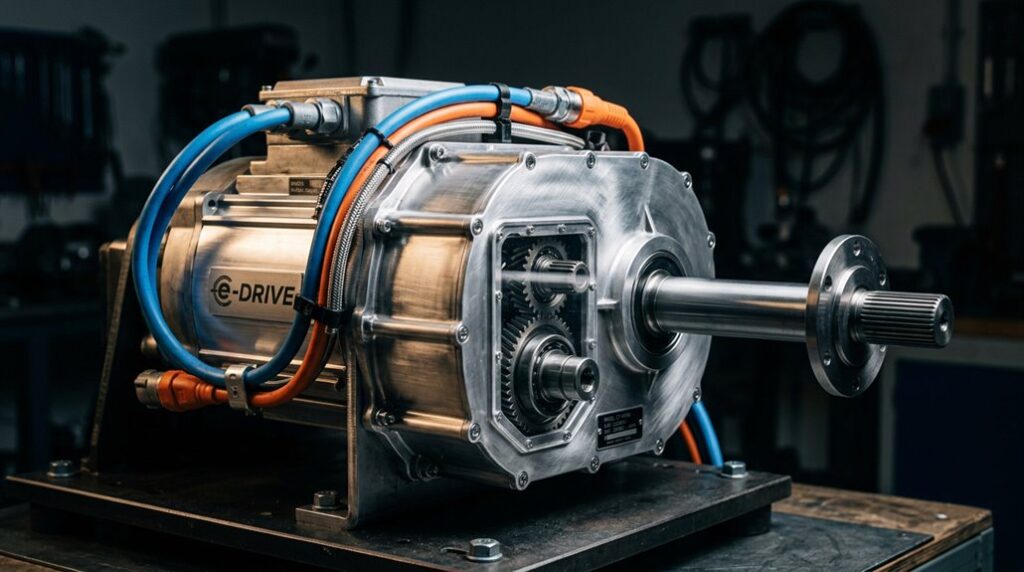
Strip away the marketing language and the distinction becomes clean: direct drive means your motor connects straight to the load with zero gear stages between them, while gear reduction inserts one or more gear stages to trade rotational speed for torque. Your motor coupling method determines everything downstream — torque availability, precision, maintenance burden, and efficiency comparison outcomes at real operating loads.
Direct drive prioritizes simplicity. Fewer components transfer power, which means fewer losses and zero backlash (that small mechanical slop between meshing gear teeth).
Gear reduction flips the priority: a smaller, faster-spinning motor delivers higher wheel torque because the ratio multiplies output force while reducing speed proportionally.
Neither approach wins universally. Gearboxes run 85–95% efficient depending on load and design, which is genuinely impressive — just not as impressive as skipping them entirely. Your application’s torque demands finally decide which configuration makes engineering sense. In practical terms, the weight difference alone can influence installation decisions, with gear reduction units coming in around ten pounds lighter than their direct drive counterparts.
When evaluating drivetrain configurations for an EV, it’s worth noting that drivetrain and battery claims remain eligible for warranty coverage unless a modification is proven to have caused the failure.
Most EV drivers never actually see what’s happening behind the smooth acceleration—they just feel the instant torque and assume everything is working efficiently by default. But without real data, it’s easy to miss how driving style, traffic conditions, or even temperature can quietly affect energy use and range over time. Plug in a Tesla-compatible OBD2 Bluetooth diagnostic adapter to start seeing real-time efficiency and drivetrain data so you understand what your EV is actually doing every time you drive.
Why Most EVs Use a Fixed-Ratio Gear Reduction
Now that you grasp what gear reduction actually does mechanically, the next question writes itself: why do most EVs — including every Tesla currently in production — settle on a single fixed ratio instead of a multi-speed gearbox?
The answer starts with torque. Electric motors produce full torque from zero RPM, so you don’t need a low gear to get moving. A single reduction ratio (roughly 9:1 to 11:1 in most Teslas) handles city crawling and highway cruising without complaint. Add the motor’s naturally wide efficient RPM band, and the case for extra gears fundamentally collapses.
Electric motors deliver full torque from zero RPM — one gear ratio is simply all you need.
There are practical engineering wins, too. Fewer moving parts means fewer wear points, simpler motor cooling management, and meaningful noise mitigation — a multi-speed gearbox introduces gear-mesh frequencies that engineers would then spend considerable effort suppressing. Software handles torque delivery and speed limits instead. In Tesla’s case, that same onboard software layer also governs systems like neural network processing, which continuously computes steering, braking, and acceleration outputs in real time.
Electric motors can also spin to around 20,000 RPM, giving them a vast usable speed range that makes a single fixed ratio genuinely workable from a standstill all the way to top speed.
It’s a cleaner solution, and cleaner usually wins.
Do Any EVs Use a Multi-Speed Gearbox?
Yes, a handful of production EVs do use multi-speed gearboxes — the Porsche Taycan being the most prominent example, running a two-speed transmission on its rear axle to balance hard launches against high-speed efficiency.
First gear delivers strong low-speed torque, while second gear keeps motor rpm manageable at triple-digit speeds, reducing heat and improving efficiency where single-ratio designs typically struggle.
The Audi e-tron GT shares the Taycan’s J1 platform and carries a similar setup. The Dodge Charger Daytona EV has also entered the conversation with reported multi-speed gearing. For performance EVs chasing both blistering acceleration and sustained highway speed, a second ratio solves what a single fixed gear cannot.
Heavy duty applications make persuasive candidates too — towing and sustained high-load operation expose the efficiency gaps that multi-speed gearing directly addresses. ZF’s 2-speed e-drive claims up to 5% range improvement, which matters considerably when payload weight compounds motor demands.
For everyday EV owners, the practical payoff of efficiency gains connects directly to home charging costs, where even modest reductions in energy consumption translate to lower per-mile expenses over time.
Single-Speed EV Drive vs. Multi-Speed: Which Works Better?
Which setup actually wins depends entirely on what you’re asking the drivetrain to do. For most daily driving, single-speed reduction gears handle torque management cleanly without the overhead of shift mapping logic or added mechanical weight.
For most daily driving, single-speed reduction gears handle torque management cleanly — no shift logic, no added weight.
- Single-speed wins on simplicity, cost, and reliability across everyday commutes
- Multi-speed wins when you need strong launch and sustained high-speed pull
- Fixed gearing compromises efficiency at very high motor rpm
- Additional ratios keep the motor spinning in its sweet spot across broader speed ranges
- Heavy towing and steep grades expose single-speed limitations faster than anything else
The honest answer is that single-speed works remarkably well for roughly 95% of passenger EV use cases. Where it stumbles — sustained high-load performance, top-end efficiency — multi-speed layouts earn their complexity. Tesla’s Model 3 and Model Y demonstrate this efficiency advantage clearly, with both models converting kilowatts into miles more effectively than heavier vehicles due to their lower curb weight and drivetrain design.
For a Tesla Model 3 commuter, one ratio is plenty. For a heavy-duty hauler, that math changes quickly.
EVs don’t lose efficiency through gears or shifting like traditional cars, but that doesn’t mean range is fully “free”—the real drag often comes from the road itself. Tire resistance quietly eats into efficiency every time you accelerate, cruise, or brake, especially on heavier electric vehicles that already demand more from their contact patch. Upgrade to low rolling resistance EV performance tires before unnoticed energy loss starts shaving range off every trip you take.
Frequently Asked Questions
Can I Swap My Tesla’s Drive Unit Into a Custom EV Conversion?
While warranty issues might give you pause, you can absolutely pull off a Tesla swap. You’ll need aftermarket controllers, custom mounts, cooling, and a high-voltage battery pack to make it work.
How Does Gear Reduction Affect Tesla Battery Range in Real-World Driving?
Gear reduction increases your range by keeping drivetrain losses low through efficient torque multiplication. It helps your motor stay in its sweet spot, supporting battery longevity across city stops, highway cruises, and demanding hill climbs.
Does Tesla Use the Same Gear Ratio Across All Its Different Models?
No, Tesla doesn’t use the same gear ratio across all models. You’ll find model-specific ratios customized to performance goals, with axle variations differing between platforms like the Model 3, X, and S Plaid.
Will Removing the Reduction Gear Damage My Motor During High-Speed Driving?
Yes, removing the reduction gear can damage your motor. Without it, you’ll face motor overheating from excessive current draw and accelerated bearing wear as your motor struggles outside its intended operating range.
How Loud Is a Tesla Drive Unit Compared to a Traditional Transmission?
Your Tesla’s drive unit wins the noise comparison easily — it’s quieter than a traditional transmission. During acoustic profiling, you’ll notice only a brief, tonal whine under hard acceleration versus the constant mechanical clatter of shifting gears.