
Most Tesla drivers never figure out the left scroll button‘s real purpose. And the ones who do? Their calls feel completely seamless—no fumbling, no distractions, no missed connections while moving. The secret isn’t just knowing *what* to press—it’s knowing the exact sequence between your steering wheel and touchscreen. Get it wrong once and you’ll feel it. Get it right and you’ll wonder how you ever drove without it.
Pair Your Phone With Tesla via Bluetooth
Before you can answer calls through your Tesla’s speakers, you’ll need to establish a Bluetooth handshake between your phone and the vehicle’s infotainment system. Start by tapping the Bluetooth icon on the touchscreen, then select the option to scan for nearby devices.
Phone discoverability matters here — your phone must be accessible, Bluetooth-enabled, and visible to other devices before the car can find it. Some phones (iPhones especially) require you to open Bluetooth Settings to complete the final steps.
Once your phone appears on the display, tap its name. Tesla generates a randomly generated security code that appears simultaneously on both screens — confirm they match exactly before proceeding. Mismatched codes mean you’re connecting to the wrong device, which defeats the purpose entirely.
Act promptly. Most systems enforce a pairing timeout if you stall too long. You’ll also get prompts requesting contacts and media access, which enables call-related features once approved. After pairing is complete, you can designate your phone as the priority device so the car connects to it first whenever you get in.
The quality and responsiveness of the Bluetooth interface can vary depending on your vehicle’s MCU hardware generation, as newer platforms like the AMD Ryzen-based MCU3 deliver faster app loading and more reliable connectivity performance overall.
Upgrade your driving safety with this hands-free Bluetooth car speakerphone. Enjoy crystal-clear calls with 6W Hi-Fi sound and automatic dual-phone connection, so you stay focused on the road, not your phone.
Answer or Decline Calls With the Tesla Steering Wheel
Once Bluetooth‘s squared away, your steering wheel becomes the fastest tool for managing incoming calls without pulling your eyes off the road.
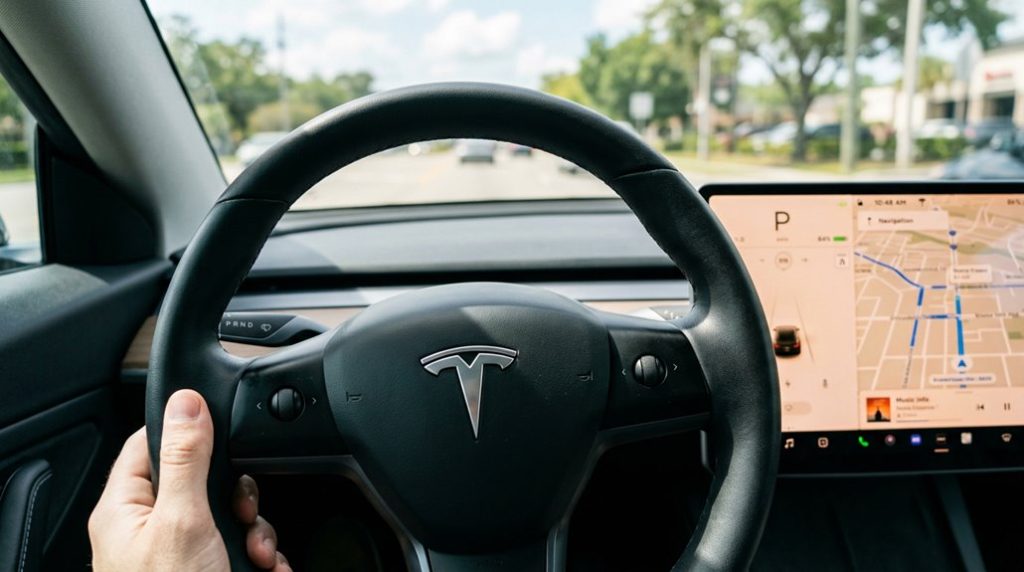
Tesla’s steering wheel ergonomics are deliberately designed around minimal distraction. On the Model 3, tilting the left scroll button left answers an incoming call; tilting it right declines it. Clean, deliberate, effective. The Model S and Yoke variants work differently — you press the scroll button to answer, then press it again to hang up. Same outcome, different gesture.
Gesture reliability matters here because fumbling mid-commute defeats the purpose. Tesla builds these controls into its Phone App integration, meaning the wheel responds to actual call states rather than generic button mappings. During an active call, the left scroll button can also mute or unmute your microphone (depending on your software version). No touchscreen required, no awkward reach across the cabin — just the wheel doing exactly what it should. The touchscreen’s Software menu serves as the primary reference point for confirming your current software version, which determines which call-control gestures are available on your specific build.
The microphone button on the steering wheel also lets you send voice replies to incoming messages directly without ever touching the screen.
Answer Calls From the Tesla Touchscreen
Proper touchscreen etiquette here is straightforward — tap your preferred option directly on the display rather than reaching for your phone. The interface stays visible once you’ve answered, keeping call status front and center throughout the conversation. Call volume adjusts separately, so don’t expect that from the answer screen itself.
One non-negotiable prerequisite: your phone must be Bluetooth-paired to the vehicle beforehand. Without that connection, the incoming call interface won’t function properly (and the call assuredly won’t route through your speakers). Tesla’s phone app also lets you initiate calls through contacts, a dial pad, or even a tapped map pin — answering incoming calls fits naturally into that same workflow. When a call comes in, media automatically mutes so the conversation takes full audio priority without any manual adjustment needed.
Tesla’s vehicles support the NACS connector standard for charging, unifying Supercharger, Destination, and home charging under one plug design, which reflects the same philosophy of seamless integration found throughout the Tesla ecosystem. The same attention to connectivity extends to how your devices interact with the car, making Bluetooth pairing a foundational step before any in-call features become available.
Keep your phone secure, charged, and perfectly positioned while driving with this Tesla phone mount charger. The strong N52 magnet and 15W wireless charging make navigation and calls effortless.
Control Volume and Mute During a Tesla Call
Managing call audio in a Tesla almost always comes down to one control: the left scroll wheel on your steering wheel or yoke. It handles everything without pulling your eyes off the road, which is solid in call ergonomics design.
Here’s what that scroll wheel does during an active call:
- Roll up to increase call volume
- Roll down to decrease call volume
- Press once to mute both the call audio and your microphone simultaneously
- Touchscreen speaker icon (bottom corner) offers a backup slider for finer audio isolation adjustments
Worth noting: Tesla doesn’t separate call audio from media or route prompts. It’s a master-volume system, meaning adjustments affect everything.
If your call still sounds quiet after maxing the scroll wheel, check your phone’s own in-call volume — device-side settings frequently cause the problem. Muting differs from lowering volume; it cuts microphone pickup entirely, not just loudness. Tesla’s remote software updates can also alter audio behavior overnight, so a sudden change in call volume after an update is worth investigating. For more granular control over individual audio sources, navigate to Controls to find audio settings that let you adjust navigation and media volumes independently.
Fix Tesla Bluetooth and Contact Sync Problems
Call volume control is straightforward once everything’s connected — but getting Bluetooth to cooperate in the first place is where things can fall apart fast.
Start with the basics: phone inside the vehicle, touchscreen on, Bluetooth enabled, Airplane Mode off.
Scan for devices from the touchscreen, select your phone, and confirm the pairing code matches on both screens.
If it still won’t connect, turn Bluetooth off and back on before retrying.
Low battery can quietly sabotage the process, so charge your phone first.
Contact sync failures are trickier.
On iPhone, open Bluetooth settings, tap the Tesla info icon, and enable Sync Contacts — it’s off by default on some devices.
If your contact list includes special characters like & or #, remove them.
They can trigger a parsing loop that causes repeated disconnects.
For persistent issues, reset settings entirely by unpairing and re-pairing.
Avoid third party apps managing Bluetooth simultaneously — they create conflicts.
Tesla’s minimalist interior design, centered on a single touchscreen for all in-cockpit functions, means phone connectivity issues can affect far more than just calls — navigation, media, and vehicle controls all run through the same interface.
Frequently Asked Questions
Can Tesla Voice Commands Answer an Incoming Call Automatically?
Tesla’s voice activation can’t handle automatic pickup of incoming calls. You’ll need to tap “Answer” on your touchscreen or use your steering-wheel controls to accept calls instead.
How Do Calendar Event Phone Numbers Work for Tesla Calling?
Image a buzzing schedule ahead — your Tesla reads calendar invites and surfaces event numbers directly on-screen. Once you’ve synced contacts and enabled calendar access, you can tap meeting callers’ numbers to call instantly.
Does Tesla Calling Work Without the Mobile App Installed?
Yes, you don’t need the app for appless dialing to work. Your paired phone handles cellular fallback, while Tesla’s Bluetooth integration manages the hands-free interface directly through the touchscreen or steering wheel controls.
Can Map Pins With Business Numbers Be Used to Call?
Over 90% of Tesla owners use route guidance daily, yet map pins don’t support business numbers for calling. You can’t tap a pin to dial—pins are strictly for routing and location guidance.
What Tesla Software Versions Support Hands-Free Voice Calling Features?
Tesla’s official manuals don’t tie hands-free voice calling to specific software versions. You’ll find it works across models as long as you’ve got Bluetooth compatibility established through a paired phone.