
Most drivers assume electric cars are quieter simply because there’s no engine. That’s only half the story. Tesla quietly bonds polyurethane foam inside its tyres to kill a specific frequency — the low, droning hum coarse roads pump into the cabin around 200–250 Hz. It’s a small detail most owners never notice, yet it changes how the entire car feels at speed. The physics behind why it works are far more fascinating than the foam itself.
Why Tesla Tyres Use Internal Acoustic Foam
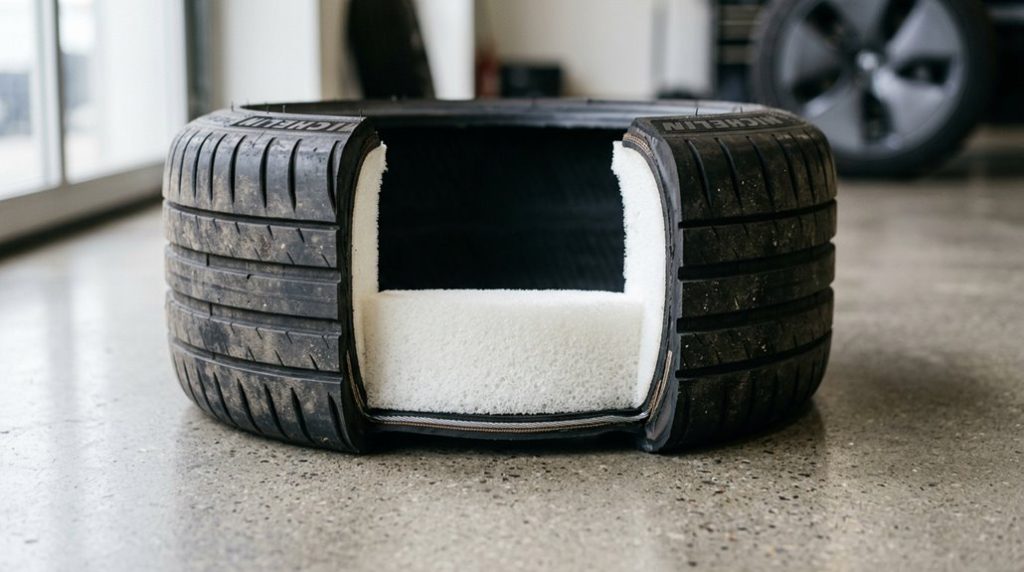
Tesla’s acoustic foam-lined tyres exist for one reason: to kill road noise before it reaches your ears. The foam itself is a polyurethane layer bonded to the tyre’s inner surface, positioned precisely where cavity resonance does the most damage to cabin comfort. Here’s the physics: tyres naturally amplify airborne sound inside their hollow cavity, then transmit that vibration straight into the cabin structure. The foam interrupts that process.
Tesla first applied this technology across Model S and Model X platforms, targeting the resonant frequencies that make highway driving unnecessarily fatiguing. This isn’t structural reinforcement or a grip upgrade — it’s pure resonance control, nothing more. Continental’s own data supports reductions of up to 9 dB(A) before noise even approaches your cabin. That’s not trivial. Nine decibels represents a meaningful shift in perceived loudness, particularly on coarse pavement where tyre noise typically peaks. When replacing these tyres, fitment verification by model, year, and VIN is essential because acoustic foam-lined variants are not universally interchangeable across model years. The need for this solution became particularly acute in electric vehicles because the absence of engine noise leaves tyre and road interaction as the dominant source of cabin sound.
Which Tyre Brands Tesla Fits at the Factory
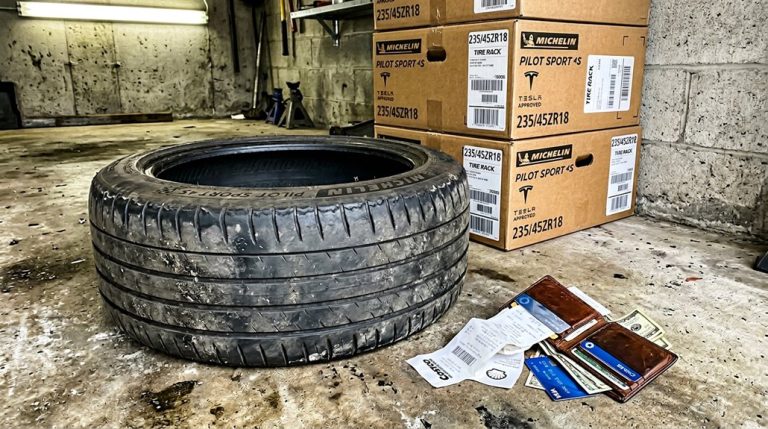
Factory tyre fitment on Tesla vehicles isn’t a one-brand operation. Tesla sources from several manufacturers depending on your model, wheel size, trim, and regional fitments tied to supply logistics. Michelin partnerships, for instance, produce the Pilot Sport 4S T0—a Tesla-approved spec you’ll find on higher-performance configurations. Pirelli, Hankook, Continental, and Goodyear also appear across the lineup.
| Tesla Model | Common OEM Brand | Notable Fitment |
|---|---|---|
| Model 3 | Michelin / Hankook | Pilot Sport 4S T0 / Ventus S1 Evo3 |
| Model Y | Pirelli / Hankook | P Zero / Ventus S1 Evo2 |
| Model S/X | Continental / Goodyear | SportContact / EV-oriented variants |
The sidewall markings—T0, T1, T2—identify Tesla-approved specifications engineered for range, noise reduction, and load compatibility. Your factory tyres were selected deliberately. Replacements don’t need to come from Tesla Service Centers, but matching the original size, load index, and speed rating isn’t optional. Tesla’s Model 3, for example, offers an internal tyre pressure display that allows drivers to monitor inflation levels directly from the cabin screen. Michelin fits more than 50% of Tesla cars, making it the most prevalent brand across the entire Tesla fleet by a significant margin.
Why Tesla’s Torque and Weight Eat Tyres Fast
Knowing which brands Tesla bolts on at the factory tells you what you’re working with, but it doesn’t explain why those tyres wear out faster than you’d expect.
Electric motors deliver peak torque from zero rpm, meaning every hard launch transfers load violently across the contact patch. That’s micro-slip — tread scrubbing against asphalt before you’ve even noticed wheelspin. Your launch technique matters enormously here; smooth pedal inputs genuinely extend tyre life.
Then there’s weight. Battery packs push Tesla’s curb weight well above comparable ICE vehicles, and that mass doesn’t disappear — it concentrates directly into load distribution across all four tyres. High-performance Tesla models can exceed 4,800 pounds curb weight, demanding a higher load index from tyres that are already fighting accelerated wear. Battery packs alone contribute 800 to 1,200 pounds to overall vehicle mass, a figure that would be unthinkable in a comparable petrol-powered car.
Every acceleration event, braking zone, and corner multiplies stress at the tread surface and shoulders. Heat builds faster under load, and heat accelerates wear. Regenerative braking adds cumulative deceleration forces through the rubber, compounding the problem further. Physics, unfortunately, doesn’t negotiate.
Foam-filled Tesla tires can complicate what should be a simple roadside puncture—what used to be a quick plug job can now turn into a tow if you’re not prepared. A compact road hazard tire repair kit gives you a way to temporarily seal small leaks and get safely to a service center before the damage spreads.
How Tesla’s TPMS Sensors and Jacking Points Work Differently
Swapping tyres on a Tesla isn’t quite the same exercise as doing it on a conventional car, and that difference runs deeper than just the badge on the wheel. Tesla uses direct TPMS sensors embedded in each wheel that broadcast pressure, temperature, and battery status via 433 MHz radio frequency to the vehicle’s ECU. When you fit new wheels, the system relies on sensor auto-learning, typically triggering once you exceed 25 km/h and completing within ten minutes of driving. No manual scan gun ritual required in most cases. The TREAD Act of 2005 made direct TPMS systems like this mandatory on all new passenger vehicles sold in the United States by 2007, cementing the technology as a standard safety requirement rather than a luxury option.
The jacking side is equally non-negotiable. Tesla specifies designated jackpoints on every model, and ignoring them risks crushing battery pack structures or suspension arms — expensive mistakes that a floor jack placed carelessly under a rocker panel will happily introduce you to. Use the correct model-specific lift adapters, set cold tyre pressure before any relearn procedure, and you’ll avoid compounding the problem. Tyre pressure readings for your specific vehicle are also accessible directly from the touchscreen controls menu, removing any ambiguity about target inflation figures before you begin.
How to Extend Tyre Life on Any Tesla Model
Getting the jacking and sensor side of things right keeps your Tesla rolling without unintended repair bills, but the longer game is making those tyres last as long as physically possible before replacement becomes unavoidable.
Getting the technical basics right is only half the job — the real win is squeezing every possible mile out of your tyres.
Tire rotation every 5,000 to 7,500 miles (especially on the Model Y) and consistent pressure monitoring keep wear patterns honest and predictable.
Three habits make a measurable difference:
- Smooth acceleration: Tesla torque is instant and brutal on tread, so use Chill Mode to soften throttle delivery and protect the contact patch.
- Monthly pressure checks: Aim for 42 to 45 PSI depending on your model, and recheck after significant temperature drops.
- Annual alignment inspections: Inside-edge wear signals misalignment early, and catching it before 5,000 miles of damage saves you a full replacement set.
Conservative habits routinely push Model 3 and Model Y tyres past 35,000 miles. That’s not luck — that’s maintenance. The instant torque and vehicle weight that define Tesla’s performance are the same forces accelerating tyre wear faster than most comparable gas-powered vehicles, which is why consistent maintenance habits matter more here than they would with a conventional car.
Foam-lined Tesla tires rely heavily on precise pressure—run them too low and you risk heat buildup, uneven wear, and reduced efficiency long before the tread is actually gone. A portable inflator with a digital gauge lets you dial in exact PSI anytime, keeping your tires balanced and performing the way they were designed to.
Frequently Asked Questions
Can Foam-Lined Tyres Be Safely Repaired After a Puncture or Nail?
By Jove, you can safely repair foam-lined tyres after a puncture or nail. Follow standard puncture protocols, cut away the foam, prep the liner, and stay within established repair limits for a successful fix.
Do Replacement Tyres for Tesla Need to Include Acoustic Foam?
No, your replacement tyres don’t need acoustic foam. You’ll maintain full mechanical function without it. However, if ride comfort and noise reduction matter to you, foam-lined tyres do deliver a noticeably quieter cabin experience.
Does Internal Tyre Foam Affect Balancing During a Standard Tyre Rotation?
No, internal foam doesn’t affect balancing during a standard tyre rotation. Technicians use the same rotation technique and equipment as conventional tyres, so you won’t experience wheel wobble from the foam itself.
Are Acoustic Foam Tyres More Expensive Than Standard Tesla-Compatible Tyres?
Yes, you’ll pay more for acoustic foam tyres—noise reduction can reach 9 dB, but that cost comparison adds up across four tyres. Standard options offer long-term savings when acoustics aren’t your priority.
Do Other Electric Vehicle Brands Besides Tesla Use Internal Acoustic Foam?
Yes, other EV manufacturers use internal acoustic foam. You’ll find acoustic partnerships between brands like Michelin, Nokian, and Goodyear extending to Cadillac, Porsche, and Hyundai vehicles, proving Tesla doesn’t own this noise-reduction technology.