
Tesla’s premium sound system deserves better than compressed audio — yet most owners never hear what it’s actually capable of. FLAC playback is supported, but only when you know exactly which USB ports work, which file specifications the system accepts, and why a perfectly built music library can still disappear into silence. Get one detail wrong, and you’re back to streaming mediocrity. The path to true lossless audio in your Tesla is narrower than you’d think.
Which Tesla USB Port Actually Reads Music Files
Not every USB port in your Tesla is created equal, and plugging a drive into the wrong one means your music collection stays silent. Tesla installs both charge-only and data-capable ports, and only the data-capable port actually reads music files.
Armrest behavior varies by model. In the Model S, both under-armrest ports support music playback, though their charging output differs (2.1A driver-side versus 1A passenger-side). Model Y owners deal with a different layout entirely. The glovebox port handles data transfer there, making it the correct destination for your music drive, your TeslaCam setup, or both simultaneously if you’ve partitioned the drive correctly.
Plugging into a charge-only port produces nothing in your media list — no error, no warning, just silence. Your drive must also be formatted in a Tesla-recognized filesystem (typically FAT32) and properly mounted before the USB source option even appears on your screen. When partitioning your drive, creating a dedicated music partition with around 1 GB of storage is considered sufficient for most music libraries.
Before committing to an aftermarket USB drive or adapter for your setup, keep in mind that model-year compatibility matters, as component and trim changes across Tesla production years can affect how certain accessories and drives are recognized by the vehicle’s systems.
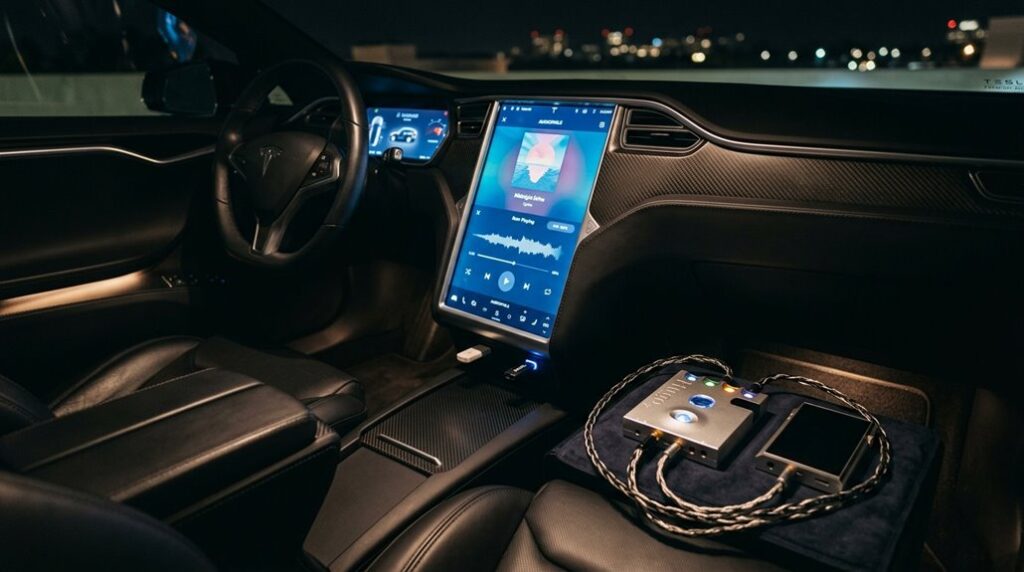
Even in a premium Tesla sound system, Bluetooth compression can still strip away fine detail in your music, leaving highs slightly flattened and instrument separation less defined than the original recording. A high-quality USB DAC helps preserve more of that lossless detail by delivering a cleaner, more direct audio signal, giving you a noticeably fuller and more accurate listening experience inside the cabin.
Which FLAC Specs Actually Work With Tesla’s Player
Tesla’s infotainment system does support native FLAC playback from USB media, though the company hasn’t published a formal codec spec sheet the way a dedicated DAC manufacturer would. What you’re working with comes from owner testing rather than official documentation.
| FLAC Specification | Tesla Compatibility |
|---|---|
| 16-bit / 44.1 kHz | Confirmed by owners |
| 24-bit / 96 kHz | Reported as playable |
| Maximum bit depth | 24-bit (owner-verified) |
| Sample rate limits | 96 kHz confirmed; 192 kHz unverified |
| Lossy-compressed FLAC | Not a standard concern |
Your safest starting point is 16-bit/44.1 kHz — Red Book CD quality wrapped in FLAC. Tesla appears to handle at least 24-bit/96 kHz based on community reports, which covers most hi-res music libraries comfortably. Beyond 96 kHz, you’re speculating. Nobody’s officially confirmed those sample rate limits extend further, so don’t rip your collection at 192 kHz expecting guarantees.
The Tesla Model S has no CD player, making USB the primary path for anyone serious about lossless audio quality in the car. Software updates delivered over the air can alter playback behavior without notice, so it’s worth checking your current software version after any OTA update to understand whether audio handling may have changed.
How to Load Lossless Audio Files Onto a Tesla USB Drive
Before transferring, handle USB tagging through a tool like MP3Tag — clean metadata makes browsing by artist or album actually functional.
Embed album art directly into each file.
Keep flac compression levels moderate (level 5 is standard) and total library size under 30 GB for snappier load times.
No portable DAC setup required. Format the drive’s first partition as exFAT with TeslaDrive as the volume label to ensure Sentry Mode and media functions are recognized correctly. Tesla vehicles receive over-the-air updates that can occasionally affect USB media compatibility, so verify your drive is still recognized after any major software update.
Why USB Beats Bluetooth and Streaming for True Lossless Playback
If you’re chasing true lossless playback in your Tesla, the connection method matters just as much as the file format itself. Bluetooth compresses audio during transmission—that’s codec limitations working against you. Even aptX, one of the better wireless codecs, still applies compression. USB delivers wired fidelity by sending uncompressed digital data directly to Tesla’s media system, preserving every bit of your original file.
| Feature | USB | Bluetooth |
|---|---|---|
| Audio Compression | None | Always applied |
| Max Latency | Near zero | Up to 150 ms |
| Dropout Risk | Very low | Moderate to high |
| Lossless Support | Full | Codec-dependent |
Bluetooth latency can hit 150 ms—humans detect around 25 ms—so the delay is real. Streaming apps add another compression layer before audio even reaches your car. USB skips all of that. If lossless actually matters to you, wire it up. Tesla’s MCU generation significantly impacts media playback performance, with MCU3’s AMD Ryzen platform delivering the processing power needed to handle demanding audio and entertainment workloads without the lag experienced on older hardware. For headphone listeners, AirPods Max over USB-C delivers full 24-bit 48KHz lossless audio, demonstrating just how much a wired digital connection preserves over wireless transmission.
Does TIDAL in Tesla’s App Actually Deliver Lossless Quality?
TIDAL is the only native streaming app in Tesla’s Media menu that actually markets itself as a lossless audio service—so the question worth asking is whether it delivers on that claim inside the car or just on the marketing page. The honest answer: mostly yes, with conditions attached.
Tidal fidelity inside Tesla typically reaches standard lossless FLAC quality—up to 1,411 kbps, which matches CD-quality resolution (16-bit/44.1 kHz). Independent testing recorded averages around 1,165 kbps, compared to Spotify’s 157 kbps and Apple Music’s underwhelming 118 kbps. That gap is audible—cleaner highs, tighter bass, better instrument separation.
Connection impact matters markedly here. Wi-Fi consistently delivers the highest bitrates; LTE introduces compression risk and buffering because lossless files are substantially larger. True HiRes FLAC (above CD quality) remains unconfirmed on Tesla hardware. Download content over Wi-Fi beforehand, and you’ll sidestep that uncertainty entirely. It’s also worth noting that Tesla’s over-the-air software updates could theoretically expand audio codec support or streaming capabilities post-purchase, meaning the hardware you own today may perform differently in the future without any physical changes.
Lossless audio files can quickly lose their advantage if the storage device can’t keep up, leading to skips, slow loading, or inconsistent playback that breaks the listening experience inside a Tesla cabin built for clarity. A Tesla-compatible high-speed USB flash drive ensures smooth, stable playback of large FLAC or ALAC libraries, keeping your music running cleanly without interruptions or performance drops while you drive.
Frequently Asked Questions
Can I Use a USB Hub to Play Music and Run Dashcam Simultaneously?
Yes, you can use USB hubs to run both simultaneously. Plug the hub into your glovebox’s data port, connect separate drives for music and dashcam, and confirm your power delivery supports both devices reliably.
Does Tesla’s Media App Support Browsing Music Files Organized by Genre?
Tesla’s media app doesn’t support genre browsing or metadata display for local music files. It’s built for streaming services like Tidal or Spotify, so you’ll need an external solution for organizing your personal lossless library.
Will Deeply Nested Folder Structures Cause Playback Issues on Tesla’s System?
Like a maze with no exit, excessive folder depth won’t break playback, but it’ll slow you down. Keep your path length short — flat structures mean you’ll find your tracks faster.
Can I Use the Same USB Drive for Both Music and Sentry Mode Storage?
Yes, you can use the same drive for both! Proper drive formatting and USB partitioning keep your music and Sentry Mode footage organized separately, letting Tesla’s system handle both functions without conflict.
Does Tesla Support WAV Files, or Is FLAC Always the Better Lossless Choice?
Why choose poorly? Tesla supports WAV compatibility, but FLAC advantages make it the smarter lossless pick—you’ll store far more music without sacrificing a single bit of audio quality.