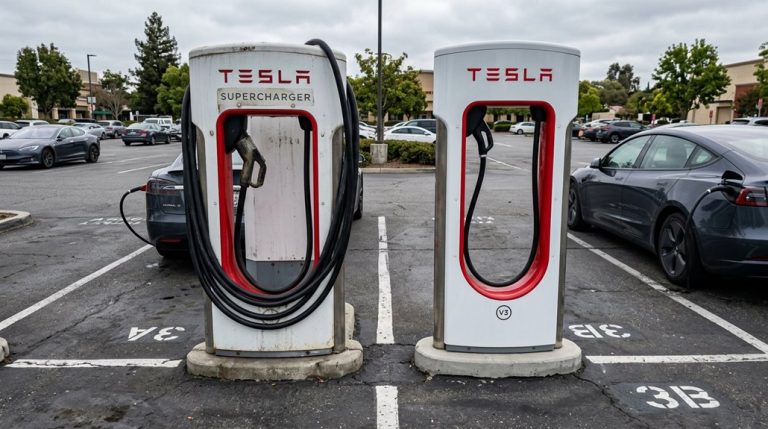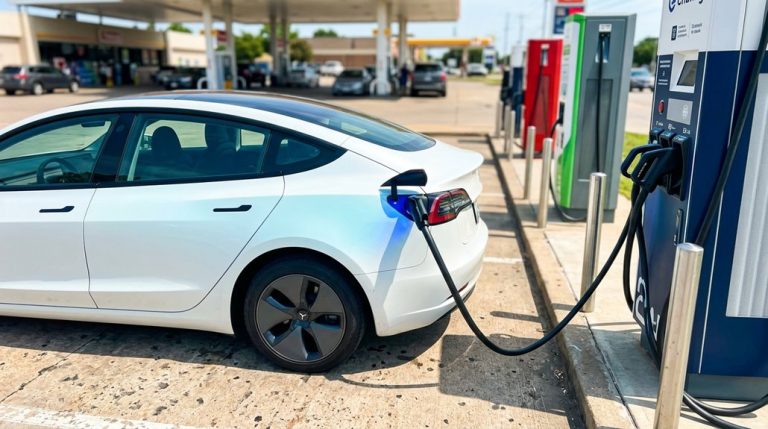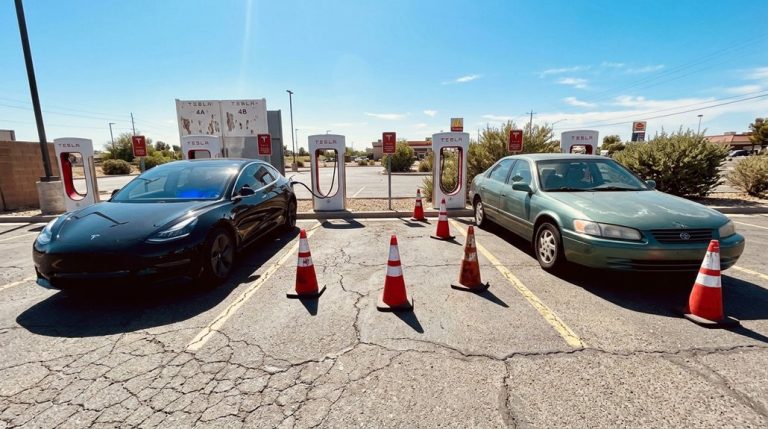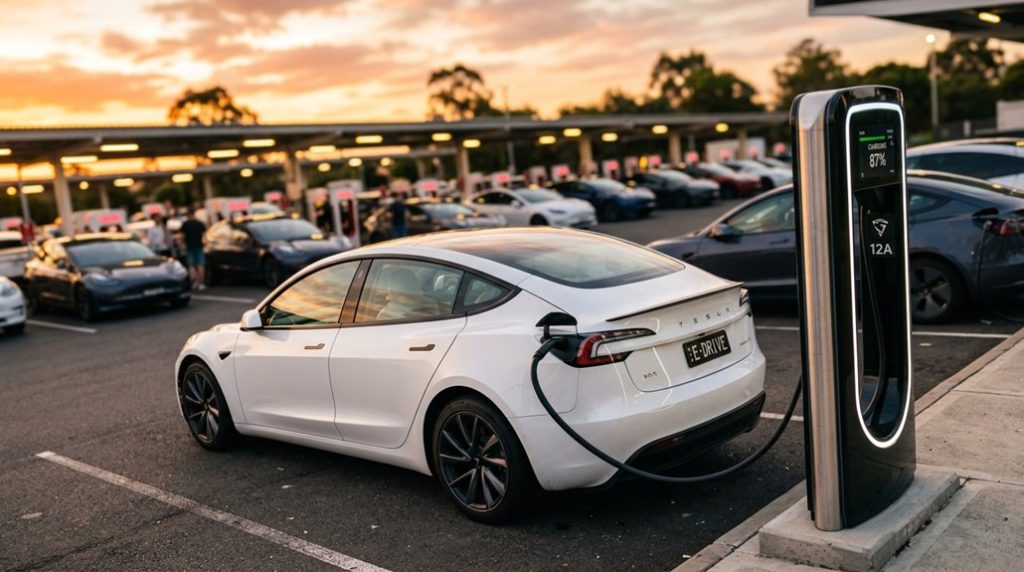

One connector. Every charger. From your garage wall to a 350kW beast on the highway. NACS (SAE J3400) has quietly rewritten the rules of EV charging while most drivers were still arguing about adapter dongles. Tesla’s Supercharger network is swinging its doors open, major automakers are already committed, and the North American charging landscape will never look the same. What this means for your wallet, your road trips, and your next EV purchase is something you need to understand right now.
What Is NACS and Why Is It Taking Over?
If you’ve been following the EV space, you’ve probably heard NACS thrown around more and more — and for good reason. NACS (North American Charging Standard) started as Tesla‘s proprietary connector before the company opened its specifications in November 2022. SAE then formalized it as SAE J3400 in 2023 — effectively stamping official industry alignment on what the Tesla ecosystem had already proven at scale.
What makes NACS technically persuasive is its single compact connector handling both AC and DC charging through shared pins. Compare that to CCS Type 1, which requires separate connectors for slow and fast charging. NACS supports up to 1,000V and 500A or more — serious numbers for serious charging speeds.
Ford, GM, Rivian, Mercedes-Benz, Nissan, Polestar, and Volvo have all announced NACS adoption. Networks like Electrify America are following. The standard isn’t just gaining traction — it’s reshaping North American charging infrastructure from the ground up. Tesla’s Supercharger network currently offers nearly double the public ports compared to CCS networks, giving NACS-compatible vehicles a meaningful real-world advantage today. Behind that advantage sits a hardware foundation that has evolved from 90 kW stations in 2012 to V4 cabinets capable of delivering up to 1.2 MW in certain configurations — a generational leap that makes the network’s scale even more significant.
One Plug for Both AC and DC Charging
One plug handles everything — that’s the core promise of NACS (SAE J3400), and it actually delivers. Whether you’re charging overnight at home or pulling highway kilowatts at a Supercharger, the same connector does the job. That’s not marketing — it’s engineering.
| Charging Type | Power Range | Use Case |
|---|---|---|
| Level 1/2 AC | Up to 22 kW | Home and public stations |
| DC Fast Charging | Up to 250 kW+ | Highway fast charging |
| Combined Capability | 500A / 500V DC max | High-demand applications |
The five-pin design carries AC or DC through shared power contacts, while three smaller pins manage ground and communication. Safety protocols embedded in that communication layer let the vehicle and charger negotiate power automatically. Installer training guarantees charge points handle both modes correctly — because AC and DC adapters aren’t interchangeable. The NACS standard now extends beyond Tesla, with non-Tesla EVs like the Chevy Equinox able to access over 17,800 Tesla Superchargers through a dedicated adapter. One connector, genuinely fewer headaches.
Rivian owners navigating the adapter ecosystem should know that the Rivian-supplied adapter only supports Level 3 DC fast charging, meaning a separate adapter is required for Level 2 AC charging at standard public stations or home chargers.
Does Your Current EV Work With NACS Chargers?
Whether your current EV works with NACS chargers comes down to one thing: what’s sitting in your charge port right now. Native NACS ports plug straight into any NACS station, no questions asked. CCS1 ports — still common on older models — require an approved converter before you can touch a Tesla Supercharger.
Model compatibility isn’t just about brand; it’s tied to your specific make, model, and year. Ford’s earlier EVs use converter-based access, while 2025 models ship with native NACS ports. Hyundai and Kia already offer built-in NACS on select new vehicles. Mercedes-Benz and Rivian are mid-transition. The Supercharger V4 network is expanding globally, which makes securing compatible access to it an increasingly valuable consideration when choosing your next EV.
Converter availability is the critical variable right now. Your automaker — not Tesla — determines whether a compatible converter exists for your vehicle. Connector shape alone doesn’t guarantee access; software authorization and hardware approval matter equally. Check your automaker’s official charging guidance before assuming Supercharger access is yours. Notably, Mitsubishi Motors stands apart as the only major automaker that has not announced any plans to adopt NACS for its vehicles.
Should You Wait for a Native NACS Car?
Knowing your current EV’s compatibility is useful, but it naturally raises a bigger question: should you hold off on buying entirely and wait for a car that ships with NACS built in? It’s a fair question, and the answer depends on your situation.
Native NACS removes adapter tradeoffs entirely — no carrying hardware, no compatibility gaps, no extra step at the charger. Some 2025 and 2026 models from Hyundai, Rivian, Lucid, and others already ship with factory-installed ports. Model year timing matters here, though. Availability is still uneven across brands, meaning waiting doesn’t guarantee a near-term option in your segment.
Meanwhile, approved adapters already give many CCS vehicles access to Tesla Superchargers. If your automaker includes one, you’re not locked out of the network today. Waiting makes sense when a specific model confirms both native NACS and meaningful updates. Otherwise, the vehicle you need might already exist. Tesla’s infotainment experience also varies significantly by hardware generation, with MCU3 AMD Ryzen hardware unlocking capabilities like AAA gaming and faster app performance that older MCU1 and MCU2 systems cannot match.
The broader network itself continues to expand, with access to 25,000+ Tesla Superchargers across North America available to compatible CCS vehicles using an approved adapter today.
Frequently Asked Questions
Will NACS Chargers Support Bidirectional Charging Like V2G or V2H?
NACS can support bidirectional charging, but your vehicle must also be compatible. Some specialized chargers already enable vehicle to home power flow and smart grid integration, though it’s not a standard feature of every NACS charger yet.
How Long Will Charging Networks Keep CCS Ports Available?
Surprisingly, you won’t lose your CCS ports anytime soon—networks expect a CCS sunset no earlier than the mid-2030s. You’ll manage the adapter shift comfortably, as dual CCS/NACS stations keep you covered through the late 2020s and beyond.
Which Automakers Are Already Selling Cars With Native NACS Ports?
Several automakers are already selling cars with native NACS ports. You’ll find Tesla models, Rivian vehicles, Hyundai, Kia, Lucid, Nissan, Cadillac, Genesis, Toyota, and Subaru all offering native NACS-equipped EVs today.
Will NACS Standardization Lower the Cost of Buying an EV?
NACS standardization won’t directly lower your EV’s purchase price. Battery pricing and dealer incentives drive the sticker cost. You’ll likely save more through reduced charging expenses than upfront buying discounts.
How Does NACS Improve the Public Charging Experience Across Different Networks?
Like a universal key, NACS opens faster roaming across multiple networks—EVgo, Tesla Superchargers, and more. You’ll benefit from unified payments and automatic session starts, making public charging simpler and more reliable wherever you plug in.