
Most fleet managers assume going electric means sacrificing payload capacity or dreading every long route. That assumption is costing businesses real money. The truth is, the right commercial electric van doesn’t just match its diesel counterpart — it outperforms it on operating costs. But cold-weather battery drain, depot charging limits, and cargo space vary wildly across available models. Choosing blindly is a risk no fleet can afford. This guide cuts through the noise with everything you need to make a confident, cost-effective decision.
Fleet Range, Payload, and Charging: What to Check Before You Buy
Buying a commercial electric van for your fleet sounds straightforward until you’re staring at a spec sheet that lists 250 miles of range while your routes, payloads, and mid-January temperatures quietly conspire to deliver something closer to 160. Real-world range depends on route profile, elevation, cargo weight, and heating load—not the number printed in the brochure. Match your longest regular route, not your average one, because detours and traffic don’t care about averages.
Payload deserves equal scrutiny. Heavy upfits, shelving, and tools eat into usable capacity fast, and larger battery packs add vehicle mass that shrinks your payload ceiling further.
Battery degradation compounds both problems over time, quietly trimming usable range year after year. Factor that progression into your total cost of ownership model. Driver training also matters—smooth acceleration and strategic regenerative braking can recover meaningful efficiency miles that aggressive driving permanently wastes. Electric drivetrains contain roughly 20 moving parts compared to approximately 2,000 in a comparable internal combustion engine, which translates directly into fewer scheduled service intervals and lower long-term maintenance costs across a fleet.
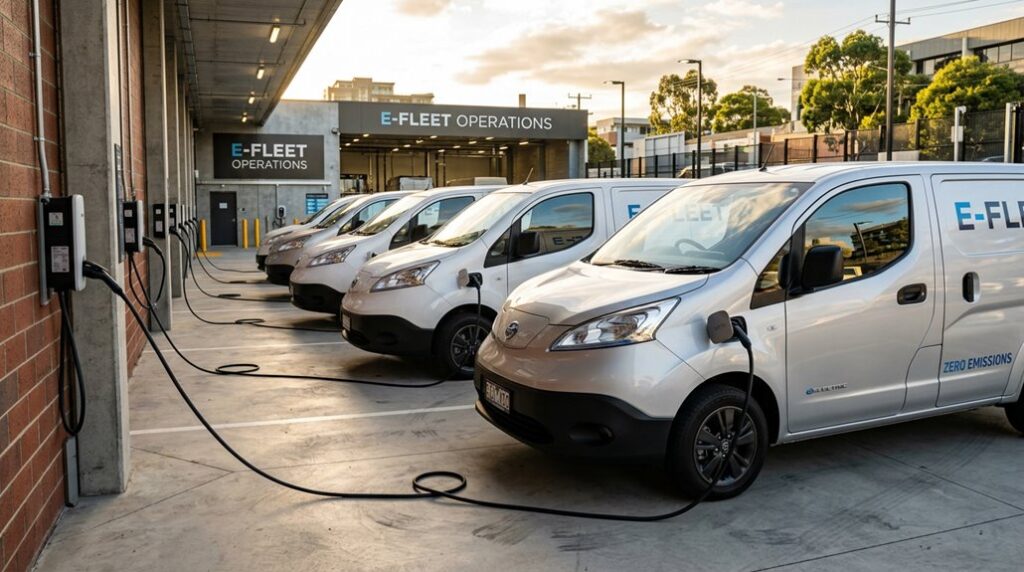
Commercial EV fleets quickly run into the same bottleneck: charging coordination. When multiple vehicles return at once, unmanaged charging setups can lead to peak load spikes, longer downtime, and vehicles sitting idle longer than they should. An OCPP-compatible Level 2 fleet charging station helps smooth out that demand by distributing power intelligently across multiple vehicles, making overnight depot charging more predictable and keeping more of the fleet ready to operate each morning.
The Best Electric Vans for Every Fleet Use Case
Fleet shopping isn’t a one-size-fits-all exercise, and the electric van market has finally matured enough to stop pretending otherwise. Match your pick to your actual duty cycle, not the brochure.
For dense urban delivery, the Rivian Commercial Van leads with urban safety systems and regenerative braking tuned specifically for stop-start city routes. Ford E-Transit wins large mixed fleets needing dealer network depth and upfit innovations across multiple roof heights and body lengths. The Kia PV5‘s dedicated EV platform makes it the smarter call for modular service and shuttle operations, where flat floors genuinely simplify upfitting and driver ergonomics matter daily.
Cold climates favor the Mercedes-Benz eSprinter‘s thermal stability, while BrightDrop Zevo 600 offers roughly 250 miles alongside serious cargo volume. Compact Stellantis vans (sharing the EMP2 platform) cover urban trades efficiently.
Budget maintenance training time per platform — fewer drivetrains means simpler technician certification across your entire fleet. Fleet managers evaluating total operating costs should also factor in that total cost of ownership calculations for commercial EVs must account for charging infrastructure investment, depreciation curves, and insurance variables that differ significantly from equivalent gas-powered fleets.
Range, Payload, and Cargo: Top Electric Models Compared
Stripped of marketing language, the numbers that actually govern your van purchase are range, payload, and cargo volume — and right now, no single electric van tops all three categories simultaneously. The Rivian Commercial Van leads tested urban range at 340 miles, with battery longevity optimized through regenerative braking tuned specifically for stop-start density. Meanwhile, the Renault Chief E-Tech wins payload at 1,625 kg with towing to 2,500 kg. BrightDrop’s Zevo 600 prioritizes dock compatibility and ergonomic loading over raw range figures. Fleet operators evaluating total cost should note that electric drivetrains eliminate oil changes and significantly reduce brake wear through regenerative braking systems, lowering long-term maintenance obligations compared to conventional commercial vehicles.
| Model | Standout Metric |
|---|---|
| Rivian Commercial Van | 340 miles urban tested range |
| Renault Chief E-Tech | 1,625 kg payload capacity |
| BrightDrop Zevo 600 | High-cube dock-compatible layout |
| Mercedes-Benz eSprinter | 2,000 kg towing, telematics integration |
| Ford E-Transit | Broadest multi-configuration fleet support |
Your operation’s daily mileage, loading dock setup, and stop frequency final determine which compromise hurts least.
Electric Van Running Costs Beyond the Sticker Price
The sticker price is just the opening bid. Your actual lifecycle economics unfold over years of fuel bills, service invoices, and charging behavior decisions.
The sticker price is just the opening bid — your real costs play out over years of roads traveled.
Here’s where electric vans quietly win:
- Fuel savings: Electricity runs roughly 10p per mile versus 16p per mile for diesel (at standard UK rates), meaning consistent daily routes compound savings fast.
- Maintenance reductions: Fewer moving parts translate directly to fewer bills — scheduled EV maintenance runs approximately 40% less than gasoline equivalents, around $600 monthly versus $1,000 for gas vans.
- Incentive offsets: A $7,500 California HVIP voucher, for example, shrinks a $17,500 upfront gap to $10,000 immediately.
The wildcard? Battery replacement (estimate around $10,000) isn’t annual, but it’s real. Smart charging behavior — prioritizing off-peak, depot-based sessions — keeps your operating costs predictable and your fleet economics genuinely competitive. For depot charging infrastructure, a dedicated 240V Level 2 circuit restores roughly 30–50 miles of range per hour, making overnight fleet replenishment straightforward when electrical panel capacity is properly assessed before installation.
The Best Electric Van for Each Fleet Type
Choosing the right electric van isn’t a one-size-fits-all decision — your fleet’s daily mileage, payload demands, charging infrastructure, and even brand image all pull the spec sheet in different directions.
For tight urban routes, the Ford E-Transit Courier (43.6 kWh, ~300 km WLTP) or Renault Kangoo E-Tech handles stop-start city work without oversizing your investment. Step up to medium general-purpose work and the Ford E-Transit Custom‘s 71 kWh battery and 373 km WLTP range gives maintenance planning genuine breathing room across mixed-service schedules. High-volume parcel operations should look at the BrightDrop Zevo 600 — 614 ft³ cargo space and 272 miles of range make depot-based routes manageable.
Customer-facing fleets prioritizing brand presence will find the VW ID. Buzz Cargo‘s distinctive styling worth the spec. For fleets that occasionally tow equipment or trailers, it’s worth noting that towing penalties on electric vehicles can be severe — boxy loads or tall trailers may cut effective range by 40–50% or more, so route planning should account for significantly reduced range on tow days. Whatever the category, charging ergonomics — how easily drivers can plug in, charge quickly, and turn around — finally determines whether your van works for the fleet or against it.
High-utilization EV fleets often overlook a simple but critical weak point: the charging cable itself. In busy depot or public fast-charging environments, lighter-duty connectors can wear down quickly under constant plugging, high heat, and repeated daily cycles. A CCS2/CCS1 heavy-duty DC fast charging cable helps reduce that risk by handling sustained high-power charging demands more reliably, keeping vehicles moving through charge cycles with fewer interruptions and less downtime across the fleet.
Frequently Asked Questions
Can Electric Vans Be Upfitted With Custom Shelving or Refrigeration Units?
Yes, you can upfit electric vans with custom shelving integration and refrigeration compatibility. Just account for payload limits, battery range impacts, and make sure you preserve access to service panels throughout the build.
How Do Electric Van Warranties Compare to Those of Diesel Equivalents?
Electric van warranties give you stronger battery guarantees—typically 8 years/100,000 miles—while diesel repair coverage focuses on engines and emissions systems. You’re effectively trading fuel-system risk for battery and power-electronics protection.
Are There Government Grants Available for Purchasing Commercial Electric Vans?
Yes, government grants are available! In the UK, you can access EV incentives like the Plug-in Van Grant, saving up to £5,000. Charging rebates through the Depot Charging Scheme can also cover 70% of installation costs.
How Does Cold Weather Affect Electric Van Battery Performance and Range?
Just as winter hits hardest when you’re most reliant on your van, cold weather triggers battery degradation and slashes range by 15–25%. Combat it with cabin preconditioning while plugged in to preserve every mile.
What Telematics Systems Are Compatible With Electric Commercial Van Fleets?
You’ll want fleet telematics platforms like Teletrac Navman, ChargePoint, Motive, Ampcontrol, and Fleet EForce. Each offers charger integration, real-time battery monitoring, and EV-specific data to keep your commercial electric vans fully operational.