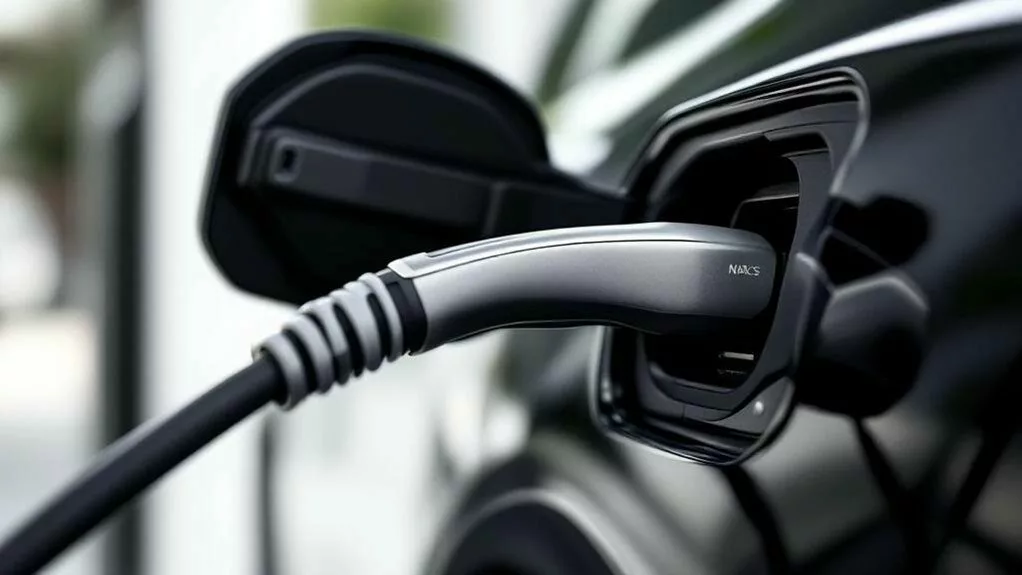
NACS is Tesla’s charging connector that’s becoming North America’s standard for electric vehicles. It’s officially called SAE J3400 since 2023. The connector works with both regular home charging and super-fast charging stations. Major car companies like Ford, BMW, and Hyundai will use NACS by 2025. It’s smaller and easier to handle than older connectors. Tesla’s Supercharger network has over 10,000 NACS charging points. There’s much more to uncover about this technology.
While electric vehicles have used different charging connectors for over a decade, the auto industry’s now shifting to a single standard called NACS. Tesla created this 5-pin connector in 2012 for its North American vehicles. The company opened it to other manufacturers in 2022, and SAE International officially standardized it as SAE J3400 in 2023.
Tesla’s NACS connector is becoming the unified North American EV charging standard after a decade of competing formats.
The NACS connector works for both AC and DC charging without needing to switch plugs. For home charging, it delivers up to 48 amps at 240 volts. Commercial locations can provide 80 amps at 277 volts. DC fast charging reaches up to 500 amps at 500 volts, with some setups supporting 1 megawatt of power transfer. A retractable latch using a UHF signal keeps the connection secure.
Major automakers including Ford, BMW, and Hyundai have committed to using NACS in their North American EVs by 2025. They’re phasing out the older CCS1 connectors in favor of this single-connector solution. Tesla’s Supercharger network, which already uses NACS exclusively, has become a key reason for the industry-wide switch. The network includes over 10,000 charging points across North America.
One of NACS’s main advantages is its universal compatibility. The same connector supports all charging speeds, from slow home charging to rapid commercial charging. This eliminates the need for multiple ports on vehicles. DC fast charging can fill a battery to 80% in about 30 minutes at Supercharger stations. The compact design makes it easier to handle compared to bulkier CCS and CHAdeMO connectors.
The system includes important safety features. Real-time communication between the vehicle and charger monitors battery health and modifies power flow. Built-in algorithms prevent overcharging that could damage batteries. The connectors work in extreme temperatures and wet conditions. Each charging session starts with a secure handshake between the vehicle and charger. These safety mechanisms prevent excessive heat during charging by monitoring temperature and adjusting power delivery.
Tesla’s also testing “Magic Dock” adapters at select Supercharger locations between 2023 and 2025. These enable both CCS1 and NACS compatibility. Third-party charging companies like Autel Energy are developing NACS-compatible equipment. Some manufacturers plan to include NACS adapters with their CCS1-equipped EVs so drivers can access Supercharger networks.
Frequently Asked Questions
Will Older EVS Need Adapters to Use NACS Charging Stations?
Older electric vehicles with CCS1 charging ports will need converters to use NACS charging stations.
EVs made before 2025 typically have CCS1 ports that aren’t compatible with the newer NACS standard. Tesla sells converters for about $200.
Some NACS stations include Magic Dock technology that provides built-in converters.
All Tesla vehicles already have NACS ports, so they don’t need converters.
Most carmakers will switch to NACS for 2025 models.
How Much Does It Cost to Install NACS Charging Equipment at Home?
Home NACS charging equipment costs vary widely.
The charger itself runs $420 to $2,000, depending on features. Tesla’s basic Wall Connector starts at $450.
Installation adds $750 to $2,500 more. Simple jobs cost less. Complex ones requiring new wiring or panel upgrades cost more.
Total expenses typically range from $1,200 to $4,500. Some car makers include free chargers with new EVs.
Can NACS Connectors Charge in Extreme Weather Conditions?
NACS connectors can charge electric vehicles in extreme weather. They’re built to work in temperatures from very cold to very hot.
The connectors have special protection against dust and water. They can even work after being underwater for 30 minutes. The plugs won’t overheat during fast charging in hot weather.
They’re also easy to use with one hand when it’s raining or snowing outside.
Which Automakers Have Committed to Adopting NACS?
Many automakers have committed to using NACS charging ports. Ford was first in May 2023.
Volkswagen’s brands like Porsche and Audi will start in 2025. Honda announced it’ll incorporate NACS to 2025 models.
Hyundai and Kia began using it in late 2024. Jaguar Land Rover promised NACS for 2025 EVs. Genesis joined too.
These companies are offering adapters for older electric cars with different plugs.
Is NACS Compatible With European and Asian Charging Standards?
NACS doesn’t work directly with European or Asian charging systems.
European cars use CCS2 plugs, while many Asian vehicles use CHAdeMO. These plugs have different shapes and won’t fit NACS ports.
Drivers need special converters to connect between standards. Tesla’s Magic Dock adds converters at some charging stations.
As automakers sell cars globally, they’re building different charging ports for each region’s standard.