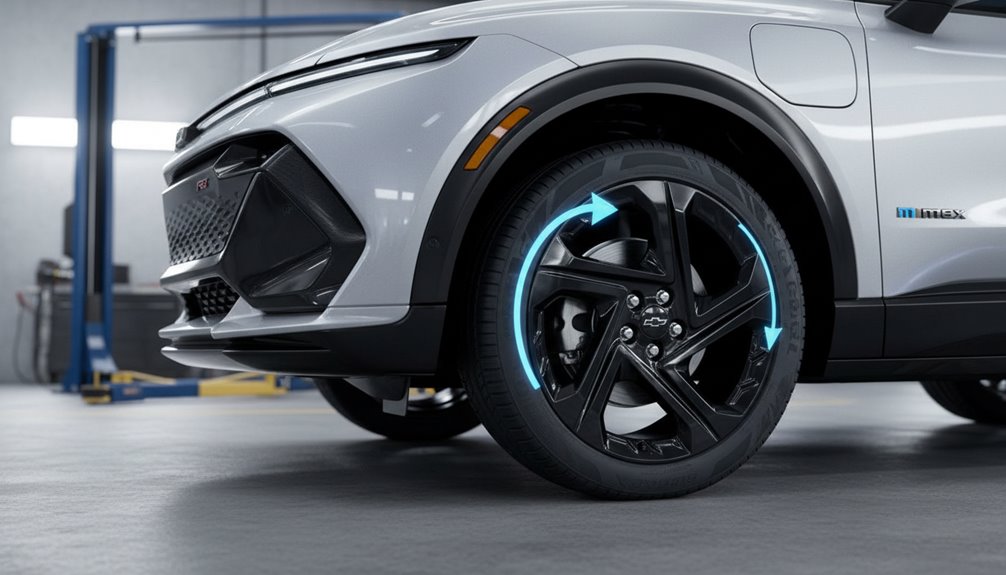

You’re destroying your tires—and paying for it—every single day you skip rotation. Most drivers treat the 7,500-mile interval as a suggestion, not realizing their front wheels are grinding through tread at twice the rate of the rears due to steering forces alone. Chevrolet engineers didn’t pick this number randomly; it’s the exact threshold where uneven wear accelerates exponentially. That free first rotation isn’t a courtesy—it’s your only chance to establish a pattern that could add 15,000 miles to your tire lifespan. The physics behind what’s happening to your rubber right now tells a different story than your service advisor wants you to hear.
Chevrolet’s 7,500-Mile Tire Rotation Rule: Here’s Why It Matters
Why do your Equinox EV’s tires wear faster in some spots than others?
Different steering pressures and handling forces distribute unevenly across each tire position, creating accelerated wear in high-stress zones.
That’s where Chevrolet’s 7,500-mile rotation interval enters the scene.
By rotating your tires every 5,000 to 7,500 miles, you’re effectively redistributing wear patterns.
Each tire moves to a fresh location, allowing previously stressed areas to recover while fresh rubber tackles demanding zones.
GM-certified technicians follow computerized protocols to determine your vehicle’s ideal rotation strategy based on wear patterns observed during inspections.
This simple maintenance task directly extends tire lifespan, reduces replacement costs, and maintains consistent grip on the road.
Uneven wear patterns also signal potential alignment issues—catching these problems early prevents cascading damage.
Following Chevrolet’s schedule keeps your Equinox EV handling predictably and safely across all conditions, especially during winter driving when tire performance becomes critical. Our four wheel balance service using state-of-the-art equipment ensures every tire reaches perfect balance for optimal performance.
When to Rotate Your Tires: Chevrolet’s Maintenance Schedule
Your Equinox EV follows Chevrolet’s standard 7,500-mile rotation interval, though your drivetrain type substantially changes the math—all-wheel drive vehicles demand rotations every 3,000 to 5,000 miles because all four tires actively share the load, accelerating wear compared to front-wheel drive’s uneven tire degradation.
You’ll catch the biggest maintenance benefits at your first service visit, where tire rotation gets bundled with brake inspection and fluid checks, establishing a baseline for how your specific driving patterns affect tread wear. Monitoring tire pressure monthly when cold supports optimal tire health and complements your rotation schedule.
From there, you’re looking at roughly twice yearly for average drivers, or you can sync rotations with Chevrolet’s 30,000, 60,000, and 90,000-mile major services depending on your mileage habits.
Chevrolet’s 7,500-Mile Standard
Chevrolet’s official recommendation is straightforward: rotate your Equinox EV’s tires every 7,500 miles, and you’ll want to stick with it.
This interval aligns with your vehicle’s scheduled maintenance visits, making it easy to remember and plan.
Here’s what happens at that critical checkpoint:
- Tire rotation prevents uneven wear patterns that compromise handling and lifespan
- Brake inspection catches potential issues before they escalate into expensive repairs
- Multi-point vehicle assessment makes certain your battery, fluids, and overall system remain healthy
Your first service visit includes complimentary tire rotation, setting the tone for proactive ownership.
The myChevrolet app tracks these intervals automatically, eliminating guesswork. Regular tire rotations also enhance fuel efficiency by reducing uneven rolling resistance across your tires.
Drive-Type Rotation Patterns
The 7,500-mile standard works as a baseline, but how you rotate depends entirely on how your Equinox EV sends power to the pavement—and that’s where things get specific.
Front-wheel drive? Cross those front tires to opposite rear sides while rear tires move forward—this counters the 20-30% faster wear up front.
All-wheel drive demands tighter 5,000-7,500 mile intervals since all four tires wear unevenly; AWD systems get cranky over 1/4-inch diameter differences.
The cross pattern (front left to rear right, front right to rear left, rears forward) distributes torque evenly and prevents drivetrain strain.
Always torque lug nuts to 100 ft-lbs post-rotation.
Monitor tire pressures afterward—your TPMS will flag imbalances.
Check your owner’s manual for model-specific variations because Chevrolet engineers fine-tuned each configuration.
First Service Benefits
While you’re already thinking about tire rotation intervals, here’s something that’ll lighten the load on your wallet: Chevrolet’s first service coverage includes a complimentary four-tire rotation and multi-point inspection within your first 12 months—no separate charge, no negotiating with service advisors.
Your initial appointment bundles three essential services:
- Four-tire rotation performed according to your vehicle’s maintenance schedule, ensuring even tread wear from day one
- Multi-point inspection catching potential issues before they become expensive repairs
- Fluid level checks including battery inspection for EV owners, establishing baseline health metrics
As an Equinox EV owner, you’re getting professional tire assessment without the cost burden. Regular rotations promote even tire wear across all four tires, which helps ensure all four tires require replacement at the same time rather than needing piecemeal replacements. This covered service kickstarts your maintenance relationship with Chevrolet Certified Service, aligning your rotation schedule perfectly with standard 7,500-mile intervals. That’s smart ownership from the moment you drive off the lot.
Why Your Tires Wear Unevenly (and How Rotation Fixes It)
If you’ve noticed your Equinox EV’s tires looking like they’ve aged at different rates, you’re witnessing uneven wear—and you’re not alone. Your tires wear unevenly because different positions experience different load distributions and friction patterns as you drive.
| Wear Pattern | Primary Cause | Location | Fix |
|---|---|---|---|
| Center wear | Overinflation | Tread middle | Reduce pressure |
| Shoulder wear | Underinflation | Tread edges | Increase pressure |
| Feather edge | Misalignment | Rib direction | Alignment service |
| Cupping | Worn suspension | Random spots | Replace components |
Rotation fixes uneven wear by repositioning tires to different corners of your vehicle. This redistributes the specific stresses each tire endures—front tires typically wear faster due to steering and braking loads—evening out tread depth across all four. By rotating every 7,500 miles, you’re effectively giving each tire a break from its most demanding position, maximizing lifespan and maintaining consistent traction. Beyond rotation, maintaining proper wheel alignment every 6,000 to 8,000 miles prevents excessive wear on one side of the tire and ensures your vehicle handles predictably. Think of it as load-sharing: what wore aggressively up front now wears moderately in back.
Rotation Costs and Pre-Paid Maintenance Plans
You’ll find tire rotation costs ranging from $20–$50 at quick-service chains up to $60–$100 at dealerships, though many tire retailers bundle complimentary rotations with purchases—a benefit that can extend your tire lifespan by roughly 25% and save you around $100 over five years.
Pre-paid maintenance plans lock in these savings upfront, typically offering annual rotation packages at discounted rates that insulate you from regional pricing fluctuations (which swing wildly between rural areas at $15–$20 and high-tax urban zones hitting $60). Some membership programs at providers like Costco also include time-sensitive coupons that further reduce per-service costs for enrolled members.
Combining rotation with wheel balancing raises your per-visit cost to $78–$99, but strategic bundling through chain retailers or dealership loyalty programs often yields the best value-to-service ratio for consistent, budget-conscious maintenance.
Cost-Effective Maintenance Plans
How much should you actually budget for tire rotations on your Equinox EV, and does it make sense to lock in costs upfront?
You’re looking at $20–$75 per basic rotation, though balancing bumps that to $40–$132.
Here’s where pre-paid plans shine:
- Bundled savings: Combining rotations with oil changes every 5,000–7,500 miles reduces per-service costs through consolidated labor.
- Fixed pricing: Pre-paid plans run $49–$72 per rotation across ten-thousand-mile intervals, eliminating price surprises.
- Extended tire life: Regular rotations stretch your tires from 30,000 to 40,000 miles, saving roughly $100 over five years.
Independent mechanics typically charge $25–$50, while dealerships command $40–$80.
Many tire shops offer free rotations with purchases.
The math favors commitment—locking costs now beats paying piecemeal later.
Budget-Friendly Rotation Options
While pre-paid maintenance plans lock in savings, they’re just one piece of the puzzle—the real money moves happen when you shop around for where you’re actually getting the work done.
Budget retailers like Walmart ($5 per tire) and Discount Tire (complimentary lifetime rotations with purchase) drastically undercut dealerships ($40–$80 basic rotation). Warehouse clubs and national chains often bundle free rotations with tire purchases, effectively eliminating recurring costs.
Independent mechanics typically charge $25–$50 for basic rotation, splitting the difference between budget and dealership pricing. The math’s straightforward: rotating at an affordable shop four times annually costs roughly $100 versus $320 at premium locations. That’s genuine savings—$880 over five years—without sacrificing service quality or your Equinox EV’s tire longevity.
How Tire Rotation Works by Drive Type: FWD, RWD, and EV
Different drivetrains create different tire wear patterns, which is why your rotation strategy should match your vehicle’s power delivery system.
Your Equinox EV‘s front-wheel-drive setup concentrates weight and power delivery at the front axle, accelerating front tire wear.
Here’s how you’ll rotate:
- Forward cross pattern: Front tires move straight back on their same side while rear tires cross diagonally forward to opposite sides
- X-pattern alternative: All four tires swap diagonally (rear left to front right, rear right to front left) if you’re running nondirectional tires
- Five-tire rotation: Include your full-size spare by moving it to the rear right position, rotating the right front tire into reserve duty
This approach prevents one tire from wearing prematurely.
Since FWD vehicles naturally stress front tires harder through acceleration and cornering loads, these patterns distribute wear evenly across all tires, maximizing tread life and maintaining consistent performance throughout your ownership experience.
Skip Rotations? Here’s What Happens to Your Tires
You might think skipping tire rotations saves money and hassle, but you’re actually trading short-term convenience for expensive long-term consequences.
When you neglect rotations, your tires develop uneven wear patterns—bald spots emerge prematurely on front tires while rear tires retain adequate tread. This creates a dangerous mismatch. According to NHTSA data, inadequate tread depth causes over 25% of tire-related accidents. Your vehicle’s handling suffers noticeably: steering becomes unpredictable, braking distances extend, and hydroplaning risk skyrockets on wet roads.
| Consequence | Impact | Cost Factor |
|---|---|---|
| Reduced tread depth | 50% of vehicles affected; insufficient grip | Safety hazard |
| Heat buildup | Tire blowouts at highway speeds | Sudden failure |
| Rolling resistance | Engine works harder; fuel consumption rises | Operating expenses |
| Suspension stress | Vibrations; accelerated component wear | Expensive repairs |
| Premature replacement | Complete set needed vs. rotation service | 3-5x costlier |
Skipped rotations force you toward complete tire replacement rather than routine maintenance—a substantially pricier scenario for your Equinox EV’s long-term reliability and your wallet.
What’s Included in Your First Chevrolet Service
Now that you realize how neglecting tire rotations leads to premature wear and costly replacement cycles, it’s worth knowing what Chevrolet builds into your first scheduled service to keep that from happening.
Your initial 7,500-mile service represents Chevrolet’s foundational maintenance checkpoint.
Here’s what technicians cover:
- Tire management: Rotation performed alongside pressure checks and tread wear assessment to catch uneven patterns early
- Fluid inventory: Coolant quality verified, brake fluid inspected, transmission fluid evaluated, and washer fluid topped—essentially every system gets scrutinized
- Critical systems inspection: Battery condition tested, brake components thoroughly examined, engine air filter observed, steering and suspension reviewed
You’ll also get wiper blade inspection, exhaust system checks for leaks, and radiator/hose evaluation.
This thorough approach catches developing issues before they compound.
Think of it as preventive medicine for your Equinox EV—addressing small concerns now beats expensive repairs later.
The interval timing (every 7,500 miles or annually, whichever arrives first) aligns with manufacturer specifications designed specifically for your vehicle’s longevity.
Combine Tire Rotation With Brake and Filter Inspections
Bundling tire rotations with brake and filter inspections turns routine maintenance from a fragmented hassle into a single, efficient visit that catches wear patterns across multiple critical systems simultaneously.
Bundling tire rotations with brake and filter inspections transforms routine maintenance into one efficient visit that catches wear across critical systems.
You’ll schedule one appointment instead of three, cutting labor costs and downtime considerably.
During your 5,000 to 7,500-mile rotation interval, technicians visually inspect brake pad thickness and rotor condition while tires are already removed.
They’ll check your engine and cabin air filters for debris accumulation—early detection prevents efficiency losses.
At 15,000-mile marks, brake hose inspections catch potential leaks before they compromise stopping power.
This synergistic approach addresses interconnected wear.
Uneven tire wear often signals suspension issues that affect braking geometry.
Combined battery testing (every 7,500 miles) during rotations guarantees electrical systems supporting your charging infrastructure function at peak performance.
You’re not just rotating rubber; you’re getting a thorough system evaluation that protects both performance and wallet.
Track Your Rotation Schedule With myChevrolet
How do you keep track of tire rotations without relying on memory or scattered service receipts?
The myChevrolet app turns tire maintenance from a guessing game into a simplified digital system.
Your Equinox EV’s built-in intelligence handles the logistics:
- Automated alerts notify you when tire rotation intervals arrive—whether you prefer mileage-based (7,500 miles) or time-based scheduling
- Direct scheduling lets you book appointments with your preferred dealer straight through the app, eliminating phone calls
- Service history tracking maintains a permanent record of every rotation, preventing duplicate work and documenting even tire wear patterns
The app pulls real-time Vehicle Status data, displaying tire pressure alongside rotation schedules.
You’ll receive alerts if pressure drops 25% below recommended specs, catching problems before they compromise your EV’s efficiency or handling.
This integration means you’re never flying blind—you’ve got concrete data and proactive notifications working together, keeping your tires (and your peace of mind) properly maintained.
Multi-Point Inspection: Beyond the Four-Tire Rotation
While you’re rotating those four tires, a thorough multi-point inspection catches the wear patterns and mechanical issues that tire rotation alone can’t address.
Your brake system—pads, rotors, and calipers—deserves particular scrutiny since uneven tire wear often signals alignment problems that stress your braking components unevenly. Worn brake fluid absorbs moisture that degrades stopping power over time.
Similarly, inspecting your engine air filter and cabin air filter during this service reveals how dirt accumulation restricts airflow. This reduces fuel efficiency and HVAC performance, which directly impacts your Equinox EV’s overall operational efficiency and your wallet.
Brake System Health Assessment
When you rotate your Equinox EV’s tires, you’re already under the vehicle—so why not take a hard look at what’s actually stopping it?
Your brake system deserves attention during every tire rotation. Here’s what you’re inspecting:
- Pad thickness: Front pads should exceed 7mm; rear pads exceed 4mm. Anything 3-5mm needs attention soon.
- Rotor condition: Look for warping, grooves, or cracks. Measure thickness against manufacturer specs—uneven wear signals alignment issues.
- Fluid and lines: Check reservoir levels, inspect fluid clarity, and examine hoses for leaks, corrosion, or bulging.
Don’t skip the parking brake test either.
These checks catch problems early, keeping your Equinox EV stopping reliably.
Since EVs brake less frequently due to regenerative braking, traditional friction brakes often last longer—but that doesn’t mean ignoring them.
Filter Inspection And Replacement
Your Equinox EV’s brakes handle the heavy lifting, but your filters handle something equally essential—keeping contaminants out of the systems that keep everything running. During your 7,500-mile service rotation, inspect both engine and cabin air filters for dirt accumulation and visible damage. Engine filters restrict airflow when clogged; cabin filters degrade HVAC performance and indoor air quality. Replace either filter showing tears, excessive debris, or reaching manufacturer mileage intervals (typically 12,000–30,000 miles). Use OEM equivalents to maintain system efficiency.
| Filter Type | Inspection Point | Replacement Trigger | Performance Impact | Service Interval |
|---|---|---|---|---|
| Engine Air | Housing seals, dirt levels | Visible restriction, oil life monitor | Reduced horsepower delivery | 15,000–30,000 mi |
| Cabin Air | Debris, odors, HVAC output | Evaporator restrictions, visible contamination | Compromised air quality | 12,000–15,000 mi |
Document findings on standardized forms for complete service history tracking.
Frequently Asked Questions
Can I Rotate Tires Myself, or Should I Use Chevrolet Certified Service?
You can DIY if you’ve got the tools, but you’re joining thousands of smart owners choosing certified service. They’ll catch issues you’d miss and keep your warranty intact while ensuring proper rotation patterns.
What Tire Pressure Should I Set After Rotation on My Equinox EV?
You’ll find your Equinox EV’s recommended tire pressure on your driver’s door jamb or in your owner’s manual. After rotation, set all four tires to that specification, then recalibrate your TPMS system through your dashboard.
Does Tire Rotation Affect My Equinox Ev’s Warranty Coverage or Service Records?
You’re covered, you’re protected, you’re maintaining your Equinox EV properly. Tire rotation won’t void your warranty—it strengthens your service records and keeps you compliant with Chevrolet’s coverage requirements.
How Do Weather Conditions or Driving Habits Affect Rotation Frequency Recommendations?
You’ll need more frequent rotations in harsh winters, heavy rain, and aggressive driving. Cold weather underinflates tires; wet conditions cause uneven wear; rough terrain accelerates damage. Rotate every 6,000–8,000 miles under these conditions.
Can I Extend Rotations Beyond 7,500 Miles if My Tires Appear Unworn?
You can’t rely on appearance alone—tires wear invisibly inside while looking fine outside. Stick with your 7,500-mile rotations to protect your warranty, avoid premature replacement costs, and keep your Equinox EV handling safely.


