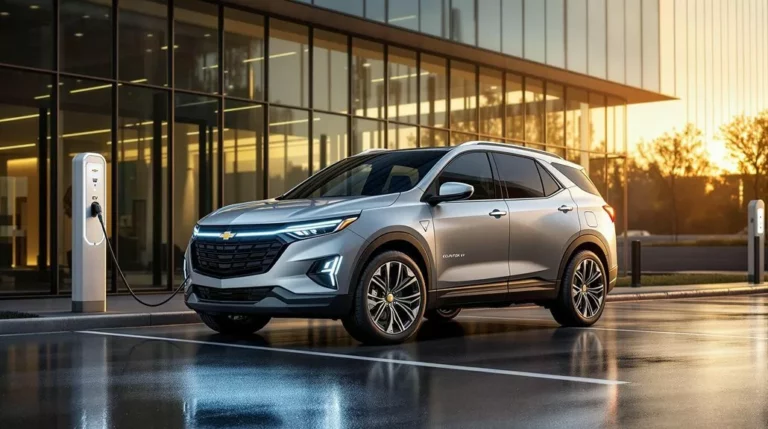

American automakers are launching over a dozen new electric vehicles in 2025. Ford’s F-150 Lightning Flash starts at $67,995 with a 320-mile range. Chevrolet’s Silverado EV RST offers an impressive 460 miles per charge. Dodge is electrifying its muscle cars with the Charger Daytona, providing up to 670 horsepower. Chrysler’s new crossover promises 400 miles of range with Level 3 autonomous driving. More breakthrough models from Cadillac, Rivian, and Jeep are set to change America’s electric future.
More than a dozen new electric vehicles from American automakers will hit the roads in 2025. These models range from powerful pickup trucks to luxury sedans, offering buyers more choices than ever before.
Ford’s F-150 Lightning Flash will arrive in 2025 with a 320-mile range and a starting price of $67,995. This full-size electric pickup seeks to compete directly with Chevrolet’s Silverado EV RST Max Range, which boasts an impressive 460-mile range. Rivian plans to release the R1T pickup with over 400 miles of range, though the company hasn’t shared complete details yet.
Dodge will launch two versions of its electric Charger Daytona in fall 2025. The R/T model delivers 496 horsepower and 308 miles of range, while the Scat Pack version produces 670 horsepower but travels only 241 miles per charge. Both electric and gas versions will be available.
Chrysler’s new electric crossover will offer about 400 miles of range and Level 3 autonomous driving features when it arrives in 2025. The company developed this model alongside the Jeep Wagoneer S. Cadillac’s Escalade IQ promises approximately 460 miles of range, though the EPA hasn’t tested it yet.
Current electric vehicles already demonstrate impressive range capabilities. Lucid’s Air Grand Touring leads the pack with 512 miles per charge, followed by the Chevrolet Silverado EV at 460 miles and Rivian’s R1S SUV at 410 miles. Tesla’s Model S provides 402 miles of range, while the high-performance Lucid Air Sapphire achieves 427 miles. For budget-conscious buyers, the Hyundai Kona Electric SE offers 200+ mile range starting at $32,875, making it the cheapest new EV to exceed this benchmark.
Looking beyond 2025, Acura confirmed it’ll revive the RSX nameplate as an electric SUV in 2026. The RSX will feature Honda’s 0-series platform and become the first vehicle to use ASIMO OS, with production starting at Honda’s new Ohio facility. Jeep continues developing the Recon, an off-road-focused electric model designed to tackle rough terrain. Industry experts anticipate that battery technology improvements will enable electric vehicles to reach even more impressive ranges by the end of the decade.
These upcoming vehicles show American automakers’ commitment to electric technology. With ranges exceeding 400 miles becoming common and various body styles available, drivers won’t need to compromise between going electric and meeting their transportation needs.
The expanding selection includes vehicles for work, family use, performance driving, and luxury transportation.
Frequently Asked Questions
How Long Do Electric Car Batteries Typically Last Before Needing Replacement?
Electric car batteries typically last 15-20 years under normal use.
Most manufacturers guarantee their batteries for 100,000-200,000 miles.
Studies show batteries lose about 1.8-2.3% of their capacity each year.
That means after 10 years, they’ll still have 77-82% of their original power.
Some newer batteries can last over 280,000 miles.
Tesla’s working on batteries that could reach one million miles.
What Government Incentives or Tax Credits Are Available for Electric Vehicle Purchases?
Electric vehicle buyers can get federal tax credits until September 30, 2025.
New EVs qualify for $7,500 credits. Used EVs under $25,000 get $4,000 credits.
Used car buyers can’t earn over $75,000 if single or $150,000 if married.
The credits aren’t refunds – they only reduce taxes owed.
Starting October 2025, these credits end. Congress replaced them with loan interest deductions, but only 1% of buyers qualify.
How Much Does It Cost to Charge an Electric Car at Home?
Charging an electric car at home costs about $30 to $45 monthly for drivers who travel 1,000 miles.
That’s roughly $1.50 daily for 40 miles of driving. The average American pays 17 cents per kilowatt-hour for electricity. Most EVs get 2.5 to 4 miles per kilowatt-hour.
Home charging costs about half as much as public fast chargers. It’s also cheaper than gasoline, which costs about twice as much per mile.
Can Electric Cars Be Charged During Power Outages or Emergencies?
Electric cars can’t charge during regular power outages unless owners have backup systems.
Tesla’s Powerwall batteries work with their vehicles during blackouts, but they’ll slow or stop charging to power homes first.
Gas generators can charge EVs if they match the car’s power needs.
Solar panels with battery storage offer another solution.
Some charging stations have their own solar panels and batteries to keep running when the grid fails.
What Happens to Old Electric Car Batteries When They’re Replaced?
When electric car batteries die, they don’t go to landfills. Recycling centers collect them through special programs.
Workers take the batteries apart and shred them into black powder. This powder contains precious metals like lithium and cobalt. Factories use chemicals or heat to pull out these metals. They’re cleaned and sold to make new batteries.
Some old batteries that still work get used for storing electricity in buildings.