Popular EV charging apps help drivers find stations and save money. PlugShare covers over 100,000 stations worldwide. Chargemap focuses on European drivers with one million locations. Electrify America and EVgo offer membership programs that reduce charging costs. These apps show real-time station availability, filter by plug type, and integrate with Google Maps. Users share reviews and report broken equipment. The apps work with most electric vehicles including Tesla, Volkswagen, and Nissan models. More features await those who investigate further.
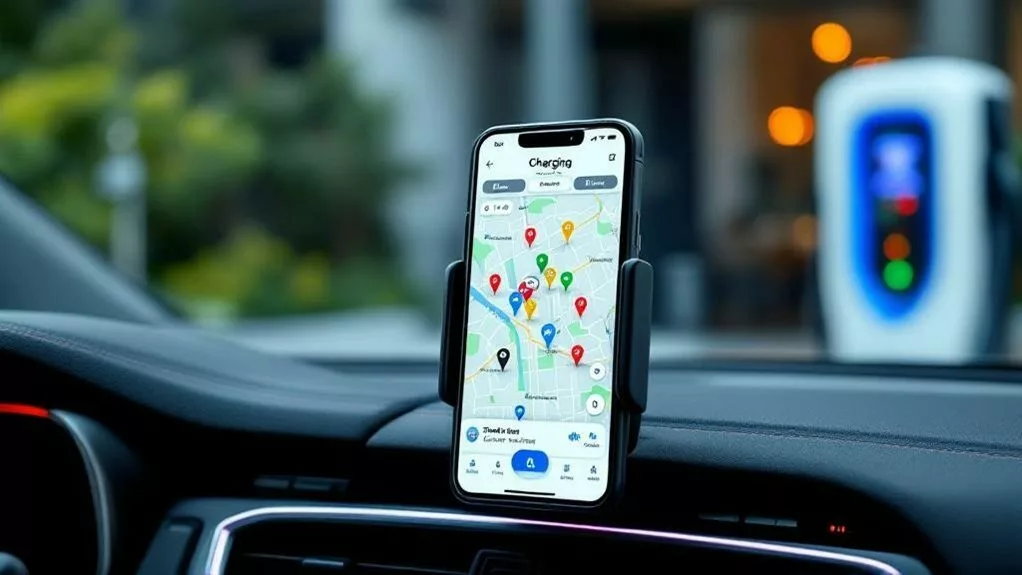
As electric vehicles become more common on American roads, drivers need reliable ways to find and use charging stations. Several apps have emerged as leaders in helping EV owners locate stations, save money, and plan trips efficiently. These apps not only provide real-time information on charging station availability but also offer features like route planning that take charging needs into account. As the history of electric vehicles reveals, the transition from traditional gasoline vehicles to electric mobility has been driven by technological advancements and environmental concerns. Now, with the right tools, users can embrace this shift confidently and conveniently. Many of these apps leverage user-generated data, allowing drivers to share experiences and updates about charging station conditions, which enhances overall reliability. With features that allow users to find nearby EV charging stations, drivers can feel assured they’ll stay powered on long journeys. Additionally, some applications even offer payment integration, making the transition between charging and paying seamless and efficient.
PlugShare stands out as the global leader with over 100,000 stations across multiple networks. The app covers ChargePoint, Tesla Destination, Electrify America, and other major providers. It’s popular in North America and Europe, offering features like Pay with PlugShare for direct payments. With a 4.7 rating from over 125,000 users, PlugShare has built the largest EV driver community for sharing station reviews and photos.
PlugShare leads globally with 100,000+ stations across major networks including ChargePoint, Tesla, and Electrify America.
Chargemap focuses primarily on European drivers with more than one million stations listed. The app excels at motorway coverage in France, Germany, and the UK. It connects to networks including New Motion, Shell Recharge, and Ionity.
For American drivers, Electrify America provides access to over 1,000 DC fast-charging stations nationwide. The company’s Pass+ membership offers reduced rates for frequent users. Electrify America’s $4 monthly membership can provide significant savings that offset membership dues even with minimal charging use. EVgo, another US-focused network, allows users to reserve stations and monitor charging sessions in real-time. With the rise of electric vehicles, understanding the dc fast charging benefits for evs is crucial for drivers seeking efficiency. Additionally, many networks, including Electrify America and EVgo, are continuously expanding their infrastructure to meet the growing demand for quick and convenient charging solutions. As more locations become available, the convenience of fast charging options further enhances the overall appeal of electric vehicle ownership.
These apps share common features that make charging convenient. They show real-time availability of stations, letting drivers know which spots are open. Users can filter results by plug type, including CHADeMO and SAE/CCS connectors, and by charging speed from Level 1 to DC Fast.
Community contributions improve these platforms. Drivers add photos, write reviews, and report broken equipment. This crowdsourced information helps others avoid problems and find the best stations.
Cost-saving options vary by network. Electrify America’s Pass+ reduces per-minute rates through monthly subscriptions. EVgo Rewards gives points for charging sessions. Some networks offer bundled deals or partnerships with energy providers.
The apps work with popular electric vehicles including Tesla’s Model 3 and Model Y, Volkswagen’s ID.4, Hyundai’s Kona Electric, and Nissan’s Leaf. Most support Android Auto for in-car direction-finding and trip planning. ChargePoint’s network provides home charging scheduling capabilities, allowing users to optimize their charging times and track energy usage.
Additional features include real-time notifications when stations become available, integration with Google Maps for directions, and remote monitoring to track charging progress. As charging infrastructure expands, these apps continue adapting to meet drivers’ needs.
Frequently Asked Questions
Can I Use These Apps Without Creating an Account?
Several popular EV charging apps don’t require accounts for basic features.
PlugShare lets drivers find stations, check connector types, and read user reviews without signing up.
EVgo offers station viewing and route finding without registration.
Volta’s app shows free charging locations account-free.
Tap Electric allows charging through partner networks without creating profiles.
These apps make it simple for EV drivers to locate and use charging stations immediately.
Do Charging Apps Work Internationally or Only in Specific Countries?
Some charging apps work globally while others operate only in specific regions.
PlugShare maps stations worldwide, while ChargePoint covers North America and Europe.
Regional apps like Zap-Map serve only the UK, and EVgo focuses on the US.
Electrify America’s limited to North America despite its parent company’s global reach.
Apps like OVO Charge operate across 11 European countries but don’t work outside Europe.
Will These Apps Drain My Phone Battery Significantly During Use?
EV charging apps do consume phone battery through several activities.
They use GPS to find stations, maintain constant data connections for real-time updates, and send frequent notifications.
Background processes continuously monitor charging progress and refresh pricing information.
Screen brightness during extended monitoring sessions also drains power.
Some apps lack efficient sleep modes, keeping phones active longer than necessary.
Users report moderate to significant battery drain during typical use.
Can Multiple Users Share One App Account for Family Vehicles?
Many EV charging apps now let families share accounts for multiple vehicles. Popular apps like Wallbox and Evtec allow several household members to access the same account.
Users can create individual profiles to track their charging separately. Some systems use RFID cards or PIN codes for different family members.
Apps can monitor each person’s energy use and costs. This sharing feature helps families manage their electric vehicles more efficiently.
Do Charging Apps Require Constant Internet Connection to Function Properly?
Most EV charging apps don’t need constant internet to work.
Apps like PowerFlex and HeyCharge let drivers start charging offline using QR codes. They save station maps and payment info on phones. When internet returns, the apps update automatically.
However, users can’t see real-time station availability or change settings without connection. The apps store charging data locally and upload it later when online again.